 A while back, I performed a small experiment with old letter writing techniques. As a result, I learned a great deal about Paper, Ink, Sand, and Pounce, how they interact, and how our layperson’s cinema-informed opinions are (not unsurprisingly) quite wrong.
This week, I dove back down into that deep dark well, and began to obsess about another old letter writing technique: letterlocking.
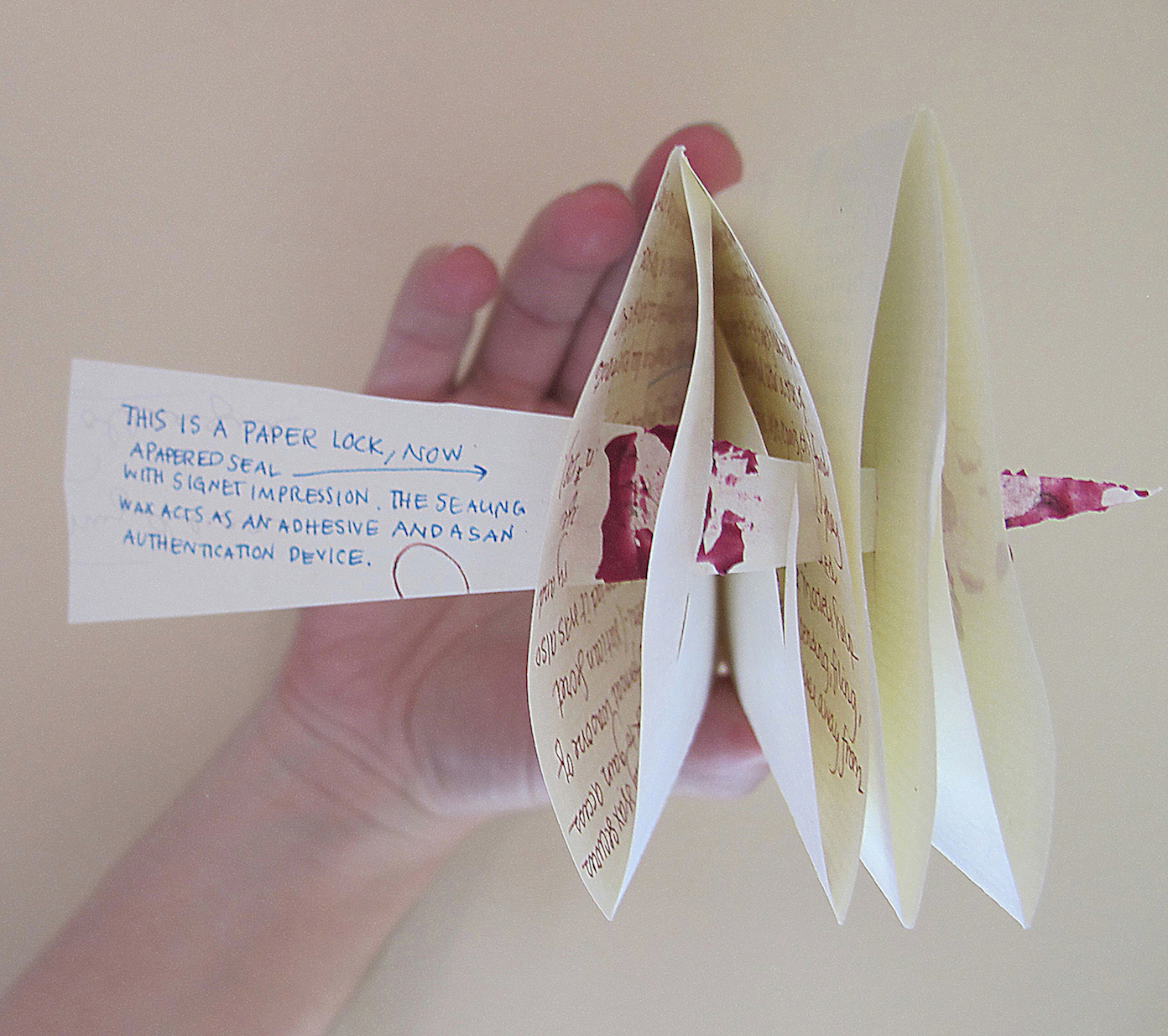
We’ve all seen it in films set in the early 19th century and before. A letter writer takes their epistle, folds it up and, essentially, makes it into its own envelope. Some of you (like me) may have even tried it yourself, only to end up with an overly thick, bulging, thoroughly recalcitrant bundle that defies closure by any wax seal you attempt to place on it. Even with a larger piece of stationery, I’ve found the process difficult to duplicate on my own.
Until I read this article about letterlocking, which opened up a trove of information.
“Letterlocking” is a relatively new word. Coined by Jana Dambrogio, the Thomas F. Peterson conservator at MIT Libraries, it lumps together the many, many different methods letter writers employed to seal their letters, back in the days before envelopes (and especially, gummed envelopes) were a thing.
While studying letters in the Vatican archives, Dambrogio noticed curious patterns of folds, slits, and excisions in the documents and began to catalogue them. Fresh out of graduate school, it was a while before she realized that, not only were these patterns new to her, they were new to everyone. It soon became clear that all of these marks and seals were not just methods of authentication (using a personal seal to emboss wax or the paper itself could authenticate the sender), but also ways of securing the contents, keeping them from prying eyes.
Some methods are simple. A few folds and a wax seal are all that is needed to keep a casual letter from being perused by an unintended reader.
Other methods are very complex, with intricate folds, tucking one edge into another, or cutting slits in the letter through which paper daggers are drawn and sealed. My favorite (so far) is the method used by Robert Devereux in a letter to Queen Elizabeth I (ca. 1590), where a “tail” cut from (yet left attached to) the letter is sent through a series of punched holes, essentially stitching the letter closed with part of the letter itself. I haven’t tried this method myself—the paper I have available is not as strong (or large) as that used in the 16th century—but I’m going to, and soon.
So, here’s yet another topic I can add to my list of Proofs I Should Have Been A Museum Conservator, as the idea of spending decades studying not the words of old letters, but the way in which they had been folded and sealed, simply thrills me.
If you want to know more about letterlocking, Dambrogio and team have a website that includes a history of their project, a dictionary of terms, and a collection of videos showing how the various methods—from the 1400s to 1960—were employed.
I know that I’ll be spending several more hours over there, learning and testing the methods, with plans to use them in my own letters.
k

Read Full Post »
 It’s been a bad week.

 Today is the 30th anniversary of the Loma Prieta earthquake and, once again, I am in San Francisco. I did not plan this visit to coincide with the anniversary of that event—a shallow 6.9 temblor that brought down bridges and freeways, tumbled hundreds of homes, and turned large sections of expensive land into quivering jelly—but here I am. With the anniversary top-of-mind here, it hasn’t helped that, since my arrival on Sunday, we’ve had two minor quakes (registering 4.5 and 4.7). Put together, it’s made the locals a bit . . . jumpy.
  Kurt R.A. Giambastiani