Feeds:
Posts
Comments

V-Day Quandary

I didn’t plan it, but a while ago I hit on the perfect solution to the annual Valentine’s Day stress-test, i.e., devising something romantic to do on V-Day. To be honest, I hit upon this solution a long while ago—thirty-eight years ago, to be exact—but it stands up to the test.

Many people, caving in to V-Day expectations and pressure, will plan something big. A recent article looked at setting up a “big night” on the town, with dinner, theater tickets, after-show drinks, and transportation, and ranked ten major U.S. cities by cost. Spoiler alert (though it’ll be no surprise to those of us who have set up an evening like this): city-dwellers can expect to drop between $350 and $550 (USD) for such a night.

My solution is much more affordable, and it has the added advantage of not needing to be “topped” in subsequent years. Continue Reading »

Blanket Fort Time

It’s been a bad week.

It started off with having to endure some seriously obnoxious behavior, after which I got dog-piled by a medical issue†, which in turn required a visit to the doc (I really dislike going to see the doc), during which visit I got a flu shot (two birds, one stone, and all that), which naturally made me feel kinda punk the next day, all of which eroded my (admittedly paltry) reserves of patience, which naturally made even the smallest annoyance loom large in my damaged psyche. And that doesn’t even take into account the constant firehose of bad news from the political world.

Upshot: I’m pretty much done with people for a while. Continue Reading »

Lock Them Up


A while back, I performed a small experiment with old letter writing techniques. As a result, I learned a great deal about Paper, Ink, Sand, and Pounce, how they interact, and how our layperson’s cinema-informed opinions are (not unsurprisingly) quite wrong.

This week, I dove back down into that deep dark well, and began to obsess about another old letter writing technique: letterlocking.

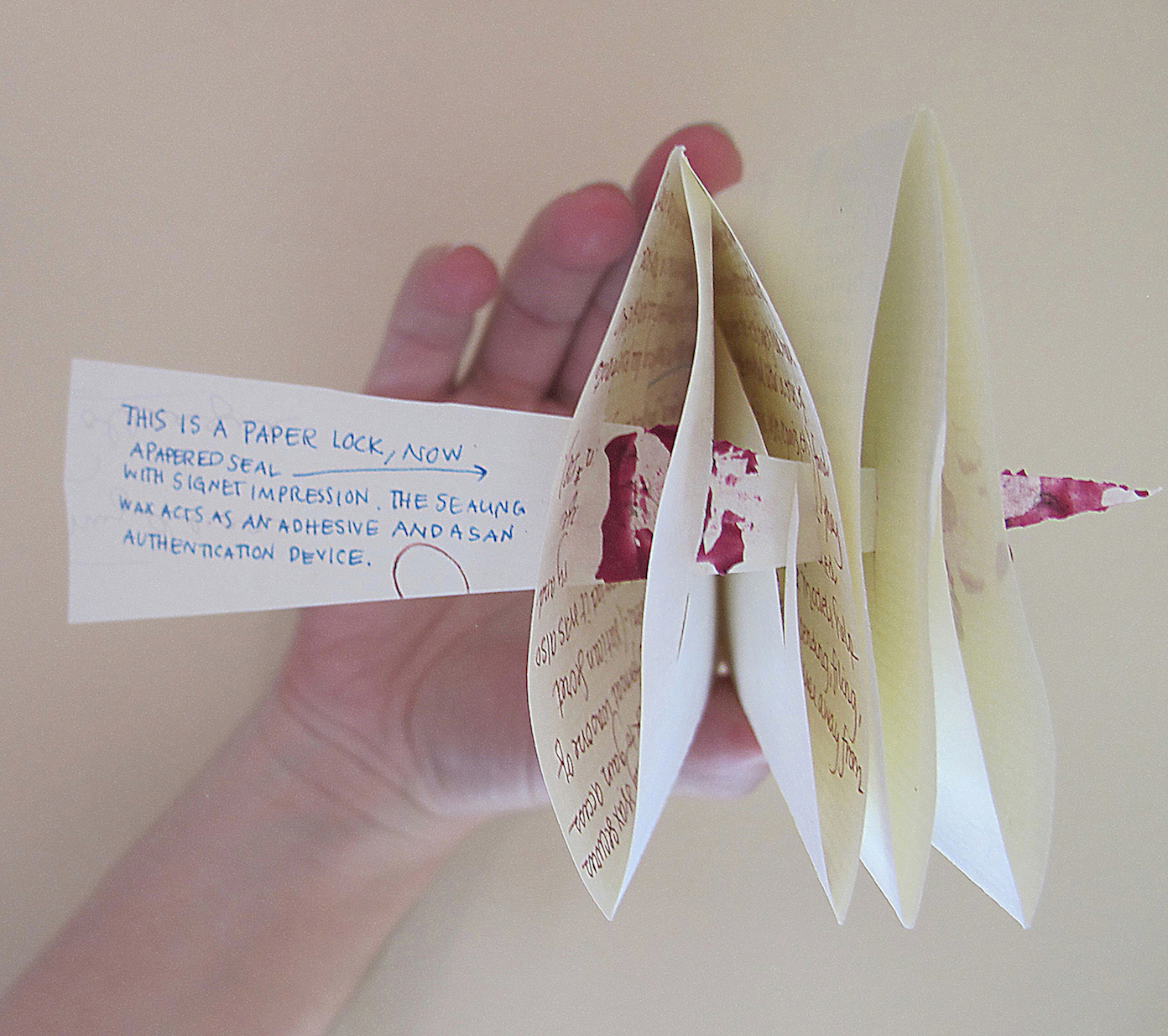
We’ve all seen it in films set in the early 19th century and before. A letter writer takes their epistle, folds it up and, essentially, makes it into its own envelope. Some of you (like me) may have even tried it yourself, only to end up with an overly thick, bulging, thoroughly recalcitrant bundle that defies closure by any wax seal you attempt to place on it. Even with a larger piece of stationery, I’ve found the process difficult to duplicate on my own.

Until I read this article about letterlocking, which opened up a trove of information.

Letterlocking” is a relatively new word. Coined by Jana Dambrogio, the Thomas F. Peterson conservator at MIT Libraries, it lumps together the many, many different methods letter writers employed to seal their letters, back in the days before envelopes (and especially, gummed envelopes) were a thing.

While studying letters in the Vatican archives, Dambrogio noticed curious patterns of folds, slits, and excisions in the documents and began to catalogue them. Fresh out of graduate school, it was a while before she realized that, not only were these patterns new to her, they were new to everyone. It soon became clear that all of these marks and seals were not just methods of authentication (using a personal seal to emboss wax or the paper itself could authenticate the sender), but also ways of securing the contents, keeping them from prying eyes. 

Some methods are simple. A few folds and a wax seal are all that is needed to keep a casual letter from being perused by an unintended reader.

Other methods are very complex, with intricate folds, tucking one edge into another, or cutting slits in the letter through which paper daggers are drawn and sealed. My favorite (so far) is the method used by Robert Devereux in a letter to Queen Elizabeth I (ca. 1590), where a “tail” cut from (yet left attached to) the letter is sent through a series of punched holes, essentially stitching the letter closed with part of the letter itself. I haven’t tried this method myself—the paper I have available is not as strong (or large) as that used in the 16th century—but I’m going to, and soon.

So, here’s yet another topic I can add to my list of Proofs I Should Have Been A Museum Conservator, as the idea of spending decades studying not the words of old letters, but the way in which they had been folded and sealed, simply thrills me. 

If you want to know more about letterlocking, Dambrogio and team have a website that includes a history of their project, a dictionary of terms, and a collection of videos showing how the various methodsfrom the 1400s to 1960were employed.

I know that I’ll be spending several more hours over there, learning and testing the methods, with plans to use them in my own letters.

k

It is that time of year when I take my slouch hat off its peg, step into my old green Wellies, head out into the garden, and contemplate shallow graves.

Last week, heavy winds cracked a twenty-foot long limb on the windward side of my blue spruce. As the limb fell the fifty or so feet to the ground, it took three lower limbs with it, all landing with a surprisingly hushed whump amongst the periwinkle. Sadly, one of the falling dead took half of a Japanese maple with it, but thankfully the maple, like the spruce, will survive.

This week, while the wind and snow and rain took a well-deserved breather, I donned my gear—the aforementioned slouch hat and Wellies, plus a billhook, machete, and saw—and made my first foray of the year out into the gardens to address the damage.

My garden in winter is not a lush thing. Though greenery still abides—the mostly moss-green lawn, the leathery green of the swordleaf ferns, the deep green of the periwinkles, and the blue-green of spruce and noble fir—on the whole the garden is spare and somewhat barren. The maples, the fruit trees, the ash and sweetgum, the lilac and willow, they all stand naked and unadorned. Remnants of last year’s blooms—gooseneck, crocosmia, spirea, and rose—huddle with their kind, shriveled and brown, ready for my pruner’s knife. And this year, of course, there was also the pile of timber that the southwesterly gales had so unkindly sent down from the canopy.

As I worked, wielding my blades, hacking branches from limbs, twigs from branches, my thoughts wandered and it struck me that though I usually think of my winter garden as a place of stasis, of rest and preparation, in truth it is more a place of death. My winter garden, amid the snows and rains and gusts of wind, is a locus of liminality where the world waits, caught between one life and the next, existing in both and in neither. All that was of the Year Gone By now lies in a shallow, leaf-strewn grave, ready to rot and return to the earth, while the Year To Come lies ready to burst forth from that very same earth, grave and cradle both.

My New Year’s Eve is not the chimes at midnight, the fireworks’ boom, the pop of champagne. This is my New Year’s Eve, this long turning-over, this slow walk from yesterday into tomorrow, when I can bury the mistakes of my past in the hopes of reaping the future wisdom that grows from their bones.

Life is a cycle, of birth and of death, but life is also cycles within that cycle, patterns within patterns, an intricate and delicate complexity that forms our years, our days, our breaths, the beating of our heart.

It’s not just a garden.

It never was just a garden.

k

Winter.

A lot of complaining gets done in winter.

lot of complaining.

People around here are summer junkies. They spend months of the year pining for the sunlight, the warmth, the outdoors-y camaraderie of our twelve weeks of summer. They look back on July and August with a nostalgia bordering on delusion, as if it was a different era, a time out of legend when life was simpler and everyone smiled. Lost from their memory are the sleepless nights spent buffeted by the manufactured wind of oscillating fans, and of dodging from air-conditioned cars to air-conditioned offices in order to avoid the “unbearable” temperatures of 90+ degrees. They remember only the hikes, the cookouts, and those pleasant short-sleeved days when birds sang the sun from its bed, when the breeze brought a hint of salt from the Sound, and when wine-infused evenings lasted until tomorrow. Continue Reading »

The holidays are over and my brain is filled with rants—how to mount a meaningful boycott, and the ramifications of foreign policy when performed by amateurs, to name two—but each time I started a post on one of them I stopped myself. I’m pretty sure regular readers don’t want to hear about that—not from me, anyway—so I’m moving on to something completely different.

Over the holiday break, my neighbor and I did a thing.

We made a game. Continue Reading »

The Gratitude Game

‘Tis the season to be grateful.

Gratitude, I have found, is a very powerful tool. It has the power to relieve my stress and infuse me with joy. It increases my empathy for others. It restoreth my soul.

I have much for which I am grateful: good health, a sound mind, a solid income, a safe home, a well-suited and loving partner, and an interesting and quirky group of friends. Oh, and my cat; she’s a hoot.

For me, though, gratitude didn’t come easy. It took practice.

I was raised to see only the flaws in my life, those elements which could be improved upon, especially in myself. As a result, for most of my life, when I would look around, I’d only see what needed to be fixed, not what had been accomplished. In the beautiful wilderness of my back garden, I saw only the weeds. Though I have nine published novels, they only represented my failure to catch on with a larger audience. And as to my cooking skills, well, in them I only saw what I lacked when compared to other, more inventive chefs I know. Across all my successes, only the lost opportunities were visible, the deeds left undone. With this mindset, it was really difficult to feel grateful about what I did have.

But then I started practicing gratitude, actually forcing myself to see the good in things. Eventually, I began to appreciate what I had more and, as that increased, the primacy of the flaws decreased, for gratitude really is a zero-sum game. I can’t appreciate something and obsess about its flaws at the same time. I can still see the flaws, of course, but by being grateful for a thing, I take it as it is, not as how I think it should be.

Once the seed of gratitude takes root, it sticks with you, and those flaws? They are transformed from negatives into opportunities to make the whole even better, even more worthy of gratitude. I still want to improve what can be improved, but the little things—the dandelion among the roses, my lack of mastery with sauces—they stay little things; I no longer inflate them beyond their true importance.

So, during this season of holidays, where we wrap up our gifts as well as the year in general, I heartily encourage you to stop, take a few moments, look around, and concentrate on the good parts of your life, for there are many, even when things seem pretty bleak.

There is good in every day, and in every yesterday, and in every tomorrow. Cherish it.

Onward.

k