Feeds:
Posts
Comments

Suddenly

and when she was gone
    the house lost its voice

no laughter echoed
    no giggles,
    no braying,
    no full-bellied mirth

banter lost its purpose
    no rejoinders,
    no quips,
    no quotes apropos

sounds of life fell silent
    no snores,
    no clatter of dishes,
    no questions shouted from two rooms away

instead, only
    stockinged feet
        on hardwood floors
    hushed whispers
        with the laconic housecat
    the ticking of clocks
        and soundless steeping tea

for when she was gone
    it felt wrong
        to laugh
        to love
        to live

but spring was coming
    her favorite season
        and her roses still wanted
            to bloom

Questioning Authority

It’s been a week. Quite a week.

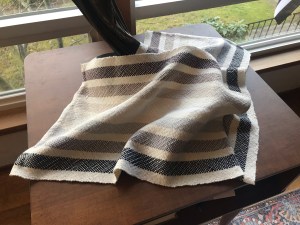
Last Wednesday, my wife went in for surgery (she’s doing well, thanks), and since then I’ve been on caregiver duty. Thanks to the Family Medical Leave Act (FMLA), I’ve been able to take two weeks off work to provide for her post-op needs, plus to do all the many, many things she normally does around the house. Things got more complicated when the cat came down with a UTI, and I had to rush her to the vet the day after my wife came home from hospital. It all came to (what I hope was) a climax yesterday, when I ran up to the shops for groceries, did a few loads of laundry, made the bed, brewed tea, monitored meds for wife and cat, unclogged a toilet, replaced light bulbs in the kitchen, paid bills (including property tax . . . ouch!), hemmed two of the kitchen towels I wove over the weekend (pictured right), braised lamb shanks (for me), cooked a frozen pizza (for her), and sat with my wife while she watched the finale of His Dark Materials (sloppy, in my view; a major disappointment, in hers).

So it wasn’t a surprise that I was a tad bushed when it came time to hit the sack. My brain, however, had other ideas; it went on a ramble through old memories, including one I hadn’t thought of in a very long time: the first time I argued with a grownup.

When I was eight, my step-mother decided it was high time for me to be given some religious education. My father had always been rather irreligious (though he believed in God). My mother, if anything, had been Episcopalian, which my father characterized as the closest thing to a non-religious religion. After Mom’s death, though, my dad remarried and my step-mother brought Roman Catholicism to the party, and she determined that I’d been living the heathen lifestyle for far too long. I needed to be baptized and to receive First Communion. In order to do this, I needed some remedial education, so she enrolled me in the catechism classes at her church.

I was not a good student, this according to Sister Catherine Michael, and for reasons that shall become evident.

Every winter, my step-mom’s folks came out from Minnesota, fleeing the frigid clime of the Iron Range for the springlike (to them) weather of the SF Bay Area. They stayed with us from Thanksgiving to Epiphany, and the entire season was a minefield—at least in those early years—as I navigated the no-man’s land between life with and without grandparental supervision and guidance.

It was the winter after I began my catechism classes. We were in the back yard, grandfather and I, watching over my infant brothers, and I was complaining of one of the school bullies.

I summed up my opinion thusly: “He can go to Hell, for all I care,”

Grandfather frowned, raised a warning finger. “That’s not a word we say,” he told me. “That’s a swear word, and swearing is a sin.”

I compared this bit of information with some of the “discussions” I’d had with Sister Catherine as we were going over the various spiritual realms. Heaven, Purgatory, Limbo, and yes, Hell. There was a serious disconnect here, somewhere.

I knew about swear words, knew many of the words themselves, in fact. Swear words were the ones Dad said when he smacked his thumb with the hammer or spilled something in the kitchen. They were often (but not always) followed by a muttered, half-hearted apology, and were never used in company. Those were sins. Other, minor epithets like “damn” were allowed when fishing and when grownups came over to visit, but only among grownups. The word “Hell,” though—Grandfather’s decree that uttering it, too, was a sin, well, that just didn’t make sense.

“But . . . it’s a place,” I said. “I just want him to go to a place.”

“It’s a swear word, and swearing is a sin,” he repeated, and in a manner that allowed no further discussion on the topic.

If I’d known the word “arbitrary,” I would have used it. It was a good thing I didn’t.

Grandfather and I had many such a tête-à-tête, ranging in topics from what constitutes sin to the proper way to drive a vehicle through a curve. Most of them ended as this first one did, with me biting my tongue and Grandfather confident that he’d gotten his point across and contributed to my social education.

Just why this anecdote came to mind last night as I was drifting off, I cannot say. Roman Catholicism didn’t “take” with me. Sure, I made it through baptism and First Communion, but it should also be noted that the first class I ever cut was Sister Catherine Michael’s catechism class. And it’s not like the “Hell” discussion was a seminal moment for me; I literally haven’t thought of that conversation in dozens of years. Maybe it was because of the ridiculous “resolution” of His Dark Materials, followed by my wife’s explanation of her utter disgust at the ending of the Narnia books (and her subsequent decree: “If it has a Christ figure, I’m out.”)

Regardless, it gave me a nice chuckle at the end of a long day.

But now, if you’ll excuse me, I have a bathroom to clean.

k

Proximity

Do not presume that
because a heart is distant
it cannot can be read

Hearts can love or loathe,
be bound or apart, unmoved
by proximity

One can be as dear
unmet, half a world away,
as from down the street

Love can falter on
the doorstep, or reach across
the space between stars

Any technology,
sufficiently advanced,
is indistinguishable
from magic.

It’s been a busy, busy start to the new year, filled with terribly mundane things—buying/selling vehicles, gathering data for financial advisors, dealing with benefits coordinators—but while I’ve been working on all of these quotidian chores, I’ve been thinking about magic.

I’ve always thought Arthur C. Clarke’s classic quotation* (paraphrased above) was pretty spot on, but now I think it needs a slight modification. For the word “advanced,” I would instead use “opaque.”

For most of my life, I never saw this quotation play out, but in my father’s last years, I got an inkling of how it worked. My dad hated computers; he never used one, hated having one in the house, and after my mom died, the computer simply gathered dust. The main reason for his distaste was not only that he didn’t understand how they worked, he didn’t understand how they could possibly work. To him, the functionality of a computer was indistinguishable from magic.

Having a rudimentary knowledge of the processes inside computers, I tried to explain to him the basics of binary code and processors and data transmission, but I quickly hit a wall; he not only didn’t understand how they could work, he didn’t want to know how they could work.  His curiosity on this topic was nil, and he returned to earth happily never having touched a computer keyboard.

This all seemed quaint and quirky and undeniably “Dad,” but recently I was surprised when I discovered that I harbored similar attitudes about some things.

Specifically, textiles.

Textiles?” I hear you say. “What’s so technologically advanced about textiles?”

To which I’d answer “Basically? Not much,” but then I’d refer you upward to where I want to replace “advanced” with “opaque.”

Like my father, I know there’s no magic involved in weaving cloth, but there are parts of it that I simply do not understand. More to the point, I can’t even visualize how they work†. However, unlike my father, I do want to understand. I know these mysteries are only born of my own ignorance, and that the mechanism is definitely within my capacity to comprehend.

This was all brought top-of-mind by a book I’m reading, Women’s Work: The First 20,000 Years, by Elizabeth Wayland Barber. In it, Barber takes us through the history of textiles, from the Paleolithic to the Iron Age. While reading, I was struck by the vast importance of the invention of string, was fascinated to learn how string became twine and rope, how weaving got its earliest start, how looms evolved, and how a 3,000-year old piece of cloth was made of sufficient string to stretch from Seattle to Portland. All this was perfectly understandable and clear in my mind—loom, warp, weft, shuttle, bobbin, I can see the fabric being woven in my mind’s eye—but then the mystery crept in: how does the weaver make the different colors, patterns, and textures in the cloth?

Barber makes reference to these elements, giving examples of some of the earliest colored patterns in Neolithic cloth fragments and discussing patterns in linens from Egypt’s Old Kingdom, but she doesn’t show the how of it. And when my mind rushes forward from these relatively simple fabrics to the intricate silks of the Far East and the jacquards of the West, the creation of these textiles soars beyond the limits of my ignorance and enters the realm of magic. Perceived magic, anyway.

It struck me at that moment that we all probably have something along these lines. Questions about basic things that we know work, but don’t know how they work. Even the simplest things, like, “How does a knife cut things?” I mean, does it separate things at a cellular level or a molecular level, and how? “How does humidity work?” We know it means there’s water in the air, but how does that work, and why is it worse in summer than in winter? “DNA is the ‘building block’ of life, but how does it know to make eyes green or hair curly?” Four molecules of acid woven together in a microscopic tapestry are somehow able to “instruct” the multifarious builds that make up living creatures. “How does a vinyl record create sound?” “How does a battery store electricity?”

Or maybe it’s just me.

For my part, though, having recognize these black pools of ignorance in my own mind, I know I’m going to explore them. In fact, it’s a fairly safe bet that I’m going to build myself a small table loom and play around with it. And thinking ahead, I think it’s also a safe bet that I’ll spend a large part of my retirement exploring similar pockets of How.

Meanwhile, I’ll probably be giving away tea towels and scarves for a while.

k

——————

* As an aside, regarding Clarke’s quotation: I always liked the fact that you could interpret it as having, embedded in the logic, a tacit belief in the existence of magic. If magic doesn’t exist, we can’t compare anything to it, can we. Yes, yes, you could say that Clarke means that tech is indistinguishable from our idea of magic, what we think magic would be like, but he doesn’t, does he?

† And don’t even get me started on sewing machines. I cannot fathom how you connect (repeatedly) two unbroken lengths of string/thread/rope. And every visualization I’ve seen (3D and otherwise) has not answered that question.

First Meals

Last week’s post got me thinking about my time in the kitchen.

My father encouraged his kids to learn to cook, by deed—he always cooked Sunday breakfast, manned the grill on cookouts, and was the go-to guy for fried chicken—as well as by word. The fact that my stepmother was, shall we say, not inspired in the ways of food preparation, was additional encouragement for us to learn how to feed ourselves. The lessons didn’t really “take” with my younger brothers, but with my sister and me, they definitely took root.

My first forays into the kitchen were, naturally enough, in supportive roles. Chopping, measuring, mincing, tending. This was useful as it taught me good knife skills, the benefit of mise en place, how to follow a recipe (and when to improvise), and how to accommodate different cooking times for disparate ingredients.

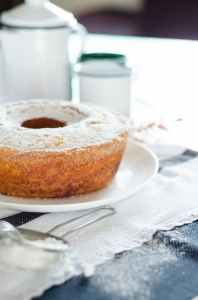
My first solo flight in the kitchen wasn’t a meal, though; it was a dessert, and the result inducted me into the realm of family legend. I was maybe twelve years old, home alone (for some reason) with hours to occupy myself, and being twelve, I wanted something to eat, something sweet, so I decided to make my favorite cake: Angel Food.

Checking the recipe, I made sure we had what I needed. With three growing boys in the house, a dozen eggs was only about half the supply in our pantry, and sugar, flour, and vanilla were also staples close at hand. I’d seen cakes baked before, so I knew the basics. Mix everything together, pour the batter into a form, bake, and a beautifully risen cake comes out. (Old hands will already see the flawed assumption here.)

Working diligently, I separated the dozen eggs, added some cream of tartar, dumped in the sugar, pulled out the French whisk, and started whipping. “Whip until soft peaks form” was the phrase in the recipe. Not having dealt with egg whites before, this was a bit of a puzzle, but I figured it’d become clear in time. I whipped and whipped. I switched hands when cramps set in. I kept whipping. A sense that I was missing something began to bloom in my sous-chef-heart, a vague feeling of being out of my depth. I switched back to my right hand, added a dash of fervor to my motions, and just as my shoulder started to seize up, I saw the mixture begin to change. It began to get foamy. Aha! My courage was renewed and I kept on whipping as the bubbles multiplied, gathered, grew smaller. But “soft peaks?” What did that really mean? Then, I saw what was happening. The foam began to achieve a structure, and the little bubbles would leave a tiny “peak” when I pulled the whisk up. I whipped more, but not too much, as the recipe also warned against achieving “stiff peaks.”

It didn’t look like any cake batter I’d ever seen—yellow, translucent, with a layer of foam across the surface—but (I reasoned) Angel Food cake didn’t look or feel like any other cake, so I was probably okay. When I poured the result into the cake form, it didn’t fill much of it. But (I again reasoned) all cakes rise in the oven, so this one would, too, rising up to fill the form. So, into the preheated oven it went.

My family arrived home just about the time it was ready to come out of the oven. The house smelled like heaven, and everyone was surprised and eager to try my first culinary attempt.

I pulled the form out of the oven and . . . looked down into its depths. The cake hadn’t risen. Not one millimeter. It was no taller than it was when it went in. If anything, it was shorter. Taken out of the form, it was a horror, a ring of translucent yellowish rubber reminiscent of jaundiced aspic. I stared at it. My kid brothers thought it the funniest thing of the year but, being boys, they cut a few “slices” and we tasted it. It was delicious; all the divine sweetness of Angel Food cake, now in a convenient compressed form. It was Angel Food jerky.

It went down in the annals as “Angel Food Flop.”

I learned a lot about cooking that day, one of which is: I’m not a great baker. Baking (to me) is too much like chemistry, where everything needs to be perfect before applying heat. That turned out not to be my style. My style is “cook a bit, taste a bit, correct” helped along by a healthy adaptability when faced with missing ingredients. I rarely cook anything the same way twice; each time I’ll try a tweak or decide that I want a slightly different mix of herbs this time.

Luckily (or not, depending on whether I’m counting calories), I married a woman who is a great baker, and one who can do with baking what I do with entrees: improvise. She gets the craft, knows it intuitively. She knows the arcane characteristics of baking powder, cream of tartar, sugars, egg whites. She measures by sight, rarely uses a recipe, and makes the best damned banana bread I’ve ever had.

I’m grateful for my dad’s encouragement. It taught me the importance of independence and adaptability, and kept me fed during my impoverished young adulthood. It also taught me the generous love language of spending hours in the kitchen and serving up a savory stew to beloved friends and family.

And I will always remember with love those Sunday mornings, a pitcher of orange juice on the table, KSFO on the radio, Dad crooning along with Mel Torme as he made pancakes, eggs, sausage, whatever his kids wanted for breakfast, while Mom slept in a bit longer.

It was his love language, too.

k

Kitchen Sink

I’m taking a break from poetry and politics this week (because, oy, it’s been a rough start to the year), and instead turn to things domestic.

Throughout 2022, I tried a few new things in the kitchen (stop it! I’m talking about cooking, here), some of which turned out exceptionally well. I am not a chef, searching for the finest ingredients, using top-of-the-line equipment, and trying my hand at the most complex of recipes. No. Definitely not. What I am is a cook that likes to make the best meal with the least amount of effort using readily available ingredients and affordable cookware. In cooking, I search for that balance between work and result, cost and return. In other words, I’m a lazy foodie.

Finding that balance can be a challenge, but this year past, I discovered a few new (to me) products that really helped that equation, products I’d like to recommend to you: one brand of cookware, and two ingredients.
(Note: I receive NO kickbacks or compensation for these recommendations; I’m just one home cook passing along info on my good experiences.)

Recommendation #1: Cookware

One of my long-lasting battle campaigns has been with non-stick cookware.

A bit of personal history . . . When I was young, Teflon and Silverstone were the only non-stick games in town. Cheap was a necessary byword back then, and what I bought was awful. Made of thin stamped aluminum, they lasted maybe a year before they started to break down, flaked bits of black into my omelettes, became warped and dented with use, and got tossed out and replaced in relatively quick succession. Sometime in the ’90s I graduated to thicker-bodied cookware—like T-Fal and Calphalon which, while more expensive, didn’t break the bank and definitely lasted longer. Still, though, they were thinly coated products, and that coating still got scratched (despite proper care), the skillets still warped, and though their lifespan was about three times that of the old stuff, replacing them every two or three years annoyed me. Later, my cookware budget increased and technologies changed, so I tried several types of anodized non-stick cookware, but the extra cost did not translate into longer life or a reduction in warping on larger skillets. These days, I use stainless for pots and sauciers, cast iron for grilling and Dutch ovens, but I still want non-stick skillets for sautéing, cooking eggs and fish, and making pancakes/crepes. So, the battle continued.

Until last year.
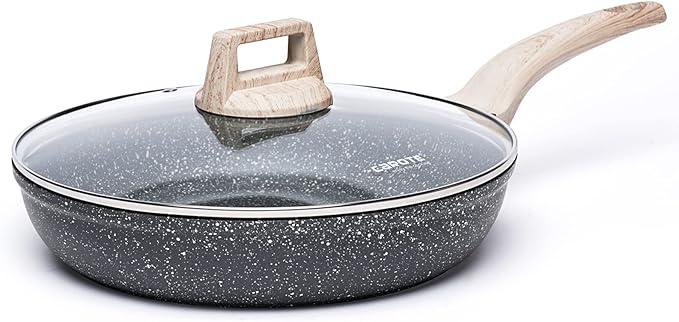
Last year I saw a non-stick skillet on sale. It was an 8″ skillet, and it was $13. It looked unlike any other skillet I’d ever tried and had received high ratings so, being extremely dissatisfied with my pricy Scan-Pan and Anolon skillets, I figured I could risk a little coin on this loss-leader.

Made by Carote, it was “grey granite” in color—an unusual but pleasantly retro look, reminiscent of old enamelware—was made of thick aluminum with five layers of heavy non-stick coating, and had a wood-tone handle (also lovely) that was super-comfortable and secure in the hand while also being oven-safe to 500°F. It didn’t take long for me to fall for this little skillet, especially after I realized that it had no riveting on the inside (where the handle connects), making cleanup (almost) a pleasure. Moreover, the base of the pan was thick, devoid of “hot spots,” and was designed to evenly expand and thus avoid warping.

When I checked the rest of the Carote line, I found that even the regular prices were a third the cost of the higher-end pans I’d been trying, so I picked up a ten- and a twelve-inch skillet, with covers, all for less than the last Scanpan skillet I’d bought.

They’ve been in daily use for the last three months, and I could not be more pleased. They come in other colors, which isn’t a factor for me, but might be for others, and a ten-piece set (skillets, pans, covers) can be had for around $120.

Recommendation #2: Ingredients

Another of my culinary challenges has been sauces.
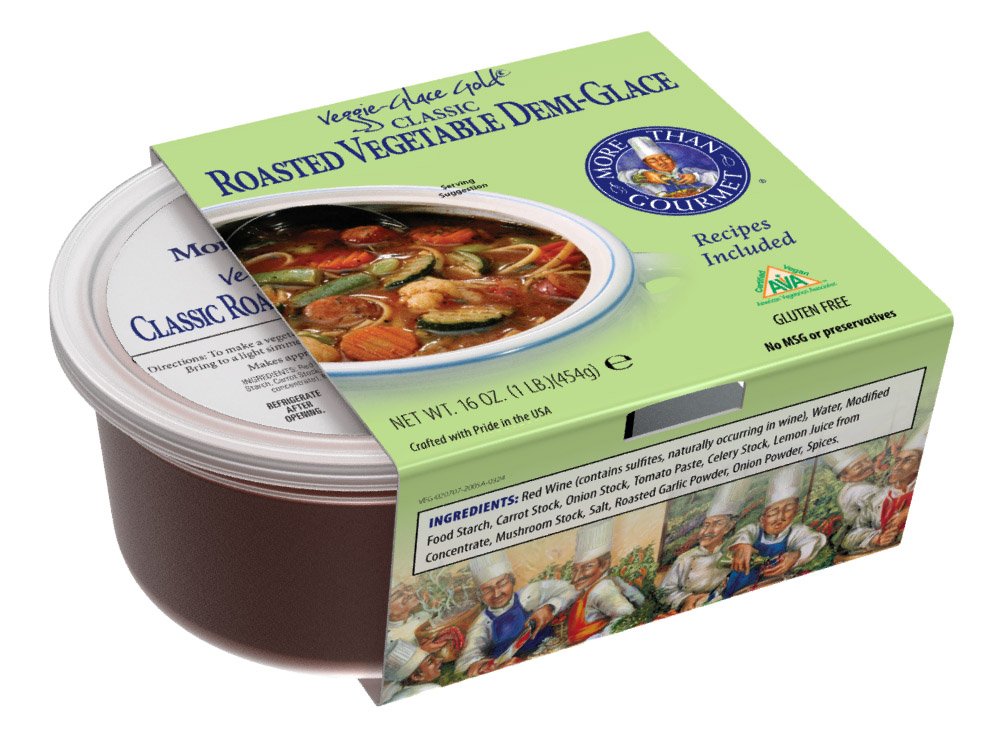
If you make sauces, you need stock and you need a thickener. Making stock at home means saving bits and bobs from larger cuts and/or buying bones to roast, then hours of simmering and reducing all to turn a gallon of water into a quart of decent stock. Buying stock means, well, you can’t, not real stock, anyway; sure, you can buy broth and emend it, or you can buy bouillon cubes and try to counter all the salt, or . . .

I present to you More Than Gourmet’s classic demi-glace reductions. These are a collection of gelatinized demi-glaces that may be used as stock, as a demi-glace, or as the basis for a heavier sauce. They are shelf-stable until opened, at which point they will last six months in the fridge. While not sodium-free, they are made with about a third of the salt/sodium of standard bouillon preparations and, to tell you the truth, I really can’t taste much salt in them at all, even at full concentration. They come in various incarnations, including vegetable/vegan, mushroom/vegan, veal, chicken, duck, lamb, and fish.

You can get them in small 1.5 ounce packets (including a variety pack, if you want to try some out), but I’ve been buying them in the one-pound tubs (yes, I use them that much). One thing I really like about the one-pound tubs is that I can open it up, carve off a slice, build my stock base, and if that’s not flavorful enough, carve off some more and deepen the concentration. Whether I’m making a quart of stock or a cup of glaze, these reductions are my go-to ingredient.

But, what about thickening that stock for a sauce? Well, for that I used to spend a lot of time making roux. Take equal parts fat and flour, cook them up at a low/med heat until they get to the desired nuttiness/darkness, and then hope you made enough for the quantity of base you want to thicken. I got into the habit of making a mess of roux, parceling it out into teaspoon punkles or cooling it into a sliceable stick, so I wouldn’t have to make it each time. Not optimal, but workable.

Jacques Pépin to the rescue!
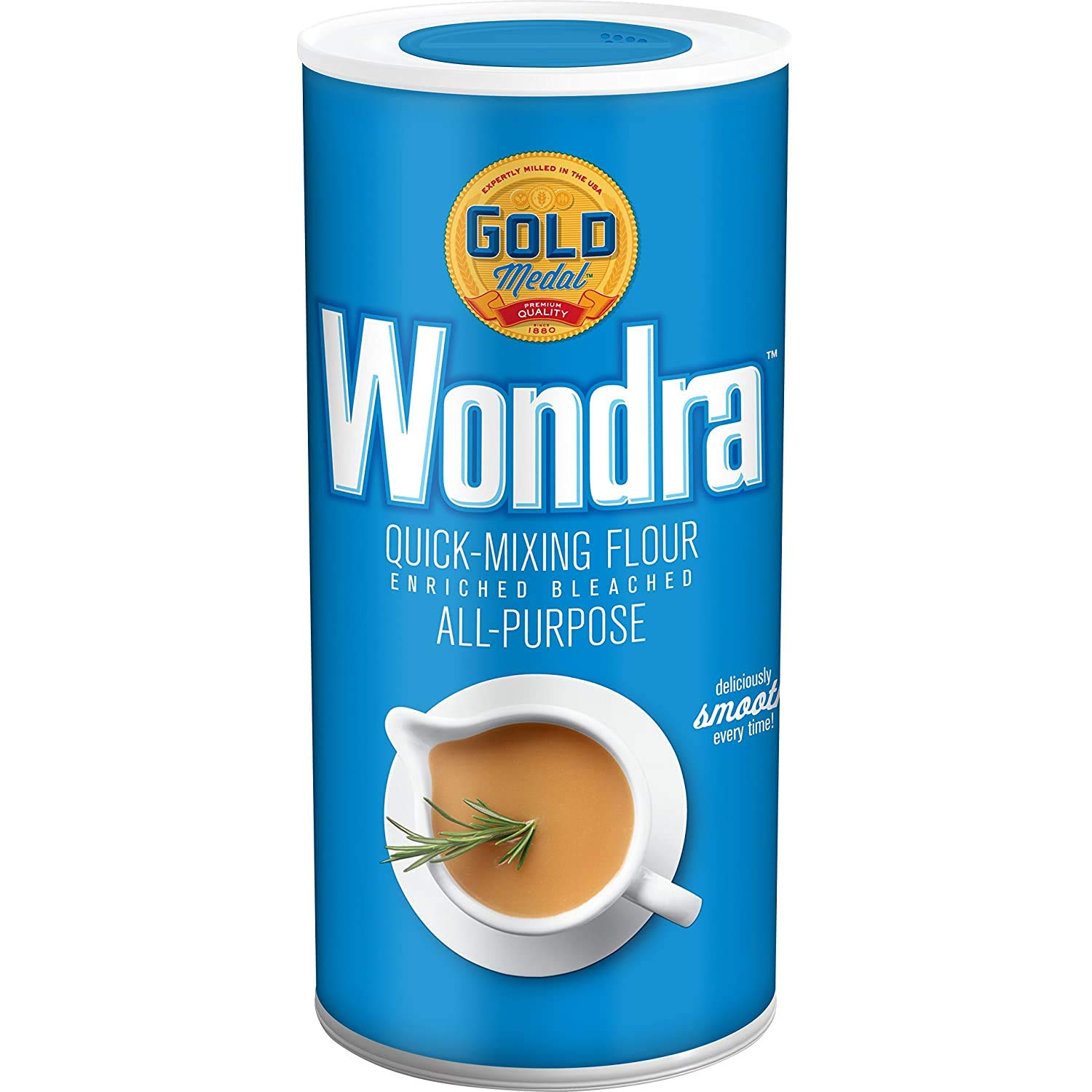
I read an article in which the master (who, it turns out, doesn’t like fussing about with things when there’s a viable, equally useful alternative) sang the praises of Gold Medal’s Wondra. Now, Wondra has been around for decades, and chances are you’ve seen it at the grocer’s, down there on the bottom shelf under all the froufrou flours and organic/non-GMO pastas. Chances also are that you’ve never bought it, used it, or heard of it (I certainly hadn’t).

Wondra is a flour that is pre-cooked and finely milled, so that it dissolves immediately into liquid (hot or cold), with no lumps. Put that liquid on some heat and: voilà! instant thickener. In other words, it works just like corn starch, but it doesn’t have that gummy, flavorless, starchy mouth feel, but rather adds a bit of that woody/toasty base you get from roux. If you add some butter to the mix, it’s almost indistinguishable from a roux-based sauce. Combining Wondra with the More Than Gourmet reduction (and appropriate spices, herbs, aromatics, etc.) is a quick and easy way to get to the perfect ladle of sauce. Of course, if you’re trained at the Cordon Bleu, you’ve just fainted dead away, I’m sure, but for us mere mortals, this is a godsend.

But wait! There’s more!

Wondra has other uses, too. As a dredge on fried foods, it gives a crispier, lighter crust. I tried it last night on the slurry I use to make a lacy “skirt” around dumplings and gyoza, and it was light, fragrant, and oh-so-crispy. A massive improvement over using AP flour.

And it can be used for crepes as well, not only making them lighter and less glutinous, but also allowing you to skip the “resting” step that crepe batters usually require.

Wondra is my latest discovery from 2022 and, as such, I haven’t plumbed the depths of its possible uses, but it’s already earned a spot as a pantry staple.

That’s all for this week. Thanks for stopping by and may the year ahead be healthy, strong, and peaceful.

k


I’ve never been one for New Year’s resolutions. However, as someone who’s been developing software for thirty-five years, I am one for retrospective reviews, and just like deploying a new app to a production environment, hanging up a new calendar on the kitchen wall has always seemed an appropriate time for retrospection. After all, by this time the holiday hubbub has dissipated, the gardens are still asleep, kids are back in school, the days are short, the nights cold and lengthy. What better time to look back with an eye toward the future?

But, rather than setting goals, I look at trends in my past behavior and decide whether I’m on the right path, or want to implement a course correction.

For instance, last year I read a pitifully small number of books, less than one a month. Looking further, I see that this is a downward trend, and I want to correct it. But why did I read fewer books in ’22? The simple fact is, I was busy. With all the renovations and events and projects I had on my plate, I simply did not have enough time to sit back and relax with a book. Also, ’21 was COVID Lockdown year, with nothing in it by way of travel, family events, or DIY, so I had plenty of time then.

Unfortunately, this year is going to be a busy one, too. We’re still consolidating parts of our life, still fixing up the house, the gardens need upkeep. And I have to get serious about my coming retirement, figuring out what I need to do with Medicare, talk to our financial advisors, and wade through tons of info from HR. We’re also taking care of some medical stuff while we still have top-grade insurance.

So, seeing all that ahead, am I going to make a resolution to read a book (or more) a month? No. That’s setting myself up for failure, as too much can happen that might devour my free time. However, I am going to try to correct that trend, which means I need to apply a bit more discipline as regards my unstructured time.

This will seem silly to some, and as serious anal-retentive overkill to others. I don’t mind, though, because another trendline I’m fostering is not giving a damn about the opinion of others. It works for me, and I’m the only one for whom this needs to work.

Despite what Yoda says, I think trying is a worthy endeavor because life is rarely binary, and incremental progress is still progress. So while I’m not going to “resolve” to lose weight, learn Italian, or give up playing video games, I am going to encourage myself in certain directions, to wit:

  • Continue to Improve
    • Weight loss program
    • Healthier food choices
    • Regular exercise (workouts or garden)
    • Household improvements
    • Writing letters closer to monthly than quarterly
  • Course Corrections
    • Read more books
    • Read less news
    • Employ more social media “fasts”
    • Visit more with people IRL

May the new year bring you all much happiness.

Onward.

k