There are times when something happens, something innocuous, something that, on any other day, would just be a pain or an annoyance but which, on this day, adds to all the invisible things you’ve been avoiding and tips the scales, hitting you hard, harder than seems reasonable, harder than seems rational. But really, it’s not the thing that’s causing it; it’s the collective effect of everything else—the tumult, the tragedy, the futility that surrounds us all—it’s the stuff that’s been building, the leaden weights you’ve been dragging along while you try to manage life, solve the daily problems, keep everything on track, make sure everyone’s needs are met.
And yesterday, that thing happened to me. It was a little thing, a silly little thing. Only it wasn’t little; it didn’t feel little. And it didn’t feel silly.
For a long time, I’ve written letters. To friends, to businesses, to people of note, to sweethearts. And usually, letters come back. I have received replies from presidents and royalty, authors and celebrities, lovers and family and friends. But it’s the writing of those letters that I’ve loved.
About thirty years ago, I discovered the perfect paper. I was in a stationers in downtown Seattle—one of those narrow, cramped shops that seem to have been created along with the building itself—and way in the back, past all the greeting cards and overly ornate stationery, was a selection of papers for writing letters. Shallow boxes with sheets of paper in standard US letter size (8.5″x11″), each set on an angled shelf for display and easy access. I’d never seen the like. All sorts of papers, from onion skin to vellum to parchment to bond weight to card stock, made of cellulose or linen or cotton, each in a variety of finishes, some smooth as silk, and others rough with marks of handiwork and deckled edges.
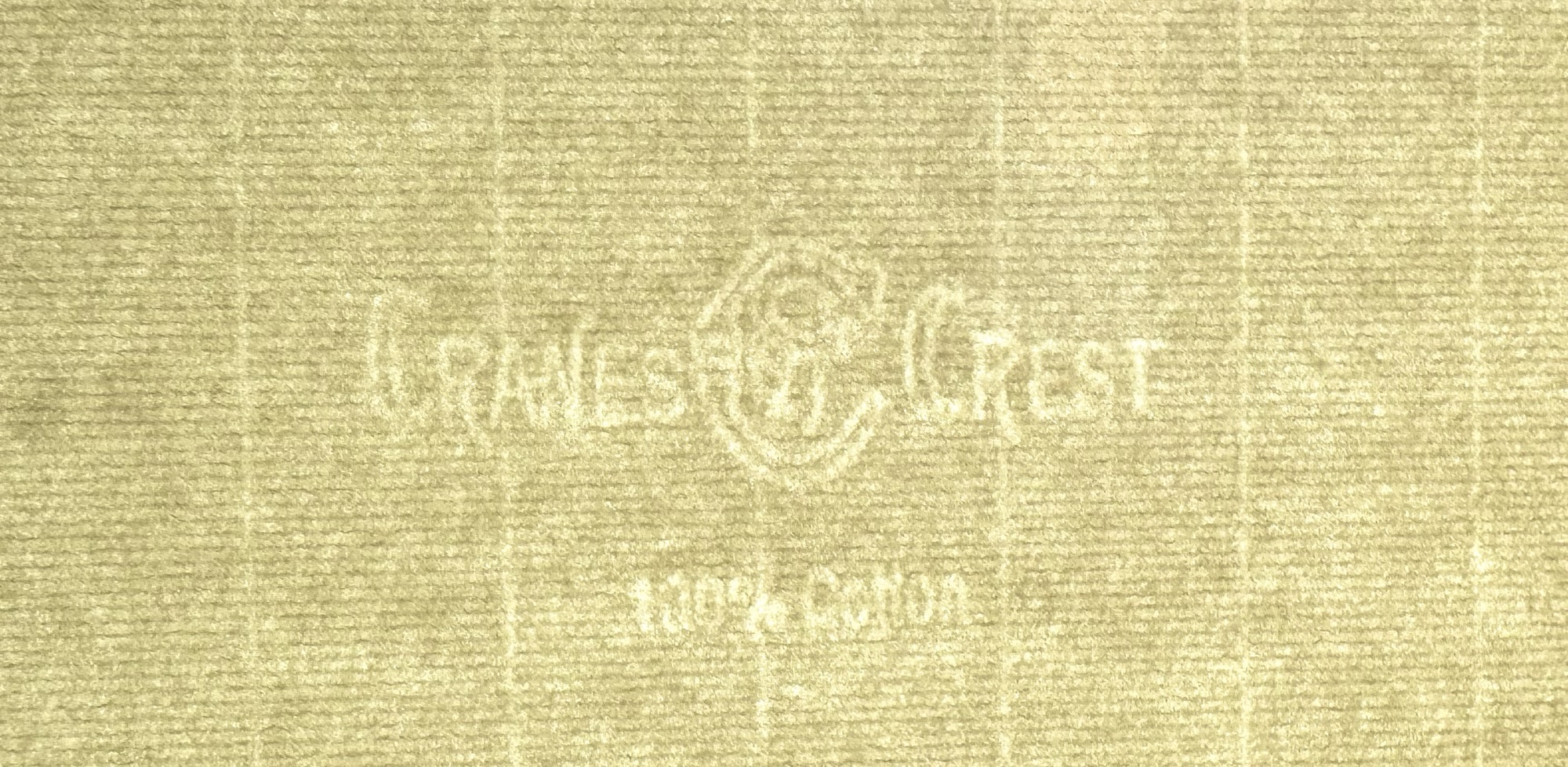
Enthralled, I reached out tentative fingers to touch them, feel their surfaces, compare one to the next. The snap of the edges, the stiffness of the curl. I found one set, ivory colored (later I learned that “ecru” was the official name for it), with ridges going across the width of each sheet. “Hold it up,” the woman at the back of the shop said. “To the light.” I did, and I saw within the paper, hidden in direct light but revealed as it passed through, the watermark: “Crane’s Crest 100% Cotton”, and vertical lines down the length. The maker’s mark.
I purchased a small bundle of a hundred sheets. On the shallow box it read: Crane & Co.
I knew about Crane & Co., from back in seventh grade when I wrote a report on counterfeiting (heavily plagiarized from Encyclopedia Brittanica). Crane & Co. are the makers of paper used to make U.S. currency. Every dollar bill was printed on paper from Crane & Co., is still being printed on their paper. And it was all made of 100% cotton. I learned about the little red and blue fibers that you could see in the clear spots. I learned about the immensely detailed engraving of each printing blank, about how on the back of a clean five-dollar bill you can read the names of the states on the upper walls of the memorial, and about how on the front of the one-dollar bill, on the escutcheon in the upper right hand corner, in the northwest curve, you can find the little spider that wove the webs that decorate the border of the entire bill. And now I had paper made by the same company, of 100% cotton. It was “laid” paper, which gave it the small but discernible ridges that crossed its width. They used to be an artifact of the process of making the paper by hand, on screened forms, but now the texture was created with plates.
Writing on this paper, though, it was different. The paper had a give to it that other papers did not. And the ridges of the laid finish made writing so easy. When I switched from a ballpoint pen to a fountain pen—I didn’t have a good one, back then, but even so—it was a revelation. The pen and paper seemed to work as a team, with the ink their medium. The ridges encouraged the nib to release the ink and the paper held onto it, just where it went down. It was a tactile experience, but even with the texture of the paper, the nib never caught, the paper rough but smooth with each stroke of the pen.
I bought two full reams of this paper, nearly 1,100 sheets when added to my first purchase, and I have written almost exclusively on this paper for the last thirty years. It was like writing on history, and once I found my perfect fountain pen (Monteverde Innova EF) and the perfect inks (Noodler’s), my letters got longer and longer. Writing letters became a meditation—the ritual of filling the pen, opening the drawer where the paper was stored, selecting the top few sheets, feeling the familiar texture, placing one sheet on the writing block, and beginning to write, “Dear . . .”—that might take a few days to complete, with a couple of hours here, another few there, giving my hand a break to rest and uncramp between sessions.
Until yesterday, when I opened the drawer and only one sheet remained.
Ah, no matter. I’ll order more.
No.
Crane & Co. had been sold, years ago, and was now owned by Monarch, and Monarch no longer made 100% cotton laid letter writing paper. In fact, during my increasingly frantic search, I learned that no one made 100% cotton laid letter writing paper anymore, not Monarch, not Neenah, not the French, not those monks in Belgium, not the old Italian family that’s been making paper since the Medicis ran Florence. Twenty-five percent cotton, yes, I could find that; 100% cotton, no.
I was bereft. Simply bereft. Something had been ripped from me when I wasn’t looking, an essential piece of me, gone.
The wall cracked, then. It broke, tumbled down upon my head, the wall I’d built and buttressed, shored up in the past months. The wall that had kept at bay all my angers. Angers over so many things: over the worsening pain in my hand as I waited six months for my surgery date; over the complicated hoard of emotions that was unearthed after my brother’s recent death; over the constant reminders of mortality not just because people I knew (or knew of) were dying, but because people my age were dying; over the crumbling of my youth; over the accumulation of yahrzeits; over the incredible stupidity of our government; over fears that this is how democracies end; over the incompetence of so-called professionals; over the fact that it’s summer now and I just hate summer.
Over the fact that I could no longer write my letters on Crane & Co. 100% cotton laid writing paper.
A little thing. A silly little thing.
Grief comes in many shapes and sizes and colors and values. It cannot be adequately defined, only estimated. It is a malleable thing, amoebic, capable of joining together small losses—a broken mug, a canceled show, a fragrance discontinued—into a medium-sized sadness, and mid-sized sadnesses into larger heartaches. The way gentle breezes can build to winds and to gusts and then to keening gales and thundering storms. Grief can do that.
Life is loss, some say, and in some ways it is true. But life is also living, and that, I think, is the greater part.
I will rebuild my ritual. A different paper. A different texture. It is, after all, a little thing.
We adapt. We move on.
We live.
k
Read Full Post »



 in the passenger seat,