The last time my wife and I took a really-for-real out-of-state vacation was about eight years ago, so when she said she wanted to visit her brother down on the coast of California, we decided to turn it into a road trip. We’d skedaddle down I-5 to Morro Bay, her brother’s town, and then toodle back up along the coast.
Now, I-5 isn’t the most scintillating of avenues; basically, it follows the path of least resistance from Tijuana, Mexico to Vancouver, Canada, and is about as picturesque as as that description would lead you to believe. But it is an extremely efficient pathway for north-south travel, making up for what it lacks in overall beauty with unfettered miles, wide lanes, frequent rest areas, convenient off-on access, and plentiful refueling options of both food and petrol.
The coastal path, following California Highway 1 and then US 101, is the exact opposite. This is a narrow, twisted, gnarled mare’s nest of usually two-lane undivided roadway beset by rockfalls and landslides. Towns are small, strewn hither and yon like lost beads from a broken necklace, and often accompanied by signs saying “NO SERVICES NEXT 45 MILES.” But it is a gorgeous trip, taking you through micro-climates of desert and rain forest, alongside sandy beaches and sundered, rocky cliffs that, quite literally, take your breath.
But before we could get to the pretty part, we had to pass through the gantlet of I-5.
Seasonal Fast Forward
Traveling south from Seattle along I-5 in April was like a time-travel jaunt through the seasons. At home, my lawn was just waking up and the trees were still in flower and bud, but even as we hit central Washington things began to change. It wasn’t long until it seemed like we were in May, then June. The grasses on the hills were a patchwork of acid- and DayGlo-green. Trees were almost in full leaf, and the summertime wildflowers painted the roadside slopes with swaths of orange poppies, yellow buttercups, and purple bush lupines. My eyes, which for the past month had been swollen and painfully dry from dust storms of tree pollen, began to feel once more like part of my body rather than sand-encrusted stones.
The temperatures rose as well. Even as we climbed into the Siskiyous, the mountains that separate Oregon and California, the temps rose up into the 80s (25–30°C), and then as we descended the southern slopes, it got even hotter, into the 90s. What the hell? This is April! It finally hit 98°F (37°C) when we dropped down from the pass and into the high chaparral of northern California.
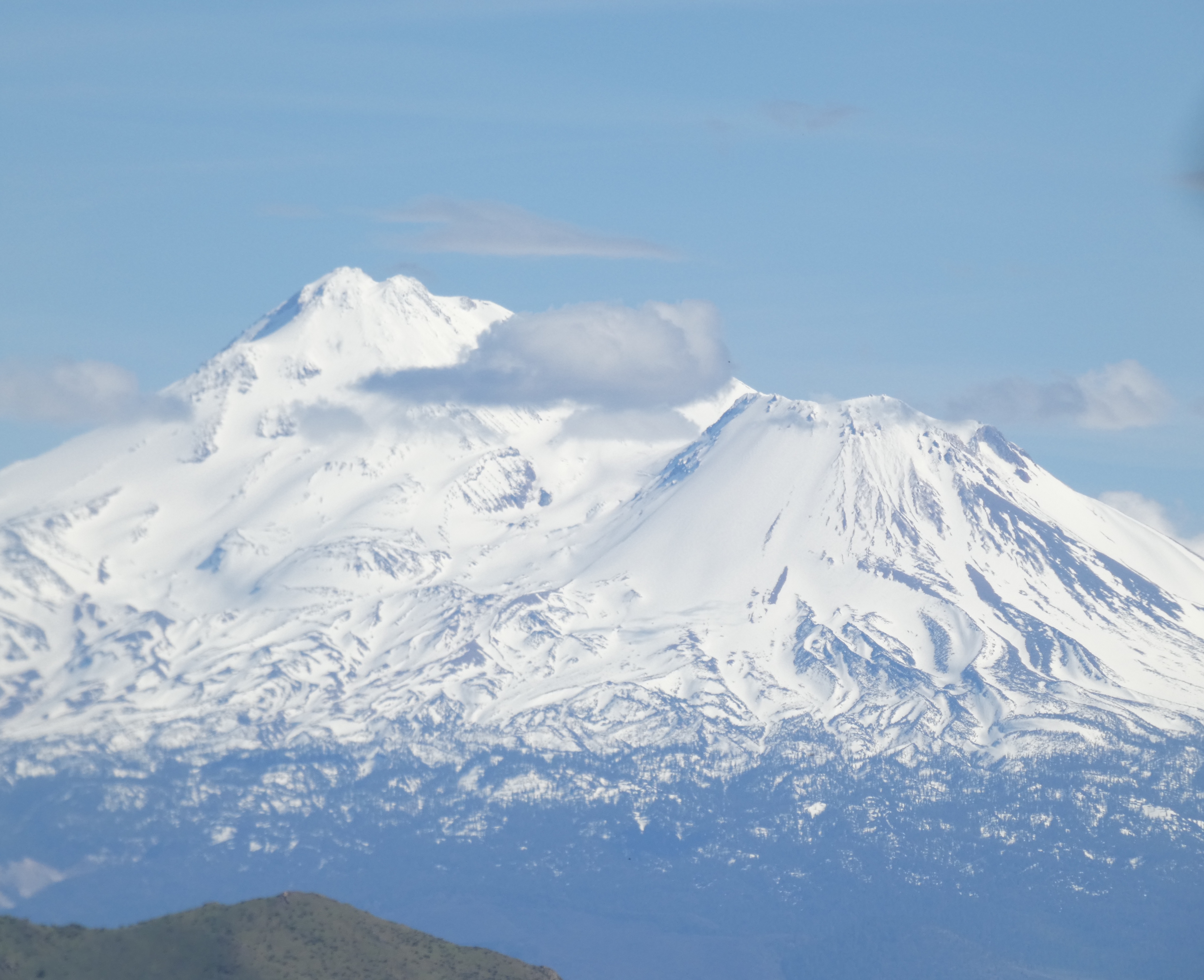 With temps like that, it was surprising to see Mount Shasta covered with snow, and Lake Shasta (a major reservoir) full nearly to the brim. In all the trips I’ve taken past that lake, it has never been as full as it was this time, and a good thing, too, as it means the poor folks of NoCal might have an easier time this year with wildfires.
And it was right after that, right after we’d passed Shasta (mountain and lake) that the terrain went from deep summer to hellish.
The countryside was scarred by the remnants of the massive wildfires that ravaged the landscape and razed entire towns last fall. California burns every year, but 2018 was brutal. Entire mountains were denuded of green, and square miles had been burnt down to the bare earth. The ridgelines, normally blanketed with thick coniferous forests, had nothing but charred treetrunks that looked like scorched toothpicks on an overdone roast. And road crews were at work everywhere, staking down straw-filled burlap tubes along hillsides to act as bulwarks against the erosion that was sure to come, and laying crushed rock to stabilize the oven-baked slopes that had already started to slip.
Travels Without Charlie
Past the devastation of the fires, we dropped down out of the mountains and hit the central valleys of California, a long slog through flat croplands filled with orchards, dust, heat, and pain. The temps were still unbearably hot for our well-watered Seattle constitutions, but our little car’s A/C kept us refrigerated. We had to say goodbye to I-5 and head to the section of US 101 that would lead us through the Salinas Valley—Steinbeck country—but before we could do that we had to jockey through I-505 and I-680, a nerve-wracking series of meandering, narrow-laned roadways where the trailer-tractors outnumbered cars ten-to-one, where car wrecks and construction zones popped up around every blind curve, and where the faster, far left lanes were owned by “FasTrak,” which protected them with dire warnings of punishments bordering on disintegration should any mortal dare to enter into them without first setting your FasTrak Flex toll tag to position (2) or (3+). Insofar as we did not know what a FasTrak Flex toll tag was (much less have one), we stayed in our plebeian lanes, surrounded by monstrous eighteen-wheeled cargo carriers, until we finally connected with southbound US 101 near San Jose.
The air outside was now 100°F, and we dared not open the windows for fear of incineration. And yet, as we passed through the valley, banked on either side by coastal mountains, filled from one edge to the other with cropland, we saw men and women out there, working, backs bent, skin and clothes the color of dust, hoodies pulled up as protection from the sun that blazed down from what, in any normal place, would be called high summer, but which here was only the early spring of late April in California. We passed buses filled with migrant workers and towing trailers with porta-potties, the better to get more work with less down-time. Towns, low-slung and tired, poked their gabled heads up over highway embankments, hoping for some commerce, even if it was only that we stop for gas and a Coke. Everything seemed broken, age-old, built from cast-off and re-purposed parts, and I envied nothing in that entire valley.
At the bottom, where the mountains encroached, narrowing the vale, the crop changed from vegetable- to petroleum-based. Here the flatland was ruled by the wide, squat cylinders of storage tanks, hubs of arterial webs of pipes, valves, and railroad spurs, all set amidst forests of pumpjacks, those drinking-bird styled machines that bring crude up from the depths.
 A right turn at Atascadero led us into a narrow ravine, which became a defile, which dropped down to follow an old creekbed through bends and hairpins, where the knee-high grasses leaned out over the tarmacadam and lichenous oaks waved ghostly scarves of Spanish moss above our heads. Within a mile, the temperature dropped twenty degrees. Within three miles, it had dropped another ten. Lush, green, moist, it was a hidden Eden betwixt Hell and the Pacific Coast. The track debouched without warning or omen onto the Coast Highway, and we had arrived at Morro Bay, a town named for a rock that looked to the Spaniards like a nose (morro, Sp. “nose”).
Tired, buzzing from the rumble of the road, the southbound portion of our trip—the hard part, we hoped—was done, and now we could begin to enjoy the journey.
More on that, later.
k






 Kurt R.A. Giambastiani