Feeds:
Posts
Comments

The glass still in hand, he knelt and shifted the harness so the fat lower section of the samovar swung around his hip.  Deftly, he crooked back an arm to open the spigot.

David expected either the syrupy, blazingly strong coffee of the Arabs and Turks, or the sweet minted tea that was sipped through a sugar cube held in the teeth.  Both were beverage staples for every Arab café and restaurant.  Instead, however, the man released from the spigot a stream of hot, thick, white liquid.  David immediately smelled a honeyed aroma that filled his mind with the image of pink and lavender flowers in a desert oasis.  It smelled absolutely luscious.

“What is that?” he asked bluntly.  The man looked up from his task, the thick stream still arcing into the glass.

“My friend has never tasted salep?  Ah, such a treat you are about to have.”  The glass was full, and the vendor closed the tap, catching the last drops in the glass with a move of long practice.  He shifted his position, the samovar swung back along the harness strap and settled once more into the middle of his back.  Still kneeling, he placed the glass of steaming liquid into a handled cradle of brass lacework and presented it to David as if it were a delicacy to a king.

David took the cup and ventured a sip.  Thick, hot, smooth, and milky, the concoction was a wonderful collection of taste and texture: a satiny sweetness unlike anything he had ever experienced.

Giambastiani, Dreams of the Desert Wind,
(Seattle, Fairwood Press, 2004), p24

When I lived in Jerusalem, on cool mornings I would go down to the shuk in the Old City where I’d buy two things: a semit and some salep. A semit (or simit) is a large bread ring topped with sesame and other seeds. Vendors would carry them stacked on a stick and I’d buy one, still warm from the oven. Salep (or sahlab) is a beverage made from wild orchid tubers dried and ground into a powder. The powder is a thickener, and when added to milk along with a bit of sugar, some flavorings, and topped with whatever your heart desires, it is a luscious treat. I loved this combo so much that it made its way into my novel, Dreams of the Desert Wind (excerpted above).

Finding true salep outside of the Levant is damned near impossible, and the only sources I’ve found for authentic salep powder run about $10 USD per 1oz/30g. Since it takes a tablespoon/15g of powder per cup of the beverage, that’s way too pricey for my taste, so for years I’ve been looking for an alternative. The mass-marketed “instant salep” powders cheat, using corn starch or potato flour as a thickener, and they are always too . . . something. Too bland, too thin, too insipid, too gummy.

But rice flour, specifically glutinous rice flour, this makes a thickened drink that is the closest approximation I have found. As a rule, I try to avoid posting recipes with uncommon ingredients (life’s hard enough), but in this case, glutinous rice flour and rose water are pretty easy to find, either in a higher-end grocery, a Mediterranean bodega, or online. They’re inexpensive, too, both costing less than an ounce of real salep powder.

Salep (or Sahlab)

Makes 1 serving

Hardware

  • A 1-quart saucier pan works best for this because of its rounded bottom, but any small pot or pan will work. Just get the whisk into the corners.

Ingredients

For the salep:

  • 1 tablespoon glutinous rice flour
  • 1 cup milk (whole is best)
  • 2 teaspoons sugar
  • 1/4 teaspoon rose water

Optional toppings:

  • ground cinnamon, nutmeg, or ginger
  • ground/chopped pistachios
  • raisins or sultanas
  • shredded coconut

Procedure

  • In a small pot, whisk the rice flour with a bit of the milk to dissolve, adding the rest of the milk when the flour is incorporated.
  • Put pot over a medium heat and warm the mixture, whisking frequently as it thickens.
  • When the salep starts to simmer, pull it from the heat. Stir in the sugar and rose water.
  • Pour into a mug or glass, and top with whatever strikes your fancy.

Notes

  • I devised this recipe is for a single serving, but it is easily scaled up for more.
  • You can replace the rice flour with corn starch or potato flour, but there’s a marked difference in consistency and umami. Not recommended.
  • Some recipes out there suggest using vanilla as well. I do not recommend this, as it cuts the flowery aroma of the rose water.

k
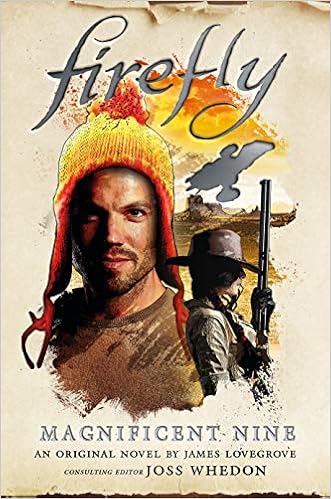
As regular readers know, I’m a Browncoat for life. However, I am not the sort of über-fan who will buy anything they slap a “Firefly” logo on. Yes, I have Firefly-related t-shirts, a couple of “behind the scenes” books, and on the back of my car there is an “I aim to misbehave” sticker, but I’ve passed on most of the comic books, the graphic novels, and other paraphernalia that’s out there vying for my Browncoat credits.

A series of novels, though? Sign me up.

The Magnificent Nine is the second installment in the new Firefly novel series, penned by James Lovegrove, who also gave us the first in the series (a review of which can be found here.) I was underwhelmed by Lovegrove’s first title, but I enjoyed the book despite its flaws.

Alas, this title also has its flaws, some of them serious.

But first, what’s good . . . Continue Reading »

Pass it On

A number of years ago, my neighbor expressed an interest in my books. Being the  new-author-hungry-for-any-attention sort of guy, I gave her a copy of the first three books in my Fallen Cloud Saga. (No, I wasn’t being stingy; it’s all that had been published at the time.)

My neighbor never mentioned the books again—not a good sign—so, as per my usual practice, I never brought up the subject again.

Fast-forward a dozen years. Continue Reading »

(If you’re late to the party, no worries.
Here’s where you can find the posts on the Southbound leg,
and the Northbound legs Part 1, Part 2, & Part 3.)

We were on the last few legs of our road trip, but this one was where we would say farewell to California and to Highway 1. It had been a wonderful road, filled with beauty, expanse, clear skies, wildlife, ocean vistas, wonderful towns, great cities, and a feeling that we were really, truly, quite far away from our everyday lives and the thousand natural shocks that they are heir to. However, before we could say goodbye to that old road, CA-1 had one last trick up its sleeve.

Online maps will tell you that the drive from Gualala to Crescent City will take you five hours and forty-five minutes.

This. Is. A. Lie.

It is 276 miles from Gualala to Crescent City, taking Highway 1 to Leggett and US-101 from there. In five and three-quarter hours, that’s an average of forty-eight miles per hour.

This. Is. A. Damnable. Lie.

You might be able to do it in seven hours, maybe six and a half if you pee into a bottle and don’t even stop for petrol, but the only way you’re going to make it from Gualala to Crescent City in 5.75 hours is if you’re a rally driver on a perfectly dry day with all traffic blocked off and you have a co-driver in the next seat calling out “Right 5 over crest, then Left 2 Tightens 1. Don’t cut. DON’T CUT!”

As with most things Highway 1, time along this road is fluid, but unlike in other areas, where time flies by as your eyes take in the wonderful conjunction of ocean and shore, here it expands, eating up the hours in tick-tock fashion, making you work for every mile.

The last section of CA-1, an inland cut between Rockport and Leggett, is an especially harrying bit of road. You will have to use every lesson CA-1 has taught you up to this point. It will take concentration on the driver’s part, and fortitude for any passengers you’ve cajoled into traveling with you. For my wife, whose superpower is sleeping in any moving vehicle, that section of road proved to be her Kryptonite. Unhappily awake, breathing through gritted teeth, right hand white-knuckling the Jesus bar, left hand clenched and ready, she battled centripetal force and nausea as we ascended, descended, twisted, banked, sped up, braked, and wondered how long this damned bit of road actually was.

And yet, as was every other mile along CA-1, it was gorgeous.

Before we hit that section, though, Highway 1 gave us one last spin along the coast. It took us through Point Arena, with its classic lighthouse and keeper’s domicile out on a cliff-sided outcrop, and then through the town of Elk where—would you believe it?—a herd of elk was grazing in the field just past the community church.

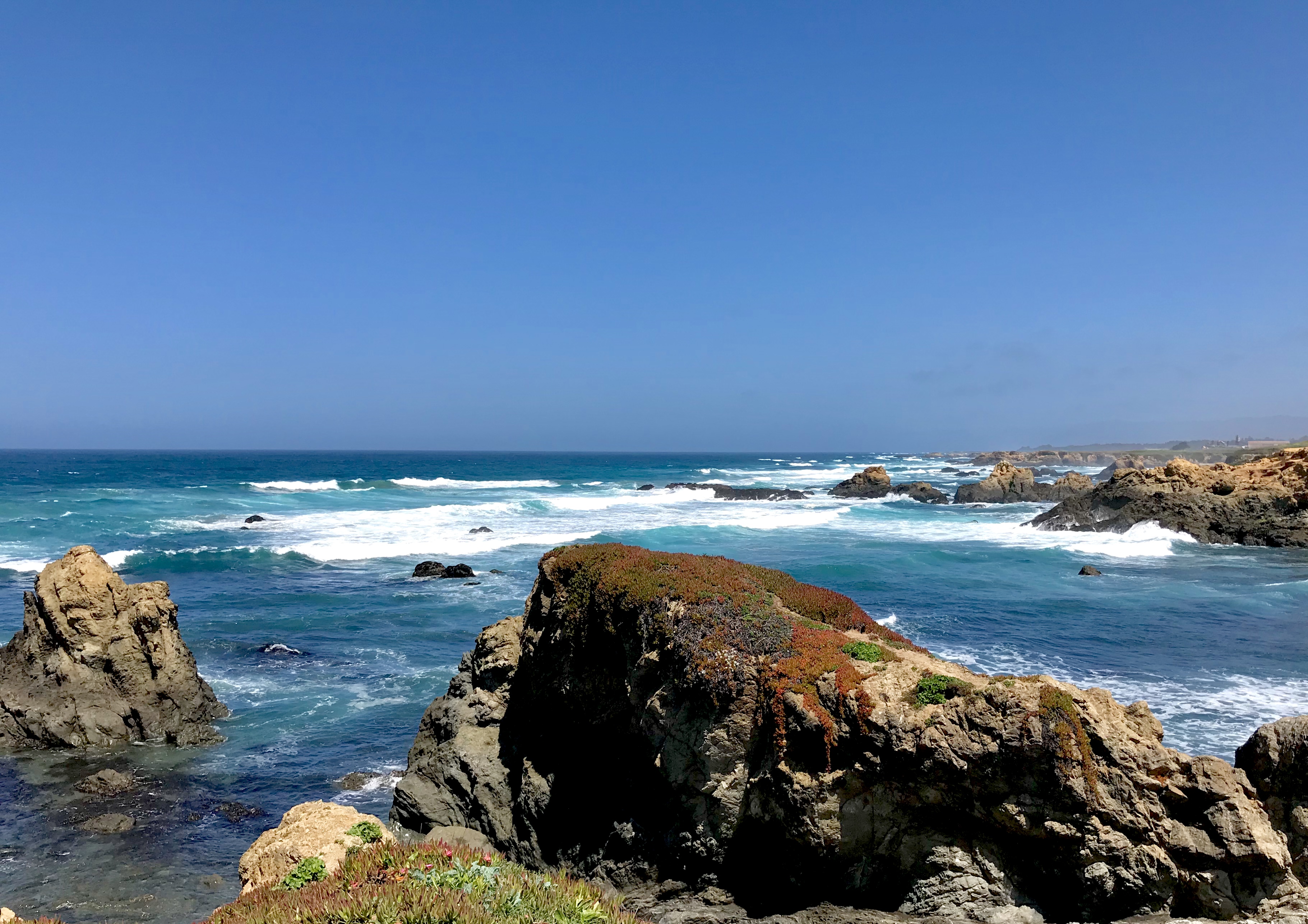
We stopped in Fort Bragg, where there is a famous bit of shoreline called Glass Beach. It is where, from 1949 to 1967, the residents of Fort Bragg dumped their solid scrap: appliances, vehicles, and famously, glass. The metal was carted away, but the glass, broken and shattered, remained, to be washed and polished by the waves of decades. Now, the beach is a curiosity, a mixture of sand, shingle, and myriad bits of glass, all rounded and polished.

If you want to visit Glass Beach, your online map will show you a trail—the Glass Beach Trail—out at the end of Elm Street.

This. Is. Another. Lie.

Technically, there is a “Glass Beach Trail” from the end of Elm Street to the shoreline, but it does not take you to the Glass Beach. It just takes you out to the shoreline somewhere north of Glass Beach.

While my wife rested in the car, I walked the Glass Beach Trail three times, sure I was missing something crucial. I walked it once, hit the shoreline, saw no Glass Beach, searched for some—any—signage, and finding none, returned to the trailhead. I tried a second time, wandering a bit north of the trail’s end, looking for a clue. Back at the trailhead, I found the “You Are Here” map and checked it. Glass Beach was a dot a tiny bit south of the trail end, with a staircase to descend the cliffside to the shore. I walked it again and wandered south. Still, no signs, no staircase, no Glass Beach. It was a beautiful walk, and a stunning section of coastline, but if you go, know that the actual Glass Beach is a quarter mile south of the end of the quarter-mile long Glass Beach Trail, and there are no signs directing you to your goal. After my third failed attempt, I’d burned too much daylight walking and head-scratching to allow for another mile’s walk, round trip, on sandy bluffs, so I abandoned the effort and we pressed on.

I wish we’d planned more time on this last section of the trip. Even one more day would have made it much more enjoyable, much less “under the gun.” However, I’d been duped by Google’s 5.75 hour drive-time “estimate,” which I took at face value, and we were committed to our itinerary (and our now non-refundable reservations).

We survived our last battle with CA-1 and connected with US-101 at Leggett. Wider, smoother, straighter, US-101 took us inland along the Eel River, through the majesty of the ancient redwood forests, and past natural wonders like Avenue of the Giants, the Drive-Thru Tree, and Trees of Mystery (actually, worth the visit), as well as more gimmicky roadside attractions selling evidence of Bigfoot and touting encounters with some sort of mysterious “vortex.”

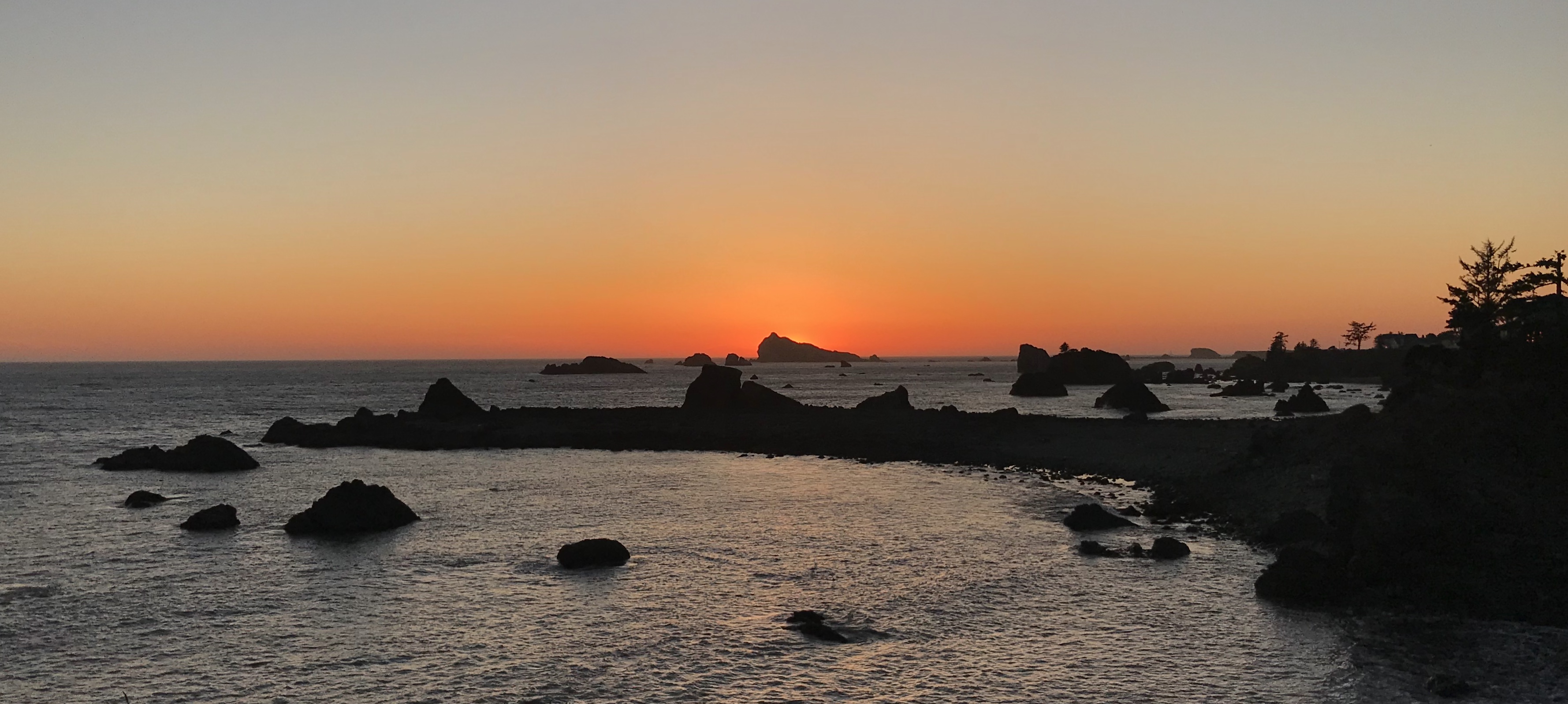
We did make it to Crescent City before the sun set, albeit barely. We had a few more days on the road, but those were more to visit friends than to enjoy the scenery, so this was, in essence, the end of our road trip. From here, we’d go to Lincoln City and Portland before heading home to Seattle.

By the end, we would have traveled over two thousand miles. My online map tells me it is a forty-hour drive.

This. Is. A. Lie.

k

(If you’re late to the party, no worries.
Here’s where you can find the posts on the Southbound leg,
and the Northbound legs Part 1 and Part 2.)

At this point, if I as a newly-minted sixty-something had learned anything, it was . . . well . . . that I was sixty-something.

In my early years, I could hop in the car and drive for days. Thousands of miles. Little to no sleep. Who needs motels? Just pull over, push the seat back, and catch a few winks. Dead simple. I once traveled 3,000 miles in six days on a whirlwind tour of the American Southwest, looping from San Francisco to San Diego to Tuscon to Canyon de Chelly to the Grand Canyon to Zion National Park to Las Vegas to Death Valley to Yosemite and back home, all in a two-cylinder Honda car with a dodgy clutch. Easy peasy. No sweat. (Okay, there was a lot of sweat—it was the desert—but you get my drift.)

But after our day of rest and exploration in San Francisco, as we were packing up for the next northbound leg, I had a revelation: I don’t like road trips as much anymore, at least not the kind where you drive all day, bed down for the night, get up, and do it all again. I’m much more into quality these days, not quantity. I don’t want to see as much as I can; I want to see what I see as fully as I can.

And that’s a big difference.

It’s not that I wasn’t enjoying the trip—I was enjoying it a lot—it’s just that I felt rushed, pushed, even cheated by our own itinerary. I was seeing so much, but didn’t have the time for that “deep dive” into the place, the people, the culture, the habits, the smells, sounds, and tastes of wherever we were when the car came to rest for the night.

However, lessons learned notwithstanding, today we were on a schedule, and our next stop was a fair ways up the coast.

What’s That Name Again?

Gualala.

Say it with me. Gualala. Gwah-LAH-lah. Fun, right? Well, after twelve hundred miles, we were a bit road-punchy, and we thought it was hilarious. Anyway . . .

Gualala is a little town—technically, not even a town, but an “unincorporated community”—on the Mendocino Coast. Back in high school, when my friend and I used to ride our bicycles up from San Rafael to the cabin his family had in Anchor Bay, Gualala was the town we called “Almost There.” It’s a tiny burg of two thousand souls situated at the mouth of the Gualala River (from the Pomo phrase for “coming down water place”). There’s not much to it: a couple of markets, a gas station, a hotel, a land office or two, some B&Bs, and dozens of homes perched over (or at least in view of) the magnificent rocky coast. Essentially, it’s either a retreat, or a place to pass through.

Or, in our case, to stop for the night.

History Revisited

Thirty-six years ago, on our honeymoon, my wife and I spent a week at that same cabin my friend had up in Anchor Bay, and as we passed through Gualala, my bride (through her Dramamine-induced torpor) pointed out her window and said, “Wha tha?” I looked at where she was sort-of pointing, and saw an unusual building. I had ridden by it many times on my cycling trips but, as it was Gualala and we were “Almost There,” I’d never given it much attention. (In my defense, after a 100-mile bicycle ride, one begins to lose interest in the scenery.) This time, though, being in a car and not on a fifteen-speed touring cycle, I slowed down and looked more closely.

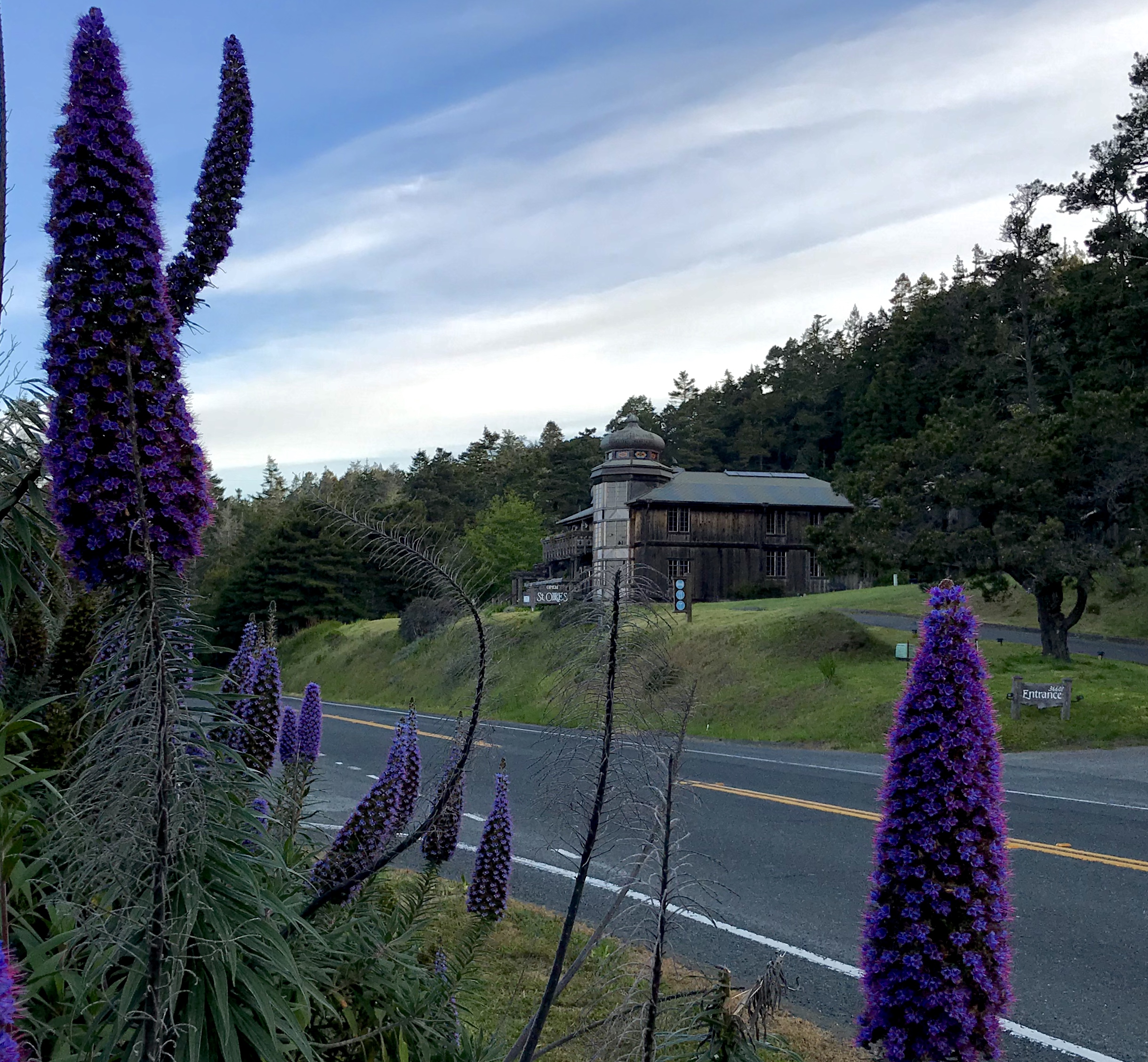
Built of dark, sun-scorched, unfinished wood, with turrets and onion-dome cupolas, it was a hotel/restaurant called St. Orres. While it was unique, beautiful, and rather interesting, this was my honeymoon and I had other things on my mind than inquiring further, so I tucked it away in my brain for future reference.

For our first anniversary, I remembered St. Orres and inquired. They had rooms with shared baths, and cottages for a more private getaway. I rented the best we could afford, which was two nights in their cheapest private cottage. It was wonderful and quirky and very 1980s California, with a small sitting room, a loft bed, bats chirping in the eaves, and an outdoor shower overlooking the coast.

With that as prologue, you can imagine that when I was planning this road trip (I’m the detail-guy, when it comes to itineraries), the realization that we’d be going back past St. Orres set off alerts in my brain. Were they still there? The interwebs answered: they were, and not only that, they had expanded a bit, too. How could we not go back? Having gotten into the “almost top drawer” groove, we opted for the room they called Black Chanterelle. When we checked in, I mentioned to the host that our last stay had been in The Wildflower cottage. “You’re going from the doghouse to the penthouse, then!” she told us, and she was right.

Unlike The Wildflower cottage of our previous stay, which was a simple one-gable affair, this place was built along the same designs as the main buildings: onion dome cupola, hand-fitted tongue-and-groove panels, massive redwood beams, airy, bright, and clean. It was sumptuous, but in a very Arts and Crafts style manner, where all the quality and expense was in the workmanship and raw materials, not in gold and filigree.

Sadly, the restaurant (which we remembered fondly for its stupendous food) was closed on Mondays, and this was a Monday. Since Gualala isn’t known as a foodie mecca, once again we opted for a bread, cheese, and wine dinner. We fired up the wood-burning stove, opened the doors to let in the birdsong, and enjoyed the serenity. In retrospect, seeing as we only had one night in that wonderful place, I’m glad the restaurant was closed.

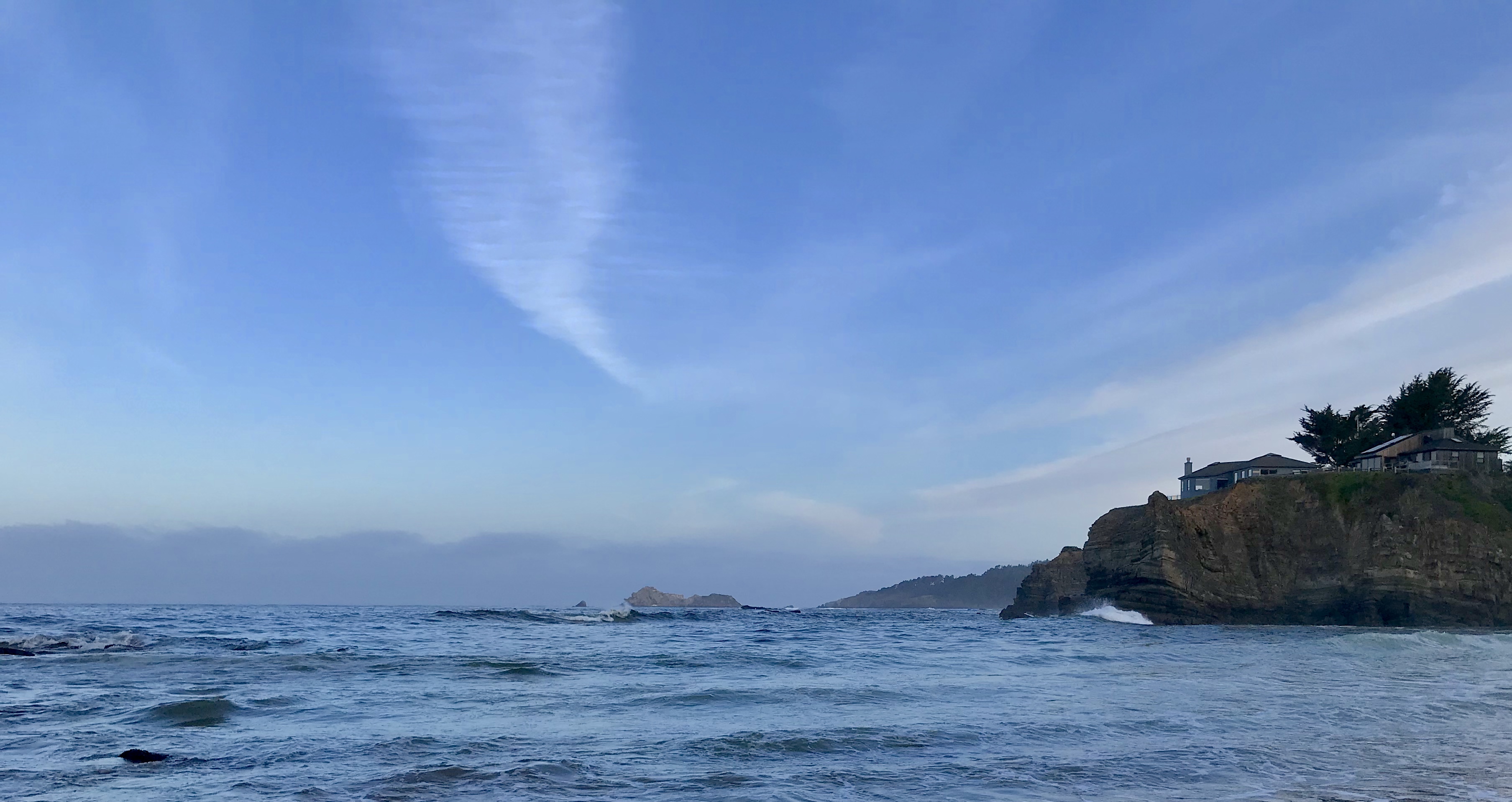
In the morning, I was up at dawn and decided to give my wife another hour of sleep while I went to explore the local beach. A short walk down to the road and a block along the highway brought me to the stairs and the trail down to a cove called Cooks Beach. It’s a small, sandy beach about the size of a football field, ringed by cliffs on which rest the aeries of the well-to-do. A creek tumbles down along the northern edge, and the place is littered with driftwood waiting to be stacked, and bracketed by rocky outcrops that await a beachcomber’s interest. It is a secluded and peaceful spot, where you will only find one or two other folks who have come down for a quiet moment by the ocean.

I’d be hard pressed to pick a favorite, between the quirky Art Deco motel in San Francisco and the masterful craft of St Orres, so I won’t. They’re too different—one urban, one rustic—and too wonderful, each in its own way.

We left, wishing for more, and vowing that it would not be another thirty-five years before we returned.

And the last two legs of our trip were going to be much more demanding, of time, and of stamina.

More later.

k

While the first section of our road trip north was one of discovery, the second section was focused on re-discovery.

My wife spent most of her youth in San Luis Obispo, down near where we started our northbound trek, but I grew up near San Francisco, as a fourth-generation resident of Marin County. I was born in San Rafael (the heart of “I Want It All Now” country), and received most of my education in Marin and San Francisco. My wife and I met in Marin, backstage at the ballet company where we both danced, and I courted her on from sides of the Golden Gate Bridge.

Since our wedding, though, we hadn’t spent any time in San Francisco, other than to pass through en route to see family. Thus, as part of this just-for-us quasi-top-drawer road trip, a few days spent in our old stomping grounds was a must. It was in scheduling this stay that I learned that my wife had never taken a ride on a cable car. You know how it is; you never do the touristy things in your own town, right? Well, now we were the tourists, and I was going to make damned sure she got her cable car ride. Continue Reading »

Driving the California coast on Highway 1 comes with challenges.

For most of its length, CA-1 is a narrow, undivided, two-lane road that climbs and descends as the topography demands (sometimes rapidly), hugging the often precipitous coastline with switchbacks, hairpins, and a gazillion good old twists and turns. Negotiating these requires a fair bit of concentration, especially when you’ve already put hours of them behind you, and still have hours of them to go. As hard as it is on the driver, though, it’s even harder on the passengers, as they end up as little more than ballast, tossed from side to side like Kirk and Spock on the bridge of the Enterprise during a Klingon attack. While I spent about 80% of my brain power trying to achieve the optimum balance between minimizing the turn-induced, stomach-sloshing G-forces and maximizing our velocity so that we might get to the hotel by the end of check-in time, my wife, whose superpower is the ability to sleep in damned near any moving conveyance, spent several nausea-limned hours regretting our decision to take this route.

Fortunately, the California coast provides ample excuses to pull over, give one’s innards a rest,  and enjoy the scenery. We found the first excuse fairly quickly. Continue Reading »