Feeds:
Posts
Comments

It’s Chaos. Be Kind.

I am a white middle-class sixty-something hetero male living in America. I am arguably the possessor of the highest level of entitlement in the less-than-billionaire world. I have lived my life in two of the bluest of blue demographic regions in the nation. I have never known any discrimination beyond those deserved by my own flaws.
I grew up, though, during an era of intense racial strife. My family and teachers brought the concept of civil rights into my young life. I learned that our nation had a history of treating people differently, based on how they looked. I learned that, though I did not personally feel the effects of prejudice, others in the world definitely did. I learned that the presumptions made about me were not necessarily made of others, if their skin was darker than mine, if their religion was different than mine.

And I was asked, did that seem fair?

It did not.

As I grew older, I discovered that it didn’t even matter if our skin was pale. If you were a woman, you could be treated differently, also as “less than.” Having been schooled by women, having been raised by women, this also did not seem fair.

But while I was able, as a teen ensconced in my bluish-ivory tower, to intellectualize all of this and say “Oh, yes, that is bad,” and, “That is wrong and we should work to fix that,” it took many more years before I realized that this unfairness, this prejudice, this smoldering (if not outright) racism and sexism, this misogyny, this antisemitism, this idea that pale skin imbued one with an inherent supremacy, imposed a level of stress and daily anxiety the like of which I had no concept. I had no idea what it was like to fear men on the street. I had no idea of what it was like for someone to take one look at me and decide my worth, my value, my humanity.

I did learn of it, though. It wasn’t a difficult assignment. All I had to do was open my eyes and pay attention for a brief period, because it was all there, easy to see if you simply looked around.

These days, though, it’s even easier to see. Now, you have to actively look away in order not to see it.

And many of us are doing just that.

If you aren’t, though … if you are paying attention and watching what is going on and seeing what is happening out there, in our nation, in our name, I ask you this:

Be extra kind. Take care to take care of those around you, be they neighbors or strangers or just folks in the checkout line at the grocer’s. People are on edge, and tempers are near the breaking point. None of us know what the person next to us in line has g0ne through today, or this week, or this month. They might be in pain, scared, angry as hell, and just barely holding it in.

It’s fucking chaos out there. So we need to be kind to one another. Just so we can all see tomorrow.

Together.

k

Sowing

this seed
on my fingertip
dark hard smooth
small as a gnat’s wing
shiny as a starling’s eye
is a kernel of hope
a dream undreamt
of warm sunshine
and cleansing rain
and to plant it
in this black loamy bed
heady with life
is to say a prayer
for food
for flowers
for beauty
for peace

Vignette 06Dec2025

This morning, I awoke surprised as last night, in my dream, I died, that fearful thing we were always told would mean we’d seen our last waking day. Yet here I am alive and telling my tale of how I dreamt that, after a struggle, I’d succeeded in my grand task, but failed to save myself.

I lay in a hospital bed. The room was bright, the machines beeped, but when the klaxons sounded I turned my head and saw the monitor’s lines go flat, its numbers tick down to zero. I know it was it I who watched, as I felt my conscious self hanging on for a few brief breathless moments as my candle guttered out. There was no sudden pain, no last struggle against the dark, or if there was, I was unaware as my form and I had already parted ways. I heard no celestial choirs, saw no flights of angels. What filled me as my vision faded was neither terror nor fear, not even anxiety.

I felt free.

Free. Released, unfettered, one final exhalation filled with serenity and peace, the struggle over, the grand task complete, a life, concluded. I wanted nothing after, did not pray for heaven, feared no hell. I was simply content to have loved well and done my best.

That’s it.
Love well.
Do your best.
Naught else is worth tallying.

New Eyes

the boy stood there as I drove by
staring at me as if
he’d never seen my like
and of course he hadn’t
for I was a new thing
the first of my kind
to him
and I thought

oh, please, give me those eyes
those new eyes
eyes that have not yet learned
to see the world
as pigeon-holed types
sorted and rendered into
a broad-brushed tonal pastiche

driving on I prayed
let me see things
in their wondrous uniqueness
not just as
a house a fence a woman walking her dogs
but as

this house
clad in bright happy greens
partnered by a particolored sweetgum tree
brass bright on its red door
mullioned windows glinting
in shafts of the morning’s autumn light

this fence
gap-toothed and silvered with age
mottled with lichen
bent by the storms of years
a ragged highway for squirrels
racing from yard to yard

this woman
bundled in her well-worn tweed
grey hair peeking out from under a magenta cloche
breath puffing like word balloons as she talked
to the tired waddling retriever his snout misted with age
to the jaunty-stepping shepherd that looked up to ask
am I a good dog today?

let me live in this real world
let me revel in this multifarious creation
let me see life as it is

give me new eyes
again

Today’s 4,000

rain, cold, and woodsmoke
a cottage in the deep green
homespun alchemy

Extensions

I do not recognize my hands, today,
hide-wrapped and rough,
fingers moving all as one, a unit lacking youth’s independence,
working like
a team of horses, fingers yoked in tandem,
brushing crumbs or combing hair,
reaching out
claw-like, deliberate, mechanical.

Gone is the fluidity
that typed like a piano etude,
that tested the strength of rain
fingers splayed, palm up to the lowering sky.

They seem, now, more like my father’s hands,
leathered, laced with welted scratches from thorn or cat,
thick fingers slightly curved, open,
as if holding the memories
of tools and wood and mugs and plates
and books and pens and paper
and forks and spoons
and a sweetheart’s hand.

They do not close as once they did,
so tightly that they could catch
my breath on winter days,
and when now they speak
in gesture they are
slow, brutish, leaving most
to context and implication.

And, of course, the pain they carry, that is new as well,
the constant reminder of dull aches,
the sharp-edged recriminations of grip and release.

I have always seen them, in many ways, as extensions of me,
strong and supple, quietly expressive,
nimble in deed and thought, switching with ease
from fountain pen
to computer keys,
from kitchen knife
to garden tool,
from dovetail jig
to a viola’s strings
to my true love’s hair.

This still is true, I suppose, as they and I both are
a good bit older, a dash more tired,
content to spend time in restful contemplation.

We still do all the things we used to, only
with a mindfulness that comes from
a slow paring down of life from what we need
to what we desire
to do, to feel, to create.

Perhaps I do not recognize them
because I do not know who I am,
in this time.

Perhaps they are teaching me.

Clever hands.

Let’s learn together.

Eureka!

As regular visitors are aware, I have a strong perfectionist streak. My sister and I both struggle with it, but I couldn’t tell you if it is nature or nurture that infected us with this scourge. (As with most things, probably a mixture.) Neither of us would ever say that we are perfect, or even that we were close. Perfection, as I’ve often said, is unattainable, but that does not make my inner compulsion to achieve it simply disappear. It does, however, drive me batty.

But I may have found a cure. At least one that shows promise.

When I think about perfectionism, I have to recognize that it is all about control. Control (whether it be of input or environment or technique) and outcomes. And those outcome must be measurable, so they might be compared to the ideal and thereby be found wanting. Naturally, some things lend themselves more readily to this kind of rigor. Maths and engineering, for example, are much easier to control and evaluate. Skills, too, are easier to measure; whether you’re building a cabinet or shooting an arrow, it is clear to see whether the corners are square or the bullseye was hit. When you wander into the more artistic realms, though . . . that’s when it gets sticky. What is a perfect performance of a Bach partita? What is a perfect novel? What is the perfect lasagna recipe?

Trying to achieve perfection in an artistic endeavor is—let me be blunt, here—just plain stupid. And yet, it’s what I’ve tried to do for sixty-odd years. I cannot shake it. I cannot not try to do it perfectly. That partita, that novel, that recipe, I’ve tried, over and over again, to do all of them, without error, without flaw, but each time, be it my fingers, my prose, or my mastery of timing and materials, I have failed and every result has been, well, imperfect. There’s always something, whether I stumble on the high notes, or my books sell like shite*, or there’s a burnt bit on the corner of the dish.

But there’s one thing that all these activities have in common: they don’t fight back. That perfect iteration, that flawless performance, it is out there in the Platonic ether, taunting me, and the only thing keeping me from it is . . . me. My skill. My technique. My concept.

Quite recently, however, I have discovered something of a different nature. An artistic endeavor, to be sure, and something I’ve contemplated (and been warned away from) for a long time, since boyhood, to be honest. It is a creative outlet that is unpredictable, nearly impossible to control, capricious, fickle, and headstrong. Outcomes can be damaged due to environmental variables. Errors quickly become irreparable. And speed in creation is absolutely essential. In short, all the makings of an artistic disaster.

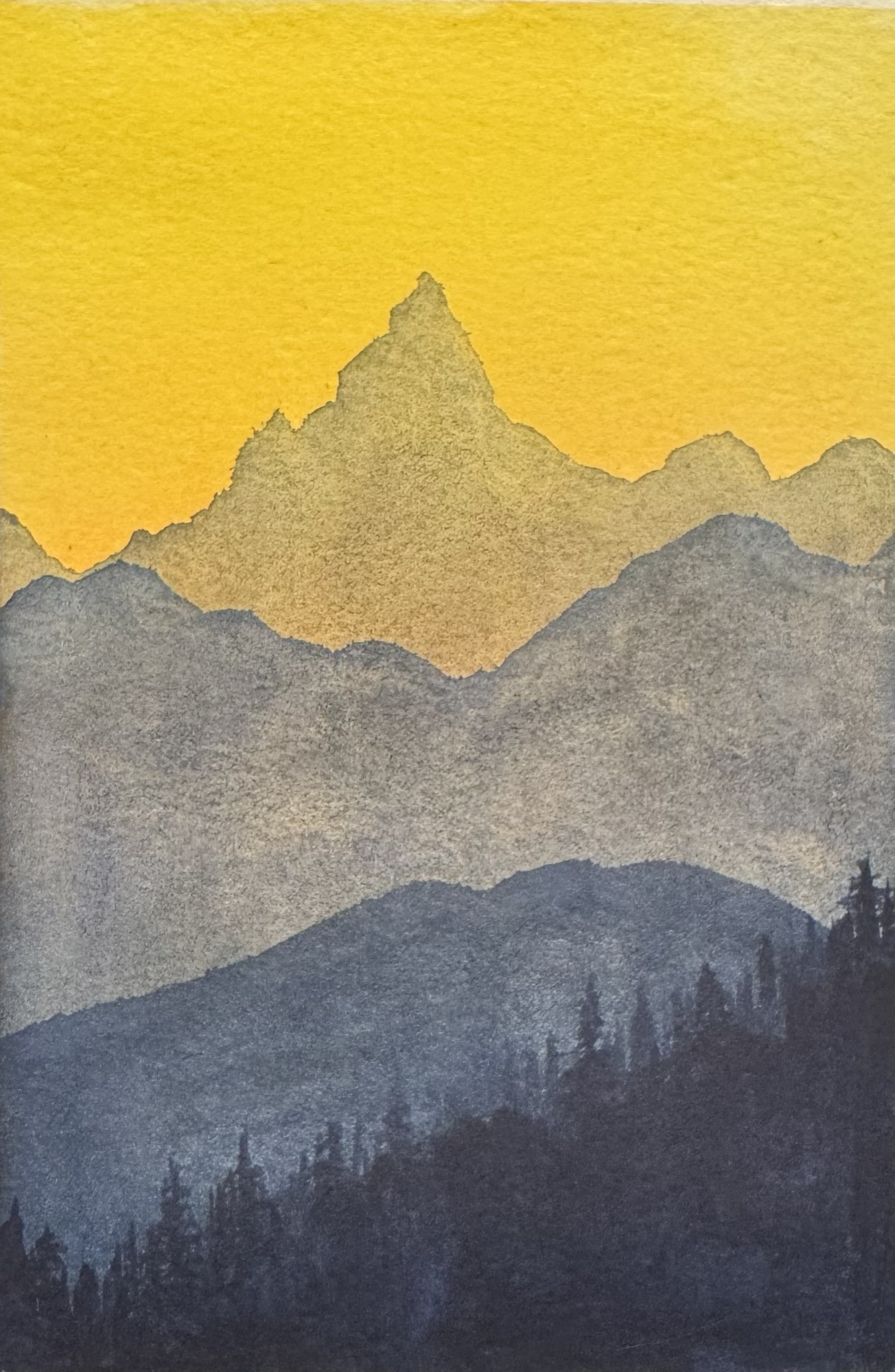
Allow me to present: watercolors.

Yeah. Watercolors. Like those collections of pre-fab paints we had as kids (because they were easier to wash out of our clothes). Those watercolors.

My father was an artist. Some of my earliest memories are of him in his studio, perched on his high wrought-iron chair, the air hazy with the scents of linseed, turpentine, and pipe tobacco. He was a graphic artist by trade, a lithographer by profession, but at home he sketched in pencil and charcoal, and painted in oils. His workplace was a controlled chaos of books on anatomy and art, of canvases stretched and rolled, the whole dominated by a large ink-stained drafting table near the door and an easel further into the room. I remember watching him working on a particular painting, scooping up gobs of titanium white with his palette knife to create an impasto sun over a southwestern desert, saying how much he liked painting in oils because “I can always scrape it off and start over. Not like watercolors. Watercolors do not forgive.”

And they don’t.

My journey in watercolor painting is only a couple of months old, but already I have learned, first-hand, exactly what my father meant. For as long as I work toward mastery of watercolors, for as long as I attempt to control the medium, they will fight me, with every step, every brushstroke. I will never learn how to succeed as a watercolorist. I will only learn how to fail less often.

And that, my friends, is my cure for perfectionism.

Find something that cannot be mastered, something that cannot be controlled but only cajoled, entreated, encouraged to give you what you want. And I don’t mean only watercolors; it could be anything, from raising orchids to fly fishing to coaching Little League. By falling in love with something that will not be controlled, in order to improve, I am the thing that must change, not only by learning to adapt to the quirks and whims of the thing, but by accepting the thing with its quirks and whims, and yes, even because of them.

I will never be a master watercolorist, but having spent just a few brief weeks playing with the medium, learning about it, seeing what it can (and cannot) do, I know that I do not want to be a master watercolorist. I do want to know more, do more, acquire more skill so that I can at least approximate on paper the pictures that I envision, but I know I will struggle to achieve even those modest goals.

Which, to be clear, is my intention. I want to be imperfect, and to be happy with that imperfection. To strive. Not to master. To accept. Not to control.

I only have so many summers left here, and I do not care to waste them dancing to the perfectionist’s tune.

k

*Just a grateful shout-out here, to those who have read my books, including the two people who recently ripped through the Fallen Cloud Saga (Yes, my sales are that low). Thank you, and I hope you enjoyed the books enough to recommend them to others.