Feeds:
Posts
Comments

Posts Tagged ‘perfectionism’

Our doubts are traitors, and make us lose the good we oft might win, by fearing to attempt.
— William Shakespeare, “Measure for Measure”

I’m sitting in my office. Behind me is my jury-rigged drafting table. This has gone through many iterations and re-dos. Today, it comprises a worktable, the leaf from an old gateleg table (attached to the front with hinges), a random block of cedar (to prop up the far edge and create a slope), and two thin strips of basswood clamped near the bottom edge of the slope with spring clamps (to keep the art-board with paper from sliding off the slope). On the bookshelf beyond rests one pint glass with brushes, and another with a palette knife, toothbrush, and other tools. A makeshift collection of drawers sits to one side, with various media, drawing implements, pastels, tubes of paint, sponges, and miscellany. To the other side is a small shelf with tape rolls, paper towels, tissues, and rags. The bookshelf holds a variety of thick cotton papers, in rolls or pads or blocks. In the closet is more paper, in a portfolio, to accommodate their large size. All of these items have been moved around at least three times, and modified (and sometimes unmodified) in several ways.

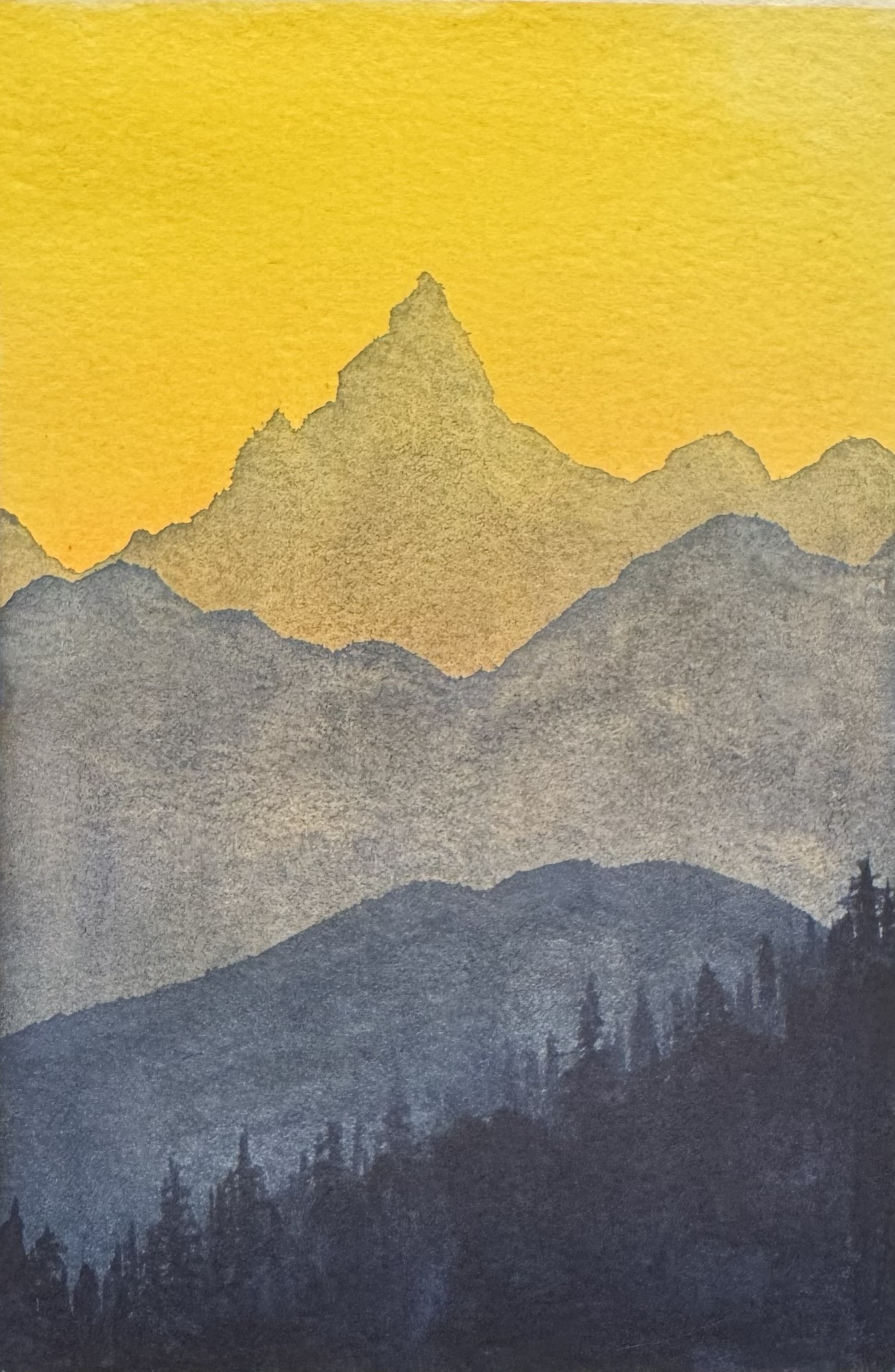
This spring, after a brief flurry of initial activity and experimentation with watercolors, I had to stop as the pain in my dominant hand was too much and my control with it was too weak to use it for painting. Then I had to wait until autumn for the surgery that would eliminate the problem. And now, after months away, I am approaching watercolors again. I have, however, been procrastinating, focusing on the studio furnishings and painting paraphernalia than with actually putting pigment on cotton. I’ve been crab-walking around the activity for weeks, thinking about restarting, but always finding something else that needed my attention.

Why? Because now I know how hard this is. Now I have seen the expertise required to paint what I want to paint.

And I doubt—

Aye, there’s the rub. I doubt that I will be able to develop the requisite skill set, so I’m using this predetermined outcome to fashion sufficient justification not to start in the first place.

Self-sabotage. Vicious cycle.

Then, about a week ago I realized, I’ve been here before, and I’ve gotten through it, with writing, with poetry, with music, with watch repair. But how? How did I get through it? I didn’t take notes. For the past few days I’ve been letting those questions steep, and today an answer arrived: Change the goal.

It’s easy to see, in retrospect. I simply aimed too far, like “over the horizon” far. That’s daunting (on a good day), and can overwhelm you with its seeming impossibility. So I need to change the goal, rein in the target. Maybe I can achieve enough skill to paint in a looser style, or with abstract designs. Let’s rein it in more. I could just paint small things in isolation—elements of a scene—rather than a big complex landscape. Or even further. How does watercolor pigment work on this brand of paper versus that, when the paper is damp versus dry, with the table flat versus sloped?

I am almost there in the process. I’m still reining it in, but I actually picked up a brush yesterday, and today I reviewed some tutorials to remind me of what is possible.

Baby steps.

k

PS. Special thanks to Dame Sarah Spring, who shone a bright light on the quotation above, which made me rethink many things.
Read Full Post »

Eureka!

As regular visitors are aware, I have a strong perfectionist streak. My sister and I both struggle with it, but I couldn’t tell you if it is nature or nurture that infected us with this scourge. (As with most things, probably a mixture.) Neither of us would ever say that we are perfect, or even that we were close. Perfection, as I’ve often said, is unattainable, but that does not make my inner compulsion to achieve it simply disappear. It does, however, drive me batty.

But I may have found a cure. At least one that shows promise.

When I think about perfectionism, I have to recognize that it is all about control. Control (whether it be of input or environment or technique) and outcomes. And those outcome must be measurable, so they might be compared to the ideal and thereby be found wanting. Naturally, some things lend themselves more readily to this kind of rigor. Maths and engineering, for example, are much easier to control and evaluate. Skills, too, are easier to measure; whether you’re building a cabinet or shooting an arrow, it is clear to see whether the corners are square or the bullseye was hit. When you wander into the more artistic realms, though . . . that’s when it gets sticky. What is a perfect performance of a Bach partita? What is a perfect novel? What is the perfect lasagna recipe?

Trying to achieve perfection in an artistic endeavor is—let me be blunt, here—just plain stupid. And yet, it’s what I’ve tried to do for sixty-odd years. I cannot shake it. I cannot not try to do it perfectly. That partita, that novel, that recipe, I’ve tried, over and over again, to do all of them, without error, without flaw, but each time, be it my fingers, my prose, or my mastery of timing and materials, I have failed and every result has been, well, imperfect. There’s always something, whether I stumble on the high notes, or my books sell like shite*, or there’s a burnt bit on the corner of the dish.

But there’s one thing that all these activities have in common: they don’t fight back. That perfect iteration, that flawless performance, it is out there in the Platonic ether, taunting me, and the only thing keeping me from it is . . . me. My skill. My technique. My concept.

Quite recently, however, I have discovered something of a different nature. An artistic endeavor, to be sure, and something I’ve contemplated (and been warned away from) for a long time, since boyhood, to be honest. It is a creative outlet that is unpredictable, nearly impossible to control, capricious, fickle, and headstrong. Outcomes can be damaged due to environmental variables. Errors quickly become irreparable. And speed in creation is absolutely essential. In short, all the makings of an artistic disaster.

Allow me to present: watercolors.

Yeah. Watercolors. Like those collections of pre-fab paints we had as kids (because they were easier to wash out of our clothes). Those watercolors.

My father was an artist. Some of my earliest memories are of him in his studio, perched on his high wrought-iron chair, the air hazy with the scents of linseed, turpentine, and pipe tobacco. He was a graphic artist by trade, a lithographer by profession, but at home he sketched in pencil and charcoal, and painted in oils. His workplace was a controlled chaos of books on anatomy and art, of canvases stretched and rolled, the whole dominated by a large ink-stained drafting table near the door and an easel further into the room. I remember watching him working on a particular painting, scooping up gobs of titanium white with his palette knife to create an impasto sun over a southwestern desert, saying how much he liked painting in oils because “I can always scrape it off and start over. Not like watercolors. Watercolors do not forgive.”

And they don’t.

My journey in watercolor painting is only a couple of months old, but already I have learned, first-hand, exactly what my father meant. For as long as I work toward mastery of watercolors, for as long as I attempt to control the medium, they will fight me, with every step, every brushstroke. I will never learn how to succeed as a watercolorist. I will only learn how to fail less often.

And that, my friends, is my cure for perfectionism.

Find something that cannot be mastered, something that cannot be controlled but only cajoled, entreated, encouraged to give you what you want. And I don’t mean only watercolors; it could be anything, from raising orchids to fly fishing to coaching Little League. By falling in love with something that will not be controlled, in order to improve, I am the thing that must change, not only by learning to adapt to the quirks and whims of the thing, but by accepting the thing with its quirks and whims, and yes, even because of them.

I will never be a master watercolorist, but having spent just a few brief weeks playing with the medium, learning about it, seeing what it can (and cannot) do, I know that I do not want to be a master watercolorist. I do want to know more, do more, acquire more skill so that I can at least approximate on paper the pictures that I envision, but I know I will struggle to achieve even those modest goals.

Which, to be clear, is my intention. I want to be imperfect, and to be happy with that imperfection. To strive. Not to master. To accept. Not to control.

I only have so many summers left here, and I do not care to waste them dancing to the perfectionist’s tune.

k

*Just a grateful shout-out here, to those who have read my books, including the two people who recently ripped through the Fallen Cloud Saga (Yes, my sales are that low). Thank you, and I hope you enjoyed the books enough to recommend them to others.

Read Full Post »

Regular readers know that I battle with perfectionism. It chides me for what I’m not doing, and berates me for what I have done. Perfectionism is both a goad and a hindrance, in equal measure, and believe me, it’s bloody exhausting.

One of my recently acquired mantras is, “If you’re not changing something, then your essentially okay with it,” and since I’m definitely not okay with my perfectionism, I’ve been working to find ways to suppress it altogether, circumvent the hurdles it places in my way, or at least ameliorate its nastier effects.

Enter the Shakers. (more…)

Read Full Post »

Le crayon rougeThe epiphany hit me when I finished Wednesday’s New York Times crossword puzzle.

Epiphanies are like that, showing up at odd times, all unexpected-like. (more…)

Read Full Post »

It's a Trap!Last week, my wife had her 60th birthday.

So, naturally, I’ve been thinking about dying.

In the past few years, life has changed. My wife and I have buried three of our four parents, making me thoroughly cognizant of my own mortality and the fact that I will, someday, end. As a result, I’ve been reevaluating … everything … from relationships with friends and family to the mental gymnastics that, while I’ve been doing them my entire life, are merely bad habits left over from an insecure childhood.

Enter should. (more…)

Read Full Post »