Feeds:
Posts
Comments

Extensions

I do not recognize my hands, today,
hide-wrapped and rough,
fingers moving all as one, a unit lacking youth’s independence,
working like
a team of horses, fingers yoked in tandem,
brushing crumbs or combing hair,
reaching out
claw-like, deliberate, mechanical.

Gone is the fluidity
that typed like a piano etude,
that tested the strength of rain
fingers splayed, palm up to the lowering sky.

They seem, now, more like my father’s hands,
leathered, laced with welted scratches from thorn or cat,
thick fingers slightly curved, open,
as if holding the memories
of tools and wood and mugs and plates
and books and pens and paper
and forks and spoons
and a sweetheart’s hand.

They do not close as once they did,
so tightly that they could catch
my breath on winter days,
and when now they speak
in gesture they are
slow, brutish, leaving most
to context and implication.

And, of course, the pain they carry, that is new as well,
the constant reminder of dull aches,
the sharp-edged recriminations of grip and release.

I have always seen them, in many ways, as extensions of me,
strong and supple, quietly expressive,
nimble in deed and thought, switching with ease
from fountain pen
to computer keys,
from kitchen knife
to garden tool,
from dovetail jig
to a viola’s strings
to my true love’s hair.

This still is true, I suppose, as they and I both are
a good bit older, a dash more tired,
content to spend time in restful contemplation.

We still do all the things we used to, only
with a mindfulness that comes from
a slow paring down of life from what we need
to what we desire
to do, to feel, to create.

Perhaps I do not recognize them
because I do not know who I am,
in this time.

Perhaps they are teaching me.

Clever hands.

Let’s learn together.

Eureka!

As regular visitors are aware, I have a strong perfectionist streak. My sister and I both struggle with it, but I couldn’t tell you if it is nature or nurture that infected us with this scourge. (As with most things, probably a mixture.) Neither of us would ever say that we are perfect, or even that we were close. Perfection, as I’ve often said, is unattainable, but that does not make my inner compulsion to achieve it simply disappear. It does, however, drive me batty.

But I may have found a cure. At least one that shows promise.

When I think about perfectionism, I have to recognize that it is all about control. Control (whether it be of input or environment or technique) and outcomes. And those outcome must be measurable, so they might be compared to the ideal and thereby be found wanting. Naturally, some things lend themselves more readily to this kind of rigor. Maths and engineering, for example, are much easier to control and evaluate. Skills, too, are easier to measure; whether you’re building a cabinet or shooting an arrow, it is clear to see whether the corners are square or the bullseye was hit. When you wander into the more artistic realms, though . . . that’s when it gets sticky. What is a perfect performance of a Bach partita? What is a perfect novel? What is the perfect lasagna recipe?

Trying to achieve perfection in an artistic endeavor is—let me be blunt, here—just plain stupid. And yet, it’s what I’ve tried to do for sixty-odd years. I cannot shake it. I cannot not try to do it perfectly. That partita, that novel, that recipe, I’ve tried, over and over again, to do all of them, without error, without flaw, but each time, be it my fingers, my prose, or my mastery of timing and materials, I have failed and every result has been, well, imperfect. There’s always something, whether I stumble on the high notes, or my books sell like shite*, or there’s a burnt bit on the corner of the dish.

But there’s one thing that all these activities have in common: they don’t fight back. That perfect iteration, that flawless performance, it is out there in the Platonic ether, taunting me, and the only thing keeping me from it is . . . me. My skill. My technique. My concept.

Quite recently, however, I have discovered something of a different nature. An artistic endeavor, to be sure, and something I’ve contemplated (and been warned away from) for a long time, since boyhood, to be honest. It is a creative outlet that is unpredictable, nearly impossible to control, capricious, fickle, and headstrong. Outcomes can be damaged due to environmental variables. Errors quickly become irreparable. And speed in creation is absolutely essential. In short, all the makings of an artistic disaster.

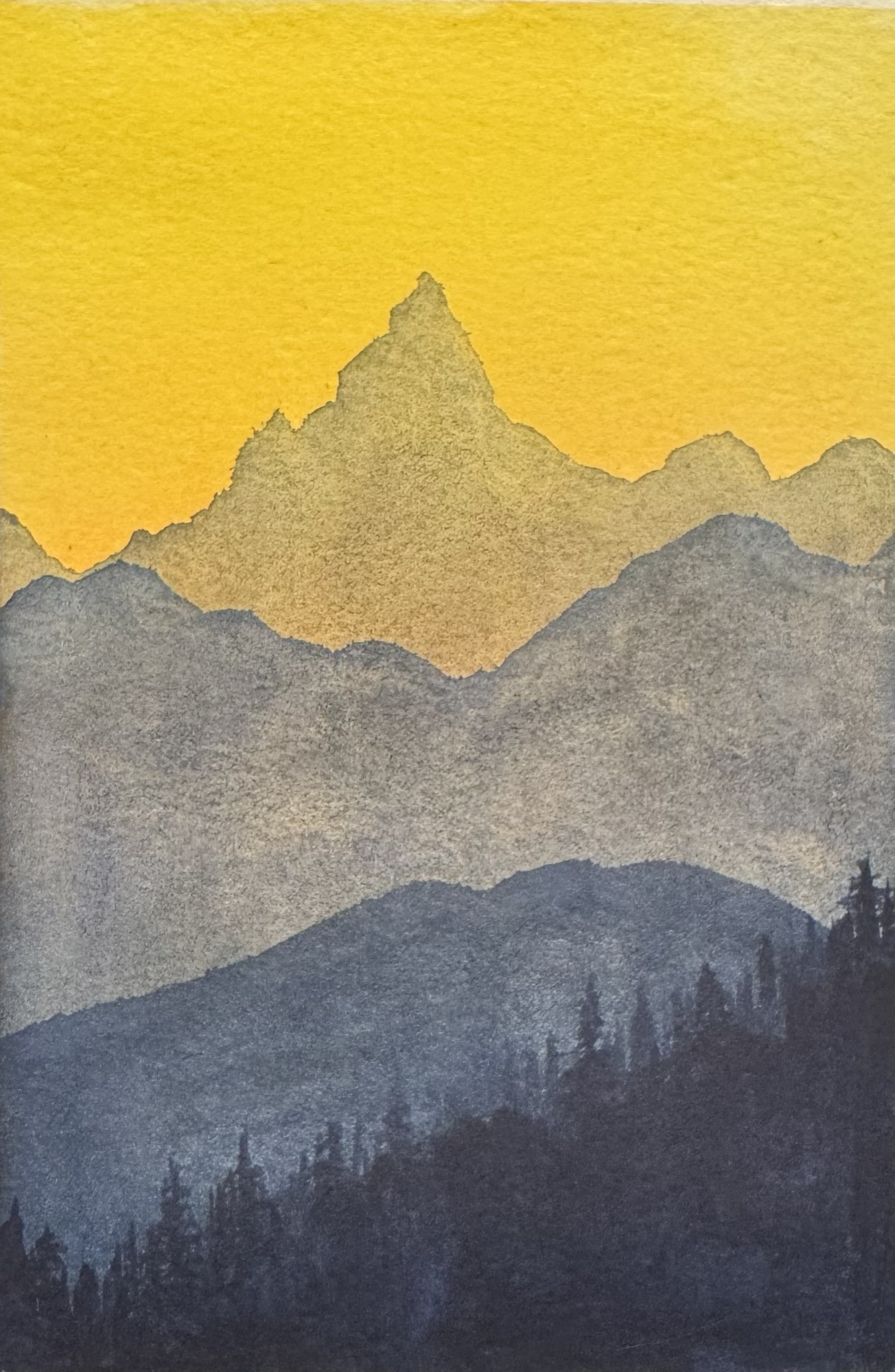
Allow me to present: watercolors.

Yeah. Watercolors. Like those collections of pre-fab paints we had as kids (because they were easier to wash out of our clothes). Those watercolors.

My father was an artist. Some of my earliest memories are of him in his studio, perched on his high wrought-iron chair, the air hazy with the scents of linseed, turpentine, and pipe tobacco. He was a graphic artist by trade, a lithographer by profession, but at home he sketched in pencil and charcoal, and painted in oils. His workplace was a controlled chaos of books on anatomy and art, of canvases stretched and rolled, the whole dominated by a large ink-stained drafting table near the door and an easel further into the room. I remember watching him working on a particular painting, scooping up gobs of titanium white with his palette knife to create an impasto sun over a southwestern desert, saying how much he liked painting in oils because “I can always scrape it off and start over. Not like watercolors. Watercolors do not forgive.”

And they don’t.

My journey in watercolor painting is only a couple of months old, but already I have learned, first-hand, exactly what my father meant. For as long as I work toward mastery of watercolors, for as long as I attempt to control the medium, they will fight me, with every step, every brushstroke. I will never learn how to succeed as a watercolorist. I will only learn how to fail less often.

And that, my friends, is my cure for perfectionism.

Find something that cannot be mastered, something that cannot be controlled but only cajoled, entreated, encouraged to give you what you want. And I don’t mean only watercolors; it could be anything, from raising orchids to fly fishing to coaching Little League. By falling in love with something that will not be controlled, in order to improve, I am the thing that must change, not only by learning to adapt to the quirks and whims of the thing, but by accepting the thing with its quirks and whims, and yes, even because of them.

I will never be a master watercolorist, but having spent just a few brief weeks playing with the medium, learning about it, seeing what it can (and cannot) do, I know that I do not want to be a master watercolorist. I do want to know more, do more, acquire more skill so that I can at least approximate on paper the pictures that I envision, but I know I will struggle to achieve even those modest goals.

Which, to be clear, is my intention. I want to be imperfect, and to be happy with that imperfection. To strive. Not to master. To accept. Not to control.

I only have so many summers left here, and I do not care to waste them dancing to the perfectionist’s tune.

k

*Just a grateful shout-out here, to those who have read my books, including the two people who recently ripped through the Fallen Cloud Saga (Yes, my sales are that low). Thank you, and I hope you enjoyed the books enough to recommend them to others.

Xbox is at a crossroads, and one major speed bump in their path seems to involve their Game Pass subscription service. Two major price increases over the past few years have caused many to reevaluate our priorities. Myself included.

To refresh memories: I’m a sixty-something Boomer who plays video games. I’ve been a consistent Xbox player, and partook in regular multiplayer sessions with my Saturday Night Massacre Posse for about twenty years … until my retirement last year. I do have a PS4 console, because … Horizon Zero Dawn … but Sony was never been my gaming “home.” Rather, I was a long-time Xbox Gold membership holder and, when it became cost-effective, a Game Pass and then Game Pass Ultimate subscriber.

Even when the SNM Posse was active (so named, because that was when my day-shift gaming window overlapped with my fellows’ graveyard shift availability), we generally played only a few games on the regular. Rainbow Six, Gears of War, Borderlands, Destiny, Ghost Recon, Halo, Sniper Elite—primarily FPS or TPS style titles—these were our Go-To games, played predominantly in co-op mode (we weren’t an overly competitive posse). Sure, we’d feather in the occasional platformer or isometric or soulslike title, but they came and, after a few months, they went. And we played hard. We’d start after dinner and would go late/early, often until 0300 hrs. It was a stretch for me, but worth it, as the banter alone (plus the challenge of keeping up with my much younger fellows) was great fun.

Post-retirement, though, the SNM Posse just dissolved. Since I’m not one for playing with strangers—I can’t keep up with twenty-something’s twitch-muscle reaction times, and won’t put up with the crude and too-often offensive language that passes as “repartee”—this meant that my need for a multiplayer service had come to an end. Yet, Game Pass Ultimate offered so many games, including some “Day One” titles I knew I’d enjoy (Borderlands 4 and Outer Worlds 2, to name a couple of recent additions), so I continued with my subscription.

Then, this fall, Microsoft jacked up the Game Pass Ultimate subscription rate by 50%, from $20/month to $30/month, or $360/year (what? you want a discount for paying for a whole year in advance? who do you think we are? HBO? LOL!).

As outlined above, I do not burn through video game titles. I don’t play a game for a few hundred hours in a single month and then move on to the next shiny new title. I don’t consume eight, twelve, twenty titles in a given year. Even if I include the small indie titles I play, I might go through six games in a calendar year. Is that worth $360/year? Even with the now-standard $70 price for a Day One AAA game, is it worth it?

Nope. It ain’t. And I suspect a lot of gamers are working this math the same way I have.

I will probably play three, at most four AAA titles in a year, and if I wait a bit, I’ll pay a discounted portion of that $70 list price. I can pick up a handful of indie games at anywhere from $5 to $15, if they get good reviews and the gameplay matches my likes. I still have my Xbox account, should multiplayer opportunities arise, but I’m not depending on it. There are so many older RPG/FPS/TPS titles out there, games I’ve never even tried, there’s no reason to pay such an exorbitant subscription price (especially if I have to save up for a new console!).

Video games used to be a unifying activity. It was something that bridged the age gap between myself and the younger folks I knew. With people struggling to make rent and buy groceries, and with the costs of gaming increasing by 20, 50, 60%, it’s losing its broad-based demographic in favor of a more affluent customer base.

Sometimes I wonder if Microsoft really gets gaming.

To Persist, Resist

don’t give in to the maelstrom’s song
the downward spiral toward denial
of what your bones know is righteous or wrong

don’t let the harmonies that sing in your blood
go quiet and numb, muffled and choked
by the unfeeling actions of criminal hearts

there’s so much so much this onrushing tide
of gleeful cruelty and polished-brass venality that
to think of nothing to jettison hope can seem the softer path

but love dies when hearts go silent
and despair takes root when tears dry up
numbness saves no one not others not us

so let the feelings come seek them out
lean in and swim with the building wave
shout out rise up and take the beachhead

for this is a fight we dare not lose

With Paper Before Me

with paper before me and
a pen in my hand
a cloud is
rising blooming billowing scudding
cumulus nimbus a thunderhead
dark foreboding airy bright

with paper before me and
a brush in my hand
a cloud is
gradients reflective limned
shadowed grey sunlit white
rounded flat-topped

with paper before me and
nothing in my hand
a cloud
is


What I Want to Hear

Republicans are blaming the Democrats for the shutdown and, following the standard congressional “I’m rubber, you’re glue” playbook, Democrats are blaming the GOP in turn. That’s a weak, schoolyard response, and I’m sick of that game. Here’s what I want to hear from Democrats:

“You’re goddamn right we’re responsible. We are shutting this shit-show down, using every tool we can muster, using the power of the minority (just as you have done so many times over the years) to obstruct, to delay, to thwart, to frustrate, to discomfit, to drive a wedge between y’all and your base, to amplify our voice and blast our message, and our message is this: We will not be complicit!

“We will not be complicit in making health care unaffordable for millions by raising premiums and cutting services (and don’t trot out that bullshit lie about us wanting to provide health care to undocumented immigrants, because you know folks need an SSN to apply for Obamacare, and the undocumented, by definition, don’t have one).  People are having a very tough time, right now, and we won’t help you make it worse. We won’t. You’ll have to sit down with us. You’ll have to take the damned meeting. You’ll have to negotiate. You’ll have to fucking govern instead of strutting around like a bunch of mooks in cheap suits running a protection racket.

“Moreover, we will not be complicit in supporting your destruction of our society. We won’t support this rogue militia you’ve created out of ICE and CBP, a force that rappels from BlackHawks down into American cities to round up people indiscriminately, en masse, without warrants, destroying property, terrorizing communities, citizens and immigrants, adults and children alike. No. We won’t.

“We’re not going to just stand by and wring our hands and think back fondly on gentler times while you erode our most basic rights. No, JD, we’re not going to be ‘civil’ in the face of your incivility, we’re not going to be silent and meek when one of the tenets of our founding documents enshrines our freedom to tell you that you’re wrong and we’re right and why.

“And we’re not going to just bite our tongues when you call everything an ‘emergency’ so you can raise the cost of goods with tariffs, withhold funding appropriated by law, extort businesses and universities into silence, prosecute individuals because they made you look bad, and slap the ‘terrorist’ label on anyone exercising free speech.

“No. We’re not. We’re going to shut this down, and we’re going to do it loudly and unapologetically. We’re going to make governing this nation as difficult as possible until you come to the table, sit down, and negotiate. We are doing this because of the real and lasting harm you are perpetrating against our nation. We are doing this because we fucking can, and because the American people need someone to protect them, to look out for their needs, their health, and their lives.”

That is what I want to hear. That is what I think we need to hear.

k

Birthplace

I was born of Pacific waters
bathed in their colors of stone and sky
swam their frigid swells and troughs
to return awakens my heart’s connection
to walk the firm yet yielding sand
to wade knee-deep through the rip
to comb a fiver’s worth of unbroken dollars
to have my ankles caressed by sea foam
to greet the sunrise and kiss the sunset
to hear my father’s words echo
“Never turn your back on the ocean”
though I do, if only to see my world
as the ocean views it
a dark forbidding challenge
to its unparalleled power
the Pacific is the edge of my existence
it flows in my veins
it nourishes my soul