Feeds:
Posts
Comments

Posts Tagged ‘books’

AI; the grift that keeps on grifting. Feed it, press a button, and (in the immortal words of our president) “Bing Bong Bing,” there you have it: AI slop.

It’s everywhere, now including your bookshelf. If you’re not careful, that is.

And we weren’t.

We wanted to read Robert Reich’s new memoir, Coming Up Short, so we went to the Evil Empire (aka Amazon) and searched. “What format?” was the question. Hardcover, Paperback, Kindle, or Audio? Paperbacks are easier on our ancient hands, so that’s what we picked. And there was our first error. I did not see the red flag, did not twig that this was a new release, available in both Hardcover and Paperback? That never happens. If you get a hardback deal, publishers aren’t going to undercut that with a simultaneous paperback release. Sadly, all we saw was the reduction from the hardcover price (expected in a paperback), so we dropped that turd into our cart and hit the checkout.

My bad on that score.

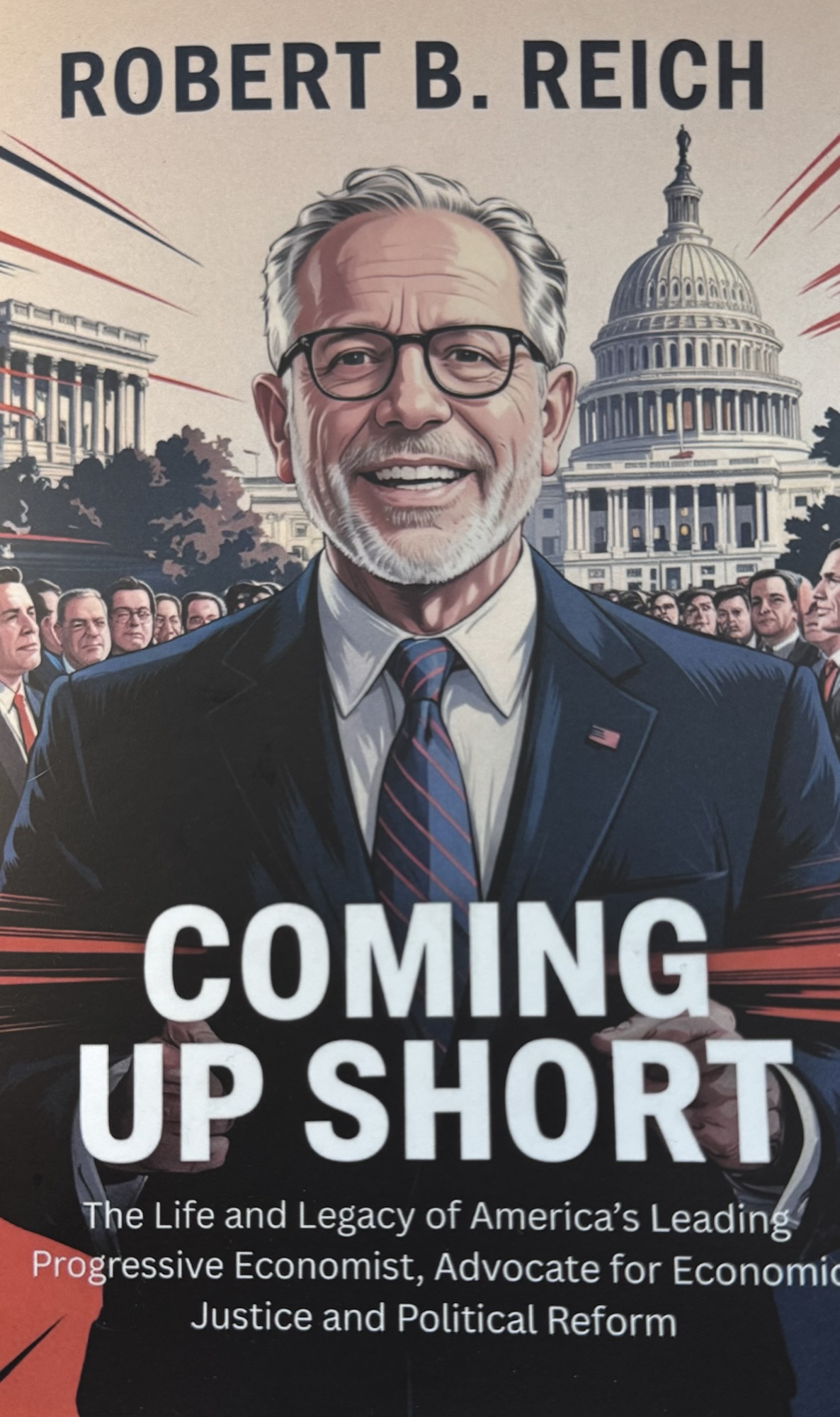
When the book arrived, it was (as my wife described it) like opening a door to an alternate universe. I was coming up the stairs as she first viewed our purchase, and all I heard her say was, “….the hell?” The cover (pictured, right) was unlike anything we’d ever seen on a new release from a major publisher. It was also about half the thickness of a major release (150 pp vs the 400 pp of the hardback).

….the hell? Indeed.

What we had purchased was a bunch of AI slop.

Someone—definitely not Shem Grant, the named author of this tripe, whose magnum opus has now been de-listed from Amazon—fed a bunch of open source info into an AI chatbot, had it spit out enough slop to fill the 150 pages required to give it a spine, slapped a cartoonish rendition of its subject on the cover, and voila, instant grift. I’ll admit, I’ve not read this “product,” but in skimming through I found it repetitive, composed much like a high schooler’s book report, and rife with errors (within three minutes I fact-checked two: Reich was born in Scranton, not New York, and he was a Rhodes Scholar, not a Marshall Scholar).

Yup . . . AI slop.

Is this a thing? I wondered. Heading back out to Amazon, I executed similar searches for new memoirs and found similar AI-generated knock-off versions:

  • Jacinda Ardern’s A Different Kind of Power had half a dozen slop versions
  • Liz Cheney’s Oath and Honor had a few grift versions, plus about a dozen “workbook” editions
  • Kamala Harris’ 107 Days had fifteen (!) “books” that included the phrase “107 days” in their title, all by “authors” who had no other titles to their credit

In addition to these obvious attempts to con buyers by piggybacking similarly titled slop onto the sales of new releases, there were many self-styled “biographies” that had dubious authors, were listed as “independently published,” and often had obviously AI-generated covers (some that were really bad, and I mean like embarrassingly bad).

So, this stuff is out there, and there is a lot of it.

Remember when self-publishing became a thing? Remember how everyone wrung their hands over that? “There’s already enough crap out there in the book-sphere, and now everyone who can hold a pencil is going to think that they’re a writer!”

Hehe. Good times, eh? Because now, not only can anyone with enough grip strength to hold a pencil pose as a writer, but all those who are too lazy to even pick up a damned pencil are able to churn out utter rubbish, slap a fake name and an SEO-optimized title on it, send it into the Amazonian jungle to sting the unwary, reap the grift, and move on.

It’s enough to make one want to give up.

But, lesson learned. Once burned . . . .

k

Read Full Post »

Having been pleasantly surprised by my recent re-read of a sci-fi/fantasy series I’d loved as a teen, I decided to extend this run of good luck and re-read another series that was influential to my own writing style (when I eventually got one).

I first crossed paths with Roger Zelazny’s works—both short form and long—in high school. It was before I’d read much fiction at all, and thus I did not have a lot of knowledge to bring to the experience. Despite this lack (or perhaps because of it), Zelazny’s stories and novels stuck with me, shaping my appreciation of the written word from then on. Zelazny was one of the triumvirate of authors who influenced my youthful enthusiasm for fiction, along with grandmasters Anne McCaffrey (a major influence, I discovered last week) and, of course, Ray Bradbury.

Each of these authors drew a different type of appreciation from me. McCaffrey’s prose was not what stayed with me, but rather her characters and their relationships, which were crucial to the workings of her plots. In considering Bradbury, I admit that none of his novels stuck with me, but his short fiction! Oh, what magic I found there. The books that collected his short works in a thematic whole—The Illustrated Man or The Martian Chronicles—were treasure boxes to read and re-read.

Roger Zelazny, though, held a special place in my pantheon, and not just because he was the only one of the three I actually met. Back in the ’70s, I didn’t have the breadth of experience to understand what I so enjoyed about his works, but yesterday, as soon as I began his Nine Princes in Amber, I could pinpoint it precisely. Where McCaffrey’s prose was straightforward, and Bradbury’s was as near to poetry as one can get in prose, Zelazny’s writing has a distinctive “voice,” matched to the mind of the character, and integral to the tenor of the storyline. As I began this book, I heard echoes of Hemingway, of Chandler and Hammett, along with the flow and descriptive power that was Zelazny’s own. That “voice,” that touch of the hard-boiled detective, was a crucial element of the character in that opening chapter—Corwin, a man out of space and time, without memories, must navigate a dangerous world filled with people bent on his demise. It was all fedoras and noir on silver nitrate and razor-sharp repartee and chiaroscuro lighting until, amazingly, subtly, color crept into the world along with Corwin’s recovered memories, and the “voice” shifted as well, matching again the mindset of the Corwin’s evolution.

I was lucky enough to meet Mr. Zelazny in the early ’90s, after I’d made my first professional-level short story sale. It was at a sci-fi convention here in Seattle, and I was trying to learn as much as I could about the craft, and meet as many “pros” as I could (a terribly difficult task for an introvert like me), but I’d been met with nothing but condescension and rudeness from nearly every established writer I approached. But I put that aside as I’d come primarily because Zelazny was a featured guest. I’d heard him read from his forthcoming book (A Night in the Lonesome October), and I’d brought my limit of three books for him to autograph (my beat-up vintage copies of the two-volume Amber omnibus and a dog-eared paperback copy of Four for Tomorrow).

Having been scorched by other authors at the convention, I expected a perfunctory meeting at the signing table, but I was determined to let Mr. Zelazny know how influential his works had been on my own nascent attempts as a writer. Instead of just signing my old books and moving on with a nod, he asked if I was submitting my work; I said yes, and that I’d been in a recent issue of a small professional magazine. He knew the magazine, actually had back issues, and wrote down my name so he could look up my story. After all the bristles and cold-shoulders I’d received that weekend, a kind word from a writer so important to me was a gift dearer than rubies. Did he really have back issues of a small-run magazine? Was he really going to read my story? I don’t know; he might have merely been encouraging me, a gentlemanly gesture to a budding young man who had kept three of his books safe and secure for a score of years. Still, I like to think he might have.

Reading these old favorites again, though, now with my older, wiser eyes, I feel the old desire to craft words renewed. I want to finish reading all of these titles I’ve pulled from the stacks, but after that . . . after that, I think I have work to do.

k

Read Full Post »

A friend asked the hive-mind for book suggestions—preferably science-fiction/fantasy/speculative fiction—to flesh out her summer reading list and (naturally) she got more titles than she could probably read in a year. I tossed in one title I’d read recently; it was less “spec-fic” and more what I’d call “magic realism,” but I had found it delightful and passed the title¹ along.

In perusing the suggestions from others, I saw a mix of genre classics along with (what I assumed were) newer titles. I used to read nothing but sf/f novels—they were my introduction into fiction, back in the late ’60s/early ’70s—but over time, for reasons (painful or practical), I drifted away from the genre, and have zero experience with many of the newer authors.

There was one particular suggestion, however, that caught my eye, It was a title² of which I’d not thought in decades, even though I adored the series when I was young. I was in my teens when the books were first published and I devoured them, thankful there was only a year between release dates.

In recent years, I’ve occasionally gone back to re-read some old favorites, but that proved a dicey proposition. At sixteen, seventeen, I had no comprehension of—much less appreciation for—writerly things like structure, characterization, world-building, foreshadowing, allusion, or pacing. If you gave me a brisk plot and a compelling reason to turn the page, I was all yours. Going back to those old, familiar titles led, more often than not, to disappointment. Clunky dialogue, predictable plots, heavy-handed setups, wooden characters, and banal prose were common, and that’s before considering the rampant sexism and gender dynamics of the period.

But, oh, I did so love these books, this series, this world. So I gave the first in the series a try.

What I found within shocked me.

It’s not that it is bad; far from it. Yes, the author has some annoying (to me) quirks, and is inordinately fond of multi-syllabic adverbs, but the characters are full and distinct, the world has a long and detailed history that affects the current action, the social structure is coherent, strong with rituals and patterns, and there is humor and passion and drama and risk aplenty.

What shocked me, though, were the echoes I recognized between these books and my own. Understand, between the time I read these books and the time I began writing fiction, two decades had passed. When I was writing my own books, I never thought back on these titles, not for inspiration, not at all.

And yet, as I re-read these old books, I see in them the seeds of the worlds I have built. From the psychic connections along ley lines in “Spencer’s Peace” and my Ploughman Chronicles, to the bonding between riders and walkers in The Fallen Cloud Saga, to the convolutions of time travel in Unraveling Time, here in these books lie the kernels from which my own books grew. These books, this series, they are my source, my wellspring.

All writers, I believe, are influenced by the writings of others. We’re all, as Stephen King once said, like “milk in the fridge,” picking up flavors from whatever we’re near, accreting reverberations from the artistry of those we admire. But to find so many thematic origins in one place, well, it’s like finding a loved one, long-lost, long-forgotten.

I’m exceedingly glad I took a chance on these old friends, and I will definitely read the six or seven titles that I read when I was a boy. I feel a need, after this difficult year, for an infusion of youthfulness and hope, and these books, for me, flow with those gifts.

k


¹ The Lost Bookshop, by Evie Woods
² Dragonflight, by Anne McCaffrey, first in the Dragonriders of Pern series

Read Full Post »

There is something special that happens, something ephemeral and transitory, when I approach the end of a good book. It can go one of two ways: I either rush headlong toward the conclusion, driven forward by a thirst for the sweet wine of revelation and release, or I hold off, pacing my approach, lingering over what has come before whilst imagining, wondering, whetting my hunger for the last few chapters. It is a magic, specific to books, this control, this opportunity to choose.

When we watch a movie, the pace is set for us, as we experience the timing, the focus, the framing decisions of director, cinematographer, and editor. The Pause button is analogous, but a weak shadow, often used merely to grab a nosh, hit the loo, or tend to a load of laundry in the dryer. One does not pause a film in its approach to a climactic scene merely to reflect on all the scenes that have come before.

But with a novel, we are the director, we frame the shots, and we flesh out the rooms and towns and landscapes—sketched by the author—with costumes and onlookers and paths of our own fashioning. In a book, we are the collaborators, assisting the author in their work. We bring the words to life in our mind’s eye, and in the case of a well-written book, it is a joy, this work, this journey, so as the pages tick past, from recto to verso, as the end-papers grow nearer, we must choose: race ahead? or slow-walk our way to the last page?

(For those of you who read the ending of a book first, no judgment—okay, a little judgment—but I think you’re missing out on one of readings truly great pleasures. That’s not to say I’ve never read a book that didn’t go along swimmingly only to have a massively sucky ending, but I’ve only thrown a handful of books across the room for that reason, so for me, knowing the ending ahead of time would ruin far more than it would preserve.)

The decade past, my fiction diet has been lacking. The ongoing stresses of work, coupled with what I perceive as the slow (and now much more rapid) deconstruction of our national norms, left my brain ill-equipped to concentrate sufficiently on a novel. The run-up to retirement was anything but stress-free. Disappointingly, the first year of retirement was likewise fraught with unexpected challenges, from dealing with new insurance carriers to a cancer scare to dealing with large household projects and more. So, my first year as a retiree was not just me, lying in my hammock, a novel in one hand and a wee dram of whisky in the other.

Since my recent non-diagnosis, however, I’ve redoubled my efforts on the fiction reading score, and once more I find myself in the delicious dilemma described above. I purchased several books that were on sale, titles and authors about which I knew nothing, the sale decision made solely on the strength of the blurb, and so far I have two titles on this year’s list of Books Read. One turned out to be a mystery, and I found myself wholly absorbed as I read to the conclusion; the other was a surprisingly twisty bit of magic realism, and for that my pace slowed, savoring the last chapters.

I plan to foster this renewed joy of reading books, physical books, in the months (and years) to come. It used to be that I never walked anywhere, stood in any queue, or waited for any bus without having a book in my hand. I took a book with me from room to room, catch a page or two while the tea water was heating, or read a chapter before sleep. I’m hoping that, like riding a bike, these habits will return, that the tablet I have been carrying with me everywhere is exchanged for a dog-eared paperback with a tattered receipt as a bookmark. It’ll take some effort, but I suspect it’ll be worth it.

k

Read Full Post »

  • “Top 10 Reads for the Summer”
  • “The Best Games of 2023, Ranked”
  • “Twelve Items Every Pantry Must Have”
  • “5 Movies You Need to See”
  • “Seattle’s Best Restaurants”

There is no scarcity of voices eager to tell us what to do, what to like, what is good. “Listicles” abound, plastered with headlines shot through with words like “Best” and “Ranked.” But, “Best” according to whom? Who decides how these things are “Ranked?” Not me, for sure. Probably not you, either. But here’s the thing:

  • I’m enjoying a book my friend didn’t like.
  • The music I’m listening to is probably not on your playlists.
  • I loathe brie cheese.
  • A well-maintained and -manicured lawn is my idea of a crime against nature.

In other words, my tastes are different than yours, and yours are different than mine. And that’s okay.

My tastes in music, books, and cuisine aren’t better than anyone else’s. Yes, I was trained as a musician, have written novels, and have taught myself to be a better cook, but my personal likes and dislikes in these areas aren’t better. Obviously, they have been influenced by what I’ve learned, but they’re not better. “Better” presumes there is some Platonic ideal against which all others are found lacking, and while this might work for some objects, when it comes to things like sandwiches, it’s useless. There is no “best” sandwich. There’s just your favorite kind of sandwich. And there’s mine.

“Bestseller” doesn’t mean “best,” and it damned sure doesn’t mean you’ll like it. Neither do awards, kudos, upvotes, likes, retweets, or some stranger’s rankings.

Where there are quantifiable characteristics that can be evaluated, let’s compare and discuss them; we might learn something, see something we never saw before, and possibly modify our opinion. But when we’re dealing with the unquantifiable, when we’re talking about basic visceral likes and dislikes, we just need to chalk it up to personal preference.

I’ll enjoy what I enjoy, and you do the same. I won’t think less of you because you love brie cheese (though I may wonder how you manage it).

In short, I don’t want to yuck your yum.

k

Read Full Post »

I get rid of things

gadgets that lie unused
plants that don’t thrive
clothes that no longer fit

I discard, donate, sell
from pasta makers to cars
wanting the unusable gone
wanting the usable used

Better a new owner
a new set of hands
to work them
a new set of eyes
to value them
than the darkness
of my understairs storage

Except for books

I get rid of things,
but books are not things

Books
read and unread
are hopeful promises
treasure maps of the mind
histories yet unknown
friends unmet

I will spend my remaining years
inhaling their aroma
hearing the rustle of their leaves
taking them in
adding them to the thing
that is me

k

Read Full Post »

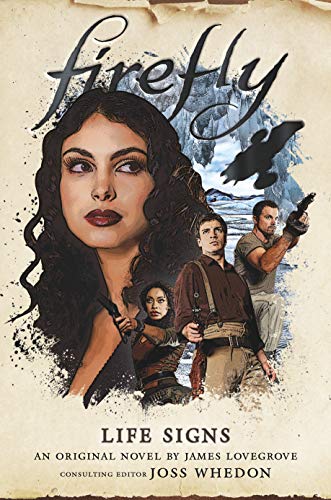
It may surprise some, considering past reviews posted here, that I deigned to read James Lovegrove’s Firefly: Life Signs, his fourth volume in the ongoing Firefly series, but I did.

I haven’t been shy with my disappointment in Lovegrove’s past entries (as seen here and here). In fact, my disappointment was so great that I didn’t even bother to review his third book in the series.

Thing is, though, it’s Firefly. I adore the show, the characters, the setting, the language. I’m a Browncoat for life, so I couldn’t not read it.

The book released just prior to this one, Generations, by Tim Lebbon, was an exceedingly pleasant change from Lovegrove, so it was disappointment layered upon disappointment when I learned that yet another Lovegrove entry was on the schedule. (FYI: the next in the series is not a Lovegrove title so, fingers crossed.)

With all that as prologue, I’m sure you’re asking: Why the hell is he reviewing this one?

The answer is two-fold.

First, Life Signs deals with a crucial bit of the Firefly canon: Inara’s terminal illness. As fans of the show, we knew about this part of Inara Serra’s planned story arc—plans cut short by the show’s abrupt truncation—so a novel that deals with that is worth exploring.

Second, this one wasn’t as bad as Lovegrove’s previous work. In fact, for most of its length, it was quite readable. (If you’re thinking I’m damning him with faint praise, that’s not my intent.)

The book is not without issues, but let me start with what works.

As Lovegrove demonstrated in previous books, he is able to evoke the pattern and rhythm of the Firefly ‘verse without reverting to caricatured patois. Rather than peppering us with g-less gerunds (e.g., fightin’ and stealin’), he leans more on the syntax and the language, which makes the dialog—and there’s a lot of it—much more readable. Once we read a few phrases like “I reckon . . .” and “Seeing as how . . .”, the g-less gerunds follow without us having to stumble over all those apostrophes. In other words, here, less is definitely more.

Moreover, his dialogue is exceptionally well-paced, which is good because, as stated, there’s a lot of it. Lovegrove successfully runs scenes of banter between three or four characters with ease, giving us just enough clues as to keep us straight on who’s talking without slowing things down. And though (once again) we have someone monologuing in the midst of a crucial action scene, this time it occurs during a brief lull so, while it’s not the optimal time for someone to explain their backstory, at least it’s not with bullets are whizzing by their heads.

The plot, while wholly improbable—and let’s face it, if you have an issue with improbable plotlines, you’re not a Browncoat anyway—is also straightforward: Inara is sick, and terminally so, but there’s a sketchy doctor who might be able to help, only, ruh-roh, he’s been incarcerated on a prison planet. (I’m not telling you anything that isn’t in the publisher’s blurb.) As expected, hijinks ensue.

The characters—canon and new—are pleasantly fleshed out. With the established characters, Lovegrove goes beyond what the series established, developing them and giving us emotional content that simply must be there, given the plot. (In this, I feel for the bind any author of these books must be in; the novels take place between the Firefly series and the movie Serenity, so with those as bookends, there’s only so much you can do.) For the characters specific to this novel, Lovegrove gives us sufficient context to understand the why of their actions, which was also a nice surprise.

However . . .

I’ve complained of this before, but Lovegrove is not great at world-building. I admit, it’s a pet peeve of mine, and it will not bother many (possibly most), but when (on the first half-page) I read of an alien world that has cicadas singing in the mesquite trees, well, that just seems a tad lazy to me. Even if we stipulate that it was a barren rock that’s been terraformed, who in their right mind is going to bring mesquite seeds and cicada larvae across interstellar space? This laziness permeates the book as much as any of his others. [sigh]

Past the first few pages, though, Lovegrove hit his stride, and I sped through the book. Some of this was illusory, however, as most of the chapters were only two or three pages long, meaning that, with a half-page for chapter header and a half-page (or more) for break to the next chapter, there’s a lot of white space in the book. Well, it’s one way to make your book a page-turner, I guess.

There are clunky bits of writing, mostly due to his use of adverbs. I’m not averse to using adverbs, in general, but Lovegrove often commits Classic Error #2, using esoteric or tongue-tying adverbs. Mostly, it’s fine, but when I hit three words like “despairingly,” “understandingly,” and “languorously” within a single chapter (did I mention how short most of the chapters are?), my mental Adverb-Overload switch flips and I need to put the book down until I reset.

Sadly, though, it’s in the climactic final sequence where Lovegrove (as usual) face-plants. If this was a one-off issue, I would grimace, make mention, and move on, as I did in previous reviews of his work, but this has now happened in every Lovegrove book in the series: to wit, he shows either a stunning disregard or an unforgivable ignorance of how things work, whether it be scientifically*, practically**, or (in this case) both. I mean come on! Doesn’t Titan Books hire editors? Shameful, mostly because they are fixable errors.

In summary, did I like it?

It’s a quick and mostly fun read with a stumbling start and a flawed finish that deals with a crucial part in the life of a beloved Firefly character, so . . . yes, I liked it, in spite of itself. And I will grudgingly (see? adverbs) recommend it to fans of the Firefly ‘verse. It has the standard Lovegrove issues, but it did pull me in for most of its length and, at times, touched my heart.

k

*Newtonian physics and the laws concerning conservation of kinetic energy are tossed out the airlock as Lovegrove misapplies the Kessler syndrome (which deals with space debris travelling at high speeds in low-Earth orbit) to pieces of space junk that are stationary relative to one another. A nudge from Serenity on one rather small piece of space junk would not cause a cascade that makes every other piece of space junk, including much larger pieces of junk, fly about like billiard balls on a pool table.

**In every aircraft (and, presumably, spacecraft capable of atmospheric flight), the steering yoke adjusts roll and pitch, the rudder pedals control yaw, and the throttle controls the thrust. Anyone who has flown a plane, played a flight simulator, or hell, just been relatively observant when watching film of someone doing the same, knows that if you pull back on the yoke, the plane goes up, and if you push it forward, the plane goes into a dive. In no aircraft does pushing forward on the yoke make it go faster; that’s the throttle. Different thing. Again, where are the editors here?

Read Full Post »

Older Posts »