 I’m going to kick the poo-pile here, so stand back.
I’m not even going to start with a caveat or a disclaimer.
“Trigger warnings” are ridiculous.
I’m going to kick the poo-pile here, so stand back.
I’m not even going to start with a caveat or a disclaimer.
“Trigger warnings” are ridiculous.
Posted in Books, Culture | Tagged books, literature, nanny state, Oberlin, trigger warnings, UCSB | 1 Comment »
 Change is not “good.” We just say that to put on a brave face. The fact is that change is neither inherently good or bad. Change, like the universe, is neutral.
Change just is.
There have been a lot of changes around my house in the last 24 months. In that time, my wife and I have lost three of our four parents. Big change. Also during this period my wife discovered Facebook and, as a result, our social circles have widened and multiplied. Change, also pretty big from my POV. And, for the past several months we’ve had a houseguest, a young person whose life blew up while visiting us, and whom we’re helping get reestablished. Epic change.
In other words, my home life, my level of social interaction, and my private world have all undergone dramatic and fundamental transformations. And it’s made me a bit stroppy.
Yes. Stroppy. Look it up. Continue Reading »
Posted in Culture, Writing | Tagged creative writing, novel writing, quiet living, the writing life, Writing, writing techniques, writing tips | 6 Comments »
hands reveal
ash-streaked eyes
smudged and sullen
like an old cloth
worn thin
wiping up
sooty tears

bluE eye by StopPanicIsJustMe
Posted in Writing | Tagged creative writing, Poetry, Writing | Leave a Comment »

My brother is an old-school kinda guy.
My brother has a lot going for him.
And I think he’s on to something. Continue Reading »
Posted in Culture, Hi Tech, Low Tech | Tagged low-tech living, plugged in, quiet living, smartphone, social media, tech diet, unplugged | 5 Comments »
 Yesterday, I started and then deleted no fewer than six posts. My mind was fragmented by circumstances and events, leaving me unable to concentrate on anything.
I started posts on the usefulness of writing conventions, on the reasons for using a pseudonym, on office “open” floorplans, on my reputation as an arrogant bastard, etc., etc. I tried repeatedly, but could not cohere my thoughts to a single subject long enough to form a reasonable discourse.
What was going on? Continue Reading »
Posted in Culture, Food | Tagged cooking, modern life, quiet living, Serenity | Leave a Comment »
 What do a fork, a model of a ship, and a priest’s right eye have in common?
No, they’re not props from a horror movie.
They’re all objects discussed in Neil MacGregor’s book, Shakespeare’s Restless World: A Portrait of an Era in Twenty Objects.
As readers of this blog know, I have a bit of a fascination with Shakespeare, so this book is right in my wheelhouse. The subtitle gave me a general idea of what I was getting, but what I didn’t expect was such a fascinating overview of life in the late Elizabethan/early Jacobean periods.
Neil MacGregor, Director of the British Museum, takes a disparate collection of 16th century objects–ranging from the everyday to the unique–and gives us a chapter on each one. Naturally, he describes each object, its history, its use, and its provenance, but this is all expected content. The lavish photos of the objects themselves (as well as related items) are clear, detailed, and beautiful, but each chapter really shines when MacGregor expands the discussion beyond the basics, showing us the social context of each item. Through MacGregor’s clean, unhurried prose, we learn what each object might have meant to the average groundling in the pit or noble in the tiers. An apprentice’s cap, for instance, looks simply like a cap to us, but if you were one of the Queen’s subjects on the streets of London in 1600, it would tell you of the wearer’s social standing, might remind you of the apprentice-led riots over food prices. Later, when you went to The Rose or The Curtain to see Coriolanus, and saw the cap-wearing citizens berating Menenius over the high cost of corn, you would remember those riots, and know that things might get very ugly, very quickly.
The list of objects MacGregor has chosen is, as I mentioned, varied. He discusses a fork used to eat sweetmeats in the same detail and depth as he does the model ship used as a token, built in thanks by James I for his safe passage home from abroad. Each object is inspected both as a thing from within Shakespeare’s world–i.e., as relates to his plays and the world of the theater–as well as within his world at large. In reading this book, I learned a great deal about the lives and the mindsets of Shakespeare’s patrons, high-born and low, but also expanded my understanding of the period and its conflicts.
This book was of great interest to me, as you might expect, but I wholeheartedly recommend it to anyone interested in history, the history of objects, and the tumultuous, change-filled period of late Elizabethan/early Jacobean England.
Oh, and that priest’s right eye?
Get the book.
k

Posted in Books | Tagged book review, british museum, elizabethan england, history, neil macgregor, Shakespeare | Leave a Comment »
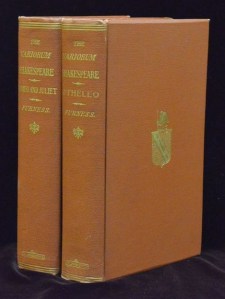
Lippincott Editions of Furness’ Variorum
Claire Bloom once told me that if I was serious about Shakespeare and acting, I must read the Shakespearean variorum. Through the variorum, she said, I could delve into the language and gain better understanding of its history and deeper meaning.
I took this advice to heart, despite the fact that I’m not an actor.
And the fact that I didn’t know what a variorum was.
And the fact that she wasn’t actually talking to me, specifically.
Yes, on rare occasions I take things celebrities say rather more personally than they were intended, such as when Sir John Gielgud gave me advice on friendship. To put your mind at ease, when I do this, I do it in a completely non-“I see you when you’re not looking,” non-“unbalanced creepy stalker” type way.
Honest.
Trust me.
Anyway… Once Ms Bloom told me this, I immediately went in search of a “variorum,” whatever it was. Continue Reading »
Posted in Books | Tagged acting, Claire Bloom, John Gielgud, Reading, reading Shakespeare, Shakespeare, Shakespeare's Women, variorum | Leave a Comment »
 Kurt R.A. Giambastiani