Feeds:
Posts
Comments

Laphroaig Cask StrengthI hate being right, sometimes.

Last month, the Washington voters’ decision to put down the state-run liquor stores went into effect. Yesterday, we went to Costco—not the smartest move on the Friday before the Fourth of July, I’ll grant you—and I took the opportunity to cruise their “liquor aisle.” What I saw was sad, depressing, and infuriating. It was also totally predictable. I know this, because I predicted it.

First (and foremost, I’ll say), as a fan of single malt whisky, it was a desert. A massive aisle of liquor and only one single malt. A good one, as it turns out (Macallan), but it had been re-branded with the Costco Kirkland label and was $75/bottle. This told me that the days of going into my local liquor store, chatting with the staff, getting advice on varieties, and selecting from at least a dozen Islay single malts alone, were truly dead and buried. I was standing the Henry Ford version of Single Malt Hell: You can have any brand of whisky you want, as long as it’s ours. Our state-run liquor stores had variety in spades: 50 tequilas, 25 rums, and dozens of single malts from highland and low. Costco, Safeway, and their ilk carry perhaps 50 different types of liquor, period. Selection, and therefore choice, are gone.

As a fan of small businesses and keeping my local dollars in local hands, it was just another example of an abject failure by the voting public. Due to a particularly convoluted rhetoric, when we got rid of the small, neighborhood (state-run) liquor stores, we said that only big stores could sell liquor. As a result, there isn’t a small business in the state that can sell liquor. Only Costco, Safeway, and other giants with the requisite square footage are allowed to purvey liquor. (Ironically, those mega-stores dedicate less square footage to liquor than we originally had in the state-run stores.) So now, not only do my liquor dollars fail to fill state coffers, they often don’t even stay in the state, and they certainly don’t go to bolster small local business. And in smaller towns, you now may have to travel miles to find a store large enough. The law has some provisions for “specialty” stores, but I haven’t seen or heard of any yet.

Of course, the final part in this debacle is the state’s loss of revenue. We won’t know for a while if the taxes Costco and Safeway must now collect on liquor will offset the government’s loss, but I predict we’ll come up losing there, too, and remember that so far I’m 2 for 2. And though that bottle of vodka looks good at $29, it doesn’t look as good when you get to the checkout and find it also has $12 worth of taxes on it.

What was so bad about the government running our liquor stores?

  • We didn’t have choice? Balderdash; we certainly did, much more so than we do now.
  • We didn’t have competition? True, but competition also means prices will be as high as the market allows, which won’t necessarily be lower than it was. And, when you add up your total bill, your savings probably amount to a buck or two. I’d pay the extra to see my Laphroaig single malt back on the shelf!
  • The government shouldn’t be in the business of making money? Why the hell not? The public demands a lot from the government and as far as I’m concerned they can sell WA.GOV mousepads if it’ll help build a revenue stream to support essential services.

Overall, it’s a cock-up. We voted for it, and we got it, but it’s a cock-up.

k

Swoopers and Bashers

It wouldn’t be right to finish out the first week of what is in essence an author’s blog without a post about writing.

If you’re not familiar with me or my writing, I have eight novels and dozen or so short stories and articles that have seen print. Publishers of my novels run the gamut, from Big House publishers to Small Press publishers to Just Me publishers. Likewise, my short stories have been in magazines, newspapers, anthologies, and small ‘zines. So, them’s my creds.

And so, as a writer with some accomplishments, I’ve learned a thing or two about writing. One thing I’ve learned is about discipline.

Writers’ working styles generally fall into two categories; I call them Swoopers and Bashers.

A Swooper is someone who can sit down on a Friday evening and churn out 30,000 words by the time “Meet the Press” airs on Sunday morning. A Swooper generally embodies that old advice, “Write first, Edit later,” and when “in the zone” is a formidable opponent in any writers’ workshop challenge. The Swooper style goes well with the organic technique for plotting and outlining (more on this next week), as the Swooper can readily rework or completely rewrite any problems that arise. If Swoopers have a weak link, it is that it is easier to slacken one’s discipline. After all, if you know you can write 30k words in a weekend, you can let that deadline cruise on toward you at full speed without worry. If you’ve just put 30k words to paper, that feeling of accomplishment can last for weeks or (as I’ve sometimes seen) months. Yes, Swoopers are the “hares” of the writing world.

Which obviously leaves Bashers as the “tortoises.” I can say this with impunity because I am a Basher.

A Basher works hard to get 1,000 words a day, 5k words in a week. Some of us are Bashers because we just can’t find a chunk of time large enough to put down more than that, but for the most part, we Bashers are as we are simply because, well, we just don’t write fast. The plot is continually percolating in our heads, twisting and permutating, and we just can’t see that far ahead. Whereas a Swooper can careen down the storyline, comfortably blindfolded, seeing the twists and turns as they appear, we Bashers want to see the road, judge it, and evaluate its worth before committing to it. We are also notorious self-editors, and if you saw some of my long-hand composition, with criss-crosses and arrows and circles and strike-outs paragraphs, you’d understand. We often plot and outline a book to death before writing “Chapter One,” and we are the ones who lose faith in our own creation, thinking it stupid and moronic, repeatedly during the creative process.

Importantly, we Bashers cannot fool ourselves into false confidence. We know we’re slow, and we know we’ll have to struggle to meet our deadlines.

But both styles require discipline, resolution, and repeatedly renewed commitment to put that pen onto that paper and scribble out a story.

Which now I seriouslymustdo.  FC:Book V won’t write itself.

Have a good weekend.

k

Yesterday was a big news day.

The Supreme Court (SCOTUS) both struck down and upheld the Affordable Care Act (ACA), Chief Justice Roberts was the swing vote, and SCOTUS proved it was a deliberative body. It was also a big day for bookies in Vegas, as lots of people lost their bet (including me). What the Obama administration managed to do was to lose their argument, but win the case, with SCOTUS acting like a soft-hearted teacher, helpfully pointing out the answers the administration should have given on the exam.

All in all, big stuff, and important stuff. But what I can’t figure is: why were we even there?

By all I’ve read and heard, Americans favor and support just about everything in the ACA. Coverage for children to age 26? Great! No lifetime caps or pre-existing conditions? Brilliant! Assistance for rural hospitals, increased coverage mobility, greater access to preventive care? All these things get a big thumbs-up from the American public. And yet, a large faction of Americans are against the ACA? Why?

For some, of course, it’s because their party are against it. They’ve been whipped into a froth by demagogues using red-meat phrases like “socialism,” “redistribution of wealth,” and “death panels.” And, in this day of divisive, über-partisan politics, you cannot escape the Faithful Base gnashing their teeth, and for these folks there is no reasoning or logic.

But for others, the only part that sticks in their craw is the “individual mandate.” And this is the source of my mystification.

You, Mr/Ms ACA-Opponent, you work hard.  You go to work, you pay your taxes. You support your family, and you provide them with health care coverage so that when something unfortunate happens, you don’t go bankrupt to pay the hospital bills and end up on the street. But, over there is a guy who doesn’t want to buy health insurance; he’d rather spend his money on something else, because he knows that if he gets really sick, he can just go to the emergency room and the hospital can’t turn him away.

So, why do you, Mr/Ms ACA-Opponent, why do you want to pay for that guy?

k

Last month, the power went out on a windless day. Last month, we took a small step away from the digital age. These two events are not unrelated.

Unlike our last home, where the power went out any time a dog barked, the infrastructure surrounding our current residence is fairly robust. So we were surprised one quiet evening when, with only a slight breeze and no rain outside, the house went dark. In the sudden silence I could just hear all the hard drives spin down and all the electronic doo-dahs begin to tick as they cooled. The house, without power, felt dead.

And just as we found the electric bill and the number for the outage hot line, the power came back on.

Leaving me with the task of going around the house, resetting the little red digits on each and every clock and appliance, save the DVRs, which (being rented) are new enough to figure it out for themselves.

I detest this chore. Twice a year, on spring-forward/fall-back Sundays (don’t get me started), I have to do this chore, and if the power goes out, I have to do it again. I hate it. It’s tedious, numbing, and (in my opinion) unnecessary. And when I have to do it because the power went out for just a couple of minutes? Ooooooh. Stay away.

After some discussion and some rather blatant lobbying reminiscent of a child asking Mum and Dad for a puppy, I began to replace our red LED digital clocks with real clocks. For the most part, I replaced them with clocks that go “tick tock,” and several of which announce the hour with chimes or a gong. Being at least as old as I am, all of the clocks required a complete breakdown, cleaning, and oiling, but for me, this was part of the journey; this made them ours, part of our house, much more so than had we bought them at Target and put them right on the shelf.

It’s hard to describe the difference in the house, now. Aside from the obvious—the music of the Westminster on the quarter hours, the bong of the chimer on the half-hour—there is another, subtler effect. There are still a few to go—an alarm clock here, a display clock there—but already the house is a much calmer place. The rooms of our house, each with their small, wood-encased heartbeat, seem more alive. We both find that we like the house quieter, now. The television is off more. We read more, or tinker with small projects. And now, late at night or when the power goes out, time continues, the house lives on, and the steady tick of a nearby clock reassures us, its pendulum measuring out each quiet moment.

Can someone please, please, explain to me the fascination—no, compulsion—to put giant Ferris wheels in front of some of the world’s best skylines?

No, the picture to the right has not been Photoshopped. This is for reals, kiddo. Seattle has a “wheel.”

Why o Why hast Thou forsaken us? I know that Seattle’s streets have an interesting mnemonic associated with Jesus, but now it looks like even the Big Guy has thrown us under the bus.

Seattle now joins Dubai, Beijing, Singapore, London, and several other cities that either already have or are planning to build one of these monstrosities. Sure, you can argue that Dubai’s skyline is already a cartoon come to life and won’t be significantly affected by the addition of a huge carnie ride, and you could also say that Beijing didn’t have a decent skyline to begin with, so anything is a help. But any view of London is now permanently scarred by the addition of the “Eye” on the shore of the Thames, right across from historic Whitehall. At least Singapore had the wisdom to put their “Flyer” off to the side, and not spang in the middle of their skyline.

And now Seattle has one; a 175-foot tall carbuncle on Pier 57, smack-dab in the middle of what was a wonderfully human-scale waterfront. It is an eyesore, a misplaced behemoth. You might as well tie it to “Hammering Man” and make a whirligig out of it. It has completely ruined our balanced, compact, almost Deco skyline. It is the urban developer’s equivalent of graffiti. Seattle, sadly, has been “tagged.”

Ironically, now the only decent view of Our Fair City is from the wheel, because it’s the only place from which you can’t see the damned thing.

k

June-uary in Seattle

Seattle’s reputation for grey, rainy, dreary weather is well known.

I grew up in California, just north of San Francisco, so I know from dreary. In Sausalito, you can set your watch by when the fog rolls in, and that Humphrey Bogart movie set in San Francisco? The one with all the fog-filled streets and misty, noir nights? Well, they didn’t make that up. I also spent some time living in the Judean desert, even vacationed in a spot where it was literally 125°F in the shade. Each climate was integral to the locale; each city had been born there, and would have been out of place in any other clime.

When I moved to Seattle (a quarter-century ago), I knew what I was getting into. I love the rain, the overcast, the clouds, the drizzle. I love the “sun-showers,” the virga (go look it up), even the moss in my lawn. Seattle and I—we’re like that.

Other folks…not so much. And this year is one of those years that tries men’s souls and tests the patience of women. This is one of those years that sends Californian transplants running back south (which explains a lot about Portland, if you think about it) and makes even the hardiest PacNorthwesterner sign up for email alerts for flights to Arizona.

In short, this is a June-uary year, a year where summer looks like it will never get here.

Don’t get me wrong. I’m not a fan of summer. Summer is my least favorite season. I hate traveling in the summer; it’s crowded, hot, expensive, and, well, hot. To me, 73°F is a nice summer’s day, and (despite my time in Jerusalem) anything over 90°F is just evil-hot.

But this year has been exceptionally dreary. Our spring just plain wasn’t, and this June—a month known for “blue-tarp camping” and indoor-contingencies for outdoor weddings—has had maybe…maybe three nice days, all told. And that’s “nice” by my standards, not yours, so you get the picture.

But it’s part of who we are here, like finding two Starbucks catty-corner across from each other at an intersection, like finding seven kinds of IPA at the Safeway, like hearing the grind of studded tires in May even though there hasn’t been snow for months.

And I’m loving it. Saturday afternoon (June 23rd), I sat out on our deck (covered), wrapped in a big-shirt (fleece), sipping a cup of coffee (French-pressed), and listened to the birds sing and the raindrops fall. The cypress branches hung low like rain-heavy clouds and everything was clean and green and moist and beautiful.

Keep it coming, June-uary.

k

You, a Disappointment

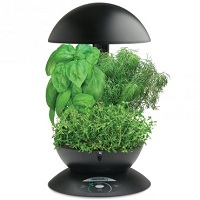
Ever-mindful of the fact that the freshest ingredients make for the tastiest meals, and always on the lookout for products that are economical and can be re-used, the line of AeroGarden hydroponic indoor grow-farms had always piqued my interest. Last year, I got a small one like the one pictured at right, along with two herb seed kits. The results? Well, let’s say that the pictures AeroGarden provides (like the one at right) should be sub-captioned “Results not typical.”

Any foodie worth a pinch of salt would be gaga over the idea of having thick, never-ending bunches of organically grown basil, dill, or thyme at the ready year-round. Well, I was, anyway. And justlookat it! Lush, tall, bursting with aroma and freshness!

Sadly, though the seed “pods” are guaranteed to grow, my first pod of thyme didn’t. And if I thought I was going to be able to rip off stalks of basil for weeks on end, I was sorely mistaken. Another realization was that these plants were no more “organic” than anything I might buy at the grocer’s, because every week I was dumping the contents of a nameless, unspecified “nutrient pack” into the water.

After a month, I was able to get two stems of basil for an omelet. A week later, I could get another stalk, maybe two. After eight weeks of growing, I had only collected as much basil as I got in one $2.99 plastic pack from Safeway. And the Italian parsley? Ha!

So, cost-wise, it was a bust. A $17.99 for a three-pod herb pack only produced a fraction of the herbs I could buy at the grocery store for around $8. It was also a bust by way of quantity; it never produced enough to supply herbs for two meals, much less enough extra to dry.

In short, a disappointment on every level.

My recommendation? Buy fresh herbs at the store, when you need them, or go down to the hardware store and get a 4-inch plant that might give you a second crop. Fresh is worth it, but the AeroGarden is more toy than utility.

k