Feeds:
Posts
Comments

The New Dark Age

Welcome to the New Dark Age.

How’s that, you say? Let me explain.

We are moving through a time when the majority of information is being stored digitally, and only digitally. Memos, letters, pictures, books, even movies, all only exist—in an increasingly large percentage—only as binary ones and zeroes on some form of digital media. Add to this all the information that exists only on websites, and you have a staggering amount if information that is, essentially, ephemeral. The British Library warns that we are already losing information, some of it important cultural information, from websites that come and go with the cultural tides. Additionally, irreplaceable scientific data may have already been lost through our inexorable march from one media to the other.

Have any old cassette tapes? Any old 3.5″ floppy disks? A tape drive for your old PC? Have any music or video stored in MP2 format? I do, and all that data—old music, pictures, stories, poems—is lost because I can no longer access it.

Let me put it this way: I have, on my desk, an edition of the Bible, printed in 1701 (pictured), complete with explications and marginalia. I can read this just as easily today as Isaac Newton could have (okay, not quite as easily, as my Latin isn’t as good as his was). I have a book, purchased in the late 90s, for use with my REB1000 eBook reader (yes, I was one of the first to try an e-reader). I cannot read it. My REB1000 is long gone, and the book’s proprietary format is indecipherable. Think about that: I can read the first book, in its original form, three centuries after it was published, and yet I can’t even view the one I bought less than twenty years ago. And don’t get me started on how many times I’ve had to buy The White Album…

Fast-forward 300 years…what will future historians find, looking back on this time? All the websites from our time are gone (What? You think Google is backing them up? Think again!). All the music, stored and delivered digitally, is in a format they can’t decode. Billions upon billions of photos, personal and professional, were lost simply through hard drive crashes. And books? The explosion of the e-book/e-reader market crushed the hardcopy publishing industry and many books, bestsellers in their day, were published only in electronic format. Think that 300-year old Kindle will fire up?

It’s not that we can’t retain all this data, and it’s not that we can’t transfer or convert all these media as new formats emerge. It’s just that we aren’t doing so.

As a species, we have all the foresight of a bug flying down the interstate. Time and again, we simply do not see the semi heading toward us until we’re splattered on the windscreen. The future may look bright and shiny, from our point of view, but from up there in the future, the view back may be much darker than we imagine.

Grey Hats

Kurt R.A. GiambastianiGrey is the new black.

Moral ambiguity. It’s everywhere you look in popular culture. Television, movies, politics, books. We have taken away all the black hats and white hats; now everyone wears a grey hat. To an extent, this can be a good thing, but more and more I see it simply as a way to be “edgy” or “raw.”

I’ll use two examples, one of which worked for me and one for which the jury is still out.

As an example of the latter: We’ve been bingeing on “Breaking Bad” this past week (having a summer cold leaves us energy for little else). Through Seasons One and Two, we watched the moral decline of Walt (the main character) until, by the finale of Season Two, he commits a sin so egregious, so callous and cold, that I wasn’t sure I cared to continue on to Season Three. The writers were able to take me along on Walt’s descent into criminality, and I was interested only insofar as (a) I understood it, and (b) could empathize with it. However, when the writers finished Season Two, Walt was no longer any one I cared about; his acts, his behavior, and his internal justification had become muddy, lost, or obscured. In short, I no longer understood him, and, once a character goes over into Crazy Land, I don’t care what happens to him.

To their credit, the writers of “Breaking Bad” had provided enough to carry me forward. They may have lost me with their main character, but I was willing to push onward just to see what happened to the secondary roles. As I write, we are in the middle of Season Three and I’m not sure if they can turn it around, as now it seems that everyone is in a downward spiral.

On the flipside, I give you the re-dux of “Battlestar Galactica.” The level of moral ambiguity in this show was very high, uncomfortably so at times. We saw characters change, both in reaction to events and in response to their own ambitions. “Good guys” became murderers, “bad guys” became heroic, and some characters were just so facile that you couldn’t pin down their moral direction for more than a scene at a time.

Regardless of a character’s relative morality/amorality, though, I always understood the reasons for action or change. I was always cognizant of why a character did something that was immoral/amoral. Whether or not I agreed with the reasoning, I could comprehend why the character thought it was a logical move.

And there is the difference. In “BSG,” the characters acted in agreement with their own internal logic, whereas in “Breaking Bad” the writers are either hiding or obscuring that internal logic, or it doesn’t seem to exist at all. When a character acts against his or her own moral code, we need to understand why. Otherwise the acts (usually violent) seem gratuitous, and it seems that the writers put it in just to add an “edge” to the episode.

Now please, don’t misunderstand me; I’m not some bluestocking crying out for a reincarnation of the Hays Office to ensure the “bad guys” always pay for their crimes and “good” always triumphs in the end. I am not advocating anything like it. What I am advocating is making the motivations of characters comprehensible, and not putting in morally ambiguous actions for their own sake.

It is my theory that for the most part, in their own mind, no one ever commits a crime. Crimes are always justified, internally. Phrases such as “victimless crime,” “He needed killing,” and “He deserved it” all point to the internal logic and moral calculation that has preceded the act.  In my own writing, I work very hard to make every character’s thought processes logical and relatively clear. You may not like my bad guys, you may not agree with their chosen course of action, but you understand them. Violence and immorality are facts of life; we cannot ignore them. But neither should we add them in just to titillate or make our writing “edgy.”

This weekend, treat yourself to homemade artisanal bread.

I put this recipe online a few days ago, and want to give it a bit more visibility because it is, in my humble opinion, the bread recipe.

It’s easy: Mix, let sit, shape, let sit, bake.

This is my version of the Bittman-Lahey version as posted by my friends over on CheapSeatEats. It’s a great recipe, especially if (like me) you’re a bit challenged in the Baking column. My main problems with baking bread have always been

  • That they never rose enough
  • I could never knead them down into that really glutenous, almost rubbery feel of the great artisanal breads
  • The crusts were never as chewy as I wanted, but always crisp and hard

This recipe solves all of those problems. The rise is guaranteed, the “tooth” is glutenous heaven, and the crust is like the old Italian loaves of my youth: firm, but chewy.

It’s an overnight rise, which actually makes it much easier. And it’s a great “master” recipe, that you can vary and tailor to your specific tastes.

Check it out, and make some this weekend!

k

Write, Don’t Edit

Heinlein’s First Rule of Writing is:

  1. Write

Sounds simple, right? Yeah, but really, really hard to do. And to this rule, I would humbly add a corollary:

  1. Write, don’t edit

This is even harder. What Heinlein meant was, “Don’t just talk about writing; do it.” What I’m talking about is what that “do it” clause means.

Admittedly, for most of us, just collecting enough time, energy, and mental focus to put words on paper is a massive challenge, but once you finally start to “do it,” don’t screw it up by wasting that precious combination. Don’t edit every written word. When you stop to back up and edit your work it before it’s done, you’re interrupting the flow of the story and the flow of your creative mind. You are letting your analytical brain stand there like the TSA, holding up every word for inspection, examining each and every phrase with a critical eye, making your prose (essentially) take off its shoes and belt and stand there, hands in the air, hoping its pants won’t fall down. In this instance, your mind is your own worst enemy, with one hemisphere fighting against the other.

The logical, left hemisphere gets in the way of the creative, right hemisphere. Of course, when dealing with language and the written word, you can’t go “all right brain, all the time.” No, you need that left brain to help you turn the movie inside your head into scribbly bits on a white page. The struggle is in managing that left side; you need to rein it in until it listens to you, and no “left brain whisperer” exists. You need to use brute force, smash-down, alpha-brain techniques here. You need to squash your every left-brained impulse to edit as you right-brain write. And believe me, it’s hard.

The reason this is so difficult is because when I say “edit,” what you should read is “second-guess.” That’s really what we’re doing when we write and edit simultaneously. We’re second-guessing our every word, every phrase, every metaphor, description, scene, and chapter. And boy-o-boy does that take time away from what we really want to do: Write.

As I said before, this is my own personal bugbear, my own monster in the closet. Even writing this post, I’ve had to struggle against it. The first third of the article was written with every line written twice or three times as I went back and rehashed my prose. For the last two-thirds, I forced my editing mind into quiet submission, only giving it the occasional typo to fix as I went along. And here’s the kicker: in the same amount of time, I wrote twice as much.

There is a time to edit. Editing is an important part of the “Write” portion of Heinlein’s First Rule. But put it where it needs to be: after you finish.

Write. Finish. Then edit.

k

I was born in Northern California, and all my young life, I was lulled to sleep by sounds of the night.

In the spring, the tadpoles came into frog-hood and set up a chorus that filled the moonlit air. On mist-shrouded evenings, the foghorns mourned across San Rafael Bay. On trips to the coast, the darkness was awash with the rumble-rush of waves and the bark of seals. And always, everywhere, as soon as twilight settled in, crickets began to sing, each one weaving a thread into the tapestry of sound, one reedy note at a time, to blanket the night.

The sound of crickets, ubiquitous and constant, came to mean something to me. Unknowingly, cricketsong meant home, security, and peace.

Then I moved to Seattle.

For months after moving here, I felt uneasy, unsettled. Even after I got a permanent job, a spot in the regional orchestra, and moved into a cute bungalow in a quiet neighborhood, I felt…at odds with the place. It struck me one evening when I was out tending the garden. It was a bucolic scene: the light had moved from dusk into gloaming, the horses across the bridle trail that backed our yard munched contentedly at grass, and the scent of roses was thick after the day’s warmth.

And nothing made a sound. No frogs, no night-birds, not even a cricket.

Seattle, as it turns out, has no crickets. I’m guessing that this is due to the moisture and the lack of summer heat, but I don’t know. What I do know is that crickets will sing constantly through the evening unless you come near them. Thus, a night without cricketsong felt ominous, as if something was out there, lurking, silencing the crickets with its presence.

I got used to it, over time, learning to sleep well and find peace without cricket-aid. And then, last night, I replaced my electric alarm clock.

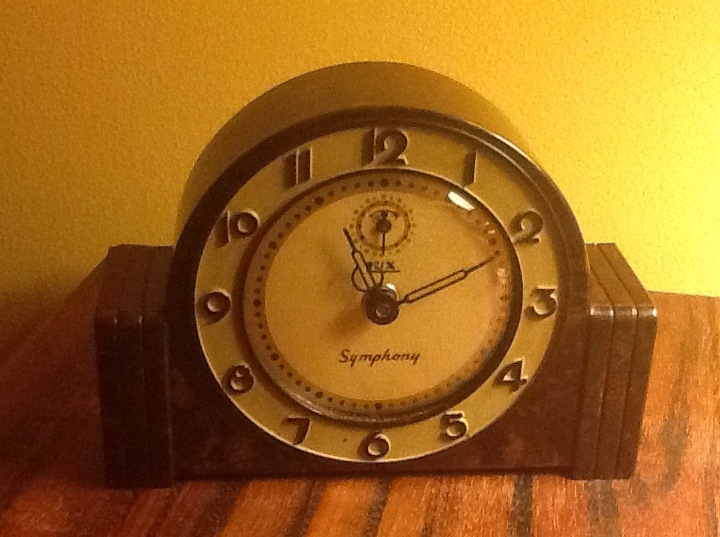
The Lux “Symphony” is a wonderful piece of Art Deco design from the 1930s and, after a good cleaning/oiling, mine now runs perfectly. Last night, I took my electric clock away and put the Lux on the nightstand.

Laying down to sleep, I felt suddenly younger. It wasn’t hard to pinpoint the source. The sound of the clock’s mechanism, the twice-per-second tick of the brass and steel escapement, made a quiet background noise that filled a void in my brain. The Lux had become, in essence, a mechanical cricket, and its constant, unerring heartbeat struck within me a chord long left silent. I slept well and woke refreshed; it may be coincidence, but something tells me otherwise.

A Double-Edged Blog

No one has said it yet; they don’t have to. There’s already a little schoolmarm voice in my head that says it loud and clear:

You shouldn’t be wasting time with a blog! You should be writing!

True, and yet…

Working on posts and pages for this blog takes time; I cannot deny it. But what I have found is that the time spent on the blog isn’t really wasted. On the contrary, I find that writing here invigorates my drive to write and exercises my technique. It also reinforces my love of the written word as I play with phrases and concentrate on the structure and focus of the much shorter form a blog post requires.

Just as a musician must work at scales and etudes, and just as a painter may create a small study for a larger work, so must a writer flex and build up literary “muscle.” When I had more time (and to be honest, more discipline), I would exercise my chops by writing a short story, but that in itself is a large expenditure of effort, especially when compared to the usually small and isolated payoff.

Thus, most importantly, I find that a blog post gives me an immediate payoff, as well as providing possible feedback via comments and re-blogs. These two things are very strong motivators, and are simply not part of the long marathon of writing a novel (especially for a Basher, like me).

So now, when that schoolmarm voice goes off in my head, I shall remember that time spent on this blog is not necessarily time wasted, and that every art and skill requires practice and study.

I spent the weekend working on my recipe for pozole, a traditional stew from Mexico, and it’s been impossible not to see this wonderful dish as Mexico’s answer to the Vietnamese phở. It’s a hearty stock, chock full of meat and a starch, served with a variety of garnishes that the diner can add to personal taste. And I suspect, as with phở, devotees will spend their lives searching for that perfect bowl of pozole.

Take a good stock—my preference is turkey stock—and add seared, grill-marked hunks of pork for a long, slow simmer. Shred the pork, add a nice mole sauce to the mix, and fill it out with a batch of hominy. This is your base, and it’s a good one; good enough to have all on its own.

But wait! There’s more!

You can split up the work on this dish, breaking it up over two days. On Day One, you take the long-duration tasks and prepare the stock and the meat, even prepare the mole. On Day Two, you put it all together, giving you time to spend with guests (and look like a master chef!)

Hang on! It gets better!

Now give everyone a steaming bowl of hearty goodness and let them add, well, just about anything they want: slices of buttery avocado, crumbled bits of salty queso fresco, chopped herbs like cilantro or oregano, whisper-thin shreds of green cabbage or romaine, crisp-fried tortilla strips. Squeeze a wedge of lime over the whole thing and dig in.

Heaven!