Feeds:
Posts
Comments

Archive for the ‘Seattle’ Category

I live in Seattle, and we have a reputation for loving our coffee. I’m no different, however, I am not a purist by any means. I can’t tell if you brewed it with tap water or distilled water or filtered water or Artesian spring water, and unless your tap water is really awful, I bet you can’t either.

I have my favorite brands of coffee—Torrefazione Italia is the best I’ve had, but hard to find; Caffe D’arte is a close second, but not available in stores—but they’re so expensive that I only get them from a barista. For everyday brewing, I buy in bulk, try to get fair-trade beans of good quality, and grind it myself as needed in a good burr grinder.

But where I can make a huge difference is in the brewing.

I’ve tried almost every brewing method. I’ve tried brewing it cowboy-style in an open saucepan (toss in an eggshell to make the grounds sink), which I do not recommend, and for years we simply stuck with our standard drip-maker and a small Braun espresso machine.

On the more esoteric side, I’ve tried one of those vacuum-siphon brewers. Aside from the sheer coolness of watching it work, and the drama it imparts to the ritual cup of coffee, it only delivered a mildly better brew than standard drip coffee makers. High-maintenance to use, a bitch to clean, it also was so fragile that it broke after only a few days’ use; a disappointment, but not a tragedy, as I’d already made my decision that it wasn’t worth the trouble.

For pure outlandishness, I have also tried the Presso® espresso maker, which works solely on muscle power. A hand-pulled demitasse is pretty cool, and it cleans up pretty easily, too. It wasn’t expensive, and it’s very solidly built, so I’ll keep it around.

But, for the best cup of coffee you can brew, I say you can’t get better than the old-school, low-tech, tried-and-true method of the French press. We use a Freiling press (pictured top) that has double-sides of stainless steel, so it also acts as a thermal insulator, keeping the coffee warmer, longer. Put your burr grinder on “coarse” and brew up a cup. Steep it for 4 minutes (longer if you need a slice of coffee instead of a cup), keep the press on the table, and serve as needed. It is never bitter, never harsh. My wife, who gave up coffee because it upset her stomach, can drink it again, now that we brew it in the press.

Another win for low-tech!

k

Read Full Post »

Harcopies Rule!Seattle peeps, it’s that time of year again.

The annual Shakespeare in the Park season is here, and there are some great, totally free performances for us to enjoy.

My personal favorite, “Twelfth Night,” along with “Taming of the Shrew,” “Henry VIII,” and “The Winter’s Tale” will all be performed, for free, in parks throughout the Seattle area. It is a great way to enjoy these plays, and both Greenstage and Wooden O promise some fun and entertaining interpretations and updates to these classics (“Shrew” in a trailer park? “Twelfth Night” on Gilligan’s Island?).

I can hardly wait!

k

Read Full Post »

Earlier, I waxed a little poetic about crickets and our lack of them here in Seattle. Anyone who’s read my novels might remember that crickets show up pretty regularly, there, and they will always be, for me, a comforting, blanket sound. “Blanket” sounds (in KRAG-speak) are sounds that fill the night air, but stay in the background; you don’t notice them until they’re gone. There are many other sounds that I find especially comforting and that, even when they wake me up in the middle of the night, immediately settle me back to sleep.

Foghorns are a big one. I grew up in the San Francisco Bay Area, where fog is a fact of life. Here, around the Puget Sound, it is similar. If you live anywhere near the shoreline, you quickly learn whence across the night water you can expect to see the blinking eye of a beacon and hear the comforting hoot of the horns. Foghorns ask their low, gentle questions across the Sound: Are you there? Can you hear me? Are you safe?

Trains, from a distance, evoke a similar mood. When we lived in Richmond Beach, closer to the shore, the coastline trains would sound their horns as they neared town. I always smile at their forlorn, two-toned call.

My favorite “blanket” sound, though, is one I’ve only experienced a few times in my life. Almost 30 years ago, my wife and I stayed in Anchor Bay, a small coastal town in Northern California. We stayed in a small cabin up on a bluff, overlooking the Pacific and a small rocky islet. On the shingled shore of that rock lay hundreds of seals, and they would bark all day and all night, their calls mixing with the rush of the surf to create a foundation of sound that waxed and waned with the strength of the ocean breeze. It took us two nights to become accustomed to this constant noise, but once we did, sleep was deep and satisfying.

I’m sure there are other sounds others find as relaxing as these. I would be interested in what your “blanket” sounds are…

k

Read Full Post »

Seattle Weathermen

No, I’m not talking about some grunge-infused radical splinter sect. I’m talking about weathermen, in Seattle. Okay, okay…meteorologists in Seattle. (Doesn’t have the same ring to it, does it? Let’s go with “weather-peeps” instead, shall we?)
I am firmly convinced that Seattle is where they send weather-peeps that have misbehaved. Take, for example, the opening for this weekend’s forecast from the KOMO News weather page:

July weather in Western Washington is usually quite straightforward. Not so this weekend: Our weather the next several days will be quite complex.

What follows is a lengthy description of upper-level lows and low-level highs, with predictions of sun, clouds, rain, thunder, and lightning, unless of course you happen to be on the coast, where there will be lightning, thunder, rain, clouds, and sun. Seems to me, if the weather-peeps need to hedge their bets like this, they should just be honest and say:

If you want to know what the weather is going to do, look outside.

k

Read Full Post »

I was born in Northern California, and all my young life, I was lulled to sleep by sounds of the night.

In the spring, the tadpoles came into frog-hood and set up a chorus that filled the moonlit air. On mist-shrouded evenings, the foghorns mourned across San Rafael Bay. On trips to the coast, the darkness was awash with the rumble-rush of waves and the bark of seals. And always, everywhere, as soon as twilight settled in, crickets began to sing, each one weaving a thread into the tapestry of sound, one reedy note at a time, to blanket the night.

The sound of crickets, ubiquitous and constant, came to mean something to me. Unknowingly, cricketsong meant home, security, and peace.

Then I moved to Seattle.

For months after moving here, I felt uneasy, unsettled. Even after I got a permanent job, a spot in the regional orchestra, and moved into a cute bungalow in a quiet neighborhood, I felt…at odds with the place. It struck me one evening when I was out tending the garden. It was a bucolic scene: the light had moved from dusk into gloaming, the horses across the bridle trail that backed our yard munched contentedly at grass, and the scent of roses was thick after the day’s warmth.

And nothing made a sound. No frogs, no night-birds, not even a cricket.

Seattle, as it turns out, has no crickets. I’m guessing that this is due to the moisture and the lack of summer heat, but I don’t know. What I do know is that crickets will sing constantly through the evening unless you come near them. Thus, a night without cricketsong felt ominous, as if something was out there, lurking, silencing the crickets with its presence.

I got used to it, over time, learning to sleep well and find peace without cricket-aid. And then, last night, I replaced my electric alarm clock.

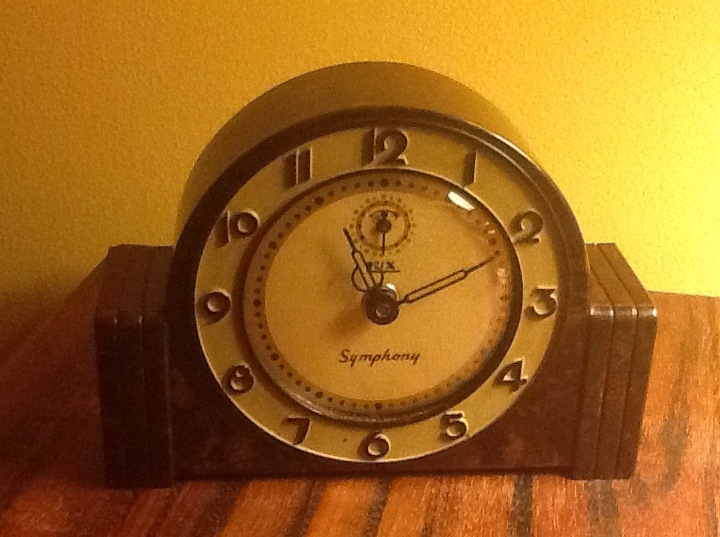
The Lux “Symphony” is a wonderful piece of Art Deco design from the 1930s and, after a good cleaning/oiling, mine now runs perfectly. Last night, I took my electric clock away and put the Lux on the nightstand.

Laying down to sleep, I felt suddenly younger. It wasn’t hard to pinpoint the source. The sound of the clock’s mechanism, the twice-per-second tick of the brass and steel escapement, made a quiet background noise that filled a void in my brain. The Lux had become, in essence, a mechanical cricket, and its constant, unerring heartbeat struck within me a chord long left silent. I slept well and woke refreshed; it may be coincidence, but something tells me otherwise.

Read Full Post »

Laphroaig Cask StrengthI hate being right, sometimes.

Last month, the Washington voters’ decision to put down the state-run liquor stores went into effect. Yesterday, we went to Costco—not the smartest move on the Friday before the Fourth of July, I’ll grant you—and I took the opportunity to cruise their “liquor aisle.” What I saw was sad, depressing, and infuriating. It was also totally predictable. I know this, because I predicted it.

First (and foremost, I’ll say), as a fan of single malt whisky, it was a desert. A massive aisle of liquor and only one single malt. A good one, as it turns out (Macallan), but it had been re-branded with the Costco Kirkland label and was $75/bottle. This told me that the days of going into my local liquor store, chatting with the staff, getting advice on varieties, and selecting from at least a dozen Islay single malts alone, were truly dead and buried. I was standing the Henry Ford version of Single Malt Hell: You can have any brand of whisky you want, as long as it’s ours. Our state-run liquor stores had variety in spades: 50 tequilas, 25 rums, and dozens of single malts from highland and low. Costco, Safeway, and their ilk carry perhaps 50 different types of liquor, period. Selection, and therefore choice, are gone.

As a fan of small businesses and keeping my local dollars in local hands, it was just another example of an abject failure by the voting public. Due to a particularly convoluted rhetoric, when we got rid of the small, neighborhood (state-run) liquor stores, we said that only big stores could sell liquor. As a result, there isn’t a small business in the state that can sell liquor. Only Costco, Safeway, and other giants with the requisite square footage are allowed to purvey liquor. (Ironically, those mega-stores dedicate less square footage to liquor than we originally had in the state-run stores.) So now, not only do my liquor dollars fail to fill state coffers, they often don’t even stay in the state, and they certainly don’t go to bolster small local business. And in smaller towns, you now may have to travel miles to find a store large enough. The law has some provisions for “specialty” stores, but I haven’t seen or heard of any yet.

Of course, the final part in this debacle is the state’s loss of revenue. We won’t know for a while if the taxes Costco and Safeway must now collect on liquor will offset the government’s loss, but I predict we’ll come up losing there, too, and remember that so far I’m 2 for 2. And though that bottle of vodka looks good at $29, it doesn’t look as good when you get to the checkout and find it also has $12 worth of taxes on it.

What was so bad about the government running our liquor stores?

  • We didn’t have choice? Balderdash; we certainly did, much more so than we do now.
  • We didn’t have competition? True, but competition also means prices will be as high as the market allows, which won’t necessarily be lower than it was. And, when you add up your total bill, your savings probably amount to a buck or two. I’d pay the extra to see my Laphroaig single malt back on the shelf!
  • The government shouldn’t be in the business of making money? Why the hell not? The public demands a lot from the government and as far as I’m concerned they can sell WA.GOV mousepads if it’ll help build a revenue stream to support essential services.

Overall, it’s a cock-up. We voted for it, and we got it, but it’s a cock-up.

k

Read Full Post »

Can someone please, please, explain to me the fascination—no, compulsion—to put giant Ferris wheels in front of some of the world’s best skylines?

No, the picture to the right has not been Photoshopped. This is for reals, kiddo. Seattle has a “wheel.”

Why o Why hast Thou forsaken us? I know that Seattle’s streets have an interesting mnemonic associated with Jesus, but now it looks like even the Big Guy has thrown us under the bus.

Seattle now joins Dubai, Beijing, Singapore, London, and several other cities that either already have or are planning to build one of these monstrosities. Sure, you can argue that Dubai’s skyline is already a cartoon come to life and won’t be significantly affected by the addition of a huge carnie ride, and you could also say that Beijing didn’t have a decent skyline to begin with, so anything is a help. But any view of London is now permanently scarred by the addition of the “Eye” on the shore of the Thames, right across from historic Whitehall. At least Singapore had the wisdom to put their “Flyer” off to the side, and not spang in the middle of their skyline.

And now Seattle has one; a 175-foot tall carbuncle on Pier 57, smack-dab in the middle of what was a wonderfully human-scale waterfront. It is an eyesore, a misplaced behemoth. You might as well tie it to “Hammering Man” and make a whirligig out of it. It has completely ruined our balanced, compact, almost Deco skyline. It is the urban developer’s equivalent of graffiti. Seattle, sadly, has been “tagged.”

Ironically, now the only decent view of Our Fair City is from the wheel, because it’s the only place from which you can’t see the damned thing.

k

Read Full Post »

« Newer Posts