Feeds:
Posts
Comments

Archive for the ‘Culture’ Category

This weekend is my Beatle Birthday.

I had my “LP” Birthday in 1992, my “Single” Birthday in 2003—and if you’re old enough to get those references, I see you—but they went by relatively (or completely) unnoticed, unmarked, unremembered. (My “78” Birthday, in 2036, might be the same, and I hope I’m lucky enough to reach it.)

Since 1967, though, I’ve thought fondly of this coming milestone, despite the fact that I was convinced I’d never reach such an “advanced” age. The song pretty much nailed what I looked forward to in my elder years (sans grandkids, of course; never wanted kids, much less grandkids), with its images of puttering in the gardens, fixing things about the house, taking a month at the seaside in summertime.

I mentioned last time that my retirement is finally visible on the horizon, and this birthday, routinely imagined for the past 55 years, is a time to stop, look around, and evaluate.

Some of my friends have already retired. Some have put their all into new ventures. Some hopped on a plane on Day One and began (or continued) to travel the world. Some, sadly, took ill, beginning entirely unplanned journeys. I admit, I compared the image in my head with how they began their Third Act, and felt the old report card put-down of “Not performing up to his potential.”

It’s not as though I plan never to travel. It’s not as though I plan not to try new things, learn new things. It’s not as though I plan to spend my entire retirement digging the weeds and fixing fuses. It’s just that, in my heart, after decades of pushing, learning, wrangling, fretting, struggling, planning, pacing, saving, working, I merely want to slow down and enjoy the ticking of the clock, the crackle of the fire, perhaps the crash of waves on the shore, and the settling of ice in a dram of whisky.

And, of course, I hope that she will still need me, that she will still feed me, when I’m sixty-four.

k

Read Full Post »

In 500 days, I will retire. In more ways than one.

I will retire, as in leave the job I have held for lo these decades past.
I will also, for a time, retire, as in go to bed and sleep (I hope) for more than 5 hours at a shot.
I may also retire, in that I may allow my naturally reticent nature may be more the norm.

Either way, in 500 days I will have, for the first time ever, a long stretch of time where I do not have a day job.

I began working in my teens. During my college years I had to hold down a job. Even when I was studying in Jerusalem, I cleaned flats and played in the symphony for extra cash. After I dropped out and returned home, at age 21 or so, I began to work full-time. Vacations, if I had them, for the first decade or so were at most one week long. In the late 90s, I had enough seniority to afford my first two-week vacation and, in the early “oughts,” I had my first  three-week vacation (I’ve only had one other, in the mid-2010s). I’ve had a full-time job for over forty years, and have been at my current company for over three decades.

I’ve been lucky. I lucked into a good profession for which I had no schooling at a time when learning “on the job” was still a thing and aptitude combined with hard work carried enough weight to balance out the lack of a degree. I got lucky with a spouse who is good with money, contented more by daily kindnesses than by flashy acquisitions, and who truly is a life partner in every sense. As a result of these lucky breaks (and my perseverance), I can retire in my mid-60s, rather than having to work until I’m in my mid-70s.

Advice on making the transition from work-a-day-monkey-boy to curmudgeonly-semi-hermit is plentiful (although perhaps not that specifically tailored to my expectations). I have friends and relatives who’ve made the transition, have seen a shift in my news- and article-feeds toward the topic, and am in contact with professional advisors on how to handle the various mechanical and financial aspects of it.

More to the point, though, I’ve begun to mentally prepare. Work takes up a large chunk of my waking life (and a not insubstantial chunk of my sleep). What time that’s left over is usually spent with chores, errands, time with my spouse, with slivers left over to spend with friends, books, and this blog (really my only writing outlet, these days). When I get back that chunk of work-time, I know I will have to apply a level of discipline to my schedule that is currently handled by my desire to receive a paycheck. Not everything will change, but a lot will, and knowing that ahead of time seems crucial to a smooth phase-shift.

But there are some questions that cannot be answered before I reach the promised land. Currently, I am a morning person, but this is primarily because at 4AM, my brain often clicks into gear in order to prepare for the work-day. Absent that impetus, will I still be a morning person? Or will I join my wife in her night-owlishness? And what of reading time? I’m not a fast reader, but part of that is because my mind is distracted and focus is often difficult to achieve. Will that change when I don’t have on-call duties or inter-office politics niggling at my attention span?

Naturally, one thing I plan on doing more of is writing, but what shall I write? A while ago I turned my hand to a mainstream/literary novel, but it’s been a struggle; is that what I really want to write? I have other ideas for series and sequels in genre fiction, and I think they might be fun to write. I have also been enjoying experiments in poetry (though the drive to create them comes and goes like a tide). So, will I finish the work-in-progress, or just move on to other projects?

I feel that it must be better to recognize these “known unknowns” than to get blindsided by them. I’m sure there are plenty of “unknown unknowns” out there, lying in wait like tigers in the bush. Best to have my head in the game.

I’ll be spending these next 500 days in preparation: downsizing expenses; selling off the unused, unneeded, unnecessary aspects of our life; learning about what needs to be done, and by when. I’ll be listening to my friends who’ve “gone before,” and reading those dry-as-dust articles about asset allocation and required minimum distribution strategies. All exciting stuff, to be sure (not).

Onward.

k

Read Full Post »

In late 2019, I felt my mental acuity begin to falter. I would lose track of days, couldn’t always remember whether an event was yesterday or a few days before, failed to recall conversations, and so forth. I didn’t think it was dementia (though that is one of my big fears), but rather, I felt it was a function of a stressful decade that had been filled with deaths, turmoil, and a job with a team I loathed. In short, I had a lot on my mind and I was having trouble keeping things organized.
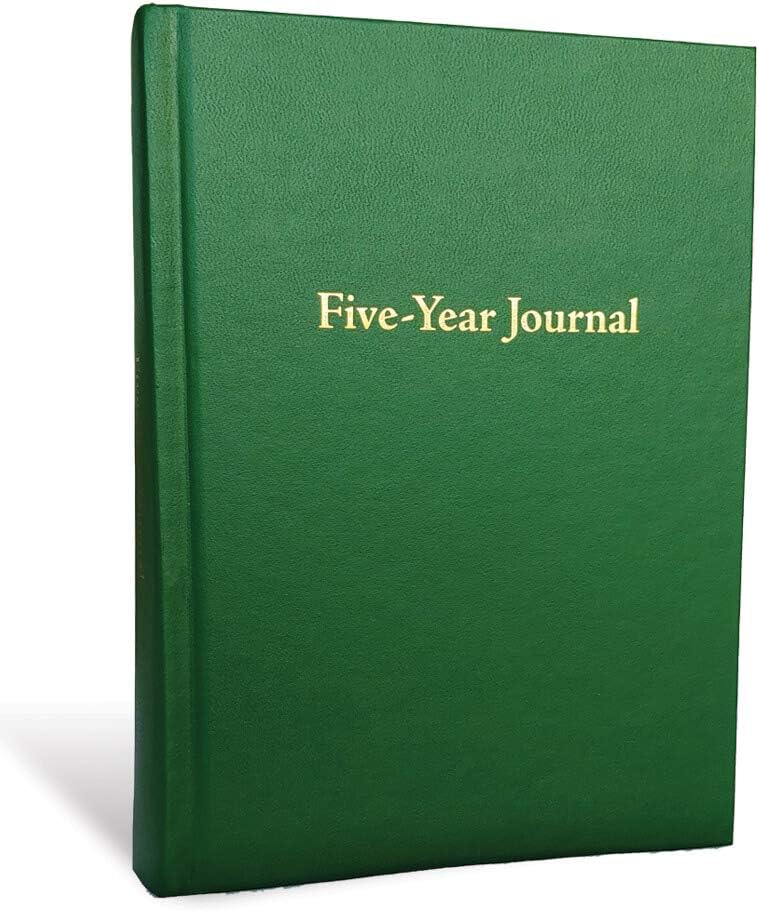
To help with this—or at least help with keeping the days straight in my memory—I purchased a Five-Year Journal. You might have seen them; each page is dedicated to a single calendar date, but divided into five sections, one for each of five years. So, Page One is January 1st, and holds an entry for 2020, 2021, 2022, etc.

Throughout my life, I have never been a reliable journalist. Generally, I’d start a journal during difficult times—breakups, relocations, end of semester panics—using an empty composition book or something similarly cheap and utilitarian. I’d fill page after page until the crisis began to abate, and then the rest of the book would remain blank. But with this Five-Year Journal, I figured I could keep it going because (primarily) the entry slots were small, just six lines that I could fill in a couple of minutes at the end of each day. In addition, it had the added attraction of allowing me to see what happened on a single date, year after year.

I’m three years into it, now, and it has helped my memory and recall. Days have a definite division, now, as the act of summarizing them each evening sort of “cements” them in my mind. And it is a very well-crafted book: sturdy, medium-weight paper, nothing fancy or unnecessary.

However . . . an issue has arisen.

The entry slots have become too damned small.

When I started, six lines was often more than enough room to hold the mundanity of my life. When I started to write more, though—here, and elsewhere—even when using a needle-thin ballpoint and my tiny, tiny scrawl, my entries regularly began to curl up into the margins in order to finish a thought.

To fix this, armed with my nearly three years’ habit of regular journal-keeping, I went in search of a larger format. One day. One page. I wouldn’t have to fill each page (some days, six lines is still more than enough), but if I wanted to, it’d be there, ready to capture every last, tedious detail of my suburban life.

There were many to choose from. I discarded “planners” right away; I do not (thankfully) have a life that requires planning. I also decided against the “page-a-day” journals that have the hours printed down the margin because, to be honest, if I have two things to do in a single day, that’s a full day, and an hour-by-hour breakdown is serious overkill.

No, what I wanted was just one page for each day, lined, with no extraneous frippery like icons for the weather, mood indicators, or “visioning” pages. Optimally, it also needed to have paper thick enough to handle my fountain pen, had to lie flat when making a mid-year entry, and it needed to be either hardbound or sturdily paperbound. Marker ribbons would be nice, too.

It took a while (the struggle is real), but eventually I found one that ticked almost every box, including the “not stupidly expensive” box.
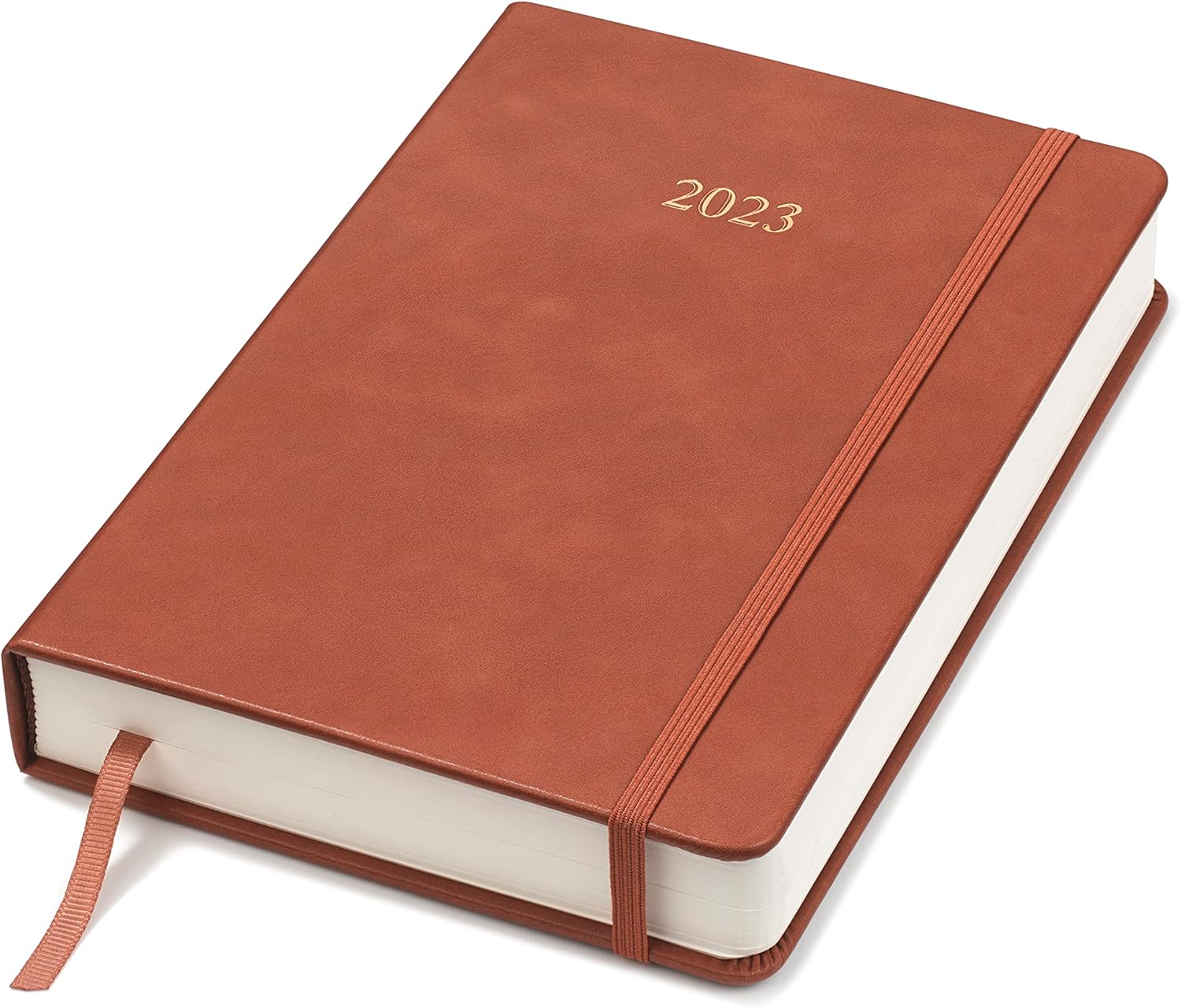
I present to you, the Wykeham’s Executive 2023 Daily Journal.

Don’t be off-put by the “Executive” appellation, as it is surprisingly void of any “strategic” thought pages, address books, tabs, and such. In fact, the only thing it has that even smells of the Executive are pages for tracking expenses (one per month, all up at the front and easy to ignore).

In the front sections, it has an “at-a-glance” calendar, the aforementioned expense pages, a “by month” calendar (two facing pages for each month, large enough to list birthdays and vacation schedules, but not enough to track the kids’ soccer games and doctor appointments), and then a full set of clean, lined, 5.5 x 8 inch (14 x 20 cm) pages, one for each calendar day. It’s bound in hard(ish) boards covered with faux leather, has a marker ribbon, an elastic band to keep it closed, and opens flat on every day of the year.

And, at less than $25, it won’t break the bank.

For me, it is the perfect choice. If it wasn’t already November, I would have bought one for the remainder of 2022. Looking ahead, I’d buy a 2023 edition for every journal writer as a holiday gift, but I don’t have a lot of them on my list, at least not who share my tastes and requirements.

However, if you have such a person on your list, check it out. (It comes in black as well as this English tan color, and ships in a nice hard box for easy gift wrapping.) Of course, the Five-Year Journal would work for many, too.

While I won’t have the chance to see what happened on March 2nd, five years running, I think the elbow room the larger space provides will outweigh that lack.

Especially now that “writing” is playing a greater role in my life.

k

Read Full Post »

My sword is bright
it lights the path ahead
through treacherous times
shining

My sword is sharp
it cuts to the heart
the dissemblers’ lies
seeking

My sword is strong
it survives unfazed
the illogic tide
standing

My sword is my vote
it points the way forward
for right and for rights
singing

——

k


Read Full Post »

This has been a week of ups and downs—society, family, health, the future—and, to be honest, right now I’m on the down-side of it. So, fair warning.

In last week’s post, I admitted that my Fallen Cloud Saga needed new covers. This led to other considerations about fixing some of the content (e.g., typos, minuscule factual errors, and one extremely overwritten prologue), but primarily I spent this week focusing on the covers. I scanned sites and services. I downloaded several apps. I contacted artists whose work ticked a lot of the project boxes. Also, realizing how it’s been a long while since I formatted content for a novel, I solicited advice on the state of play as regards the best formatting tools for books (print and digital).

Sadly, rather than this activity working to ratchet up my enthusiasm, the reverse has happened, and the Black Dog has come to visit.

The reason? The costs.

Artwork, software, hardware, I’d need to license/commission/purchase/upgrade almost everything, and for what?

For vanity?

Brass tacks: Money spent refurbishing the covers of my Fallen Cloud Saga will never be recouped. The idea of making them more attractive to the passing eye and thereby increase my readership is, of course, a real and possible goal, but the money spent will not be earned back, not when taking past sales into account. Then, I have to add in the cost of decent formatting software. Everyone swears by Vellum, but it’s Mac-only, and it isn’t cheap, so I’d need the software and either a Mac-mini or a subscription to macincloud (and I loathe subscription-based software models). Alternatives to Vellum, like Atticus, have their adherents, but as with most charts that compare the enthusiasm coefficient of Apple-heads vs Windows-thralls, the Mac comes out orders of magnitude above.

So, in large part, it comes down to this: How much am I willing to spend to indulge my vanity?

My wife, bless her, has encouraged me to recast the discussion in several ways.
—I’m not buying covers, I’m buying artwork (something we’ve done plenty of times in the past).
—This would finally raise my Fallen Cloud Saga to the state I’ve always wanted it.
—Software and hardware could be used for future projects, as well as all my other titles.
—If she’d asked for something similar, I’d have already written the check.
. . . and the kicker . . .
—”I’ll be mad if you don’t.”

I’ve never been good at spending money on myself, at least not beyond a the cost of a good bottle of whisky. This, though . . . it’s different. Where a bottle of whisky is sipped into extinction, a professional presentation of the entire Fallen Cloud Saga would be something I would enjoy until the day I die, even if no one ever bought another copy.

Vanity? Perhaps.

Or perhaps it’s love, love for the saga I spent years creating, the love that drove me to write the fifth and final book even after the publisher had dropped the project, the same love that is shared by a small but ardent group of readers. It’s not something I owe myself or those readers, and it may not be something we even deserve.

It is, though, be something we would all enjoy.

Isn’t that enough?

Onward.

k

Read Full Post »

Last weekend’s author-signing event went surprisingly well, but it was not devoid of lessons to be learned.

I say “surprisingly well” only because of my standard introvert’s dis-ease when facing the public, plus the fact that this was my first signing event in nearly a decade. The fact that I sold any books (and to strangers, no less) was also a surprise. Admittedly, we spent that revenue on books from other authors/artists at the event, but let’s be honest: I don’t do this for the money.

Another entry in the “went well” side of the ledger was using Square for accepting payments. When you consider the fact that a week before the event I had no way to accept credit card payments, Square was an excellent choice. Fast, easy, with a top-notch app and high-confidence from customers, I was able to set up an account, enter my inventory, and get a card reader with a few days to spare. I was also prepared to use Venmo and PayPal, but they weren’t needed, as every customer was very comfortable with using Square.

Aside from these plusses, though, there were a few negatives.

First, I need a “pitch” statement. The author at the next table, J.P. Barnett, was able to sum up his books in a single sentence. (“Two college roommates chase monsters instead of going to class!”) While I’m sure this oversimplified his work, the pitch gave potential customers a quick way to know if his books were something they might enjoy. To be fair, all of J.P.’s books were from the same series, so he only needed One Pitch to Rule them All, whereas my books vary in content, style, and genre. That’s just an excuse, though; hearing J.P.’s pitch and watching his customers’ immediate comprehension of what lay before them showed me the value of a pithy catch-phrase.

I also learned that even though we all say you shouldn’t judge a book by its cover, we all most definitely do. To that point, I had to admit that the second edition covers for my Fallen Cloud Saga were not doing the job (even though minimalism was all the rage a handful of years ago). By far, the busier, more eye-catching covers on my table got the most attention.

The third lesson was that, if you have a series, bring more copies of Books One and Two. I foolishly brought an equal number of all titles, thinking (wrongly) that people would want to buy the whole series. With one exception, what they did buy was just the first in the series. In retrospect, this makes perfect sense; I’m an unknown quantity, and who wants to lay down cash for a series that they might not want to finish. Luckily, I didn’t run out of “first in a series” books, but it was a near thing.

Each February, Page Turner Books puts on a big signing event, which draws about six hundred sf/f readers, all eager to browse and find new authors. That’s about five times the traffic we saw on Saturday, and I’m seriously considering taking a table. There’s a lot of work I need to do, though, based on what I learned.

As I said, my motivation to participate is not financial. I want more readers rather than more bucks, so as long as I cover my costs, I’m happy. Watching people evaluate my titles, noting their reaction to my (admittedly) long-winded descriptions, and then seeing them walk out with one of my books under their arm, well, that’s the point, for me.

Onward.

k

Read Full Post »

Between work, weddings, and assembling IKEA furniture, it’s been a busy week, but somewhere in there I also managed to wrangle an invitation to an “author appreciation” festival put on by a local independent bookstore (details below).
Kent is a town south of Seattle, and Page Turner Books is a used/new bookseller in the downtown area. PTB takes pride in being a “by the nerds, for the nerds” business, specializing in speculative fiction of all stripes, plus gaming, collectibles, and comics. They often have author and convention-like events, and next weekend they’re putting on their Fall Festi-Con Fair, with (so far) about a dozen authors and artists hanging out to sign books and chat with readers.

Now, anyone who knows anything about me knows that I heartily dislike public appearances and speechifying. Back when I did attend conventions, I went through a lot of preliminary psychological prep, and a ton of after-action recovery. Signings were even worse, in that I wasn’t sharing the stage with other writers; it was all me, and the (usually) empty ranks of chairs were a reflection of that.

Not that I haven’t done the occasional event in the years since then. I even got invited to a panel on writing historical fiction (also in Kent, if I remember correctly . . . hmm) that was a good day, but in general, no.

In short, as an author, I don’t get out much.

But sharing the venue with a dozen creative artists is definitely something I can manage, and so, if you’re interested (and in the PacNW), here are the details:

Fall Festi-Con Fair
presented by Page Turner Books
Saturday, 24 Sep 2022, from 2-7pm
314 West Meeker Street, Kent, WA 98032

Event Page on Facebook
(includes list of authors and artists, plus details)
Event Page at City of Kent
(details, map, etc.)

Bring your books or pick up a new one (I’ll have some from my stash), or just drop in to say Hey.

k

Read Full Post »

« Newer Posts - Older Posts »