Feeds:
Posts
Comments

Archive for the ‘Books’ Category

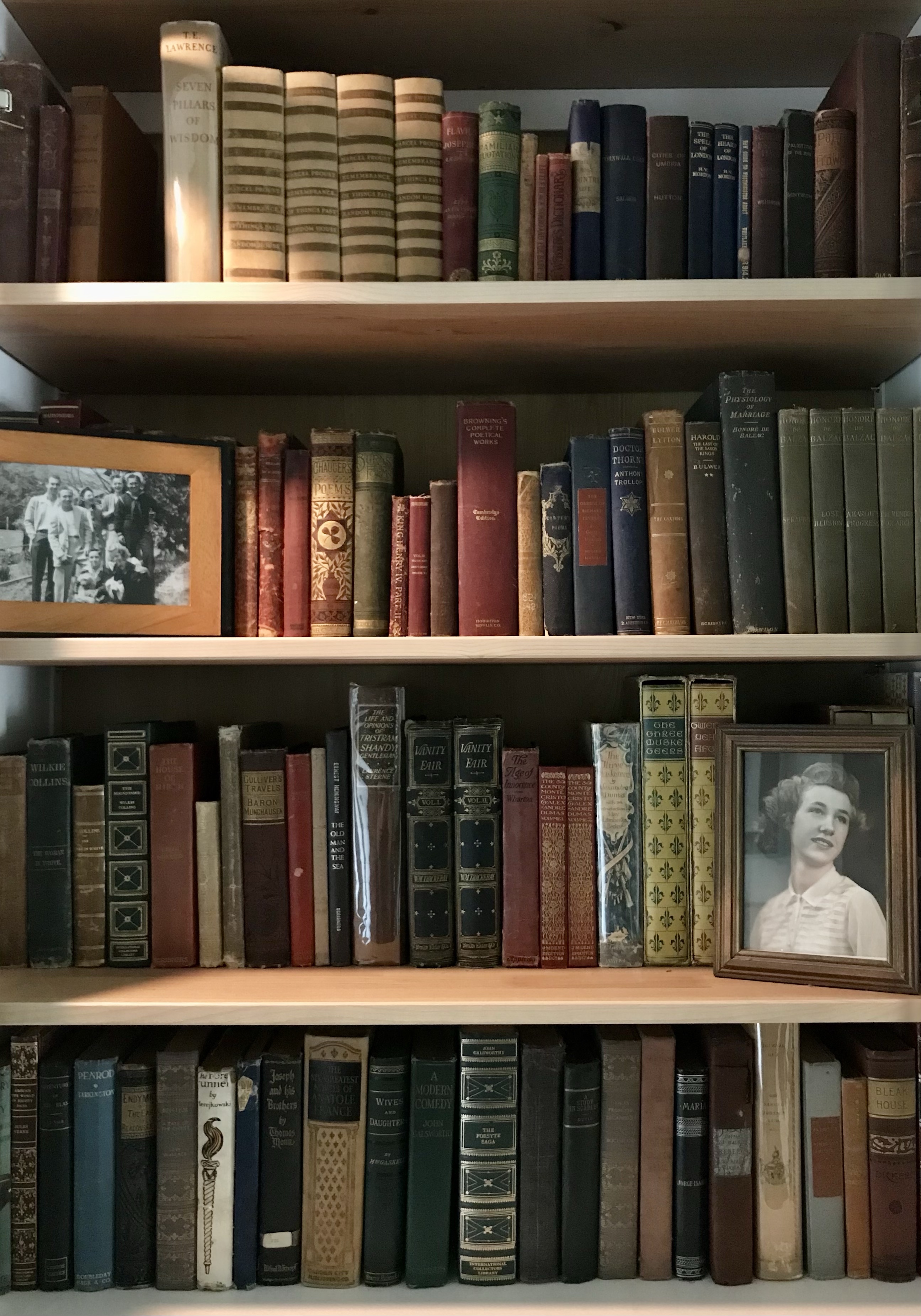
There is something special that happens, something ephemeral and transitory, when I approach the end of a good book. It can go one of two ways: I either rush headlong toward the conclusion, driven forward by a thirst for the sweet wine of revelation and release, or I hold off, pacing my approach, lingering over what has come before whilst imagining, wondering, whetting my hunger for the last few chapters. It is a magic, specific to books, this control, this opportunity to choose.

When we watch a movie, the pace is set for us, as we experience the timing, the focus, the framing decisions of director, cinematographer, and editor. The Pause button is analogous, but a weak shadow, often used merely to grab a nosh, hit the loo, or tend to a load of laundry in the dryer. One does not pause a film in its approach to a climactic scene merely to reflect on all the scenes that have come before.

But with a novel, we are the director, we frame the shots, and we flesh out the rooms and towns and landscapes—sketched by the author—with costumes and onlookers and paths of our own fashioning. In a book, we are the collaborators, assisting the author in their work. We bring the words to life in our mind’s eye, and in the case of a well-written book, it is a joy, this work, this journey, so as the pages tick past, from recto to verso, as the end-papers grow nearer, we must choose: race ahead? or slow-walk our way to the last page?

(For those of you who read the ending of a book first, no judgment—okay, a little judgment—but I think you’re missing out on one of readings truly great pleasures. That’s not to say I’ve never read a book that didn’t go along swimmingly only to have a massively sucky ending, but I’ve only thrown a handful of books across the room for that reason, so for me, knowing the ending ahead of time would ruin far more than it would preserve.)

The decade past, my fiction diet has been lacking. The ongoing stresses of work, coupled with what I perceive as the slow (and now much more rapid) deconstruction of our national norms, left my brain ill-equipped to concentrate sufficiently on a novel. The run-up to retirement was anything but stress-free. Disappointingly, the first year of retirement was likewise fraught with unexpected challenges, from dealing with new insurance carriers to a cancer scare to dealing with large household projects and more. So, my first year as a retiree was not just me, lying in my hammock, a novel in one hand and a wee dram of whisky in the other.

Since my recent non-diagnosis, however, I’ve redoubled my efforts on the fiction reading score, and once more I find myself in the delicious dilemma described above. I purchased several books that were on sale, titles and authors about which I knew nothing, the sale decision made solely on the strength of the blurb, and so far I have two titles on this year’s list of Books Read. One turned out to be a mystery, and I found myself wholly absorbed as I read to the conclusion; the other was a surprisingly twisty bit of magic realism, and for that my pace slowed, savoring the last chapters.

I plan to foster this renewed joy of reading books, physical books, in the months (and years) to come. It used to be that I never walked anywhere, stood in any queue, or waited for any bus without having a book in my hand. I took a book with me from room to room, catch a page or two while the tea water was heating, or read a chapter before sleep. I’m hoping that, like riding a bike, these habits will return, that the tablet I have been carrying with me everywhere is exchanged for a dog-eared paperback with a tattered receipt as a bookmark. It’ll take some effort, but I suspect it’ll be worth it.

k
Read Full Post »

  • “Top 10 Reads for the Summer”
  • “The Best Games of 2023, Ranked”
  • “Twelve Items Every Pantry Must Have”
  • “5 Movies You Need to See”
  • “Seattle’s Best Restaurants”

There is no scarcity of voices eager to tell us what to do, what to like, what is good. “Listicles” abound, plastered with headlines shot through with words like “Best” and “Ranked.” But, “Best” according to whom? Who decides how these things are “Ranked?” Not me, for sure. Probably not you, either. But here’s the thing:

  • I’m enjoying a book my friend didn’t like.
  • The music I’m listening to is probably not on your playlists.
  • I loathe brie cheese.
  • A well-maintained and -manicured lawn is my idea of a crime against nature.

In other words, my tastes are different than yours, and yours are different than mine. And that’s okay.

My tastes in music, books, and cuisine aren’t better than anyone else’s. Yes, I was trained as a musician, have written novels, and have taught myself to be a better cook, but my personal likes and dislikes in these areas aren’t better. Obviously, they have been influenced by what I’ve learned, but they’re not better. “Better” presumes there is some Platonic ideal against which all others are found lacking, and while this might work for some objects, when it comes to things like sandwiches, it’s useless. There is no “best” sandwich. There’s just your favorite kind of sandwich. And there’s mine.

“Bestseller” doesn’t mean “best,” and it damned sure doesn’t mean you’ll like it. Neither do awards, kudos, upvotes, likes, retweets, or some stranger’s rankings.

Where there are quantifiable characteristics that can be evaluated, let’s compare and discuss them; we might learn something, see something we never saw before, and possibly modify our opinion. But when we’re dealing with the unquantifiable, when we’re talking about basic visceral likes and dislikes, we just need to chalk it up to personal preference.

I’ll enjoy what I enjoy, and you do the same. I won’t think less of you because you love brie cheese (though I may wonder how you manage it).

In short, I don’t want to yuck your yum.

k

Read Full Post »

I get rid of things

gadgets that lie unused
plants that don’t thrive
clothes that no longer fit

I discard, donate, sell
from pasta makers to cars
wanting the unusable gone
wanting the usable used

Better a new owner
a new set of hands
to work them
a new set of eyes
to value them
than the darkness
of my understairs storage

Except for books

I get rid of things,
but books are not things

Books
read and unread
are hopeful promises
treasure maps of the mind
histories yet unknown
friends unmet

I will spend my remaining years
inhaling their aroma
hearing the rustle of their leaves
taking them in
adding them to the thing
that is me

k

Read Full Post »

In late 2019, I felt my mental acuity begin to falter. I would lose track of days, couldn’t always remember whether an event was yesterday or a few days before, failed to recall conversations, and so forth. I didn’t think it was dementia (though that is one of my big fears), but rather, I felt it was a function of a stressful decade that had been filled with deaths, turmoil, and a job with a team I loathed. In short, I had a lot on my mind and I was having trouble keeping things organized.

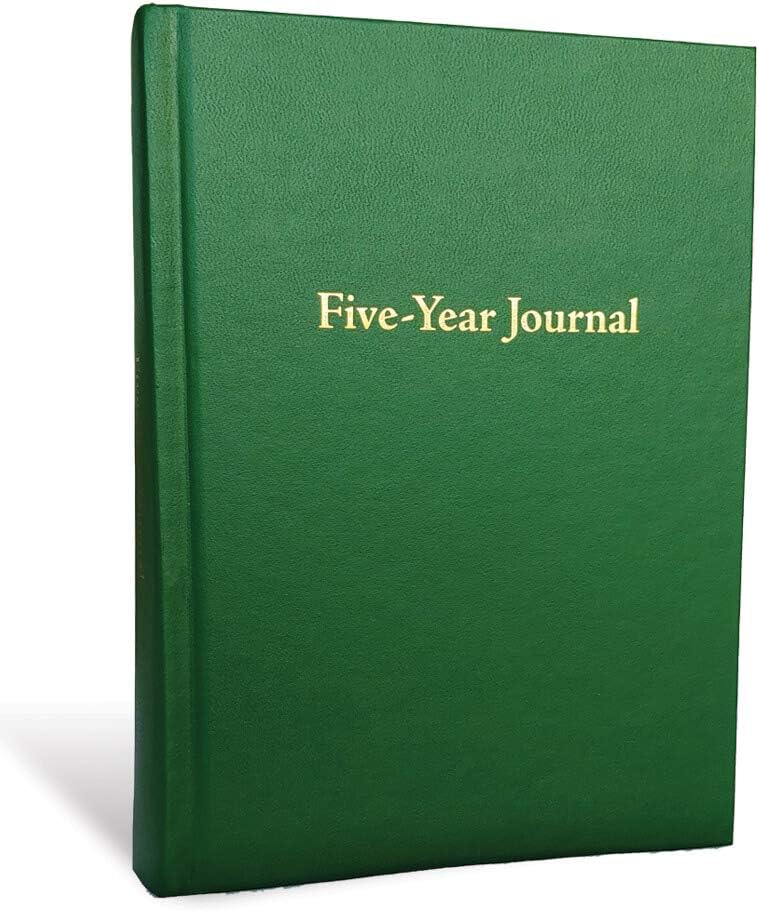
To help with this—or at least help with keeping the days straight in my memory—I purchased a Five-Year Journal. You might have seen them; each page is dedicated to a single calendar date, but divided into five sections, one for each of five years. So, Page One is January 1st, and holds an entry for 2020, 2021, 2022, etc.

Throughout my life, I have never been a reliable journalist. Generally, I’d start a journal during difficult times—breakups, relocations, end of semester panics—using an empty composition book or something similarly cheap and utilitarian. I’d fill page after page until the crisis began to abate, and then the rest of the book would remain blank. But with this Five-Year Journal, I figured I could keep it going because (primarily) the entry slots were small, just six lines that I could fill in a couple of minutes at the end of each day. In addition, it had the added attraction of allowing me to see what happened on a single date, year after year.

I’m three years into it, now, and it has helped my memory and recall. Days have a definite division, now, as the act of summarizing them each evening sort of “cements” them in my mind. And it is a very well-crafted book: sturdy, medium-weight paper, nothing fancy or unnecessary.

However . . . an issue has arisen.

The entry slots have become too damned small.

When I started, six lines was often more than enough room to hold the mundanity of my life. When I started to write more, though—here, and elsewhere—even when using a needle-thin ballpoint and my tiny, tiny scrawl, my entries regularly began to curl up into the margins in order to finish a thought.

To fix this, armed with my nearly three years’ habit of regular journal-keeping, I went in search of a larger format. One day. One page. I wouldn’t have to fill each page (some days, six lines is still more than enough), but if I wanted to, it’d be there, ready to capture every last, tedious detail of my suburban life.

There were many to choose from. I discarded “planners” right away; I do not (thankfully) have a life that requires planning. I also decided against the “page-a-day” journals that have the hours printed down the margin because, to be honest, if I have two things to do in a single day, that’s a full day, and an hour-by-hour breakdown is serious overkill.

No, what I wanted was just one page for each day, lined, with no extraneous frippery like icons for the weather, mood indicators, or “visioning” pages. Optimally, it also needed to have paper thick enough to handle my fountain pen, had to lie flat when making a mid-year entry, and it needed to be either hardbound or sturdily paperbound. Marker ribbons would be nice, too.

It took a while (the struggle is real), but eventually I found one that ticked almost every box, including the “not stupidly expensive” box.

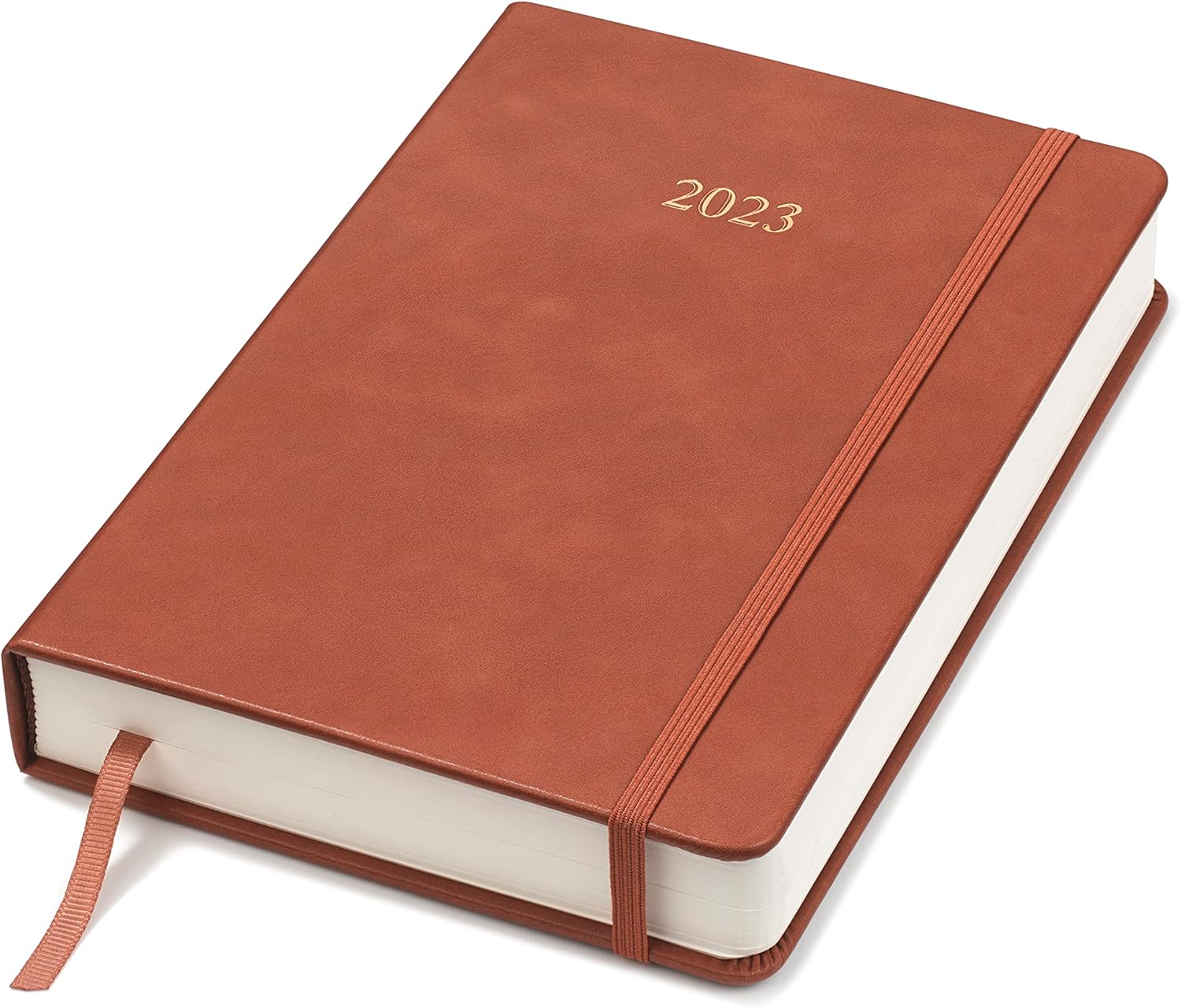
I present to you, the Wykeham’s Executive 2023 Daily Journal.

Don’t be off-put by the “Executive” appellation, as it is surprisingly void of any “strategic” thought pages, address books, tabs, and such. In fact, the only thing it has that even smells of the Executive are pages for tracking expenses (one per month, all up at the front and easy to ignore).

In the front sections, it has an “at-a-glance” calendar, the aforementioned expense pages, a “by month” calendar (two facing pages for each month, large enough to list birthdays and vacation schedules, but not enough to track the kids’ soccer games and doctor appointments), and then a full set of clean, lined, 5.5 x 8 inch (14 x 20 cm) pages, one for each calendar day. It’s bound in hard(ish) boards covered with faux leather, has a marker ribbon, an elastic band to keep it closed, and opens flat on every day of the year.

And, at less than $25, it won’t break the bank.

For me, it is the perfect choice. If it wasn’t already November, I would have bought one for the remainder of 2022. Looking ahead, I’d buy a 2023 edition for every journal writer as a holiday gift, but I don’t have a lot of them on my list, at least not who share my tastes and requirements.

However, if you have such a person on your list, check it out. (It comes in black as well as this English tan color, and ships in a nice hard box for easy gift wrapping.) Of course, the Five-Year Journal would work for many, too.

While I won’t have the chance to see what happened on March 2nd, five years running, I think the elbow room the larger space provides will outweigh that lack.

Especially now that “writing” is playing a greater role in my life.

k

Read Full Post »

This has been a week of ups and downs—society, family, health, the future—and, to be honest, right now I’m on the down-side of it. So, fair warning.

In last week’s post, I admitted that my Fallen Cloud Saga needed new covers. This led to other considerations about fixing some of the content (e.g., typos, minuscule factual errors, and one extremely overwritten prologue), but primarily I spent this week focusing on the covers. I scanned sites and services. I downloaded several apps. I contacted artists whose work ticked a lot of the project boxes. Also, realizing how it’s been a long while since I formatted content for a novel, I solicited advice on the state of play as regards the best formatting tools for books (print and digital).

Sadly, rather than this activity working to ratchet up my enthusiasm, the reverse has happened, and the Black Dog has come to visit.

The reason? The costs.

Artwork, software, hardware, I’d need to license/commission/purchase/upgrade almost everything, and for what?

For vanity?

Brass tacks: Money spent refurbishing the covers of my Fallen Cloud Saga will never be recouped. The idea of making them more attractive to the passing eye and thereby increase my readership is, of course, a real and possible goal, but the money spent will not be earned back, not when taking past sales into account. Then, I have to add in the cost of decent formatting software. Everyone swears by Vellum, but it’s Mac-only, and it isn’t cheap, so I’d need the software and either a Mac-mini or a subscription to macincloud (and I loathe subscription-based software models). Alternatives to Vellum, like Atticus, have their adherents, but as with most charts that compare the enthusiasm coefficient of Apple-heads vs Windows-thralls, the Mac comes out orders of magnitude above.

So, in large part, it comes down to this: How much am I willing to spend to indulge my vanity?

My wife, bless her, has encouraged me to recast the discussion in several ways.
—I’m not buying covers, I’m buying artwork (something we’ve done plenty of times in the past).
—This would finally raise my Fallen Cloud Saga to the state I’ve always wanted it.
—Software and hardware could be used for future projects, as well as all my other titles.
—If she’d asked for something similar, I’d have already written the check.
. . . and the kicker . . .
—”I’ll be mad if you don’t.”

I’ve never been good at spending money on myself, at least not beyond a the cost of a good bottle of whisky. This, though . . . it’s different. Where a bottle of whisky is sipped into extinction, a professional presentation of the entire Fallen Cloud Saga would be something I would enjoy until the day I die, even if no one ever bought another copy.

Vanity? Perhaps.

Or perhaps it’s love, love for the saga I spent years creating, the love that drove me to write the fifth and final book even after the publisher had dropped the project, the same love that is shared by a small but ardent group of readers. It’s not something I owe myself or those readers, and it may not be something we even deserve.

It is, though, be something we would all enjoy.

Isn’t that enough?

Onward.

k

Read Full Post »

Last weekend’s author-signing event went surprisingly well, but it was not devoid of lessons to be learned.

I say “surprisingly well” only because of my standard introvert’s dis-ease when facing the public, plus the fact that this was my first signing event in nearly a decade. The fact that I sold any books (and to strangers, no less) was also a surprise. Admittedly, we spent that revenue on books from other authors/artists at the event, but let’s be honest: I don’t do this for the money.

Another entry in the “went well” side of the ledger was using Square for accepting payments. When you consider the fact that a week before the event I had no way to accept credit card payments, Square was an excellent choice. Fast, easy, with a top-notch app and high-confidence from customers, I was able to set up an account, enter my inventory, and get a card reader with a few days to spare. I was also prepared to use Venmo and PayPal, but they weren’t needed, as every customer was very comfortable with using Square.

Aside from these plusses, though, there were a few negatives.

First, I need a “pitch” statement. The author at the next table, J.P. Barnett, was able to sum up his books in a single sentence. (“Two college roommates chase monsters instead of going to class!”) While I’m sure this oversimplified his work, the pitch gave potential customers a quick way to know if his books were something they might enjoy. To be fair, all of J.P.’s books were from the same series, so he only needed One Pitch to Rule them All, whereas my books vary in content, style, and genre. That’s just an excuse, though; hearing J.P.’s pitch and watching his customers’ immediate comprehension of what lay before them showed me the value of a pithy catch-phrase.

I also learned that even though we all say you shouldn’t judge a book by its cover, we all most definitely do. To that point, I had to admit that the second edition covers for my Fallen Cloud Saga were not doing the job (even though minimalism was all the rage a handful of years ago). By far, the busier, more eye-catching covers on my table got the most attention.

The third lesson was that, if you have a series, bring more copies of Books One and Two. I foolishly brought an equal number of all titles, thinking (wrongly) that people would want to buy the whole series. With one exception, what they did buy was just the first in the series. In retrospect, this makes perfect sense; I’m an unknown quantity, and who wants to lay down cash for a series that they might not want to finish. Luckily, I didn’t run out of “first in a series” books, but it was a near thing.

Each February, Page Turner Books puts on a big signing event, which draws about six hundred sf/f readers, all eager to browse and find new authors. That’s about five times the traffic we saw on Saturday, and I’m seriously considering taking a table. There’s a lot of work I need to do, though, based on what I learned.

As I said, my motivation to participate is not financial. I want more readers rather than more bucks, so as long as I cover my costs, I’m happy. Watching people evaluate my titles, noting their reaction to my (admittedly) long-winded descriptions, and then seeing them walk out with one of my books under their arm, well, that’s the point, for me.

Onward.

k

Read Full Post »

Between work, weddings, and assembling IKEA furniture, it’s been a busy week, but somewhere in there I also managed to wrangle an invitation to an “author appreciation” festival put on by a local independent bookstore (details below).
Kent is a town south of Seattle, and Page Turner Books is a used/new bookseller in the downtown area. PTB takes pride in being a “by the nerds, for the nerds” business, specializing in speculative fiction of all stripes, plus gaming, collectibles, and comics. They often have author and convention-like events, and next weekend they’re putting on their Fall Festi-Con Fair, with (so far) about a dozen authors and artists hanging out to sign books and chat with readers.

Now, anyone who knows anything about me knows that I heartily dislike public appearances and speechifying. Back when I did attend conventions, I went through a lot of preliminary psychological prep, and a ton of after-action recovery. Signings were even worse, in that I wasn’t sharing the stage with other writers; it was all me, and the (usually) empty ranks of chairs were a reflection of that.

Not that I haven’t done the occasional event in the years since then. I even got invited to a panel on writing historical fiction (also in Kent, if I remember correctly . . . hmm) that was a good day, but in general, no.

In short, as an author, I don’t get out much.

But sharing the venue with a dozen creative artists is definitely something I can manage, and so, if you’re interested (and in the PacNW), here are the details:

Fall Festi-Con Fair
presented by Page Turner Books
Saturday, 24 Sep 2022, from 2-7pm
314 West Meeker Street, Kent, WA 98032

Event Page on Facebook
(includes list of authors and artists, plus details)
Event Page at City of Kent
(details, map, etc.)

Bring your books or pick up a new one (I’ll have some from my stash), or just drop in to say Hey.

k

Read Full Post »

Older Posts »