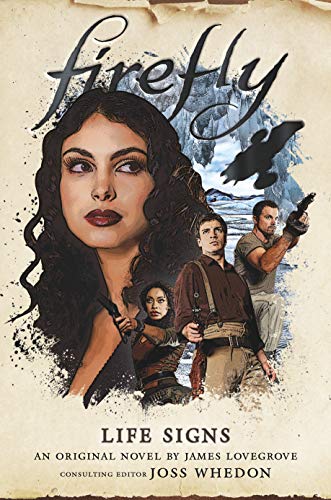
 It may surprise some, considering past reviews posted here, that I deigned to read James Lovegrove’s Firefly: Life Signs, his fourth volume in the ongoing Firefly series, but I did.
I haven’t been shy with my disappointment in Lovegrove’s past entries (as seen here and here). In fact, my disappointment was so great that I didn’t even bother to review his third book in the series.
Thing is, though, it’s Firefly. I adore the show, the characters, the setting, the language. I’m a Browncoat for life, so I couldn’t not read it.
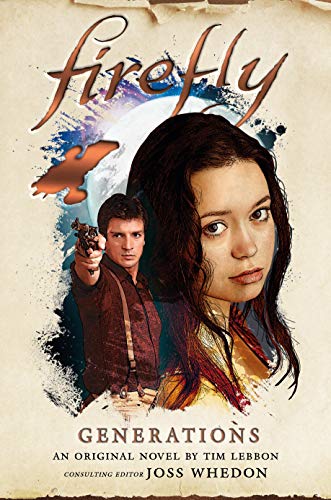
The book released just prior to this one, Generations, by Tim Lebbon, was an exceedingly pleasant change from Lovegrove, so it was disappointment layered upon disappointment when I learned that yet another Lovegrove entry was on the schedule. (FYI: the next in the series is not a Lovegrove title so, fingers crossed.)
With all that as prologue, I’m sure you’re asking: Why the hell is he reviewing this one?
The answer is two-fold.
First, Life Signs deals with a crucial bit of the Firefly canon: Inara’s terminal illness. As fans of the show, we knew about this part of Inara Serra’s planned story arc—plans cut short by the show’s abrupt truncation—so a novel that deals with that is worth exploring.
Second, this one wasn’t as bad as Lovegrove’s previous work. In fact, for most of its length, it was quite readable. (If you’re thinking I’m damning him with faint praise, that’s not my intent.)
The book is not without issues, but let me start with what works.
As Lovegrove demonstrated in previous books, he is able to evoke the pattern and rhythm of the Firefly ‘verse without reverting to caricatured patois. Rather than peppering us with g-less gerunds (e.g., fightin’ and stealin’), he leans more on the syntax and the language, which makes the dialog—and there’s a lot of it—much more readable. Once we read a few phrases like “I reckon . . .” and “Seeing as how . . .”, the g-less gerunds follow without us having to stumble over all those apostrophes. In other words, here, less is definitely more.
Moreover, his dialogue is exceptionally well-paced, which is good because, as stated, there’s a lot of it. Lovegrove successfully runs scenes of banter between three or four characters with ease, giving us just enough clues as to keep us straight on who’s talking without slowing things down. And though (once again) we have someone monologuing in the midst of a crucial action scene, this time it occurs during a brief lull so, while it’s not the optimal time for someone to explain their backstory, at least it’s not with bullets are whizzing by their heads.
The plot, while wholly improbable—and let’s face it, if you have an issue with improbable plotlines, you’re not a Browncoat anyway—is also straightforward: Inara is sick, and terminally so, but there’s a sketchy doctor who might be able to help, only, ruh-roh, he’s been incarcerated on a prison planet. (I’m not telling you anything that isn’t in the publisher’s blurb.) As expected, hijinks ensue.
The characters—canon and new—are pleasantly fleshed out. With the established characters, Lovegrove goes beyond what the series established, developing them and giving us emotional content that simply must be there, given the plot. (In this, I feel for the bind any author of these books must be in; the novels take place between the Firefly series and the movie Serenity, so with those as bookends, there’s only so much you can do.) For the characters specific to this novel, Lovegrove gives us sufficient context to understand the why of their actions, which was also a nice surprise.
However . . .
I’ve complained of this before, but Lovegrove is not great at world-building. I admit, it’s a pet peeve of mine, and it will not bother many (possibly most), but when (on the first half-page) I read of an alien world that has cicadas singing in the mesquite trees, well, that just seems a tad lazy to me. Even if we stipulate that it was a barren rock that’s been terraformed, who in their right mind is going to bring mesquite seeds and cicada larvae across interstellar space? This laziness permeates the book as much as any of his others. [sigh]
Past the first few pages, though, Lovegrove hit his stride, and I sped through the book. Some of this was illusory, however, as most of the chapters were only two or three pages long, meaning that, with a half-page for chapter header and a half-page (or more) for break to the next chapter, there’s a lot of white space in the book. Well, it’s one way to make your book a page-turner, I guess.
There are clunky bits of writing, mostly due to his use of adverbs. I’m not averse to using adverbs, in general, but Lovegrove often commits Classic Error #2, using esoteric or tongue-tying adverbs. Mostly, it’s fine, but when I hit three words like “despairingly,” “understandingly,” and “languorously” within a single chapter (did I mention how short most of the chapters are?), my mental Adverb-Overload switch flips and I need to put the book down until I reset.
Sadly, though, it’s in the climactic final sequence where Lovegrove (as usual) face-plants. If this was a one-off issue, I would grimace, make mention, and move on, as I did in previous reviews of his work, but this has now happened in every Lovegrove book in the series: to wit, he shows either a stunning disregard or an unforgivable ignorance of how things work, whether it be scientifically*, practically**, or (in this case) both. I mean come on! Doesn’t Titan Books hire editors? Shameful, mostly because they are fixable errors.
In summary, did I like it?
It’s a quick and mostly fun read with a stumbling start and a flawed finish that deals with a crucial part in the life of a beloved Firefly character, so . . . yes, I liked it, in spite of itself. And I will grudgingly (see? adverbs) recommend it to fans of the Firefly ‘verse. It has the standard Lovegrove issues, but it did pull me in for most of its length and, at times, touched my heart.
k
*Newtonian physics and the laws concerning conservation of kinetic energy are tossed out the airlock as Lovegrove misapplies the Kessler syndrome (which deals with space debris travelling at high speeds in low-Earth orbit) to pieces of space junk that are stationary relative to one another. A nudge from Serenity on one rather small piece of space junk would not cause a cascade that makes every other piece of space junk, including much larger pieces of junk, fly about like billiard balls on a pool table.
**In every aircraft (and, presumably, spacecraft capable of atmospheric flight), the steering yoke adjusts roll and pitch, the rudder pedals control yaw, and the throttle controls the thrust. Anyone who has flown a plane, played a flight simulator, or hell, just been relatively observant when watching film of someone doing the same, knows that if you pull back on the yoke, the plane goes up, and if you push it forward, the plane goes into a dive. In no aircraft does pushing forward on the yoke make it go faster; that’s the throttle. Different thing. Again, where are the editors here?

Read Full Post »
 It’s been a week of retrospection, and I mean that in the most literal sense.


 Kurt R.A. Giambastiani