Feeds:
Posts
Comments

Posts Tagged ‘Poetry’

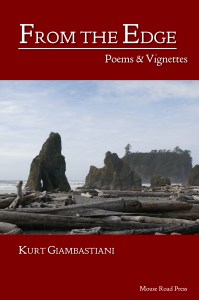
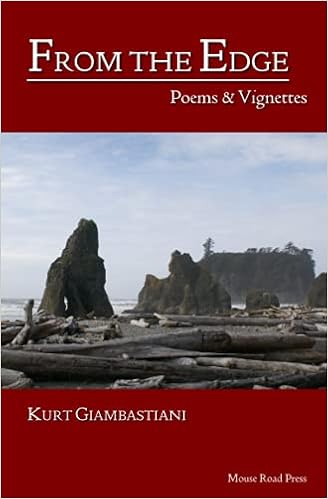
You knew this was coming (either that, or you haven’t been paying attention): From the Edge, a collection of poetry and vignettes, is now live on Amazon! W00t!

In putting this together, I encountered needs that never arose with my novels. Primary among them was the concept of a coherent theme, and right behind that, organization. These aspects were new to me, as with novels they’re just part of the package. Here, though, I was making a whole out of things that were never written as parts of a whole, so theme and organization suddenly took on new importance.

Sure, I could have just collected “poems I like” or “things I wrote in chronological order,” but I wanted the whole to have something to say, as a whole. This goal proved quite a challenge, though, since none of these pieces was written with the others in mind.

The first task, naturally, was to winnow the hundreds of pieces I’d written since the late ’90s into a manageable pile. Immediately I divided them into “Maybe” and “No” piles, a process I repeated, each time with a more exacting eye. Eventually, I had an “Almost Yes” pile of eighty or so pieces, all poetry and short poetic prose that would fit on one or two pages.

Next was to distill from these a theme. This was difficult, and literally kept me up at night. Eventually, though, it became clear that many dealt with a transition, and from that the concept of liminality became prominent. The title, I felt, should evoke that concept, and after trying out many of those, I settled on From the Edge, as in: from the edge of the century, the edge of the continent, the edge of patience, the edge of life, from the edge of a transition from one state to the next.

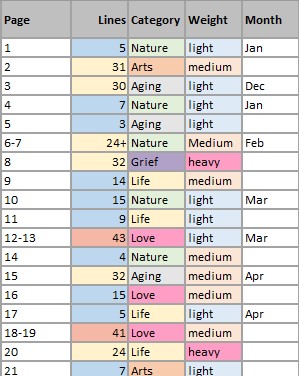
Then I needed to make a final cut and organize the pieces and here I fell back into true to geek-boy form. I put the pieces in a spreadsheet, analyzed their content, and determined a meaningful structure.

Yes, seriously.

It’s not as crazy as it sounds (or so I tell myself). Many of the pieces had a “seasonal” component, reflecting a certain time of year. Each one also carried an “emotional weight,” and I didn’t want the reader to be hit by (what I felt were) several hard-hitters in a row. Topic was a factor; just as I didn’t want three heavy poems in a row, neither did I want having three “nature” poems bunched together. Finally, the length had to be considered, both (again) to avoid clumps of longer works, but also (and more importantly) to ensure that the works requiring two pages could be read without breaking the flow by turning the page.

The result is a selection of nearly fifty pieces, from winter to winter, exploring the nature of transition and transformation.

Or, at least, that is the intent.

The last decision I made was to break with one of my guiding principles and only offer this in hardcopy. Presentation has a greater impact on poetry than on prose, and I spent many (many) iterations getting the font, format, and layout just right. If I were to adapt the book to a digital format, most of that would be lost, so, sorry-not-sorry, you won’t be able to read these in Arial or Times New Roman on your phone. Want to read them? You’ll have to go old-school.

So, From the Edge is alive and has been released into the wild. Go catch one (if you can)!

k
Read Full Post »

Born on the cusp
between two worlds

he never looked back
except with sadness

nor reminisced
but under pressure

from sons and daughters
eager to learn his source.

He kept that world
of loves and wars

tucked tight away
in his heart’s attic

for the world of his now
was challenge enough

without memories
of one that was no more.

k

Read Full Post »

Editing is hard.

Editing a work you love is very hard.

Editing a work you love and that carries great personal weight is more than very hard. It’s an emotional maelstrom, pulling you deeper with every pass, dragging you farther into the vortex of its intensity, capable of drowning you at any moment.

And poetry—my poetry—carries great personal weight.

Which is why I’ve been a spiritual shipwreck this week: I’ve been editing a collection of poems and vignettes, gleaned from my writings of the past two decades (and a bit more). Some of them have appeared here; many have not. All are, for me, distillations of power, and each one—be it a three-line haiku, a twelve-line sonnet, or a 43-line piece of free verse—is surrounded by a nimbus of context that exists only in my heart.

Nothing I write can be as powerful to a reader as it is to me. This is the nature of writing: it is an imperfect means for the transference of memories and emotions and thoughts, but it’s the best means we have. Naturally, you do not know why I wrote a particular poem, but I certainly do, and editing it, reading it over and over, even if it’s only a check for proper capitalization, even if it’s to ponder a comma at line’s end versus a period, I must perforce relive the moments, the weeks, sometimes the years that surround that poem’s inspiration, which means I must also relive the grief, the joy, the anger, the frustration, the ineffable beauty that I hoped to have captured in the amber of my words.

Despite this psychic exhaustion, I’m chuffed about this little project, as it is, in some ways, a turning point. Where I used to present myself solely as a writer of novels, this is my way of acknowledging that, as a poet, I’m not displeased with my work, and that, in this regard at least, I’m still growing as a writer.

Proofs will come in tomorrow’s post and I’ll get a chance to see how well my editing and layout skills have served me. I’ll also get yet another chance to read—this time with a proofreader’s eye—the four dozen pieces I’ve chosen for this collection.

And then, most likely, I’ll sit in the evening’s fading warmth, sip some wine, and think of something new to write.

Already, I have some ideas.

k

Read Full Post »

It’s been a week of retrospection, and I mean that in the most literal sense.
We spent most of our week going through old papers—letters, receipts, documents, and such—searching for the most important ones to put a fireproof box. This was our way of jump-starting the Big Adulting task of writing wills, issuing powers of attorney, and all the other things attendant to, well, to our inevitable death.

Naturally, as happens when rummaging through one’s past in this way, we come across a lot that was not what we were looking for, and I mean a shit-ton of it. But for every time I found a manual for an appliance we no longer have, purchased with a now-defunct credit card, issued by a bank that collapsed a decade ago, I also found a photo of my brother in Mali, a 1946 letter from my great-aunt, a receipt for baguettes from the boulangerie around the corner from our Paris walk-up, a love note from my dad to my mom, or a ticket stub from the night I took my girlfriend to the movies in Jerusalem. None of it will mean anything to my heirs (presuming I have any), but for me, each item carries incredible weight.

As I hold that old Oyster Card, I hear my panting breath as I climb the stairs to hear Big Ben strike the noon hour. Picking up that acorn, rattling in the bottom of the cardboard box, I’m hit with the unseasonable heat of Gettysburg in October, surrounded by the humid scent of wild onions as I walk beneath the oaks of Devil’s Den.

It was a long journey, this week, due to the many, many side trips we took while digging through banker’s boxes filled with, okay, filled with a lot of junk, but also a lot of our collective past. I found things I’d merely forgotten about, but I also found things I’d never seen, items turned over en masse by my folks or accreted from their estates; like my 3rd grade school photo, the one with me making a Calvinesque goofball face, the one that pissed off my mother something fierce, the one on the back of which my dad jotted a hidden note: “This is Kurt. He’s smart as a whip, and I have trouble keeping up with him.” When had he written this? And to whom? And why had he kept it so long? And why had he never expressed this thought to me?

These boxes seem filled only with musty paper, small trinkets, and fading photos, but in truth, they’re filled with love, joy, grief, anger, wonder, and history. Should the tragedy of fire strike our home, they’ll not survive—only birth certificates, marriage licenses, wills, deeds, titles, and passports will have that honor—but even if I had a fireproof box the size of a two-car garage, I don’t know that I’d protect them there.

They are my history, sure, but like me, they are transitory, incapable of permanence beyond the time circumscribed by my birth and my death.

And perhaps, this is the way it should be.

we are
ephemeral
mayfly deities
standing at the verge
in sight of the distant shore
ready to leap

k

Read Full Post »

The Key

It is not a needle.
It is not a syringe
It is a key
that fits my front door
but now that I have it
will I use it?
Am I ready
to leave my distanced redoubt?
Is my unmasked heart prepared
to trust those I meet?
I cannot say
but the key turns
the dust-dry tumblers
the bolt withdraws
the door creaks open
I squint at the sun
of a different year
smell the aromas
of an unmapped summer
hear the surf noise
of my lifeblood’s anticipation
and I step outside

Read Full Post »

In the space
Between their words
They stand
Wondering
How they arrived
At this hollow space
Where neither
Can see the other
Where friendship
Rimed with hoar
No longer warms
Both captive
To their own
Righteousness


k

Read Full Post »

Fingers deep in waking earth
  clearing ferns from wintry somnolence

Their feathered, spiked, serrate fronds
  release spores in ochre clouds

Raindrops drum my hat brim
  enthusiastic paradiddles of spring

Hands set blade to swordleaf
  trimming old stems and rusted detritus

From the center I lift accreted duff
  revealing curls, verdant and sleepy

Nestled in that fiddlehead crown
  is the confidence of rebirth

Hope is spring’s eternal gift
  a promise of life
    and all it contains


Read Full Post »

« Newer Posts - Older Posts »