
Feeds:
Posts
Comments

Posts Tagged ‘Creativity’

A friend asked the hive-mind for book suggestions—preferably science-fiction/fantasy/speculative fiction—to flesh out her summer reading list and (naturally) she got more titles than she could probably read in a year. I tossed in one title I’d read recently; it was less “spec-fic” and more what I’d call “magic realism,” but I had found it delightful and passed the title¹ along.

In perusing the suggestions from others, I saw a mix of genre classics along with (what I assumed were) newer titles. I used to read nothing but sf/f novels—they were my introduction into fiction, back in the late ’60s/early ’70s—but over time, for reasons (painful or practical), I drifted away from the genre, and have zero experience with many of the newer authors.

There was one particular suggestion, however, that caught my eye, It was a title² of which I’d not thought in decades, even though I adored the series when I was young. I was in my teens when the books were first published and I devoured them, thankful there was only a year between release dates.

In recent years, I’ve occasionally gone back to re-read some old favorites, but that proved a dicey proposition. At sixteen, seventeen, I had no comprehension of—much less appreciation for—writerly things like structure, characterization, world-building, foreshadowing, allusion, or pacing. If you gave me a brisk plot and a compelling reason to turn the page, I was all yours. Going back to those old, familiar titles led, more often than not, to disappointment. Clunky dialogue, predictable plots, heavy-handed setups, wooden characters, and banal prose were common, and that’s before considering the rampant sexism and gender dynamics of the period.

But, oh, I did so love these books, this series, this world. So I gave the first in the series a try.

What I found within shocked me.

It’s not that it is bad; far from it. Yes, the author has some annoying (to me) quirks, and is inordinately fond of multi-syllabic adverbs, but the characters are full and distinct, the world has a long and detailed history that affects the current action, the social structure is coherent, strong with rituals and patterns, and there is humor and passion and drama and risk aplenty.

What shocked me, though, were the echoes I recognized between these books and my own. Understand, between the time I read these books and the time I began writing fiction, two decades had passed. When I was writing my own books, I never thought back on these titles, not for inspiration, not at all.

And yet, as I re-read these old books, I see in them the seeds of the worlds I have built. From the psychic connections along ley lines in “Spencer’s Peace” and my Ploughman Chronicles, to the bonding between riders and walkers in The Fallen Cloud Saga, to the convolutions of time travel in Unraveling Time, here in these books lie the kernels from which my own books grew. These books, this series, they are my source, my wellspring.

All writers, I believe, are influenced by the writings of others. We’re all, as Stephen King once said, like “milk in the fridge,” picking up flavors from whatever we’re near, accreting reverberations from the artistry of those we admire. But to find so many thematic origins in one place, well, it’s like finding a loved one, long-lost, long-forgotten.

I’m exceedingly glad I took a chance on these old friends, and I will definitely read the six or seven titles that I read when I was a boy. I feel a need, after this difficult year, for an infusion of youthfulness and hope, and these books, for me, flow with those gifts.

k


¹ The Lost Bookshop, by Evie Woods
² Dragonflight, by Anne McCaffrey, first in the Dragonriders of Pern series

Read Full Post »

I see stars swimming
through eternal soul-dark seas
the horizon nears

Read Full Post »

the percussive exuberance
of K-drama dialogue
drifts down the darkened hall
a cryptic lullaby in
rollercoaster tones
leading me past
anxious abstraction
to plush midnight


(more…)

Read Full Post »

do not put vowels
in the dishwasher
as they are made
of air and intention
and will likely melt

consonants are built
of sturdier stuff
and may go in
the upper rack

punctuation is best stored
in the garage with
nuts and bolts and
other fasteners

words once crafted may be
machine-washed and tumble-dried on low
but avoid fabric softener
unless the water is
especially hard

take time assembling
phrases and sentences
aligning them to the meridian
in a clean well-lighted place
free from excessive drafts

paragraphs benefit most
from a finish on the line
in springtime when the
breath of the waking world
begins to blow

non-fiction requires precision
and regular maintenance
so for peak performance
tune to 4° before
top dead center

patience is recommended
when assembling fiction
to ensure tight seams
and a proper fit

stir poetry
over low heat
until reduced
by half


k


Read Full Post »

Book-learning, while useful, can only get you so far on the path toward competence. This is especially true in the arts. To learn a thing, often you simply have to do a thing.

But some learning curves are steeper than others. Some roads to knowledge are pitted with potholes. And along these paths there are always tigers in the bush, lying in wait, ready to ambush the unaware, the over-confident, the ignorant.

As recently mentioned, I am learning how to weave fabric using a rigid heddle loom, turning yarn into cloth. I began by reading books on the topic—primers and how-to manuals mostly—as well as by watching instructional videos. These were invaluable, giving me a sound enough foundation in the what/how/why of the craft, that I felt confident to purchase a loom and try my hand at the techniques I’d been reading about and viewing.

But, in any journey of knowledge, there are some elements that are so basic as to be considered already known. Axioms, truths, assumptions, things everyone knows; except, they’re not things everyone knows. Rather, they are things so basic that, if you know them, you forget that not everyone knows them.

Things like, how to open a hank of yarn.

We all know what a ball of yarn is. It’s not a hard concept to grasp. It’s a ball. Of yarn. You know, the thing cats play with. One of the ends is on the outside and the other is hidden, tucked away at the center of the ball. In the picture, it’s the small grey thing at lower right.

If you wind a ball of yarn but leave the center hollow, you get a cake of yarn. Cakes have one end on the outside, but give you access to the one at the center, too. You can pull from one, the other, or both. There are three of them in the picture.

You also might know what a skein of yarn is. It looks like a big ball of yarn that’s been sort of (technical term) smooshed into a football shape. As expected, it has one yarn end on the outside, but it also (often) has one that comes out from the center, and either one can be used.

Ball, cake, skein, these can be used as is, without issues.

But a hank of yarn? What the hell’s a hank?

Up until this week, I had no clue what a hank was, much less how to handle one. And none of my reading or weaving tutorials mentioned the term. Neither did any of the myriad tip-sheets on yarn have anything to warn me about what I was getting into.

So, when the box of yarn I’d ordered showed up this week—lovely yarn made of merino and cashmere, yarn so soft and light that I can barely feel it with my callused old-man fingers—I opened it up and, rather than the balls, cakes, or skeins I’d expected, I found only twisted, corkscrew spirals of yarn. Hanks. I’d seen them, but never held one before and, as I turned it over in my hands, it was clear that they had no discernible end, no visible access point.

I quickly figured that I was in trouble.

And I was correct. In the picture, the mare’s nest to the left is the trouble I found. It represents the first hank I opened.

It’s a ruin.

If I’ve learned one thing in life, it’s that mistakes are teachers. Mistakes can flatten learning curves. Mistakes can fill in the potholes waiting along that road of knowledge. Mistakes can alert you to the tigers.

But you have to let the mistakes do their work. You have to learn from them.

I have several more hanks to uncoil and wind into usable cakes. I am filled with trepidation as I proceed because I’ve proven that I can ruin the yarn; however, I’ve also proven that I can successfully cake-up said yarn, if I pay sufficient attention.

Fingers crossed.

k

Read Full Post »

Morse Code scarf in wool

As some know, a month or so ago I fell down a deep rabbit hole: I am learning how to weave—weave, as in, to make cloth from yarn or string. With a loom. And shuttles. Seriously old-school, low-tech stuff—and in doing so, I have received an unexpected gift.

Music.

I alluded to this new activity—here and here—in recent weeks (albeit obliquely), but in the past weeks it has become a full-on passion. All those books in the TBR pile? Forgotten. Those shows we were going to binge over the long weekend? Not happening. And sorry, but if I owe you a letter, it’s going to be delayed.

Weaving has infiltrated all my waking hours (and some of my sleeping ones, too). Not only has the learning curve been steep and chock-a-block with new words like “sley,” “heddle,” “gamp,” “raddle,” and “sett,” each new thing learned is like a hydra, sprouting new thoughts and questions with each answer. Hues for color palettes swoosh through my head. Wearable-fabric-as-art is now a thing for me. And inspiration strikes All The Time now, shining beams of creativity for pieces well beyond my technical expertise, illuminating ideas that I’m not sure are even possible with the tools I have.

And that’s all before I put warp to peg, weft to shuttle.

Once I get to that point, once I actually sit down and begin the weave, it’s all-involving. I’m so new to this, there is no muscle memory to kick in (a fact to which my upper back will attest), but the repetitive mechanics of working the loom, the rhythm of throwing the shuttle, the ever-present attention to tension and selvedges, these form the base of an activity which, like gardening, engages the motor-function/analytical part of my brain and leaves my creative functions free to “what if?” their way through myriad thoughts and ideas.

Then, as I become familiar with the patterns of motion for a project, as I introduce efficiencies into my movements, the world around me draws inward, and I enter a place of meditative serenity.

So, where does the music come in?

Houndstooth muffler in acrylic

The world is filled with distractions. Sirens, deliveries, hungry housecats, text message pings, K-drama sound effects; these can pop me out of my trance and make me lose track of where I am in a pattern. I could counter these with podcasts or books on tape, but the spoken word is sometimes just as distracting, sending my brain on little wonder-tours based on a thought or idea under discussion.

And that is where music comes in.

I used to listen to music a lot. My iPod (yes, I still have an iPod) has over 18,000 songs on it. That’s over 50 days of music, but ever since 2016 my music consumption rate has dropped off a cliff, replaced instead by various news broadcasts, analyses, and podcasts. In retrospect, this has not been good for my stress level; the world is not a friendly place, and focusing on news has only heightened my awareness of it.

It was, then, a surprise—as well as a surprise that it was a surprise—that when I plugged in my earbuds, put P!nk on shuffle play, and began weaving a Morse Code scarf (pictured, top right), I felt my brain relax and my heart ease as I slipped into the mood of the music. Since then, I’ve been re-exploring my own music collection, from symphonic metal to Tudor chamber music, from solo oud songs from Egypt to fully-synthesized renditions of Richard Rodgers classics.

And it has been like coming home.

I would have continued with this new weaving avocation even if I had not found this wonderful synergistic pairing, each activity feeding and supporting the other. Now, when I begin to imagine a piece to weave and colors to use, I’m also thinking about the soundtrack to go with it. Paul Hindemith? Jethro Tull? Hans Zimmer?

It’s like listening to a tapestry whilst transforming yarn into cloth.

I didn’t need an excuse to listen to music again. But I’m glad I have one.

k

Read Full Post »

Back when I was a panelist at writing/sci-fi conventions, I would occasionally pop in at the workshops, where pros read/critiqued story submissions and provided a professional’s view. The critiques were honest assessments, often served with actual “pro tips,” but the stories submitted were usually—to be honest—pretty awful.

On one such occasion a pro author/editor I knew provided a critique that was both the shortest I’ve ever heard as well as the definition of “damning with faint praise.”

Her critique: “It’s very nicely typed.”

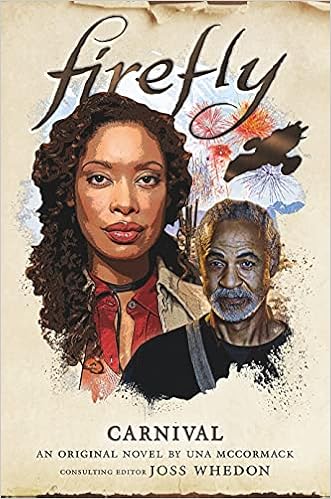
The newest title in the Firefly novel ‘verse is Una McCormack’s Firefly – Carnival, from Titan Books, and sadly, the best thing I can say about it is that “It’s very nicely bound.”

I’ve complained loud and long about previous titles in this series—the lone exception being Tim Lebbon’s entry, Firefly: Generations (also the only one with a title that comes with a colon instead of an en dash . . . go figger—as the entries written by James Lovegrove have been massive disappointments. Learning that this title was penned by a different author gave me hope.

Misplaced hope, as it turned out.

The basics of the plot are: Mal and crew are hired to provide security for a shipment and escort it across town from the train station to the space port where, once loaded, it flies off and they get paid. Naturally, things go wonky, the shipment goes astray, and two of Serenity’s crew are taken hostage—by the employer who hired the team—as collateral pending return of the goods or compensation for the loss. Failure, within 48 hours, and the “collateral” will be sent back in boxes.

Now, if that’s not a goofy enough setup for you, it gets better. Or worse. Example: the job pays 200 platinum (a ridiculously high wage for a few hours’ work) but when the crew is told they have to cover the losses, the sum is only 500 platinum (more than they have, of course, but 200 Pl is an unreasonable chunk of that profit margin).

The story unfolds and we learn that (unsurprisingly) nothing is as it seems, and therein lies the tale.

McCormack is a best-selling author of many television and movie tie-in novels, but reading this I came to the conclusion that those titles were best-sellers based on an established fan base and not on the style or content because . . . damn.

For any book set in the Firefly ‘Verse, you have to deal with the show’s excellent use of dialect and language. As with other books, the occasional sprinkling in of “g-less” gerunds (i.e., shootin’ and flyin’) helps evoke the tone from the show, and the reader fills in the rest. Lovegrove, for all his faults, did this well. McCormack does not. They pop up all over the place and, most troublesome, she throws them into non-dialogue sections, including those that are straight narrative and not part of a character’s internal thoughts. In addition, she decided to spice it up with other dialect elisions, such as “platinum” becoming “plat’num” which (to my ear at least) has no audible difference and only disturbs the eye as we trip over it. (In her defense, McCormack is a Brit who may very well have better diction than we Americans, so this may have made sense to her.)

Stylistically, the prose is pedestrian and flat, without any beauty. At regular intervals—presumably to evoke a feeling of action or a character making a quick assessment of surroundings—McCormack drops into a paragraph of fragment sentences. This in itself isn’t a bad practice, as it reads with more urgency, but when she drops pronouns and subjects from the beginning of the sentence, we have to re-read to make sure we get it, which obviates the point of the fragments.  In fact, McCormack often creates sentences where the syntax is imprecise or vague, and it can be read with one of two (sometimes opposite) meanings depending on inflection. This is simply poor writing, and should have been caught and fixed.

Sadly, the editors seem to have taken holiday on this book. And, halfway through, the proofreaders seem to have gone to join them. This is less McCormack’s fault than Titan Books’, though the author is not off the hook either. Content errors. Out-of-place references to current pop-culture. Missing punctuation. Typos. For all of these, the author gets proofs, too, and there are simply too many errors late in the book to deny a lackadaisical process from start to finish.

In short, it’s a hot mess and I found myself remembering Lovegrove’s less-than-stellar titles in the series with something approaching fondness.

The Firefly novels are now one for six, with Lebbon’s book being the only one worth the time. It’s sad, but it’s clear at this point that these are simply revenue streams—something I should have figured going in—hackwork without interest in the actual art and craft of writing.

Frankly, I don’t know that I’ll bother with any future titles. My love for the show, its original use of language, the depth of its characterizations, begins to suffer from such low-bar fare.

In short, these books are beginning to damage my calm.

k

Read Full Post »

Older Posts »