Feeds:
Posts
Comments

Recharging Station

This morning, the ocean threw a brick at me. 

My wife and I are out at the coast for a few days (we’re working things out, which is Very Good News) and, as is my wont when at the seaside, I got up early(ish) . . . earlier than she, anyway . . . and went for a walk along the shore.

Most people, when they walk along the seashore, do it in one of two ways: either they walk up along the high tide limit where the sand is still hard (but they won’t get their feet wet), or they walk down along the wave limit (where the occasional seventh wave might submerge them up to the ankles).

Yeah, that’s not me. I grew up on the Pacific coast, and the Big Blue is a critical actor in my emotional life. It’s where I go to purge my buffers and reevaluate the importance of things. Sitting on the edge of the world, glass of wine close at hand, I can look out along the curvature of the earth and watch the sun sink into the quicksilver sea; this is my heaven, my Fortress of Solitude, my recharging station. But walking along the water’s edge and not being in contact with the sea? . . . Yeah, not an option.

When I walk along the shoreline, I walk that gantlet between surf and shore. I’m always barefoot, and the water is always rushing in or flowing out around me. Sometimes this puts me knee-deep in some very cold water, but after the first five minutes, my feet don’t care anymore. They’ll complain loudly later, but for now, numbed by the northern Pacific’s chilly grasp, they’re quiet.

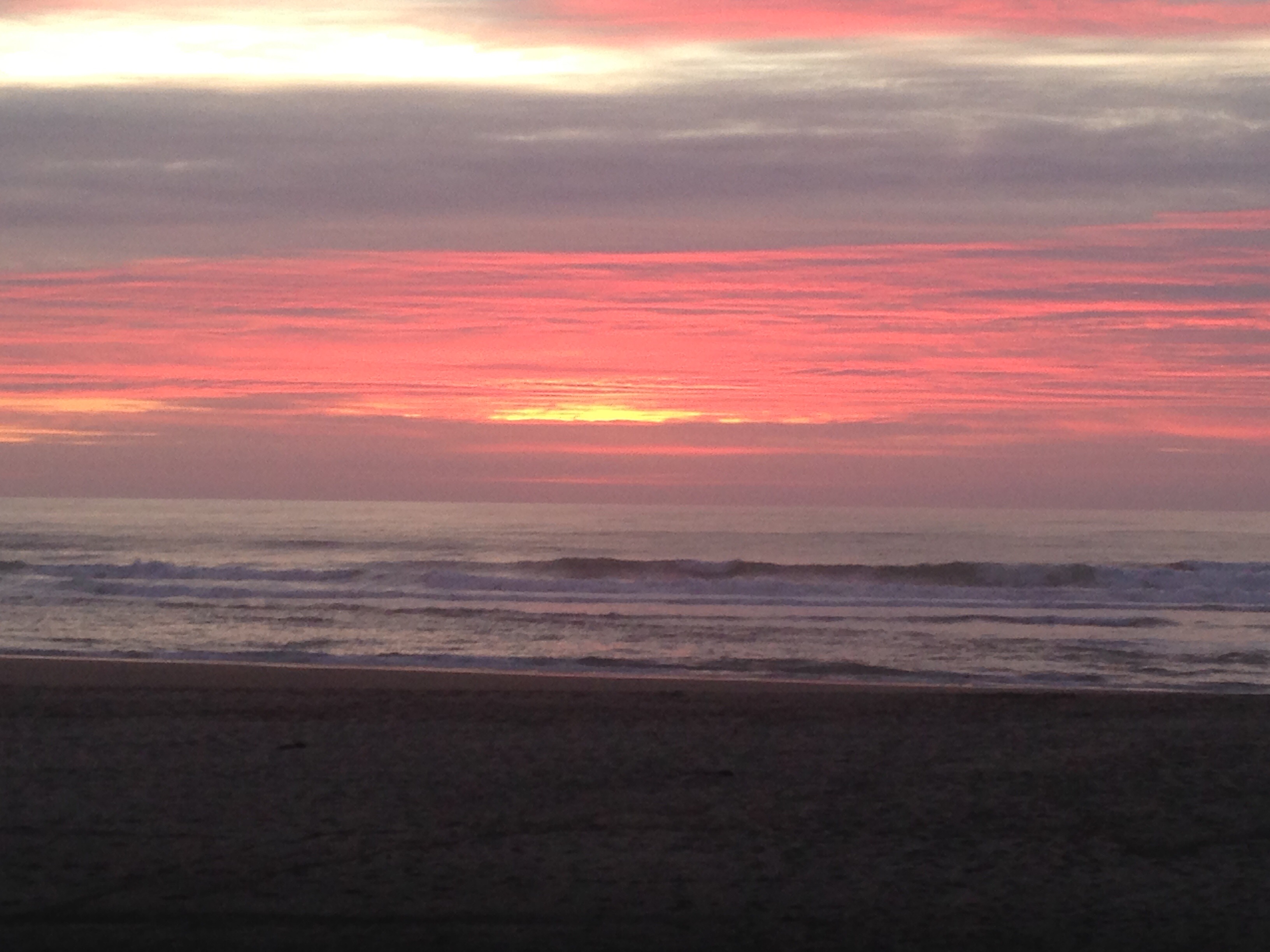
This morning, the colors of the water ranged (appropriately enough) from aquamarine and pale jade to cobalt blue, the deepest teal, and a series of greys from gunmetal to steel. Foam topped the curling waves and washed in on gentle rollers, highlighting the crests with white, ivory, and an algal yellow. 

At one end of my walk along this section of the coast, in addition to long stretches of soft sand, there are outcrops of rocks, half-drowned at low tide, that add interest to the seascape. I walked among them, thigh-deep in the rushing grottoes, smelling the funk of barnacles and anemones warming in the early sun. Seagulls pried at the shells, hoping to find a loose one among the tightly packed multitudes, and plovers poked thin beaks between the stands, searching for worms and other digestibles. The scents of salt and seaweed mingled with the iron smell of sand and the tang of carbonate. It was . . . luscious. I felt at home. I felt at peace. I felt whole.

At the other end of my walk was the D River, the shortest river in the world (running from Devil’s Lake to the Pacific in just under 124 feet at high tide). I stood in the debouchment, where river meets the sea, and silently marked the pendulum of wave and outflow with the words “Fresh water. Salt water. Fresh water. Salt water.” as the river and the sea pulsed to and fro around my feet.

But it was midway along my trek that the Pacific got stroppy. I was walking through a rip, where the curve of the shore focuses the waves and forms a strong seiche of power. The sea pulled back her skirts to show me a graveled bed of pebbles and shells, and then launched a wall of water in my direction. Beneath that lunging froth I glimpsed a flash of red, a sizable chunk, tossed and tumbling in the clear salt sea, coming right at my shin. I stopped and saw that it was a brick, a full-sized everyday brick, red as a brick, hard as a brick, with clean sharp edges. It rolled past my foot, missing me.

Where the hell did it come from? There were no brick buildings I could see along the miles of shoreline I’d walked. The Pacific was adept at throwing pebbles up on the shore here, stones perfect for skipping across a placid lake, bits and pieces broken off from the outcrops I’d visited, but nothing the size of a mason’s brick. Nothing even half that size.

Was it personal? Was the Pacific angry with me? Had I been away from it for too long?

It’s tempting to think these things, to assign reason to an event that is completely random, but that is folly. The truth is that the Pacific, mother of my youth, heart of my soul, is just a body of salty water that has no mind, no intellect, no will, no reasoned purpose. She—and I continue to call her “she”—cannot even recognize my existence. She cannot sense anything.

I know this. 

Yet, I still love this ocean, this birthplace of what I call “me,” and I will still talk to her as I walk her shores, ask her what I should do, and, depending on her mood, I will hear the answers in the murmur or the roar of her waves.

k

Ancora Imparo

One aspect of my life’s recent twist is that I learned something. This is always a good thing, especially when I learn something about myself.

I’m a pretty introspective guy, I think. I’ve always tried to learn from my errors and missteps, but that only works when you see them. Just as it is hard to fix a problem of which you’re not aware, it’s hard to learn from a mistake you didn’t know you made.

A sudden shock can sometimes bring an old habit into a new light. Well, I’ve had a shock, and I can now see something about which I’ve been wrong.

Friends. Continue Reading »

Nuked from Orbit

I never wanted this, but here it is.

You know that saying, Life is what happens when you’re making plans?

Monday night my wife came home from an out-of-town seminar. She told me how it went, what she learned, and we sat down and watched the finale of Game of Thrones. After the credits rolled, she told me she was leaving me, she packed a suitcase, and she drove off.

Yeah. That happened.

Thirty-four years and thirty days of marriage, nuked from orbit.

And now I am a cliché. A greying divorcé who drives a red sports car. Eff me.

The fact that I didn’t see it coming—along with being an understatement—does nothing to dispel the stereotypical pall.

For reasons of honor, privacy, and legality, I won’t litigate the case in a public forum. My perspective is irrelevant, anyway. She’s gone. She’s not coming back. This isn’t a trial separation. It’s the end of “us.”

To be honest, if she was that unhappy, I don’t blame her for leaving. I would have preferred being given the chance to work on it, but that horse has fled the barn. Still, though, I say with all sincerity that I wish her happy and I wish her well.

I never wanted this. I never even dreamed it could happen to us.

But here it is.


k

My garbage, the refuse created by my household, must now be separated into three categories: compostables, recyclables, and, well, garbage. It’s a chore I now have to do, a decision, an evaluation I must now perform each and every time I want to dispose of something. Is this OK to go into the yard waste? Does this plastic have the little recycling triangle, and is it one of the accepted recyclable plastics? Is it clean enough? Yes, I now have to wash my trash before disposing of some of it.

Many stores now have “self-checkout” queues, where I can scan and bag my own groceries. This is sold as a time-saver, but usually it isn’t. Usually, I have to get approval to buy a beer, and usually, I put something into the bag too fast or too slowly for the machine to register it, requiring an override from a person, which means that usually, it’s not a time-saver, it’s a pain in the tuchas and, almost always, it’s slower than letting a pro do it, especially if the pro has been teamed with a bagger.

We pay many of our bills online, but it can be a hassle. The way it used to work, we got a bill, we wrote a check, we mailed it off. It took, literally, like thirty seconds. Now, there are login IDs, passwords, account numbers, and procedures, and if there’s an issue, it can take days to resolve. It is definitely not faster, but when they change the due dates so you only have six or seven days to pay the damned thing, well, sometimes online bill-pay is the only option if I want my payment to arrive in time.

Yesterday, reading an article online, there was a button at the bottom. “Report a Typo,” it read. Excuse me? You want me to proofread your articles? I mean, I expect that from some of the more dodgy publications, but the Boston Globe? CBC? ABC? The National Post? I’ve become so inured to poor editing in online news—typos, bad grammar, extraneous words—that it’s obvious they’re all cutting corners by cutting editorial staff. But asking the public to report typos? Have you seen the posts regular folks put up these days? That’s like asking a sixth-grader to tune-up your car.

My point here is this: Increasingly, we are all being used as unpaid employees and, along with increased automation, we are all tacitly complicit in the ongoing loss of jobs. Every time we check out our own groceries, separate our trash, or edit someone else’s article, we’re taking a job away from someone who can do it better, faster, more efficiently.

Better, faster, more efficient, but also more costly for the corporation. Employees cost money. We, on the other hand, are free of charge. We cost them nothing.

But we, by our compliance, cost someone a job.

My options are limited, of course. I must separate my garbage or deal with it all myself. I can pay my bill with a check but risk it being late. However, I can go the the checkout line with a human (or two) behind the conveyor. I can click that “Report a Typo” button, but not tell them exactly what it is or where.

It’s a small thing, I know, but if it keeps one person from being laid off, it’ll be a big thing to them.

k

Yesterday, I donated my ninety-second pint of blood at Bloodworks Northwest (a name that is much cooler, and more quasi-gruesome than the previous “Puget Sound Blood Bank”).

Yep. 92 pints. That’s 11 ½ gallons.

That’s a lot of blood.

But I digress. Continue Reading »

Say What You Want

Let’s have a discussion about Free Speech.

To begin, let’s go over the basics. The First Amendment does not give you or me the right to say whatever we want; our freedom of speech does have limits. Incitement to violence, threats of violence, and defamation are three of the very few exceptions to this freedom. Hate speech, though, actually is a protected form of speech, as Justice Brennan pointed out in a Texas v. Johnson, concerning flag burning:

If there is a bedrock principle underlying the First Amendment, it is that government may not prohibit the expression of an idea simply because society finds the idea itself offensive or disagreeable.

Given this as a foundation, it is clear that the white supremacists, neo-Nazis, and others of that racist ilk who descended upon Charlottesville last weekend had every right, under our Constitution, to assemble and spew their hate.

However…

They do not have a right to be heard.

They do not have a right to be accepted.

They do not have a right to an audience.

And they most certainly do not have a right to beat, assault, maim, or murder.

As a result…

They should expect to be shouted down at every turn of every street corner of every town.

They should expect to be shunned, ostracized, and condemned by every reasonable person who lives outside their twisted clans.

They should expect to be turned away, denied access, canceled on without notice, and prohibited any privately managed venue.

And they should expect to engender our disgust, and our retributive fury, for the crimes they commit.

Some people have tried to equate the two sides that faced off in Charlottesville, saying that there were violent acts from both factions. While we will never know who threw the first punch, we do know which side came with shields, torches, clubs, and guns. We do know which side surrounded a church and chanted Nazi slogans while the congregants were praying inside. And, of course, we do know which side drove a car, at speed, into a crowd.

I do not condone violence, but if I have to choose between the Nazis and the Maquis, between the Gestapo and the Jewish resistance, between the slavers and the slaves, I know which side I choose.

There is no moral equivalence between these two sides. None. And anyone who cannot see that deserves to be called out for it, shamed, castigated, and voted out of office.

k

Showtime Follow-up

On Monday I mentioned that I had gotten myself into a bit of a sticky wicket by offering to run the kitchen while my wife hosted a business retreat. News that we’d have both gluten-free and vegan dietary restrictions gave me serious agita, as I am not well-schooled in cooking for non-meat-based diets.

With a little research and some creative thinking, though, I managed to pull it off. Cooking double-purpose menus meant that I overdid it a little on the quantities, but hey, leftovers, right? Continue Reading »