The grandson of a charcoal burner (yes, that was a thing), the son of a cement truck driver, my father was an artist by passion and a lithographer by trade, back in the day when his trade was not far removed from actual litho-graphy, i.e., etching graphics on hunks of limestone (like the one I still have, pictured, right).
As his life progressed, the world moved from Ford’s Model T to Tesla’s Model 3, from The Great Depression to The Great Recession, from flying across the Atlantic to flying to the Moon and Mars, and from the wireless and talkies to smart phones and streaming video. Yet through it all, he managed to never use a computer, even when his industry embraced the technology of digital scanning, imagery, and on-demand printing. The closest he got to the digital world was a DVD player (which he rarely employed, preferring broadcast television) and his little clamshell phone (which he used only in emergencies, and often not even then). Continue Reading »
The heroes of my early youth (aside from Walt Disney and JFK) were the astronauts of the Mercury, Gemini, and Apollo missions. Without fail, I would sit down in front of our little black-and-white television to watch every launch, every splashdown. It never got old, especially during the “seven minutes of terror” during re-entry. I read every article I could find about the programs. I assembled scale models of the boosters and capsules. I used words like “gantry” and “gimbal,” and could instruct adults on the meanings of pitch, roll, yaw, and skew.
As the decade progressed, the space race gave me something to focus on, something other than missile crises, assassinations, Cold War saber-rattling, and duck-and-cover exercises. I cheered with each liftoff and exulted at each return.
Then came Apollo 11.
Apollo 11 was different. Apollo 11 was much more than a liftoff and return. It was a culmination of years of rapt attention. The prospect of a lunar landing would have been enough, but a man on the moon? A man walking on that virginal orb, that silvery fingernail lunette, that icon of the feminine, ever-constant yet ever-changing, both young and ancient at the same time? It filled me with wonder, amazement, anxiety, and the absolute knowledge that, if it happened, if tragedy stayed its hand and we succeeded, the world would never be the same.
Then, on July 21, 1969, Neil and Buzz stepped out on the grey dust of the Sea of Tranquility, and the world looked up in awe.
That year, for my birthday I was given the Revell 1/96 scale Apollo 11 Columbia and Eagle kit, which came with a bit of gold-colored foil to wrap around the base of the LEM, and it was the coolest thing ever. I did not approach this build with my usual pubescent fervor. Oh, no. This kit I assembled like a surgeon, removing parts from their runners with X-Acto precision, shaving flash and sprue from the delicate pieces, applying glue with a sparing hand, and affixing the fragile decals of flag and “UNITED STATES” with a steadiness acquired during years of model-building.
The Columbia and the Eagle hung from my bedroom ceiling, a place of honor where, at night, the LEM’s gold foil glinted in the light from the moon their namesakes had visited. Over time, they were joined by the Orion and Moebius (2001: A Space Odyssey), the Hawk (Space: 1999), X-Wings and TIE fighters (do I really need to tell you where they’re from?) until, dusty and cobwebbed, I finally gave them to my kid brothers to enjoy.
With this as prologue, you can imagine my squee-ful reaction when I learned that I could actually own a piece of Apollo history. It took a nanosecond to make the decision.
The item is not impressive. It’s not a moon rock or a dial or a vintage mission patch. But it is special to me.
Pictured above, encased in a Lucite box, it is a tiny square of the kapton thermal protection blanket that covered Columbia, the Apollo 11 command module. This little square has been to the moon and back. Half a million miles. Pretty damned amazing.
at the cliff’s edge the earth falls through giddy space to clammy sands sunlight spears the steel wool clouds and blazes from gunmetal curls brined winds press me back with death-cold hands
hot anger fills me magma of rage ready to spew forth and boil the sea below as I ponder the choice between a hateful god slayer of the young and no god at all
humanity we are upright beasts gifted with massive power over nothing with dreams of eternity circumscribed by birth and death we are ephemeral mayfly deities standing at the verge in sight of the distant shore ready to leap to fly to perish on a solitary sojourn that has no arrival
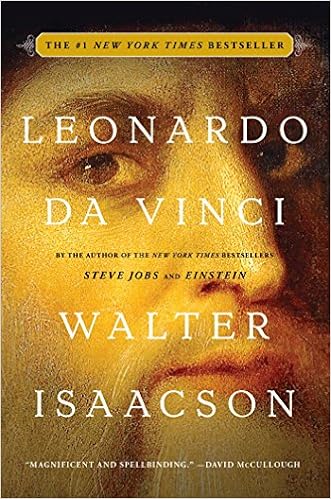
Leonardo da Vinci has fascinated me for a very long time, so when I learned of Walter Isaacson’s biography of the quintessential Renaissance Man, I snapped it up. The hardcover edition is a hefty tome, not merely by virtue of its 624 pages, but also because of the heavy coated paper, employed to better display the many color plates and illustrations that are scattered throughout the book.
Isaacson’s analysis of Leonardo’s life, personality, virtues, and faults, is engagingly warm and human, bringing the deified icon of the Italian Renaissance back down to earth. That Leonardo was a genius is not in dispute—his wide-ranging expertise on everything from anatomy to optics to engineering to painting to architecture provide ample proof of his genius—but he was a flawed one, given to bouts of vanity, arrogance, self-doubt, and impatience. His reputation as a master of science and art was matched by his reputation for failure: commissions repeatedly went unfinished, and projects dragged on and on until patrons found someone else to fulfill their needs. Continue Reading »
On occasion, I ask my brain to go through its memory banks and search for something I know I know, but which I cannot at the moment remember. This search method is a technique honed by decades of living in a pre-Internet world, before Google, Wikipedia, IMDb, and all the rest.
What is her phone number? Didn’t I read a book about this subject? Who wrote that song? Where have I seen that actor before?
I got so good at this that I could do it in my sleep. Literally.
At work, I had all my tasks back-burnered by “walk-on” issues, I called in chits to get assistance from team members who’ve moved on to greener pastures, and I yelled at my boss in an open meeting (no profanity, and no actual “yelling,” per se, but my blood was definitely up).
At home, I tested a new recipe, answered my correspondence, got a chance to playtest a new boardgame, and (after days of back and forth texts) finally got the contractor to agree on a date to start work fixing the back stairs.
But it was my Work-In-Progress that really did me in.
I sat down with what I have written so far and the current outline, and took a look forward. Even though this novel has so far been the hardest for me to write, all indications are that the real struggle is going to be getting it up to a decent novel-length, a realization that thoroughly depressed me. I mean, it’s hard enough to sell a novel these days, but selling a thin novel is likely to be even harder.
There are thin novels out there, true, but in general they’re either classics (when the expectations of novel length were different), or they’re written by established authors. Neither of those cases pertains to me, a modern writer with only modest credits to my name. Word counts of my previous books have all been in the 90–120k range—standard for their genres—but this one looks like it’s going to be closer to 60k.
Some of you may scoff at my struggle to reach 60,000 words. “Pish tosh,” you say. “I know folks who can write 20k in a weekend.”
I know some of those writers, as well.
I am not one of those writers.
In my head, the novel already exists. I know where I’m going, I know how it will all be resolved. But I am not Zeus, and things do not sprout fully formed from my mortal noggin. Putting the words down is torturous, as my desires and my failing confidence vie in a battle royale. Even the good review the WIP got from First Reader cannot cure that malady. It’s why NaNoWriMo is such a turn-off for me; it requires a skill that, try as I might, I cannot acquire, much less master. This book especially, with its new genre and its intensely personal content, has been very difficult to write.
And yet, I want to write it. I want to finish it. I want it to be read.
I also want to sell it, so it can reach more readers than I can garner on my own, but that will be a long hill to climb.
Across the Sound there is a place where, when the day is young, I can walk the forest trail and emerge, my shins wet from wading through ferns heavy with dew, and climb the concrete steps to ramparts set high atop a bluff overlooking the steel-grey waters of the Salish Sea. Continue Reading »



 It’s been a helluva week.

 Kurt R.A. Giambastiani