Feeds:
Posts
Comments

Last month, the power went out on a windless day. Last month, we took a small step away from the digital age. These two events are not unrelated.

Unlike our last home, where the power went out any time a dog barked, the infrastructure surrounding our current residence is fairly robust. So we were surprised one quiet evening when, with only a slight breeze and no rain outside, the house went dark. In the sudden silence I could just hear all the hard drives spin down and all the electronic doo-dahs begin to tick as they cooled. The house, without power, felt dead.

And just as we found the electric bill and the number for the outage hot line, the power came back on.

Leaving me with the task of going around the house, resetting the little red digits on each and every clock and appliance, save the DVRs, which (being rented) are new enough to figure it out for themselves.

I detest this chore. Twice a year, on spring-forward/fall-back Sundays (don’t get me started), I have to do this chore, and if the power goes out, I have to do it again. I hate it. It’s tedious, numbing, and (in my opinion) unnecessary. And when I have to do it because the power went out for just a couple of minutes? Ooooooh. Stay away.

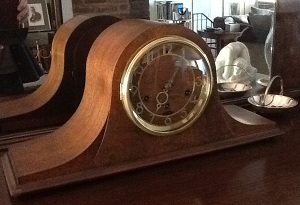
After some discussion and some rather blatant lobbying reminiscent of a child asking Mum and Dad for a puppy, I began to replace our red LED digital clocks with real clocks. For the most part, I replaced them with clocks that go “tick tock,” and several of which announce the hour with chimes or a gong. Being at least as old as I am, all of the clocks required a complete breakdown, cleaning, and oiling, but for me, this was part of the journey; this made them ours, part of our house, much more so than had we bought them at Target and put them right on the shelf.

It’s hard to describe the difference in the house, now. Aside from the obvious—the music of the Westminster on the quarter hours, the bong of the chimer on the half-hour—there is another, subtler effect. There are still a few to go—an alarm clock here, a display clock there—but already the house is a much calmer place. The rooms of our house, each with their small, wood-encased heartbeat, seem more alive. We both find that we like the house quieter, now. The television is off more. We read more, or tinker with small projects. And now, late at night or when the power goes out, time continues, the house lives on, and the steady tick of a nearby clock reassures us, its pendulum measuring out each quiet moment.

Can someone please, please, explain to me the fascination—no, compulsion—to put giant Ferris wheels in front of some of the world’s best skylines?

No, the picture to the right has not been Photoshopped. This is for reals, kiddo. Seattle has a “wheel.”

Why o Why hast Thou forsaken us? I know that Seattle’s streets have an interesting mnemonic associated with Jesus, but now it looks like even the Big Guy has thrown us under the bus.

Seattle now joins Dubai, Beijing, Singapore, London, and several other cities that either already have or are planning to build one of these monstrosities. Sure, you can argue that Dubai’s skyline is already a cartoon come to life and won’t be significantly affected by the addition of a huge carnie ride, and you could also say that Beijing didn’t have a decent skyline to begin with, so anything is a help. But any view of London is now permanently scarred by the addition of the “Eye” on the shore of the Thames, right across from historic Whitehall. At least Singapore had the wisdom to put their “Flyer” off to the side, and not spang in the middle of their skyline.

And now Seattle has one; a 175-foot tall carbuncle on Pier 57, smack-dab in the middle of what was a wonderfully human-scale waterfront. It is an eyesore, a misplaced behemoth. You might as well tie it to “Hammering Man” and make a whirligig out of it. It has completely ruined our balanced, compact, almost Deco skyline. It is the urban developer’s equivalent of graffiti. Seattle, sadly, has been “tagged.”

Ironically, now the only decent view of Our Fair City is from the wheel, because it’s the only place from which you can’t see the damned thing.

k

June-uary in Seattle

Seattle’s reputation for grey, rainy, dreary weather is well known.

I grew up in California, just north of San Francisco, so I know from dreary. In Sausalito, you can set your watch by when the fog rolls in, and that Humphrey Bogart movie set in San Francisco? The one with all the fog-filled streets and misty, noir nights? Well, they didn’t make that up. I also spent some time living in the Judean desert, even vacationed in a spot where it was literally 125°F in the shade. Each climate was integral to the locale; each city had been born there, and would have been out of place in any other clime.

When I moved to Seattle (a quarter-century ago), I knew what I was getting into. I love the rain, the overcast, the clouds, the drizzle. I love the “sun-showers,” the virga (go look it up), even the moss in my lawn. Seattle and I—we’re like that.

Other folks…not so much. And this year is one of those years that tries men’s souls and tests the patience of women. This is one of those years that sends Californian transplants running back south (which explains a lot about Portland, if you think about it) and makes even the hardiest PacNorthwesterner sign up for email alerts for flights to Arizona.

In short, this is a June-uary year, a year where summer looks like it will never get here.

Don’t get me wrong. I’m not a fan of summer. Summer is my least favorite season. I hate traveling in the summer; it’s crowded, hot, expensive, and, well, hot. To me, 73°F is a nice summer’s day, and (despite my time in Jerusalem) anything over 90°F is just evil-hot.

But this year has been exceptionally dreary. Our spring just plain wasn’t, and this June—a month known for “blue-tarp camping” and indoor-contingencies for outdoor weddings—has had maybe…maybe three nice days, all told. And that’s “nice” by my standards, not yours, so you get the picture.

But it’s part of who we are here, like finding two Starbucks catty-corner across from each other at an intersection, like finding seven kinds of IPA at the Safeway, like hearing the grind of studded tires in May even though there hasn’t been snow for months.

And I’m loving it. Saturday afternoon (June 23rd), I sat out on our deck (covered), wrapped in a big-shirt (fleece), sipping a cup of coffee (French-pressed), and listened to the birds sing and the raindrops fall. The cypress branches hung low like rain-heavy clouds and everything was clean and green and moist and beautiful.

Keep it coming, June-uary.

k

You, a Disappointment

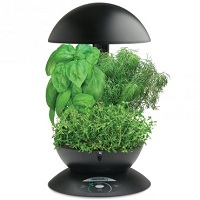
Ever-mindful of the fact that the freshest ingredients make for the tastiest meals, and always on the lookout for products that are economical and can be re-used, the line of AeroGarden hydroponic indoor grow-farms had always piqued my interest. Last year, I got a small one like the one pictured at right, along with two herb seed kits. The results? Well, let’s say that the pictures AeroGarden provides (like the one at right) should be sub-captioned “Results not typical.”

Any foodie worth a pinch of salt would be gaga over the idea of having thick, never-ending bunches of organically grown basil, dill, or thyme at the ready year-round. Well, I was, anyway. And justlookat it! Lush, tall, bursting with aroma and freshness!

Sadly, though the seed “pods” are guaranteed to grow, my first pod of thyme didn’t. And if I thought I was going to be able to rip off stalks of basil for weeks on end, I was sorely mistaken. Another realization was that these plants were no more “organic” than anything I might buy at the grocer’s, because every week I was dumping the contents of a nameless, unspecified “nutrient pack” into the water.

After a month, I was able to get two stems of basil for an omelet. A week later, I could get another stalk, maybe two. After eight weeks of growing, I had only collected as much basil as I got in one $2.99 plastic pack from Safeway. And the Italian parsley? Ha!

So, cost-wise, it was a bust. A $17.99 for a three-pod herb pack only produced a fraction of the herbs I could buy at the grocery store for around $8. It was also a bust by way of quantity; it never produced enough to supply herbs for two meals, much less enough extra to dry.

In short, a disappointment on every level.

My recommendation? Buy fresh herbs at the store, when you need them, or go down to the hardware store and get a 4-inch plant that might give you a second crop. Fresh is worth it, but the AeroGarden is more toy than utility.

k

I'm Melting!!Is every corporation in America as Meeting-Happy as mine?

Recently, my we implemented a new methodology: Agile. We’d already been using it, here and there, but this was an across the board mandate, so that we were “all on the same page.” To be honest, I wasn’t a fan, since after 20 years in IT it was perfectly obvious that this was nothing new; we’d been “agile” back in the 90s and all these guys did was change the jargon. One thing I do like about it, though, is its enforced honesty about how you spend your time.

I just calculated the hours I’d have available for this next 3-week “sprint” (see what I mean about the jargon?). Out of 84 possible productive hours (14 days @ 6 hrs a day), once I take away all the meetings I have scheduled, I have a grand total of 37 hours to apply to actual work. Reduce that by the number of hours I expect to spend handling on-call issues (15) and I have 22 hours of work, or 26%.

Best case scenario, that means I’m spending over half my time in meetings. Planning meetings, “Backlog Grooming” sessions, demos, “retrospectives,” reviews, etc., etc.

No wonder IT has a rep for never getting anything done (or done well). After spending all that time in meetings, we don’t have time to do quality work! We slam it all together in the remaining 25% of our time and hope for the best.

Agile has some good points, but its enforced egalitarianism, born of today’s “Everyone’s a winner!” mentality, is stupendously inefficient. Divide the work, and you get more done faster. If everyone has to be present for every activity, we just get bogged down.

k

Evening-Iris-Cluster

Some things are too good not to share. Check out The Wildflower Scout. Beautiful, and inspiring for anyone with a camera.

20120624-101018.jpgOver on his blog, a friend of mine admits that he just doesn’t grok the whole “Dick’s” thing. This is a shame because, as much of a foodie as he is, this means he is at risk of becoming that most despised of all things: a food critic.

Just as movie critics often lose sight of what movies are for and about—i.e. entertainment—food critics often forget that eating isn’t about cuisine. Eating, arguably the most basic thing in our lives (that we discuss openly), is an experience.

Example: on a recent road trip I spent about 600 miles craving a corn dog. Driving through the high Sierras, through lost towns and backwater podunks, we stopped at several places, but no corn dog joy was found. Then, stopping for gas in northern Oregon, after I had given up all hope, we entered the mini-mart and I smelled that combination of corn and grease that spoke of times gone by. When the unlovely girl behind the counter told me that they just changed the grease yesterday, I ordered two. I sat in that drab mini-mart with its ear-splitting door chime, watched a parade of ugly, tattoed locals come in with a smile and leave with their cases of beer, ate two servings of tasteless tube meat covered in fried corn batter and slathered with mustard that was more vinegar than turmeric, and I was happy.

Dick’s Drive-In is similar. Dick’s is a place the locals know, love, and visit frequently. Just as when, ages ago, I used to take visiting friends and relatives to Starbucks because Seattle was the only place you could find one, now I take them to Dick’s.

Dick’s is not grand cuisine. The burgers will not make you type “OMG” as a caption to your Instagram photo. To be honest, you’ll find a better burger and better fries in many places. But what my dear friend over at Cheap Seat Eats is missing is what the rest of us know: Dick’s is an experience.

When you go to Dick’s, you take a step back in time. You stand in line outside a window (and in Seattle, this is definitely an experience for many). You look at the readerboard menu and goggle at the Henry Ford-esque menu (any flavor you want as long as it’s “beef”). You see the prices and you feel like you’re in an older time–a burger for a buck and a quarter? The “Deluxe” for $2.70? You state your order as you would get tickets at a cineplex, and a very, very young person zips around, gathering your desires; it’s all right there, but you know it’s fresh because the food is just flying out of there and all will need to be replenished in minutes. You get your grease-stained bag and go back to your car, and you want to eat it right there, no waiting, and often you do. And when you take that bite, sitting in your latest-model vehicle, swathed in the scent of grease and meat, you are transported, and now you are sitting on a bench seat with a massive steering wheel and Buddy Holly playing on the AM radio. The lettuce may be wilted, the fries may be soggy, the condiments may be a little on the sweet side, but that burger tastes just like that burger you had as a kid, back before the world went to hell, back before you had to worry about mortgages and college tuition, back when summer was a golden, shining thing waiting for you at the end of the school year. And you are happy.

When you leave Dick’s, if you’ve paid attention, that happy will last for a while.

Now that, my friends, is a burger.

k