Feeds:
Posts
Comments

Angle of Incidence

This week, we decided to go to WinCo on Wednesday, because, I mean, who goes to the grocery on a Wednesday afternoon?

It had not been a great week—work had been a pain, our joints were aching—but our vacation was to begin on Friday afternoon, and we didn’t want to start the vacation with an errand. Thursdays, on the other hand, are never great at WinCo because, well, no one wants to start their time off with an errand, either, so Thursday was right out. Thus, Wednesday it was and, despite the fact that I was working with an injured ankle, and she was working with a bum knee, and we were both grumpy from [gestures to everything in general], off we went to WinCo because like I said, who goes shopping on a Wednesday afternoon?

I’ll tell you who goes shopping on a Wednesday afternoon. The entire 4th Battalion goes shopping on a Wednesday afternoon, that’s who.

Well, not literally, but damn, it seemed like it.

The parking lot was only middling full, but once we entered the store it was clear that something was up, something was different. Patrons stalked the aisles slowly, cautiously, as if expecting an ambush, as if raiders lay in wait around the end-caps, ready to rush in and capture the contents of their carts. And oh, those carts were full, so full, full to brimming, full to the point that they made the carts’ little wobbly casters scream from the sheer weight stacked upon them.

These were not casual shoppers. These were not folks stopping by for a quart of milk on their way home.

These people were serious. These people were seasoned veterans. These people were not to be trifled with. You could see it in their eye; heads on swivels, searching for deals, for discounts, comparing unit prices, ounce to ounce, doing long division in their heads, determining cost and return in a blink.

The weaker ones had already been weeded out. We came across the remains: carts half-filled, left askew in the center of an aisle, the contents abandoned as shoppers fled the field.

Walking the aisles, we crossed paths repeatedly with one family—Mom, Grandma, two Daughters—who were pushing two carts like a tractor-trailer rig. Our paltry list, our sparsely populated haul, seemed like a sign of the neophyte, a target for hazing. We added a 12-roll package of toilet paper to fill it out, to make it look like we, too, meant business. Probably a rookie move, but it bolstered our resolve.

We moved quickly but with purpose, efficient but without haste, from produce to baked goods to dairy to frozen foods and, at last, to the rank of checkout lines where we craned our necks and I used all of my 6’2″ height to see which line was the best line.

There was no best line. None.

First, only four lines were open. Four lines and probably twenty people waiting to check out. And with each of those twenty, a cart overtopped, groaning with booty.

Moving blindly to the end of the nearest line, we prayed that some employees would finish their break and open up new queues. God answered our prayer: “No.”

As evidence of how cowed, how shell-shocked we were at this point, I will tell you that it took a full ten minutes before I realized that, ahead of us in line, were Mom, Grandma, and Daughters, the family we’d encountered several times on our trek. And it took another few minutes before I realized that instead of two carts filled with goods, they had three. Three full-sized carts stacked high and deep with items large and small. I admit; I gawked at the scale of it. Literally gawked. Eyes wide, mouth agape, gawking.

“We’re doomed,” I whispered to my wife. I think she may have begun to weep.

But then, as the family approached the checkout conveyor (no, they were not even the first in line, and hadn’t even begun to unload), something happened. Dad appeared.

He had a bag of bagels in his hand. He showed it to Mom. She shook her head, and off he went. He was running recon for her, a scout heading back out into the bush, gathering intel. He came back with two different bags. “English muffins,” I heard her say, but then she took one of the bagel bags. “This’ll be fine,” she told him, and then he was off on another mission.

Then, as they reached the conveyor and Grandma (and Daughters) began placing the first of hundreds of items on the belt, something else happened. Grandpa appeared. And two Sons.

Grandpa and Sons positioned themselves, with an empty cart, at the end of the second conveyor belt (at WinCo, we bag our own groceries). While Grandma and Daughters were feeding items to the checkout clerk, Grandpa and Sons (well, mostly Sons) were bagging up what the clerk had rung up and filling the empty cart.

And over it all, Mom was running the campaign with the smooth confidence of a four-star general. There was no bickering. Hell, there was hardly even any conversation. It was a massive operation, a logistical ballet, all coordinated and directed with a look here, a gesture there, a kind but firm word placed in a listening ear.

And then something else happened.

I realized that, at some point, my annoyance at the interminable wait had disappeared, poof, replaced by a sincere appreciation (and not a little respect) for the quiet, efficient, beautiful functionality of this family team. At some point, my attitude had been changed, and what had before felt like a turbulent trip was now smooth flying.

Sometimes, it really is in how you look at things.

k
Garden Party

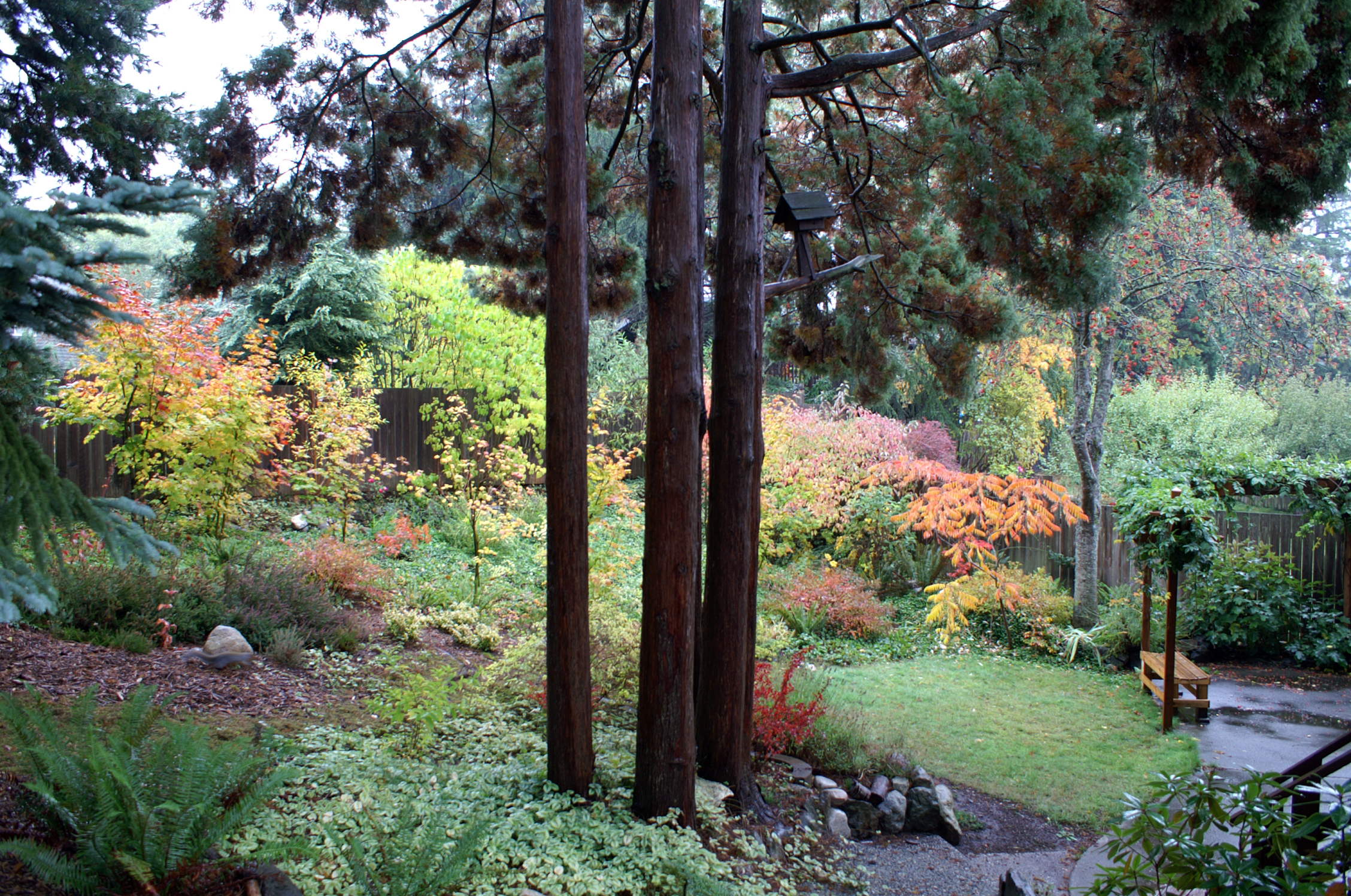
sumac, feathered fronds waving, hear it first
autumn’s gentle rapping on the garden gate
put on parti-colored togs to greet the arrival

nearby maples eavesdrop on the reunion
catch half the meaning but all the sense of joy
don festive gloves on five-fingered leaves

sweetgum and dogwood wake with a start
having overslept in summer’s waning sun
leaves blushing with groggy embarrassment

wisteria, in denial, refuses to join the fun
and with tendril fingers in viny ears
will sing la-la-la until their guest departs

evergreen elders tower over the festivities
enjoying the youthful exuberance at their feet
preparing for storms they know will come

I’ve been working full-time since 1980 and in that time only once have I had a three-week vacation.

Like most workers my age, when I started working full-time, my time-off allowance (if I had any) would only cover sick days for the occasional cold or flu. Later, as I developed my career, I accrued enough hours to take a week off during the year, as well. About twenty years ago, I had sufficient seniority at my firm to take two-week vacations. Bliss! Two weeks was enough to spend a week powering down from the stress of the daily grind, and still have a week to really enjoy the time off. Eventually, that time-off allowance grew large enough that I was able to manage an entire three-week vacation. That was about ten years ago, and it was the only time in those forty-three full-time worker-bee years that I had such a stretch of time away from the work-a-day world.

Today, though, is a milestone, as I am 200 days away from a very long vacation: on April 1, 2024 I will retire from my firm, after working there for 33 years.

There’s a lot wrapped up in that because in addition to retiring soon, I’m also turning 65. As I mentioned last week, we’ve been quite busy this year preparing for the transition, and yesterday was a big one: we met with our Medicare Guy.

I’ll tell you at the outset, when it comes to Medicare, seek advice (and not just from friends and family). Seek advice from a professional. Find an independent broker* (i.e., someone who isn’t tied to a single insurance provider). Find someone who is responsive, experienced, and able to assist you in navigating the myriad of options available. I tried four different brokers before I found “our guy,” who will help us not only sign up, but will provide ongoing advice through the years as plans and policies change.

Yesterday, we had a two-hour meeting with him, and we came away from it frazzled, fuzzy-brained, deluged with information, but ultimately much more comfortable and confident that we can do this.

We still have a lot of work ahead of us, and many decisions to make, but we have greater knowledge now, knowledge that will help us make better decisions. And—more importantly, for our peace of mind—we also know that whatever decision we do make, it’s not written in stone. If it turns out the choice we made isn’t working or (crucially) if our situation changes, we can change our coverage options to accommodate.

All this is very boring, not at all artsy or creative, and has nothing to do with what I usually bang on about here, but wow, I cannot tell you how much it helped. And it’s a lesson that can be applied in other areas.

Asking for expert advice is not a sign of weakness or failure. It’s simply an acknowledgment that I don’t know everything (gasp!). Just as I ask a doctor about medical issues and don’t rely on whatever advice the TikTok algorithm sends my way, so too will I ask a professional about areas in which I have little or no expertise. This only makes sense.

So, that’s today’s totally boring and very un-entertaining post. I’ll get back to more creative stuff, hopefully soon.

k

* This advice holds true also for financial advisors. Pick an independent advisor, who isn’t beholden to a specific financial institution. They cost more, but the difference is you get totally unbiased assessments and recommendations, because they make their money from you, and not from some financial institution in the background.

Bless me, Reader. It’s been three weeks since my last post.

Why? Because my calendar broke. Or more accurately, my introvert calendar broke.

What’s an introvert calendar? A calendar with nothing on it. Clean slate. Empty boxes with no fixed engagements. A fully functioning introvert calendar doesn’t mean I plan to do nothing. It means I have nothing planned. Big difference.

In this, my last year before retirement (T-minus 207 days and counting), there is much to do, and we’ve been doing it. Our calendar—especially during the past two months—has been chockablock with appointments, meetings, consultations, meet-n-greets, follow-ups, examinations, and procedures. We’ve seen doctors, dermatologists, radiologists, phlebotomists, dentists, and oral surgeons (yes, #32 strikes again). We’ve met face-to-face with financial advisors, Medicare consultants, contractors, plumbers, and suppliers. And, somehow, we also managed to squeeze in a birthday (hers), a 40th wedding anniversary (ours), and even a few social engagements.

For anyone it would be a serious course in Advanced Adulting, but for a serious introvert like me, it’s been all that whilst running a marathon, and to be perfectly frank, I simply haven’t had the spoons for anything creative. My brain has been filled with concerns, info, deadlines, questions, and fretfulness both reasonable and un-, so my gardening mode has been “maintenance,” my cooking has been pedestrian, my reading has been limited to emails and current events, and I’ve written little and woven even less.

However (thankfully) September’s schedule has a bit more white space than did July/August, and we’re both counting on October to remain featureless and calm as the doldrums, because come November, it’s a new round of activity, with another birthday (mine), the holiday season, some brief travel, and a bathroom renovation stuck in for good measure.

But here’s the thing I want to pass along: during this time of non-creative busy-ness, I chided myself for avoiding creative endeavors, or at least I did, until I actually looked back at the calendar (the broken calendar) and saw just how busy we’ve actually been. Creativity takes energy, and as an introvert, I need quiet to recharge my batteries, and I haven’t had any of that. All of my energy has gone into what was needed, leaving little (or none) for what was wanted.

So when you find that you haven’t gotten back to that quilting project or written that poem, when you find yourself exhausted at the end of the day with no energy for that new recipe or insufficient focus to get back to that book you’ve been reading, take a breath and admit two things: we all have only so much energy, and we have to prioritize demands on it.

Life is rarely constant; it much prefers cycles, rising and falling, waves and troughs. As long as we keep creativity on the To Do list, there will eventually be time for it.

Just keep it on the list.

k

Walking my garden paths
fingers inspecting leaves
snips cutting spent blossoms
I hum a tune born
four centuries past
across continents
and seas

I wonder if the author
as he wove his tapestry
of notes and voices
imagined his music
would live beyond his life
persist through time
as empires rose
and fell

I wonder if he
as the ink dried on
quavers and triads
imagined his melodies
would grace the flower-scented air
of distant gardens
in a land
unknown


do not put vowels
in the dishwasher
as they are made
of air and intention
and will likely melt

consonants are built
of sturdier stuff
and may go in
the upper rack

punctuation is best stored
in the garage with
nuts and bolts and
other fasteners

words once crafted may be
machine-washed and tumble-dried on low
but avoid fabric softener
unless the water is
especially hard

take time assembling
phrases and sentences
aligning them to the meridian
in a clean well-lighted place
free from excessive drafts

paragraphs benefit most
from a finish on the line
in springtime when the
breath of the waking world
begins to blow

non-fiction requires precision
and regular maintenance
so for peak performance
tune to 4° before
top dead center

patience is recommended
when assembling fiction
to ensure tight seams
and a proper fit

stir poetry
over low heat
until reduced
by half


k


The Non-Event

This weekend is a milestone for us, my wife and me. It’s our 40th wedding anniversary.

We’ve learned a few things over these four decades, but the most important lesson has been “How to Communicate.”

Case in point: Last night I delivered a critique based on bad information. I’d misunderstood something my wife had said, made a judgment based on that misunderstanding, and calmly supplied her with my ill-wrought criticism. Naturally, it didn’t go over too well. Thirty years ago this might have ended in a row. Twenty years ago, we’d probably have bickered and sniped. Ten years ago, there would have been an airing of our grievances, but we still would have ended up a bit bent out of shape.

Last night? After a brief period of quiet, my wife informed me of my mistake, correcting what I’d misinterpreted. In response, I agreed that I’d obviously gotten it wrong, retracted my statement, and thanked her for setting me straight. A non-event.

This improvement has not been a straight line progression, and some topics are obviously more fraught than others in this regard. The point, though, is that we’ve been working at it, via both introspection and dialogue, refining and adjusting our attitudes, our approaches, and our methods.

Relationships aren’t constant. They change with conditions and react to events. They strengthen. They become strained. Sometimes, they break. Sometimes, they should break. But with attention and communication, they almost always can be improved upon. The “more perfect Union” is a goal worth striving for.

k