Feeds:
Posts
Comments

Archive for the ‘Culture’ Category

Alas, despite my new diet, some memes are unavoidable. This new one, with POTUS supposedly dissing businesses, has come at me from all angles. News, Facebook, emails, workplace chitchat…this argument has been carried into my personal sphere by almost every vector available.

Whenever I am faced with a diatribe, I first like to look into the source a little more. Then I like to give it a little think.

By looking into the source, the first thing I found was that, true to form, the anti-POTUS rank has snipped and clipped the video like an Elizabethan coin. They’ve taken the 5 seconds they want, the 5-second sound-bite they could really give a good spin, and tossed the rest. POTUS says: If you have a business…you didn’t build that.

Well, first, that’s not the exact quote, and second, if you back the clip up by just 2-3 seconds, you see that he’s talking about something else. Watch the whole clip and see if you don’t agree. What POTUS is saying is that hey, all these roads and bridges, if you own a business, all that infrastructure? You didn’t build that. But, of course, that doesn’t take a right-hand spin as well, so it was dropped.

So, all the arguments you hear are not about something POTUS meant, but about a segment of the idea he was presenting. Typical.

Second, by listening to the arguments that were made and giving it all a think, it was clear that what all the furor boils down to is a difference in how we perceive the individual.

Some people see individuals as an island, a rock standing up against the world. For these folks, a person who starts a business is solely responsible for its success or failure. Devil take the man who says otherwise, and to Hell with him who tries to chisel away at the financial gains because they sure as hell don’t share in the financial ruin. For these folks, it’s about the money, and that’s an end to it. They put up the money, therefore they get all the glory or all the notoriety. The math is simple.

Others (like myself), see individuals as part of a larger whole, a member of a society. For me, a person who starts a business is the impetus, but shares responsibility for success and failure with employees, regulatory bodies, and whatever customer base the business targets. And there is a different calculus that separates financial gain/loss with social gain/loss. A good business builds both financial gain and social benefit, grows with the help of the relationships it makes, and succeeds or fails depending on the value it provides. The math is complex.

I used to work for a man who, at the beginning of the “mission statement” era, said to us, “Our mission, our purpose here, is to be in business next year. Our goal is to keep us all employed.” He understood that, despite being the man who had the idea, the man who put up the money, we were all part of a team, a team that included his employees and his customers. We were a small society, providing mutual benefit. He recognized that though his financial risk was higher, we all shared in it. Employees trusted that their paychecks would clear, that the benefits would come through when needed, and that the pension funds wouldn’t be raided. He, in turn, trusted in us to do a good job, to work hard, and to give him value for our exchange. We all worked for the combined benefit. For his entrepreneurship, and for his higher risk, he got more of the gains, and none of us begrudged him that gain.

His goal wasn’t to make a pile of money and bail out with a golden parachute. His goal wasn’t to build his portfolio, or do whatever it took to ensure the dividends his investors demanded, even if it meant stripping companies or firing his domestic workforce. His goal was, simply, to provide income for himself and his family, to provide employment for others, and to provide a marketable service for his customers.

He was not working for himself. He was the owner, but he was not working for himself. We were all working together.

He was my Mr. Fezziwig, and I haven’t seen his like since.

Read Full Post »

Obey the Kitty!I have put myself on a “news diet.”

A “news diet” is where you severely limit your intake of news reports, news shows, news feeds, and general punditry.

As the election cycle shifts into top gear, we get bombarded by more and more input. Unfortunately, this input provides less and less content as the positions of the various sides divide and solidify, and rhetoric coefficients grind upward toward what will undoubtedly be an hysterical fever-pitch by November.

Case in point: For years, I was a faithful Sunday news show watcher, but that habit collapsed with the sudden death of our beloved Tim Russert. My interest was revived for a while, when Christiane Amanpour took over the helm at “This Week,” but when her stint ended, so did my renewed interest.

I still check in on the shows, now and again, and last Sunday I rose a bit early and sat down with my coffee to give “This Week” a look-see. What I saw, infuriated me. When boiled down to its essential components, the first 25 minutes looked like this:

George asks Question A.
Faction-X-Representative gives answer to Question B.
George asks Question A again.
Faction-X-Representative gives answer to Question B again.
George shrugs, and moves on to Question C.
Faction-X-Representative gives answer to Question B, yet again.

Switch to Faction-Y-Representative.
Repeat.

This is repeated on every Sunday news show, and it is without a doubt the most ludicrous excuse for news I have seen. These shows do not provide any news and they are not even providing useful content. They have become nothing more than a soap-box from which each faction can deliver their spin and rhetoric for 15-20 minutes, free of charge. It is then followed up with another 25 minutes of “analysis,” in which the pundits merely restate the rhetoric of their favored faction (Mary Matalin looked positively foolish, trying to dodge and twist questions to fit her prepared talking-points answers.)

But this is only the most egregious example. Already, this dilution and corruption of the news extends to every media outlet. Every story of a political nature is nothing more than a tit-for-tat exchange of platform language. Soon, any story that can be tied to policy will have its portion of spin, and eventually, even current events reportage will reach us colored by various political spectra.

So, my “news diet” is as follows:

  • Sunday news shows and pundits: cold turkey stop (Sorry, Rachel; love ya, but it’s for my own good).
  • National news outlets: only the first 10 minutes of the main broadcast, and only a couple nights a week.
  • Local news outlets: check headlines and weather online, no opinion or op-ed pieces.

It’s the only way I’m going to stay sane until November.

k

Read Full Post »

1972 Sheaffer Stylist White Dot Fountain PenI used to be much more disciplined about “writing time.” I also used to have crushing deadlines, which were a great motivator. Now, I have less time, my monkey-boy-day-job is more demanding, and it’s just damned hard to find time to shut myself in the back room, sit down at the computer, alone, without distractions, and pump a couple thousand words past the CPU.

To counter this, I’ve tried many tactics. First, I bought a netbook, thinking it would allow me to work anywhere; it turned out to be too slow and underpowered to provide any real convenience. Then, I bought a keyboard for my iPad, but while faster, it proved to be too clumsy to balance on the bus and still required a larger chunk of time in order to be productive.

So, I went Old School, returning to my writerly roots, as it were. As some of you know, my first books were written longhand, with pen on paper. Yes, kids, I actually wrote four whole novels without the aid of a computer. I swear it’s true; FC:I-II and PC:I-II were all written with a Uni-Ball pen on Cambridge steno pads.

This new/old method has increased my productivity for several reasons. Primarily, it is more suited to my Basher style; cudgeling out a few dozen or maybe a hundred words at a time is much easier than trying to force out a couple thousand words. It is also perfectly suited to my catch-as-catch-can writing schedule, allowing me to squeeze out a couple of lines at the bus stop, en route to the transit station, while waiting for a program to compile, or as I’m cooling down after my workout.

There’s also another, less obvious benefit: because writing with pen and paper is slower than typing, the resulting prose is the product of a more thoughtful and deliberate process. Writing with pen on paper increases the lyricism of my prose, and what ends up on the page is tighter, less cluttered by unnecessary wiggle-words, and is closer to what I really wanted to say. Yes, there are lots of cross-outs and insertions (see picture), which yes, looks as if I editing as I go along (Bad writer! No biscuit!), but this isn’t really editing; this is searching for the narrative path.

Moreover, writing with pen and paper just makes me feel like a writer. It is how almost all of my favorite authors composed. It’s an organic, completely natural way to create, completely divested of the trappings and necessities of computers and cables and cords. It’s immediate, it’s personal, and to me, it’s more than processing words; it’s writing.

k

Read Full Post »

Obey the Kitty!If I told you that the problem with your kids is that they think too much, what would you say? Well, that’s what the Texas GOP is saying in their platform section on education.

We oppose the teaching of Higher Order Thinking Skills…, critical thinking skills and similar programs…which focus on behavior modification and have the purpose of challenging the student’s fixed beliefs and undermining parental authority.

I knew it! All those pesky teachers, sitting in their classrooms, waiting—just like a spider!—until we send them our kids so they can teach them to think for themselves! Damned commie pinko junkies!

There are other gems in this section of the TX-GOP platform, including:

  • A rant against multiculturalism (It’s divisive.)
  • A hoo-rah for corporal punishment (We’ll beat your kids for you!)
  • A contradictory statement against disciplining kids without consent (We’ll beat them, but only if you give the green-light.)
  • A Henry Ford style approval of sex education (Teach them anything, as long as it’s “abstinence before marriage.”)
  • A curriculum weighted heavily with founding documents, including Founder’s writings (I guess they never read Ben Franklin’s “Fart Proudly”.)
  • The complete removal of any sort of oversight to private education (Hell…anyone can be a teacher; what’s so hard?)

And, in a final, oxymoronic, only-in-Texas coup de grâce:

  • All controversial topics such as evolution and climate change should be presented as “challengeable scientific theories” (which would be great except that, oh yeah, we don’t want to be guilty of “challenging the student’s fixed beliefs and undermining parental authority,” remember?)

In short, it’s the kind of approach to education that evokes an image of millions of students, standing rank and file, each holding up their little red book. It’s the kind of approach that fosters bovine complacency and stifles genius. It’s the kind of approach that says:

“Don’t question authority.”
“Don’t worry your pretty little head about it.”
“The nail that stands up will be hammered down.”

From a purely sociological viewpoint, it would be interesting to compare the graduates of this educational policy with those of other methods, but I’d prefer to start with a smaller test group than the whole State of Texas.

k

Read Full Post »

Kurt R.A. GiambastianiWhen you hear the phrase “class action lawsuit” you probably think Big Tobacco or (if you’re lucky) Erin Brockovich. You probably even get a “David and Goliath” feeling inside, where some virtuous law firm takes on an Evil Corporation, all to help a group of people injured or made ill by some dastardly act of depraved indifference.
Yesterday, I got a settlement check in the Hanson v. Google class action lawsuit.

It was for $0.02. That’s right. Two red cents. So, now, I’m going to get my two cents’ worth out of it.

Class action lawsuits are primarily a tool to feed, clothe, and provide shelter for lawyers. I’ve been a “member” in several class actions—against travel websites, against Google, one against Sony (I think), and a couple of others. In each case, I’ve received a letter, filled out a form, sent it in, and forgotten about it for years until, one day, I got a coupon for a discount at the defendant company, or a check for twenty-five cents, maybe $5, and once my wife and I each got one for $18. Wow, wasthata red-letter day!

My point is that, in all of these class action lawsuits—and thus extrapolating outward to presume that in most class action lawsuits in this country—the settlement is never worth much of anything to the class members. Who comes out ahead? Well, of the $20M settlement,

  • The two “named plaintiffs” each get $20K
  • The rest of the “class members” get checks, some worth $50 or $100, but most of us get something under $1

and, you guessed it

  • The law firm gets $5.25M

No wonder these class action lawsuits pop up like dandelions in April.

k

Read Full Post »

Welcome to the New Dark Age.

How’s that, you say? Let me explain.

We are moving through a time when the majority of information is being stored digitally, and only digitally. Memos, letters, pictures, books, even movies, all only exist—in an increasingly large percentage—only as binary ones and zeroes on some form of digital media. Add to this all the information that exists only on websites, and you have a staggering amount if information that is, essentially, ephemeral. The British Library warns that we are already losing information, some of it important cultural information, from websites that come and go with the cultural tides. Additionally, irreplaceable scientific data may have already been lost through our inexorable march from one media to the other.

Have any old cassette tapes? Any old 3.5″ floppy disks? A tape drive for your old PC? Have any music or video stored in MP2 format? I do, and all that data—old music, pictures, stories, poems—is lost because I can no longer access it.

Let me put it this way: I have, on my desk, an edition of the Bible, printed in 1701 (pictured), complete with explications and marginalia. I can read this just as easily today as Isaac Newton could have (okay, not quite as easily, as my Latin isn’t as good as his was). I have a book, purchased in the late 90s, for use with my REB1000 eBook reader (yes, I was one of the first to try an e-reader). I cannot read it. My REB1000 is long gone, and the book’s proprietary format is indecipherable. Think about that: I can read the first book, in its original form, three centuries after it was published, and yet I can’t even view the one I bought less than twenty years ago. And don’t get me started on how many times I’ve had to buy The White Album…

Fast-forward 300 years…what will future historians find, looking back on this time? All the websites from our time are gone (What? You think Google is backing them up? Think again!). All the music, stored and delivered digitally, is in a format they can’t decode. Billions upon billions of photos, personal and professional, were lost simply through hard drive crashes. And books? The explosion of the e-book/e-reader market crushed the hardcopy publishing industry and many books, bestsellers in their day, were published only in electronic format. Think that 300-year old Kindle will fire up?

It’s not that we can’t retain all this data, and it’s not that we can’t transfer or convert all these media as new formats emerge. It’s just that we aren’t doing so.

As a species, we have all the foresight of a bug flying down the interstate. Time and again, we simply do not see the semi heading toward us until we’re splattered on the windscreen. The future may look bright and shiny, from our point of view, but from up there in the future, the view back may be much darker than we imagine.

Read Full Post »

I was born in Northern California, and all my young life, I was lulled to sleep by sounds of the night.

In the spring, the tadpoles came into frog-hood and set up a chorus that filled the moonlit air. On mist-shrouded evenings, the foghorns mourned across San Rafael Bay. On trips to the coast, the darkness was awash with the rumble-rush of waves and the bark of seals. And always, everywhere, as soon as twilight settled in, crickets began to sing, each one weaving a thread into the tapestry of sound, one reedy note at a time, to blanket the night.

The sound of crickets, ubiquitous and constant, came to mean something to me. Unknowingly, cricketsong meant home, security, and peace.

Then I moved to Seattle.

For months after moving here, I felt uneasy, unsettled. Even after I got a permanent job, a spot in the regional orchestra, and moved into a cute bungalow in a quiet neighborhood, I felt…at odds with the place. It struck me one evening when I was out tending the garden. It was a bucolic scene: the light had moved from dusk into gloaming, the horses across the bridle trail that backed our yard munched contentedly at grass, and the scent of roses was thick after the day’s warmth.

And nothing made a sound. No frogs, no night-birds, not even a cricket.

Seattle, as it turns out, has no crickets. I’m guessing that this is due to the moisture and the lack of summer heat, but I don’t know. What I do know is that crickets will sing constantly through the evening unless you come near them. Thus, a night without cricketsong felt ominous, as if something was out there, lurking, silencing the crickets with its presence.

I got used to it, over time, learning to sleep well and find peace without cricket-aid. And then, last night, I replaced my electric alarm clock.

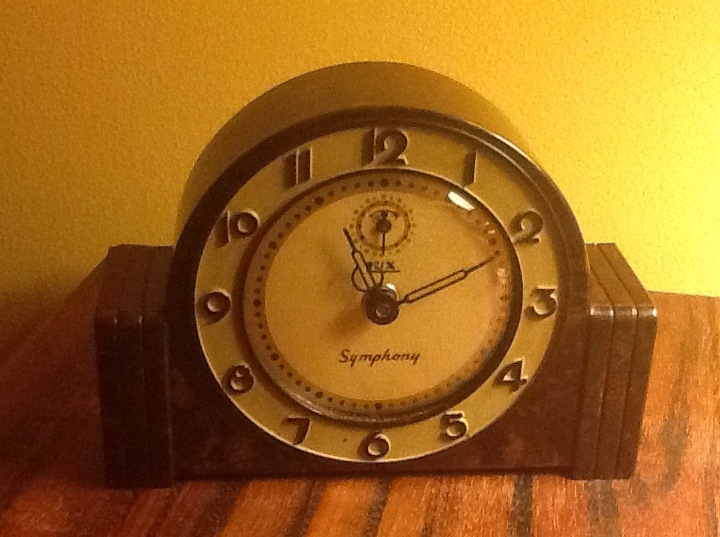
The Lux “Symphony” is a wonderful piece of Art Deco design from the 1930s and, after a good cleaning/oiling, mine now runs perfectly. Last night, I took my electric clock away and put the Lux on the nightstand.

Laying down to sleep, I felt suddenly younger. It wasn’t hard to pinpoint the source. The sound of the clock’s mechanism, the twice-per-second tick of the brass and steel escapement, made a quiet background noise that filled a void in my brain. The Lux had become, in essence, a mechanical cricket, and its constant, unerring heartbeat struck within me a chord long left silent. I slept well and woke refreshed; it may be coincidence, but something tells me otherwise.

Read Full Post »

« Newer Posts - Older Posts »