Feeds:
Posts
Comments

Archive for the ‘Culture’ Category

This weekend is a milestone for us, my wife and me. It’s our 40th wedding anniversary.

We’ve learned a few things over these four decades, but the most important lesson has been “How to Communicate.”

Case in point: Last night I delivered a critique based on bad information. I’d misunderstood something my wife had said, made a judgment based on that misunderstanding, and calmly supplied her with my ill-wrought criticism. Naturally, it didn’t go over too well. Thirty years ago this might have ended in a row. Twenty years ago, we’d probably have bickered and sniped. Ten years ago, there would have been an airing of our grievances, but we still would have ended up a bit bent out of shape.

Last night? After a brief period of quiet, my wife informed me of my mistake, correcting what I’d misinterpreted. In response, I agreed that I’d obviously gotten it wrong, retracted my statement, and thanked her for setting me straight. A non-event.

This improvement has not been a straight line progression, and some topics are obviously more fraught than others in this regard. The point, though, is that we’ve been working at it, via both introspection and dialogue, refining and adjusting our attitudes, our approaches, and our methods.

Relationships aren’t constant. They change with conditions and react to events. They strengthen. They become strained. Sometimes, they break. Sometimes, they should break. But with attention and communication, they almost always can be improved upon. The “more perfect Union” is a goal worth striving for.

k

Read Full Post »

it’s broke, so broke
I wake and feel
each day’s harsh edge
broke like torn tin
sharp and hungry
unforgiving

why so angry?
so harsh, so cruel
as if people
weren’t people
as if kindness
had no value

we want we want
it’s all we know
we take we take
it’s all we do
our circles shrink
collapse, darken
into a void

I don’t believe
in souls or gods
though I did once
a long time past
but then people
showed me their truth
and it seemed best
to believe them

Read Full Post »

  • “Top 10 Reads for the Summer”
  • “The Best Games of 2023, Ranked”
  • “Twelve Items Every Pantry Must Have”
  • “5 Movies You Need to See”
  • “Seattle’s Best Restaurants”

There is no scarcity of voices eager to tell us what to do, what to like, what is good. “Listicles” abound, plastered with headlines shot through with words like “Best” and “Ranked.” But, “Best” according to whom? Who decides how these things are “Ranked?” Not me, for sure. Probably not you, either. But here’s the thing:

  • I’m enjoying a book my friend didn’t like.
  • The music I’m listening to is probably not on your playlists.
  • I loathe brie cheese.
  • A well-maintained and -manicured lawn is my idea of a crime against nature.

In other words, my tastes are different than yours, and yours are different than mine. And that’s okay.

My tastes in music, books, and cuisine aren’t better than anyone else’s. Yes, I was trained as a musician, have written novels, and have taught myself to be a better cook, but my personal likes and dislikes in these areas aren’t better. Obviously, they have been influenced by what I’ve learned, but they’re not better. “Better” presumes there is some Platonic ideal against which all others are found lacking, and while this might work for some objects, when it comes to things like sandwiches, it’s useless. There is no “best” sandwich. There’s just your favorite kind of sandwich. And there’s mine.

“Bestseller” doesn’t mean “best,” and it damned sure doesn’t mean you’ll like it. Neither do awards, kudos, upvotes, likes, retweets, or some stranger’s rankings.

Where there are quantifiable characteristics that can be evaluated, let’s compare and discuss them; we might learn something, see something we never saw before, and possibly modify our opinion. But when we’re dealing with the unquantifiable, when we’re talking about basic visceral likes and dislikes, we just need to chalk it up to personal preference.

I’ll enjoy what I enjoy, and you do the same. I won’t think less of you because you love brie cheese (though I may wonder how you manage it).

In short, I don’t want to yuck your yum.

k

Read Full Post »

I’ll be honest. Death has been on my mind. For a while.

This is not unusual for someone in their early-mid-sixties (i.e., me). In the past decade, my folks died, my brother died, and friends have died. Others we know in our cohort are battling cancer (successfully, we’re glad to hear), surviving strokes, and dealing with the trials of getting older. It’s not like I thought I was immortal, before—I always knew I’d die, someday—but it just wasn’t ever . . . real, y’know? It was an eventuality, but never registered on my radar.

Well, for the past few years, it has been a distinct blip on my screen, and it is now impossible to ignore.

And again, to be honest, I’ve lost sleep over it. A lot of sleep. How long do I have? What quality of life awaits me? What am I doing to improve what’s ahead? What am I doing that is eroding my future? What can I change? What benefits will they bring, and what costs, and would they be worth it?

It always hit me at about 4AM, too, and thus, the lost sleep. Which probably didn’t help things. Vicious circle.

I’m nine months from retirement—the final act in my grand opus—and I am definitely looking forward to it. Except, that is, for all the fretting about mortality.

But (oh, come on; you knew there was a “but” coming) then I remembered something I wrote, a passage from The Year the Cloud Fell. In the opening scene, the heroine is fighting the onset of a vision. She is afraid of it, and she is struggling against it. Her grandmother is at her side, and counsels her to give in, to accept what is inevitable.

“If you fight it, you will only get sick.  Then you will have the vision, and you will be sick, too.”

I realized that I was only compounding my problems. Yes, I am mortal. Yes, I am going to die. Yes, I am powerless in the face of that inevitable outcome. And all I’m doing with this fretting and “what if”-ing is making it worse. I’m stealing time, from myself.

The magnetic polarity of Earth flips every couple hundred thousand years or so. But it isn’t like flipping a switch. It’s not like, next Tuesday, we’ll wake up and all our Norths will now be Souths. It takes time. It’s gradual. It staggers around, meandering closer and farther from true polar coordinates until, after a few thousand years, our magnetic north is somewhere in the Antarctic.

This shift within me, it’s kind of like that. Seeing each day not as another step on the path to decrepitude and demise, but as a finite commodity to be cherished and enjoyed, it takes time. And effort. I have to choose to see it in this light. And yeah, I fail, and it’s usually around 4AM when I do fail, but I’m failing less and less.

My days don’t have to be stellar, red-letter days to be precious. Just the sight of a wild rabbit in the back garden, the smell of petrichor, learning something new, a hearty laugh are each more than enough to make a memorable.

Gratitude for the gifts nature has given me—breath, life, senses, emotions—make each day worth the trouble.

Onward.

k

Read Full Post »

Here, in the middle of Pride Month and with Juneteenth just a few days away, I began asking myself some questions, and in ruminating on one question, I landed on a surprising (to me) answer.

Maybe it’s because I’m old. Older. Calmer. With a longer view. More experience from which to draw and evaluate. Maybe.

Or maybe I just had an epiphany. A light-bulb moment—not in the sense of a sudden idea, but more like, Hey, I turned on the light and now I can see what was hiding in the shadows.

Or maybe it’s merely because I asked myself a question that I’d never asked before, never even thought of before.

Regardless of the why, the fact is that I did ask myself a question.

The question: What good is hate?

We all have emotions. It’s in our nature. We love, we fear, we get angry and happy and sad, and we hate*. If I were to posit factors common to them all, I would say that these emotions all
(a) cloud our rational judgement and
(b) have an upside.

Except hate. I just don’t see an upside to hate.

Love definitely clouds our judgement, blinding us to flaws, but it helps us bond and work for mutual benefit. Fear has obvious irrational downsides, but “the gift of fear” is that it can alert us to dangers of which we might not be cognizant. Anger, happiness, sadness, they’re more subtle, but the same factors apply.

Except hate.

I see no benefit to hate. There’s no “gift of hate,” no advantage it bestows that might counter its many and obvious drawbacks. Hate only clouds our judgement and makes it easier for us to do harm, wish ill, lash out, fight, hurt, kill.  Hate allows us to impute to others fictitious motivations, fueling our righteous anger. (Those immigrants aren’t coming here to steal your job. They’re just trying to make a better life, live in a safer place, or escape danger, just as you would.) Hate allows us to justify wrongs and persecute others for being different. (Someone who dresses in different clothes, loves a different type of person, or speaks a different language is not trying to make you do the same; they just want to live their life their way, not yours.)

But there’s nothing I do that requires hate. There’s no action that is instigated or accompanied by hate that I can’t also do without hate. I can dislike or avoid people, I can try to change a person’s mind or the way a system works, I can prosecute and jail someone for breaking the law, I can battle a foe with political or (if necessary) physical force, all without hatred. It could also be argued, that I might do all of those things better, more efficiently, absent any feelings of hate, as my judgement would not be clouded by passionate emotion that lead me astray.

There is so much around us today that is seeded in fear and fed by hate—of minorities, of LGBTQ+ folks, of immigrants, even of women—that it’s difficult to get to the core of any of it (much less all of it). I’m not saying we don’t have issues and problems that need to be resolved (we definitely do); I’m saying that it’d be a helluva lot easier to address those issues and problems if we didn’t hate so much. Hate is counter-productive. It only heightens confrontation, diminishes understanding, and leads to brute force methods when ratiocination would almost always provide a a better outcome. Hate is counter to peace.

People will disagree with me on this. Definitely. And if someone can point to an actual benefit for hate, please, shout it out. But saying that “it’s in our nature” isn’t a good enough reason to engage in it. To quote Rose Sayer (from The African Queen, 1951): “Nature, Mr. Allnut, is what we are put in this world to rise above.”

k

.

* In researching for this post, I asked “How many basic human emotions are there, and what are they?” The answers varied, of course, but in general they listed between four and seven basic human emotions. What I found surprising was that neither love nor hate were on the lists, even though (to me) they seem the most human of emotions.

Read Full Post »

As often happens when performing mundane tasks, I was surfing through samples of bathroom tiles when it really hit me. The thought has been coming for a while—several months, if I’m honest—but even so, yesterday’s version was a mule-kick.

Strokes, heart attacks, cancers . . . relatives, friends, icons of my time: Death has been stalking my cohort, scything us down, bringing in the sheaves.

When combined with retirement broaching the horizon (I retire in a little over 300 days), it has become impossible not to look ahead toward my own end game. Facing facts, if I’m lucky, I probably have about twenty years before I hit my sell-by date. Twenty years. That may sound like a long time to some of you but let me tell ya, by the time you hit 65, it’s a blink, a flash, a mere moment. I’ve been working for fifty years. I’ve been married for forty years. I’ve been working for the same company for thirty years. I’ve lived in the same house for over twenty years. And those years, with all their challenges, their dreams, their lessons, they’ve sped by in a breathless rush, leaving only dusty memories.

So, twenty years does not feel like a long time, especially when it’s the final act of my story. It’s not like I had lofty ambitions. It’s not like I’m afraid I won’t “make my mark” or “live up to my potential” in my remaining time—I gave up on those tropes long ago—but I did expect that the path we’d all been traveling for most of my existence would plod along in the same basic direction, rather than taking the sharp U-turn that it has.

I think I can be forgiven for having had faith in our progress as a species. My earlier life saw increases in protections—for minorities, for women, for the environment, for consumers—and ever-greater acceptance of people as individuals. We survived wars and riots, assassinations and upheavals, and emerged confident, devoted to the betterment of society and cooperation between nations. Things were still far from perfect—far from acceptable, truth be told—but steps were being taken, and progress was being made, and I had faith in the trendline; I could see its upward arc and imagined my future, following it as a guide.

All that has changed. Or perhaps it only seems to have changed; more likely, I simply misjudged the breadth of human compassion and the influence of our “better angels.” While some . . . many . . . still work toward a society of inclusion and mutual respect, of peace and shared prosperity, many others live the dogma of exclusion, bent on the imposition of control over those unlike themselves.

Too many are now governed by the philosophy of NOT.
NOT this. NOT that. Thou shalt NOT.
–Thou shalt NOT teach about bad things in our past.
–Thou shalt NOT allow those unlike yourself to have the same opportunities as you.
–Thou shalt NOT even respect the facts.

The trendline of the next twenty years—likely my last—has been pretzeled into a knot, a strange loop from which we may not emerge while I live, if ever. And that’s a bitter pill.

The thing is, it’s so easy to be kind. In fact, it’s easier to be kind than it is to be hateful, angry, cruel. All that rage, it takes energy; it eats away at the psyche, corroding the soul.

I don’t have an answer, other than to be kind myself and advocate for kindness. Conflict has been with us forever—it’s part of our nature—so there will always be times when being kind is a challenge.

But it’s better to fail at being kind than never to try.

k

Read Full Post »

I get rid of things

gadgets that lie unused
plants that don’t thrive
clothes that no longer fit

I discard, donate, sell
from pasta makers to cars
wanting the unusable gone
wanting the usable used

Better a new owner
a new set of hands
to work them
a new set of eyes
to value them
than the darkness
of my understairs storage

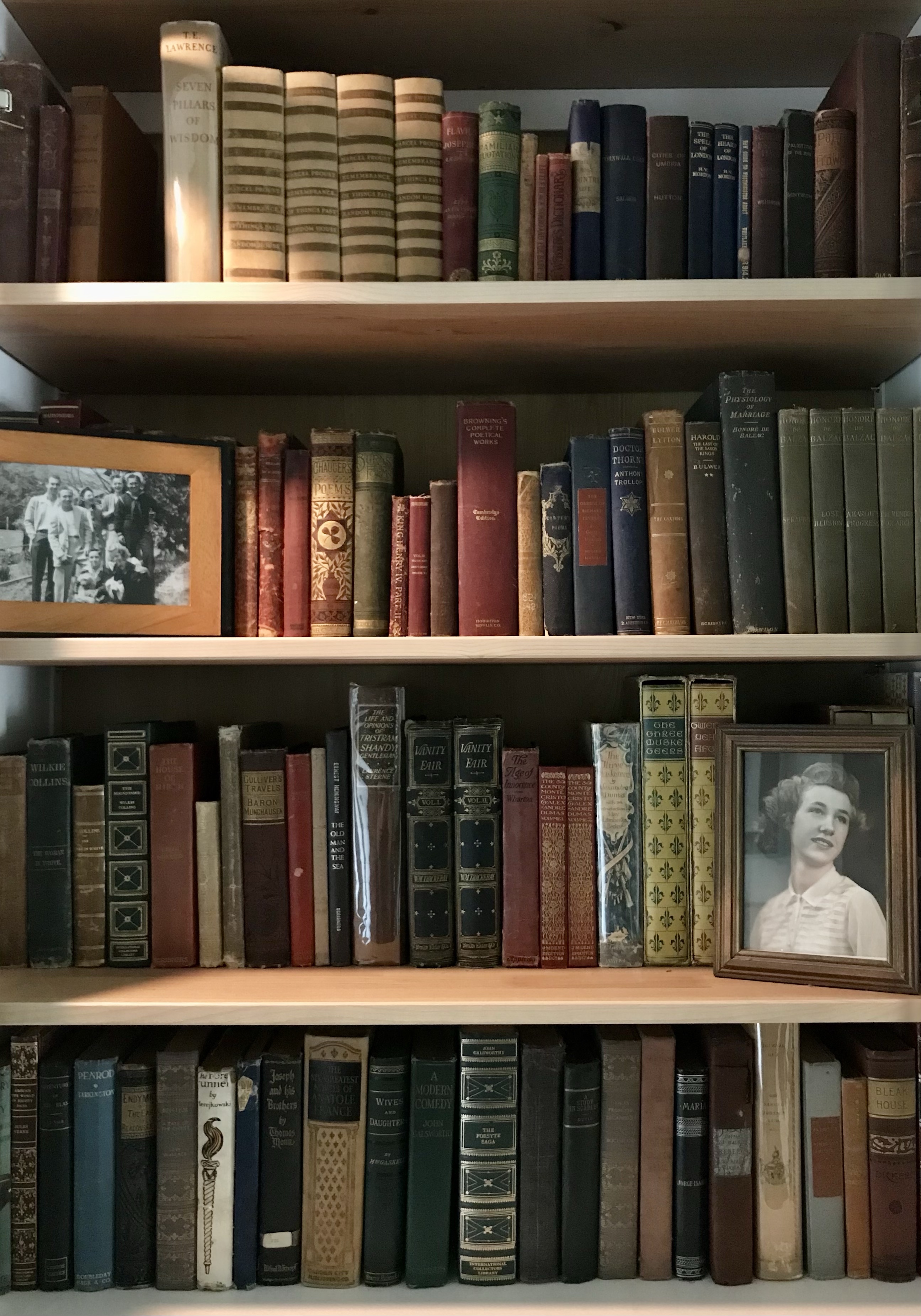
Except for books

I get rid of things,
but books are not things

Books
read and unread
are hopeful promises
treasure maps of the mind
histories yet unknown
friends unmet

I will spend my remaining years
inhaling their aroma
hearing the rustle of their leaves
taking them in
adding them to the thing
that is me

k

Read Full Post »

« Newer Posts - Older Posts »