 Trigger Warning: The following might be considered “cultural appropriation adjacent.” (Whatever that means.)
Caveat #1: I was born in California, and have never lived in the American South.
Caveat #2: I have not made a study of this.
Posted in Culture, Writing, tagged business correspondence, customer service, language, y'all on 16 Feb 2026| 3 Comments »
Trigger Warning: The following might be considered “cultural appropriation adjacent.” (Whatever that means.)
Caveat #1: I was born in California, and have never lived in the American South.
Caveat #2: I have not made a study of this.
Posted in Poetry, Politics, tagged Campos, Cáceras, CBP, Díaz, DHS, Domíngues, Good, ICE, La, Minneapolis, Minnesota, modern poetry, murder, noem, Poetry, Pretti, resist, Stephen Miller, Trump, Yáñez-Cruz on 29 Jan 2026| Leave a Comment »
three shots, maybe four
from her ‘I’m not mad at you’
to his ‘fucking bitch’
five shots, maybe ten
to go from ‘Are you okay?”
to oblivion
two deaths plus six more
this winter of ’26
merely a month old
Cáceras, Campos,
Díaz, La, Good, Yáñez-Cruz,
Domíngues, Pretti
remember their names
that their dreams and hopes and joys
are not forgotten
Posted in Gaming, Movies, tagged avatar, cameron, frontiers, pandora, review, ubisoft, video game on 22 Jan 2026| Leave a Comment »
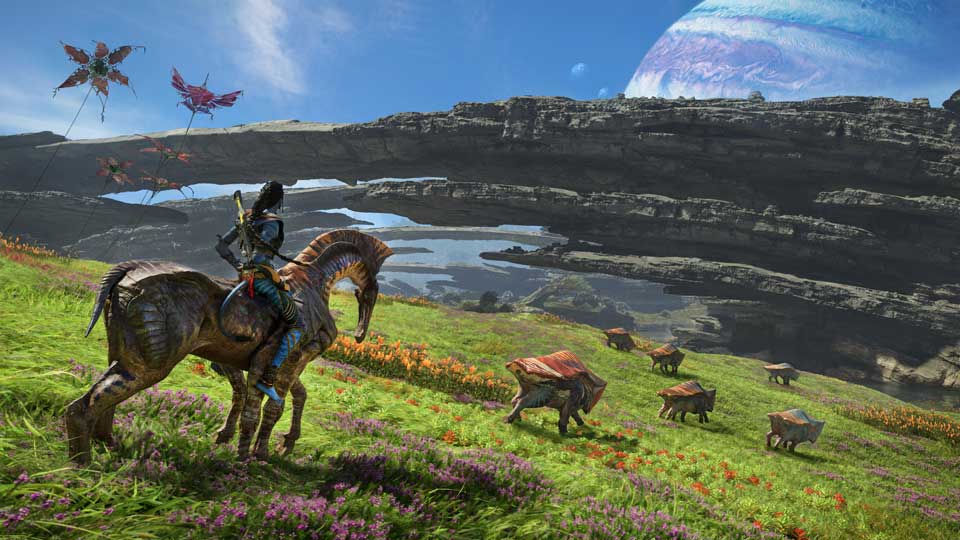 Yes, I’m rather behind the curve on this, as Ubisoft’s game, Avatar: Frontiers of Pandora, was released late in 2023; since I no longer have a gaming posse, I’m exploring some of the open world solo games that I missed in recent years. And yes, I’ve been critical of the Avatar movie franchise (probably here, but definitely elsewhere), ever since seeing the first Avatar movie in theater back in 2009; though the films are undeniably gorgeous and technological marvels, I’ve not warmed to their plots, writing, or acting.
With those caveats laid bare, you might expect me to be lukewarm on this title. Nope. I loved it. Here’s why.
I just finished the main story, which I did not complete in a rush. I took my own sweet time, sticking mostly with the main quest-line, but enjoying the many side quests as well. I took my time because, unlike many games I’ve played since retiring last April, this game world was a real pleasure to explore. Moreover, it felt like a cohesive world, a world that made sense despite being complex and intricate, where the flora and fauna were reflective of the various biomes had micro-biomes, and where the sub-cultures of the Na’vi had likewise tailored themselves to interact best with their environment, be it forest, mountains, or plains.
The goal of the game is simple: save the world from rapacious invaders (e.g., humans). We play the game as one of the Na’vi, the tall, blue-skinned people who live in their pre-industrial idyll where they live in close harmony with the ecosystems of their moon, Pandora. Humans have arrived and, holding true to their historical nature, use their advanced technology to exploit the moon’s resources, regardless of the damage to the ecology or to the native inhabitants. Sound familiar? Yeah. Pretty much why I didn’t care for the movies.
However, where the movies do little more than put a glossy coat of paint on analogues of [insert name of indigenous people here], the game has more elbow room to flesh out the cultures of the Na’vi clans. Each sub-culture has art and rituals that are tied to the unique nature that surrounds them, and while yes, there are similarities between Terran and Na’vi cultures, it doesn’t feel like a direct lift from one to the other. The Zeswa, for instance, are a nomadic clan that wander the Upper Plains, but they are not hunters; rather, they are herdsfolk, protecting the massive zakru—large animals that provide a milk-based diet—as the beasts migrate across the landscape. Everything from art to tradition to recipes to clothing is reflective of the open steppes and the winds that cross them.
From a gameplay standpoint, it’s a smooth and polished product. The option to switch between first-person and third-person viewpoint is a big deal; it’s seamless and on-the-fly, and trust me, there are situations where first-person is what you want, but when I was running through the forest, leaping from stone to massive willow trunk, it was third-person I wanted. Combat is flexible, though geared more toward ranged weaponry and stealth than melee. And as you have more weapon options than quick-slots to choose from, you’ll definitely find yourself developing a style. The skill advancement system is simple, specifically in that you do not have to choose a “tree” to devote your skill points toward. Sure, at the beginning, you’ll pick what you feel is important, but by game’s end, you’ll have more than enough points to acquire every skill on every tree. And as for crafting, the game makes it easy to add ammunition on the fly, but requires more attention when crafting gear or weaponry, an exercise that you can make as easy or difficult as you choose. as some designs require very specific items of a very high quality; you may not need that high-end heavy bow, but ooooh, wouldn’t it be nice?
But where I think this game really shines is in the story line. Much like my other Top Five game, Horizon: Zero Dawn, this game weaves a story that has twists and turns, betrayals and unexpected alliances. Not all humans are bad, not all Na’vi are good, and in the course of the main quest-line we encounter politics and power plays and a real search for self and growth. And while the overarching impetus can be boiled down to “eco-warrior vs industrialist,” there are some good interpersonal dramas that are well-crafted and excellently timed. The use of cut-scenes is limited but well executed.
Small things, too, pleased me about this game. There’s a fairly big cast of NPCs, but unlike some other studios (cough-cough-Bethesda-cough), each one I talked to had a unique facial structure made even more distinct by age, clothing, decoration, and the excellent work of the voice actors. Traveling the world, I began to learn what plants and animals were nearby by their sounds. Even the quality of light was different, depending on the terrain, the biome, the weather, and the time of day. And the voice work was top-notch. One of my pet peeves about sci-fi is the indiscriminate use of meaningless apostrophes in alien names, but here—as in Na’vi and Ri’nela, the people and one of the characters—the voice actors use those apostrophes as glottal stops (like the apostrophe in Hawai’i or in the break in the phrase “uh-oh”). Little things, but they all help bolster the realism of the world.
It is not a perfect game. It has glitches. It has a few bugs. I got “clipped” into inescapable areas a few times (I tend to explore . . . a lot), but a quick Fast Travel sorted that out. There were times when the foliage would flicker, usually when the sun was low in the sky or the clouds began to gather. There were two spots where a side-quest refused to start, but a quick visit to Reddit helped me get past the bugs. And, after a few days’ worth of reclaiming drill sites and coming across RDA patrols, I saw the patterns that allowed me to game these small encounters. To be honest, though, these were not even annoyances, and were much less prevalent here. Maybe it’s a good thing, waiting two years to start a game. Hehe.
Mostly, though, it is just a gorgeous game world. Once I got my ikran (one of the quasi-mini-dragons one can fly around) and was able to bond with a direhorse (great for the plains), I often eschewed all Fast Travel in favor of taking the scenic route. I expect you will, too.
I’m about to embark on the two DLCs that came out a while ago, and there’s a new one—From the Ashes—released to coincide with the third movie in the franchise. I’ll wait for the movie to hit a streaming channel, but in all likelihood I’ll buy the expansion.
k
Posted in Culture, Politics, tagged civil rights, ICE, prejudice, Renee Good, Serenity on 12 Jan 2026| Leave a Comment »
 I am a white middle-class sixty-something hetero male living in America. I am arguably the possessor of the highest level of entitlement in the less-than-billionaire world. I have lived my life in two of the bluest of blue demographic regions in the nation. I have never known any discrimination beyond those deserved by my own flaws.
I grew up, though, during an era of intense racial strife. My family and teachers brought the concept of civil rights into my young life. I learned that our nation had a history of treating people differently, based on how they looked. I learned that, though I did not personally feel the effects of prejudice, others in the world definitely did. I learned that the presumptions made about me were not necessarily made of others, if their skin was darker than mine, if their religion was different than mine.
And I was asked, did that seem fair?
It did not.
As I grew older, I discovered that it didn’t even matter if our skin was pale. If you were a woman, you could be treated differently, also as “less than.” Having been schooled by women, having been raised by women, this also did not seem fair.
But while I was able, as a teen ensconced in my bluish-ivory tower, to intellectualize all of this and say “Oh, yes, that is bad,” and, “That is wrong and we should work to fix that,” it took many more years before I realized that this unfairness, this prejudice, this smoldering (if not outright) racism and sexism, this misogyny, this antisemitism, this idea that pale skin imbued one with an inherent supremacy, imposed a level of stress and daily anxiety the like of which I had no concept. I had no idea what it was like to fear men on the street. I had no idea of what it was like for someone to take one look at me and decide my worth, my value, my humanity.
I did learn of it, though. It wasn’t a difficult assignment. All I had to do was open my eyes and pay attention for a brief period, because it was all there, easy to see if you simply looked around.
These days, though, it’s even easier to see. Now, you have to actively look away in order not to see it.
And many of us are doing just that.
If you aren’t, though … if you are paying attention and watching what is going on and seeing what is happening out there, in our nation, in our name, I ask you this:
Be extra kind. Take care to take care of those around you, be they neighbors or strangers or just folks in the checkout line at the grocer’s. People are on edge, and tempers are near the breaking point. None of us know what the person next to us in line has g0ne through today, or this week, or this month. They might be in pain, scared, angry as hell, and just barely holding it in.
It’s fucking chaos out there. So we need to be kind to one another. Just so we can all see tomorrow.
Together.
k
Posted in Gaming, tagged game pass, Gaming, inflation, price increase, video gaming, xbox on 01 Nov 2025| 2 Comments »
 Xbox is at a crossroads, and one major speed bump in their path seems to involve their Game Pass subscription service. Two major price increases over the past few years have caused many to reevaluate our priorities. Myself included.
To refresh memories: I’m a sixty-something Boomer who plays video games. I’ve been a consistent Xbox player, and partook in regular multiplayer sessions with my Saturday Night Massacre Posse for about twenty years … until my retirement last year. I do have a PS4 console, because … Horizon Zero Dawn … but Sony was never been my gaming “home.” Rather, I was a long-time Xbox Gold membership holder and, when it became cost-effective, a Game Pass and then Game Pass Ultimate subscriber.
Even when the SNM Posse was active (so named, because that was when my day-shift gaming window overlapped with my fellows’ graveyard shift availability), we generally played only a few games on the regular. Rainbow Six, Gears of War, Borderlands, Destiny, Ghost Recon, Halo, Sniper Elite—primarily FPS or TPS style titles—these were our Go-To games, played predominantly in co-op mode (we weren’t an overly competitive posse). Sure, we’d feather in the occasional platformer or isometric or soulslike title, but they came and, after a few months, they went. And we played hard. We’d start after dinner and would go late/early, often until 0300 hrs. It was a stretch for me, but worth it, as the banter alone (plus the challenge of keeping up with my much younger fellows) was great fun.
Post-retirement, though, the SNM Posse just dissolved. Since I’m not one for playing with strangers—I can’t keep up with twenty-something’s twitch-muscle reaction times, and won’t put up with the crude and too-often offensive language that passes as “repartee”—this meant that my need for a multiplayer service had come to an end. Yet, Game Pass Ultimate offered so many games, including some “Day One” titles I knew I’d enjoy (Borderlands 4 and Outer Worlds 2, to name a couple of recent additions), so I continued with my subscription.
Then, this fall, Microsoft jacked up the Game Pass Ultimate subscription rate by 50%, from $20/month to $30/month, or $360/year (what? you want a discount for paying for a whole year in advance? who do you think we are? HBO? LOL!).
As outlined above, I do not burn through video game titles. I don’t play a game for a few hundred hours in a single month and then move on to the next shiny new title. I don’t consume eight, twelve, twenty titles in a given year. Even if I include the small indie titles I play, I might go through six games in a calendar year. Is that worth $360/year? Even with the now-standard $70 price for a Day One AAA game, is it worth it?
Nope. It ain’t. And I suspect a lot of gamers are working this math the same way I have.
I will probably play three, at most four AAA titles in a year, and if I wait a bit, I’ll pay a discounted portion of that $70 list price. I can pick up a handful of indie games at anywhere from $5 to $15, if they get good reviews and the gameplay matches my likes. I still have my Xbox account, should multiplayer opportunities arise, but I’m not depending on it. There are so many older RPG/FPS/TPS titles out there, games I’ve never even tried, there’s no reason to pay such an exorbitant subscription price (especially if I have to save up for a new console!).
Video games used to be a unifying activity. It was something that bridged the age gap between myself and the younger folks I knew. With people struggling to make rent and buy groceries, and with the costs of gaming increasing by 20, 50, 60%, it’s losing its broad-based demographic in favor of a more affluent customer base.
Sometimes I wonder if Microsoft really gets gaming.
Posted in Poetry, Politics, tagged creative writing, modern poetry, no kings, Poetry, resist, Trump, Writing on 23 Oct 2025| Leave a Comment »
don’t give in to the maelstrom’s song
the downward spiral toward denial
of what your bones know is righteous or wrong
don’t let the harmonies that sing in your blood
go quiet and numb, muffled and choked
by the unfeeling actions of criminal hearts
there’s so much so much this onrushing tide
of gleeful cruelty and polished-brass venality that
to think of nothing to jettison hope can seem the softer path
but love dies when hearts go silent
and despair takes root when tears dry up
numbness saves no one not others not us
so let the feelings come seek them out
lean in and swim with the building wave
shout out rise up and take the beachhead
for this is a fight we dare not lose
Posted in Culture, Politics, tagged blame game, civil rights, congress, freedom of speech, government shutdown, ICE, politics, senate on 05 Oct 2025| 2 Comments »
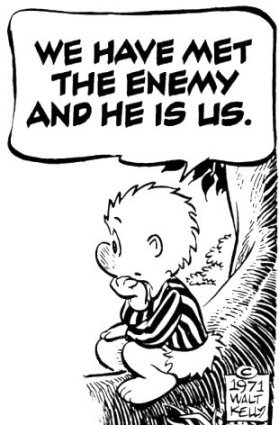 Republicans are blaming the Democrats for the shutdown and, following the standard congressional “I’m rubber, you’re glue” playbook, Democrats are blaming the GOP in turn. That’s a weak, schoolyard response, and I’m sick of that game. Here’s what I want to hear from Democrats:
“You’re goddamn right we’re responsible. We are shutting this shit-show down, using every tool we can muster, using the power of the minority (just as you have done so many times over the years) to obstruct, to delay, to thwart, to frustrate, to discomfit, to drive a wedge between y’all and your base, to amplify our voice and blast our message, and our message is this: We will not be complicit!
“We will not be complicit in making health care unaffordable for millions by raising premiums and cutting services (and don’t trot out that bullshit lie about us wanting to provide health care to undocumented immigrants, because you know folks need an SSN to apply for Obamacare, and the undocumented, by definition, don’t have one). People are having a very tough time, right now, and we won’t help you make it worse. We won’t. You’ll have to sit down with us. You’ll have to take the damned meeting. You’ll have to negotiate. You’ll have to fucking govern instead of strutting around like a bunch of mooks in cheap suits running a protection racket.
“Moreover, we will not be complicit in supporting your destruction of our society. We won’t support this rogue militia you’ve created out of ICE and CBP, a force that rappels from BlackHawks down into American cities to round up people indiscriminately, en masse, without warrants, destroying property, terrorizing communities, citizens and immigrants, adults and children alike. No. We won’t.
“We’re not going to just stand by and wring our hands and think back fondly on gentler times while you erode our most basic rights. No, JD, we’re not going to be ‘civil’ in the face of your incivility, we’re not going to be silent and meek when one of the tenets of our founding documents enshrines our freedom to tell you that you’re wrong and we’re right and why.
“And we’re not going to just bite our tongues when you call everything an ‘emergency’ so you can raise the cost of goods with tariffs, withhold funding appropriated by law, extort businesses and universities into silence, prosecute individuals because they made you look bad, and slap the ‘terrorist’ label on anyone exercising free speech.
“No. We’re not. We’re going to shut this down, and we’re going to do it loudly and unapologetically. We’re going to make governing this nation as difficult as possible until you come to the table, sit down, and negotiate. We are doing this because of the real and lasting harm you are perpetrating against our nation. We are doing this because we fucking can, and because the American people need someone to protect them, to look out for their needs, their health, and their lives.”
That is what I want to hear. That is what I think we need to hear.
k
 Kurt R.A. Giambastiani