Feeds:
Posts
Comments

Archive for the ‘Writing’ Category

I could say that, as she entered the drawing room, all skirts and leg-o-mutton sleeves of emerald silk over petticoats of crinoline and stiff cotton, the dark skin of her pearl-draped throat rising above her off-the-shoulder neckline, hair piled up in thick black plaits, dark eyes meeting each guest with a warm and welcoming glance, that she moved with the sound of rustling leaves, but such simplicity would be unfair, for the truth was more specific, more evocative, as with her smallest step we heard—all of us—the memory of an afternoon’s respite in the shade of a chestnut’s overarching boughs on a bone-dry summer day when rain was but a fond wish and the tree’s huge, canoe-like leaves, jostled by the gardenia-scented breeze, caressed one another with a dry and papery sweetness that was at once both gentle and substantial; such was her effect upon her parlor of admirers.

Read Full Post »

Back when I was a panelist at writing/sci-fi conventions, I would occasionally pop in at the workshops, where pros read/critiqued story submissions and provided a professional’s view. The critiques were honest assessments, often served with actual “pro tips,” but the stories submitted were usually—to be honest—pretty awful.

On one such occasion a pro author/editor I knew provided a critique that was both the shortest I’ve ever heard as well as the definition of “damning with faint praise.”

Her critique: “It’s very nicely typed.”

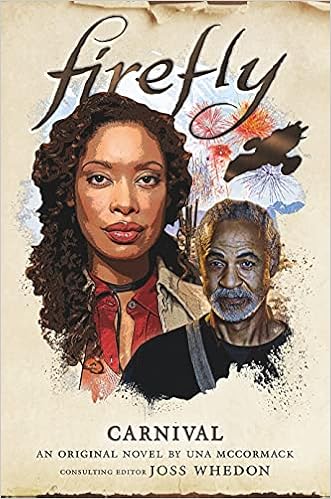
The newest title in the Firefly novel ‘verse is Una McCormack’s Firefly – Carnival, from Titan Books, and sadly, the best thing I can say about it is that “It’s very nicely bound.”

I’ve complained loud and long about previous titles in this series—the lone exception being Tim Lebbon’s entry, Firefly: Generations (also the only one with a title that comes with a colon instead of an en dash . . . go figger—as the entries written by James Lovegrove have been massive disappointments. Learning that this title was penned by a different author gave me hope.

Misplaced hope, as it turned out.

The basics of the plot are: Mal and crew are hired to provide security for a shipment and escort it across town from the train station to the space port where, once loaded, it flies off and they get paid. Naturally, things go wonky, the shipment goes astray, and two of Serenity’s crew are taken hostage—by the employer who hired the team—as collateral pending return of the goods or compensation for the loss. Failure, within 48 hours, and the “collateral” will be sent back in boxes.

Now, if that’s not a goofy enough setup for you, it gets better. Or worse. Example: the job pays 200 platinum (a ridiculously high wage for a few hours’ work) but when the crew is told they have to cover the losses, the sum is only 500 platinum (more than they have, of course, but 200 Pl is an unreasonable chunk of that profit margin).

The story unfolds and we learn that (unsurprisingly) nothing is as it seems, and therein lies the tale.

McCormack is a best-selling author of many television and movie tie-in novels, but reading this I came to the conclusion that those titles were best-sellers based on an established fan base and not on the style or content because . . . damn.

For any book set in the Firefly ‘Verse, you have to deal with the show’s excellent use of dialect and language. As with other books, the occasional sprinkling in of “g-less” gerunds (i.e., shootin’ and flyin’) helps evoke the tone from the show, and the reader fills in the rest. Lovegrove, for all his faults, did this well. McCormack does not. They pop up all over the place and, most troublesome, she throws them into non-dialogue sections, including those that are straight narrative and not part of a character’s internal thoughts. In addition, she decided to spice it up with other dialect elisions, such as “platinum” becoming “plat’num” which (to my ear at least) has no audible difference and only disturbs the eye as we trip over it. (In her defense, McCormack is a Brit who may very well have better diction than we Americans, so this may have made sense to her.)

Stylistically, the prose is pedestrian and flat, without any beauty. At regular intervals—presumably to evoke a feeling of action or a character making a quick assessment of surroundings—McCormack drops into a paragraph of fragment sentences. This in itself isn’t a bad practice, as it reads with more urgency, but when she drops pronouns and subjects from the beginning of the sentence, we have to re-read to make sure we get it, which obviates the point of the fragments.  In fact, McCormack often creates sentences where the syntax is imprecise or vague, and it can be read with one of two (sometimes opposite) meanings depending on inflection. This is simply poor writing, and should have been caught and fixed.

Sadly, the editors seem to have taken holiday on this book. And, halfway through, the proofreaders seem to have gone to join them. This is less McCormack’s fault than Titan Books’, though the author is not off the hook either. Content errors. Out-of-place references to current pop-culture. Missing punctuation. Typos. For all of these, the author gets proofs, too, and there are simply too many errors late in the book to deny a lackadaisical process from start to finish.

In short, it’s a hot mess and I found myself remembering Lovegrove’s less-than-stellar titles in the series with something approaching fondness.

The Firefly novels are now one for six, with Lebbon’s book being the only one worth the time. It’s sad, but it’s clear at this point that these are simply revenue streams—something I should have figured going in—hackwork without interest in the actual art and craft of writing.

Frankly, I don’t know that I’ll bother with any future titles. My love for the show, its original use of language, the depth of its characterizations, begins to suffer from such low-bar fare.

In short, these books are beginning to damage my calm.

k

Read Full Post »

Inspiration often comes from a surprising direction.

I recently had a birthday and my sister sent me a gift. It was a pack of pencils, with a cunning two-stage sharpener and a “point guard” (a metal cap that fits over and protects the pencil’s point, a thing of which I never before heard and now wonder how I ever lived without).

I have a thing about pencils. I’m very particular.

I do not like mechanical pencils. I positively loathe the disposable mechanical pencil (such wastefulness should be resoundingly decried). Give me a pencil of wood and graphite, every time.

Over the past six decades, I’ve always had a preferred brand.

  • First and for many years, it was the old-school yellow Ticonderoga #2. Nothing could beat it for availability, economy, smoothness of draw, and dark positive line.
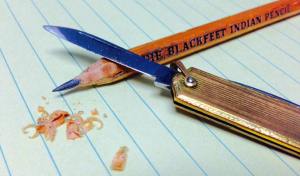
  • Then I discovered Blackfeet Indian pencils and immediately fell for their natural wood finish and aromatic cedar wood (not to mention the cedar wood box each dozen came in); I was faithful to them for years after they were discontinued, but recently the price of a box became too expensive.

Disappointed by replacement options and running low on my stock of (now prohibitively expensive) Blackfeet, I did what any self-respecting stationery nerd would do. I switched to a fountain pen. I wrote all of the Fallen Cloud Saga with a fountain pen, but recently, as I’ve been concentrating more on poetry, I’ve returned to my first love, the pencil, meting out my Blackfeet Indian pencils with miserly oversight, running each one down to the absolute nub.

Then my sister’s gift arrived.

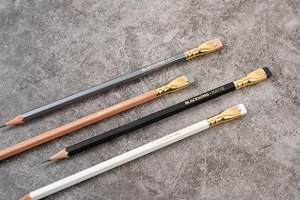
The pencils she sent are Blackwing 602s. As with the Blackfeet Indian pencil, they had a long and storied reputation; 602s were the preferred (and often exclusive ) choice of great talents: artists (Chuck Jones, Don Bluth), composers (Copland, Bernstein, Sondheim), playwrights (O’Neill, Laurents), and novelists (Steinbeck, White). Also as with the Blackfeet, the line was discontinued in the late 1990s (at which time Sondheim reportedly bought himself a lifetime supply).

The Blackwing 602, however, was revived in 2010, and my sister, knowing my love of All Things Stationery, gifted me with a dozen.

And they are wonderful.

Smooth, long, lean, requiring only the lightest touch for a dark line, with graphite tough enough to hold a fine point (but easy to re-tip, using the 2-stage sharpener), and with a wide eraser that can be extended as it’s used up, they are my new favorite.

“But wait,” I hear you say. “What was that bit up there about inspiration? Where does that come in?”0

Well, it turns out that, as I’ve been toying with these new pencils, using them for notes and analyses for my day job, I’ve grown dissatisfied with using these perfect pencils just for jotting down procedures and sketching out data flows. Even using them for poetry wasn’t enough.

The obvious thing, then, was to take out The Wolf Tree, the novel I’ve been working on since before the pandemic, which still needs a lot of writing.

Which means that the gift of a pencil has unexpectedly provided me the inspiration to get back to work on my novel.

And that’s a gift with a worth that’s far above rubies.

k

Read Full Post »

A week or so ago, I had a hankering to spend time with some old friends. We’d been out of contact for fifteen years, and I felt it was time to reconnect, to catch up, to share stories. So, for the past week, I’ve been hanging with Alain, Bronwyn, Wrdisten, Boduos, and the rest of the gang from old Breizh.

In other words, I re-read The Ploughman Chronicles, my 9th century historical high fantasy series.

And we had a blast. Literarily speaking, that is.

In the year AD 880, much of Europe was on the cusp between the old/pagan and new/Christian worldviews, and Brittany itself (where the series is set) was in open revolt against the expanding Carolingian Empire, so there’s a lot of historical intrigue woven into the books. Added to that, though, is an even greater intrigue between our world and the fabled Summerland, the land of the Fey, which lies beyond the Veil. Now throw in a prophecy, that there will come a man who will travel between, and master the power of both the line magic of the Veil and the earth magic of the sleeping gods.

For me, though, it is the characters I love most. I mean, they’re so . . . individual, so quirky, each with a distinct manner, their own way of speaking, and with motivations that are set (and revealed) in layer upon layer.

These books are not your usual high fantasy; I can’t think of another series that even comes close to it. Sadly, this series got no love from my agent—perhaps precisely because it isn’t your usual high fantasy—so they never had much opportunity to get shopped around. Also sadly, when I decided to publish them myself, my editing skills weren’t as sharp as they should have been, so I had to contend with the odd typo (and I really hate typos, especially when I’m the one who let them get into the final product).

But here’s where y’all come in.

You see, I love these books, even more so after my re-read, and I want to share them with you.

So, from now through Monday (November 22), the Kindle versions are free. You can find them both on this page at Amazon.

Download them for free, get the reading app for free, and (I hope) fall in love with them, for free.

Paperback versions are still available, of course.

So go, enjoy; tell a friend; hell, tell an enemy, I don’t care. I just want to share them. And if you like them, write a review. If you don’t, tell it to my agent; I think you’ll find a receptive audience there.

k

Read Full Post »


your need is my desire
your desire is my hope
your hope is my dream
your dream is my heart
your heart is my home
your home is my love
your love is my comfort
your comfort is my need

Read Full Post »

There are, in my home, many watches. But for five years, I’ve carried only one.

My watches date from the Age of Steam to the Age of Jets, bearing the marks of craftsmen from Victorian, Edwardian, Nouveau, Deco, and Mid-Century eras.

I have watches that were used to keep trains running on time, mark a valued employee’s retirement, chime the quarter hour, and show the time in the dark with radium-lit dials. Some glister with ruby bearings and gears of gold, their plates tooled with filigree, their enameled dials bright, while others are of stamped brass, paper faces, encased in cheap tin.

They are the watches of men both rich and poor, bespoke or mass-produced, but all came to me in somnolent neglect and the silence of disrepair. For each of them, I cracked their cases, disassembled their movements, cleaned and repaired and replaced the parts that were begrimed, bent, or broken, bringing them back to life, allowing their spring-loaded hearts to beat once again.

I used to swap them out, carry a different one every week, its chain hooked onto my denim belt loop, the watch itself tucked into the tiny right-hand pocket designed solely for the purpose.

But no longer.

Waltham, Elgin, Hampden, Ingersoll, and the others, high-end or base-born, all now lie stored in cushioned darkness, their mainsprings having ticked down to quiet rest.

Now, my watch pocket is empty, for my wrist carries my watch.

It’s a scuffed and scarred thing, with a crystal that’s a bit scratched, a bit chipped. It isn’t very old—a score of years at most—and it is decidedly plain, with square hands and numbers on a simple white face. It doesn’t even have a mainspring, the coiled powerhouse of nearly every other watch I own, but runs on a battery.

It’s a run-of-the-mill Timex Indiglo wristwatch. And it is my father’s watch.

When my father died, five years ago, and I was cleaning out his last abode, his watch was included in his effects. It is the watch he wore every day, whether he was out fishing for steelhead, sneaking a smoke out back, or painting a landscape, and it is—as was he—basic, uncomplicated, quiet, easy to read, dependable, sturdy, and consistent.

For five years, it’s been on my wrist doing yeoman’s work, ticking away, showing me the wee hours with its cyan glow, keeping perfect time. I’ve never changed the battery, not once in those five years. It is, as I said, dependable, sturdy, and consistent.

Someday, it too will run down, its battery spent, and that day, I suppose, when the new battery clicks into place, that will be when the watch will stop being his, and will then be mine.

k


Read Full Post »

Maples at Seattle Arboretum

Well, sometimes the magic works. Sometimes it doesn’t.

I’m back from a two-week vacation and, for me, two weeks is the minimum required to feel like I’ve actually had a vacation. The first week I spend powering down—sleeping decent hours, relaxing, reading, puttering—but the second week is when my brain finally looks up, sees the sky, hears the birdsong, smiles, and forgets about the day job.

It was a good stay-at-home fortnight, filled with fall colors (in my gardens and around the Sound), blustery fall weather, rain, walks, movies, and even a bit of socializing. It was a rather creative time, as well. I finished building my hurdy-gurdy, cooked a couple of excellent meals, and managed to craft one or two fairly decent pieces for this blog.

But this week . . . eh, not so much.

Granted, the week back at work after well-spent time off is always difficult, but this one has been quite the challenge. You see, my retirement is out there, waiting. I can smell its heady aroma and hear its quiet song, lofted by the onshore breeze. Going back to the day job gets harder each time, but usually (thankfully) there’s a grace period granted to vacation-returnees: sufficient time to go through the mountains of emails; to catch up on all the changes, gossip, and news; and to ramp back up on the work we’d set aside during our weeks away.

This time, though, it was more of a “hit the ground running” type of week. I was met with an excessively aggressive deadline date (promised during my absence), plus a slew of quarterly meetings that stole a whole day that I really could have used trying to meet that promised deadline.

So, today, when I sat down in front of my blank sheet of paper and tried to come up with a poem or vignette, chicken-scratching my way around the metaphor that’s been in my head for a couple of days (family lineage as a river), I came up empty. Empty, that is, except for lines and stanzas written and then struck out, word clouds that dissipated into thin air, and several crumpled sheets of 11×18 newsprint on my office floor (which at least entertained the cat, if only for a few minutes).

I then compounded that frustration by spending the evening trying to solidify new ideas out of the ether—it’s not as though I had no ideas, just that I could bring none of them into sufficient focus to wrap words around—until, in the end, I cried, “Hold! Enough!”

And so here we are.

If I might torture another metaphor, every farmer knows that letting a field lie fallow for a time benefits the land and the crops. So, seeing as how I’ve been very creative during the past few months, I think I can allow myself a fallow week.

Here’s hoping that my crops rebound after the rest.

k

Read Full Post »

« Newer Posts - Older Posts »