Feeds:
Posts
Comments

Posts Tagged ‘simplification’

I live in Seattle, and we have a reputation for loving our coffee. I’m no different, however, I am not a purist by any means. I can’t tell if you brewed it with tap water or distilled water or filtered water or Artesian spring water, and unless your tap water is really awful, I bet you can’t either.

I have my favorite brands of coffee—Torrefazione Italia is the best I’ve had, but hard to find; Caffe D’arte is a close second, but not available in stores—but they’re so expensive that I only get them from a barista. For everyday brewing, I buy in bulk, try to get fair-trade beans of good quality, and grind it myself as needed in a good burr grinder.

But where I can make a huge difference is in the brewing.

I’ve tried almost every brewing method. I’ve tried brewing it cowboy-style in an open saucepan (toss in an eggshell to make the grounds sink), which I do not recommend, and for years we simply stuck with our standard drip-maker and a small Braun espresso machine.

On the more esoteric side, I’ve tried one of those vacuum-siphon brewers. Aside from the sheer coolness of watching it work, and the drama it imparts to the ritual cup of coffee, it only delivered a mildly better brew than standard drip coffee makers. High-maintenance to use, a bitch to clean, it also was so fragile that it broke after only a few days’ use; a disappointment, but not a tragedy, as I’d already made my decision that it wasn’t worth the trouble.

For pure outlandishness, I have also tried the Presso® espresso maker, which works solely on muscle power. A hand-pulled demitasse is pretty cool, and it cleans up pretty easily, too. It wasn’t expensive, and it’s very solidly built, so I’ll keep it around.

But, for the best cup of coffee you can brew, I say you can’t get better than the old-school, low-tech, tried-and-true method of the French press. We use a Freiling press (pictured top) that has double-sides of stainless steel, so it also acts as a thermal insulator, keeping the coffee warmer, longer. Put your burr grinder on “coarse” and brew up a cup. Steep it for 4 minutes (longer if you need a slice of coffee instead of a cup), keep the press on the table, and serve as needed. It is never bitter, never harsh. My wife, who gave up coffee because it upset her stomach, can drink it again, now that we brew it in the press.

Another win for low-tech!

k

Read Full Post »

Obey the Kitty!I have put myself on a “news diet.”

A “news diet” is where you severely limit your intake of news reports, news shows, news feeds, and general punditry.

As the election cycle shifts into top gear, we get bombarded by more and more input. Unfortunately, this input provides less and less content as the positions of the various sides divide and solidify, and rhetoric coefficients grind upward toward what will undoubtedly be an hysterical fever-pitch by November.

Case in point: For years, I was a faithful Sunday news show watcher, but that habit collapsed with the sudden death of our beloved Tim Russert. My interest was revived for a while, when Christiane Amanpour took over the helm at “This Week,” but when her stint ended, so did my renewed interest.

I still check in on the shows, now and again, and last Sunday I rose a bit early and sat down with my coffee to give “This Week” a look-see. What I saw, infuriated me. When boiled down to its essential components, the first 25 minutes looked like this:

George asks Question A.
Faction-X-Representative gives answer to Question B.
George asks Question A again.
Faction-X-Representative gives answer to Question B again.
George shrugs, and moves on to Question C.
Faction-X-Representative gives answer to Question B, yet again.

Switch to Faction-Y-Representative.
Repeat.

This is repeated on every Sunday news show, and it is without a doubt the most ludicrous excuse for news I have seen. These shows do not provide any news and they are not even providing useful content. They have become nothing more than a soap-box from which each faction can deliver their spin and rhetoric for 15-20 minutes, free of charge. It is then followed up with another 25 minutes of “analysis,” in which the pundits merely restate the rhetoric of their favored faction (Mary Matalin looked positively foolish, trying to dodge and twist questions to fit her prepared talking-points answers.)

But this is only the most egregious example. Already, this dilution and corruption of the news extends to every media outlet. Every story of a political nature is nothing more than a tit-for-tat exchange of platform language. Soon, any story that can be tied to policy will have its portion of spin, and eventually, even current events reportage will reach us colored by various political spectra.

So, my “news diet” is as follows:

  • Sunday news shows and pundits: cold turkey stop (Sorry, Rachel; love ya, but it’s for my own good).
  • National news outlets: only the first 10 minutes of the main broadcast, and only a couple nights a week.
  • Local news outlets: check headlines and weather online, no opinion or op-ed pieces.

It’s the only way I’m going to stay sane until November.

k

Read Full Post »

Earlier, I waxed a little poetic about crickets and our lack of them here in Seattle. Anyone who’s read my novels might remember that crickets show up pretty regularly, there, and they will always be, for me, a comforting, blanket sound. “Blanket” sounds (in KRAG-speak) are sounds that fill the night air, but stay in the background; you don’t notice them until they’re gone. There are many other sounds that I find especially comforting and that, even when they wake me up in the middle of the night, immediately settle me back to sleep.

Foghorns are a big one. I grew up in the San Francisco Bay Area, where fog is a fact of life. Here, around the Puget Sound, it is similar. If you live anywhere near the shoreline, you quickly learn whence across the night water you can expect to see the blinking eye of a beacon and hear the comforting hoot of the horns. Foghorns ask their low, gentle questions across the Sound: Are you there? Can you hear me? Are you safe?

Trains, from a distance, evoke a similar mood. When we lived in Richmond Beach, closer to the shore, the coastline trains would sound their horns as they neared town. I always smile at their forlorn, two-toned call.

My favorite “blanket” sound, though, is one I’ve only experienced a few times in my life. Almost 30 years ago, my wife and I stayed in Anchor Bay, a small coastal town in Northern California. We stayed in a small cabin up on a bluff, overlooking the Pacific and a small rocky islet. On the shingled shore of that rock lay hundreds of seals, and they would bark all day and all night, their calls mixing with the rush of the surf to create a foundation of sound that waxed and waned with the strength of the ocean breeze. It took us two nights to become accustomed to this constant noise, but once we did, sleep was deep and satisfying.

I’m sure there are other sounds others find as relaxing as these. I would be interested in what your “blanket” sounds are…

k

Read Full Post »

1972 Sheaffer Stylist White Dot Fountain PenI used to be much more disciplined about “writing time.” I also used to have crushing deadlines, which were a great motivator. Now, I have less time, my monkey-boy-day-job is more demanding, and it’s just damned hard to find time to shut myself in the back room, sit down at the computer, alone, without distractions, and pump a couple thousand words past the CPU.

To counter this, I’ve tried many tactics. First, I bought a netbook, thinking it would allow me to work anywhere; it turned out to be too slow and underpowered to provide any real convenience. Then, I bought a keyboard for my iPad, but while faster, it proved to be too clumsy to balance on the bus and still required a larger chunk of time in order to be productive.

So, I went Old School, returning to my writerly roots, as it were. As some of you know, my first books were written longhand, with pen on paper. Yes, kids, I actually wrote four whole novels without the aid of a computer. I swear it’s true; FC:I-II and PC:I-II were all written with a Uni-Ball pen on Cambridge steno pads.

This new/old method has increased my productivity for several reasons. Primarily, it is more suited to my Basher style; cudgeling out a few dozen or maybe a hundred words at a time is much easier than trying to force out a couple thousand words. It is also perfectly suited to my catch-as-catch-can writing schedule, allowing me to squeeze out a couple of lines at the bus stop, en route to the transit station, while waiting for a program to compile, or as I’m cooling down after my workout.

There’s also another, less obvious benefit: because writing with pen and paper is slower than typing, the resulting prose is the product of a more thoughtful and deliberate process. Writing with pen on paper increases the lyricism of my prose, and what ends up on the page is tighter, less cluttered by unnecessary wiggle-words, and is closer to what I really wanted to say. Yes, there are lots of cross-outs and insertions (see picture), which yes, looks as if I editing as I go along (Bad writer! No biscuit!), but this isn’t really editing; this is searching for the narrative path.

Moreover, writing with pen and paper just makes me feel like a writer. It is how almost all of my favorite authors composed. It’s an organic, completely natural way to create, completely divested of the trappings and necessities of computers and cables and cords. It’s immediate, it’s personal, and to me, it’s more than processing words; it’s writing.

k

Read Full Post »

Last month, the power went out on a windless day. Last month, we took a small step away from the digital age. These two events are not unrelated.

Unlike our last home, where the power went out any time a dog barked, the infrastructure surrounding our current residence is fairly robust. So we were surprised one quiet evening when, with only a slight breeze and no rain outside, the house went dark. In the sudden silence I could just hear all the hard drives spin down and all the electronic doo-dahs begin to tick as they cooled. The house, without power, felt dead.

And just as we found the electric bill and the number for the outage hot line, the power came back on.

Leaving me with the task of going around the house, resetting the little red digits on each and every clock and appliance, save the DVRs, which (being rented) are new enough to figure it out for themselves.

I detest this chore. Twice a year, on spring-forward/fall-back Sundays (don’t get me started), I have to do this chore, and if the power goes out, I have to do it again. I hate it. It’s tedious, numbing, and (in my opinion) unnecessary. And when I have to do it because the power went out for just a couple of minutes? Ooooooh. Stay away.

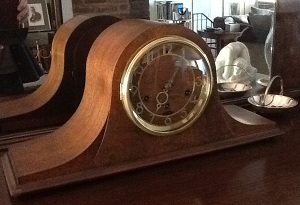
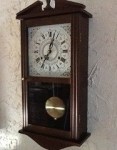
After some discussion and some rather blatant lobbying reminiscent of a child asking Mum and Dad for a puppy, I began to replace our red LED digital clocks with real clocks. For the most part, I replaced them with clocks that go “tick tock,” and several of which announce the hour with chimes or a gong. Being at least as old as I am, all of the clocks required a complete breakdown, cleaning, and oiling, but for me, this was part of the journey; this made them ours, part of our house, much more so than had we bought them at Target and put them right on the shelf.

It’s hard to describe the difference in the house, now. Aside from the obvious—the music of the Westminster on the quarter hours, the bong of the chimer on the half-hour—there is another, subtler effect. There are still a few to go—an alarm clock here, a display clock there—but already the house is a much calmer place. The rooms of our house, each with their small, wood-encased heartbeat, seem more alive. We both find that we like the house quieter, now. The television is off more. We read more, or tinker with small projects. And now, late at night or when the power goes out, time continues, the house lives on, and the steady tick of a nearby clock reassures us, its pendulum measuring out each quiet moment.

Read Full Post »

« Newer Posts