 Yesterday, champagne to celebrate of our 30th Anniversary.
Late last night, a phone call.
Today, calls to funeral homes, setting up final arrangements for my wife’s mother.
Tomorrow?
It’s a funny world.
Yesterday, champagne to celebrate of our 30th Anniversary.
Late last night, a phone call.
Today, calls to funeral homes, setting up final arrangements for my wife’s mother.
Tomorrow?
It’s a funny world.
Posted in Uncategorized | 3 Comments »
 In 1983, carrying a cellular phone was like walking around with a stick blender in your hand (except heavier), and cassette-playing Walkmans were de rigeur.
In 1983, we argued VHS versus Betamax (I lost that one), saw the birth of the internet, and wondered what Microsoft WIndows would look like.
In 1983, M*A*S*H was ending but “The A-Team” was starting up, Debra Winger died in “Terms of Endearment,” and George Lucas disappointed the world with Ewoks.
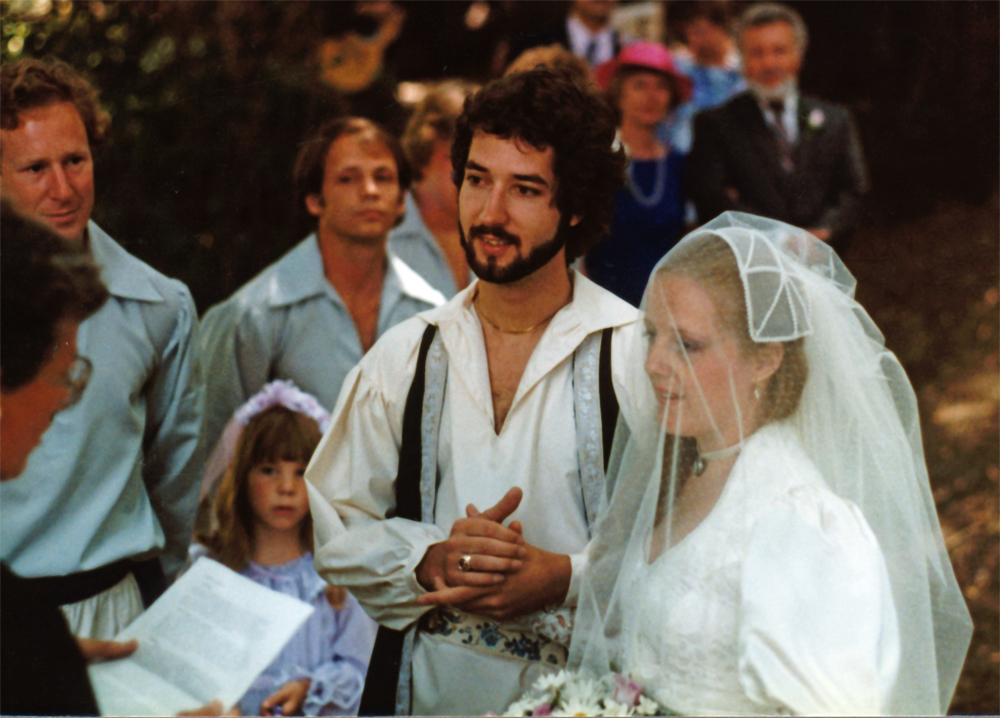
Also, in 1983, on July 30, I said “I do, I shall, I will,” for the first and only time, standing before a company of friends and family beneath a canopy of redwoods in a hometown park. Continue Reading »
Posted in Culture | Tagged anniversary, marriage, what marriage is, what marriage isn't | 13 Comments »
 First, a welcome to our new subscribers. At some point we popped up over the 200 member mark, which I find pretty cool. So, thanks, all, for your interest.
My free time this weekend was spent backtracking. I’d started my research of Seattle’s history at 1860, heading up the years toward 1874, but it became clear that for my purposes, 1874 Seattle was just too big a town. I want a setting that is rougher, more primitive, and a town that is smaller.
Picking 1874, the backstory for my main “Old Seattle” character included experience in the Civil War, possibly with injuries, certainly with trauma. I wanted a reason for him to immigrate to the West, but also a reason for him to recoil from society and live outside the town. Continue Reading »
Posted in Writing | Tagged building backstory, building believable characters, building characters, Characters, creative writing, novel writing, Seattle, The Wolf Tree, Writing, writing research, writing techniques, writing tips | 1 Comment »
 No, not my Chapter One. Sorry if I got your hopes up, there. (Did I? I hope I did, actually.)
No, I mean Chapter Ones (or is it Chapters One, like attorneys general?), in general. What are the needs, what are the requirements of a novel’s Chapter One.
A lot of writers paraphrase Chekhov. In essence, If you hang a loaded gun on the wall in Act I, it must go off by the end of Act III.
A lot of writers (mostly newer writers) want the literary equivalent of a movie’s “establishing shot.” They want everything set up in Chapter One–characters, setting, conflict, subplots–everything.
For me, the best advice I’ve ever heard on how to build my Chapter One is this:
Shoot the sheriff on the first page.
Posted in Writing | Tagged Chapter One, Chekhov, Chekhov's gun, creative writing, how to start a novel, novel writing, Writing, writing techniques, writing tips | 14 Comments »
 Critical thinking is at an all-time low.
Do you believe that? I just made it up.
But it feels true. Especially after this week.
This week I’ve seen a rash of posts, all expounding strongly worded views with the utmost confidence. Here! See this picture/statistic? This is what it means to you! Aren’t you outraged?
Sources for these have been other bloggers, online journalism, and internet memes, and in each case the material has been misconstrued, taken out of context, hyped for the sake of a headline, or just plain fabricated.
Why does this rile me up? Because I was taught to think for myself.
I was taught to think, not to take it all on faith. I was taught that the phrase “No aspirin is stronger than Bayer,” doesn’t mean that Bayer is the strongest; it means that there are others that are just as strong as Bayer.
I don’t know if my upbringing was unusual, or we stopped teaching this to our kids, but either way, it made for a maddening week. And it’s only Thursday.
Posted in Culture | Tagged critical thinking, internet memes, journalistic hype, out of context, questioning, sound bites, thinking for yourself | Leave a Comment »
If there’s one thing that irks me, it’s applying rules to creative endeavors.
I’m also not much for taking things out of context. Like this.
Any word you have to hunt for in a thesaurus is the wrong word. There are no exceptions to this rule. — Stephen King
A lot of writers treat King’s advice on writing like a bible and, like a lot of Bible carriers, they often take things over-literally and take quotes completely out of context.
This is an example of both.
Posted in Books, Writing | Tagged creative writing, novel writing, quote, Stephen King, thesaurus, Writing, writing techniques, writing tips | 9 Comments »
…and why it matters.I’m still researching Seattle history for my next book, The Wolf Tree, trudging through Thomas Prosch’s bone-dry but fact-filled Chronological History of Seattle from 1850 to 1897. I’m up to 1871, which is within spitting distance to my target of 1874.
Some people might say this is a bit over-the-top for what is essentially a secondary story line in a mainstream/non-genre novel, and I’ll admit, I do have a tendency to over-research.
But you know what? That’s just tough. Deal with it, peeps. I won’t apologize or change.
Here’s why. Continue Reading »
Posted in Writing | Tagged creative writing, Fallen Cloud Saga, longmire, novel writing, Seattle, The Wolf Tree, Writing, writing techniques, writing tips | Leave a Comment »
 Kurt R.A. Giambastiani