Feeds:
Posts
Comments

Kitchen Sink

I’m taking a break from poetry and politics this week (because, oy, it’s been a rough start to the year), and instead turn to things domestic.

Throughout 2022, I tried a few new things in the kitchen (stop it! I’m talking about cooking, here), some of which turned out exceptionally well. I am not a chef, searching for the finest ingredients, using top-of-the-line equipment, and trying my hand at the most complex of recipes. No. Definitely not. What I am is a cook that likes to make the best meal with the least amount of effort using readily available ingredients and affordable cookware. In cooking, I search for that balance between work and result, cost and return. In other words, I’m a lazy foodie.

Finding that balance can be a challenge, but this year past, I discovered a few new (to me) products that really helped that equation, products I’d like to recommend to you: one brand of cookware, and two ingredients.
(Note: I receive NO kickbacks or compensation for these recommendations; I’m just one home cook passing along info on my good experiences.)

Recommendation #1: Cookware

One of my long-lasting battle campaigns has been with non-stick cookware.

A bit of personal history . . . When I was young, Teflon and Silverstone were the only non-stick games in town. Cheap was a necessary byword back then, and what I bought was awful. Made of thin stamped aluminum, they lasted maybe a year before they started to break down, flaked bits of black into my omelettes, became warped and dented with use, and got tossed out and replaced in relatively quick succession. Sometime in the ’90s I graduated to thicker-bodied cookware—like T-Fal and Calphalon which, while more expensive, didn’t break the bank and definitely lasted longer. Still, though, they were thinly coated products, and that coating still got scratched (despite proper care), the skillets still warped, and though their lifespan was about three times that of the old stuff, replacing them every two or three years annoyed me. Later, my cookware budget increased and technologies changed, so I tried several types of anodized non-stick cookware, but the extra cost did not translate into longer life or a reduction in warping on larger skillets. These days, I use stainless for pots and sauciers, cast iron for grilling and Dutch ovens, but I still want non-stick skillets for sautéing, cooking eggs and fish, and making pancakes/crepes. So, the battle continued.

Until last year.
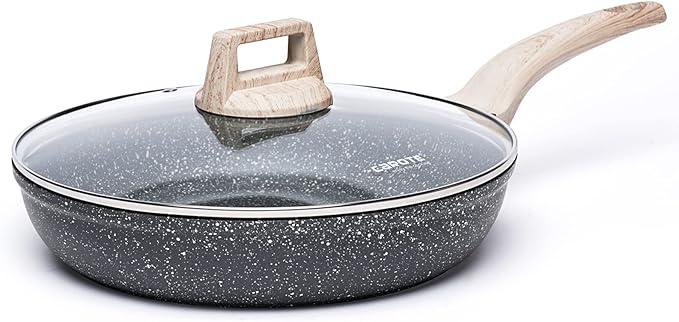
Last year I saw a non-stick skillet on sale. It was an 8″ skillet, and it was $13. It looked unlike any other skillet I’d ever tried and had received high ratings so, being extremely dissatisfied with my pricy Scan-Pan and Anolon skillets, I figured I could risk a little coin on this loss-leader.

Made by Carote, it was “grey granite” in color—an unusual but pleasantly retro look, reminiscent of old enamelware—was made of thick aluminum with five layers of heavy non-stick coating, and had a wood-tone handle (also lovely) that was super-comfortable and secure in the hand while also being oven-safe to 500°F. It didn’t take long for me to fall for this little skillet, especially after I realized that it had no riveting on the inside (where the handle connects), making cleanup (almost) a pleasure. Moreover, the base of the pan was thick, devoid of “hot spots,” and was designed to evenly expand and thus avoid warping.

When I checked the rest of the Carote line, I found that even the regular prices were a third the cost of the higher-end pans I’d been trying, so I picked up a ten- and a twelve-inch skillet, with covers, all for less than the last Scanpan skillet I’d bought.

They’ve been in daily use for the last three months, and I could not be more pleased. They come in other colors, which isn’t a factor for me, but might be for others, and a ten-piece set (skillets, pans, covers) can be had for around $120.

Recommendation #2: Ingredients

Another of my culinary challenges has been sauces.
If you make sauces, you need stock and you need a thickener. Making stock at home means saving bits and bobs from larger cuts and/or buying bones to roast, then hours of simmering and reducing all to turn a gallon of water into a quart of decent stock. Buying stock means, well, you can’t, not real stock, anyway; sure, you can buy broth and emend it, or you can buy bouillon cubes and try to counter all the salt, or . . .

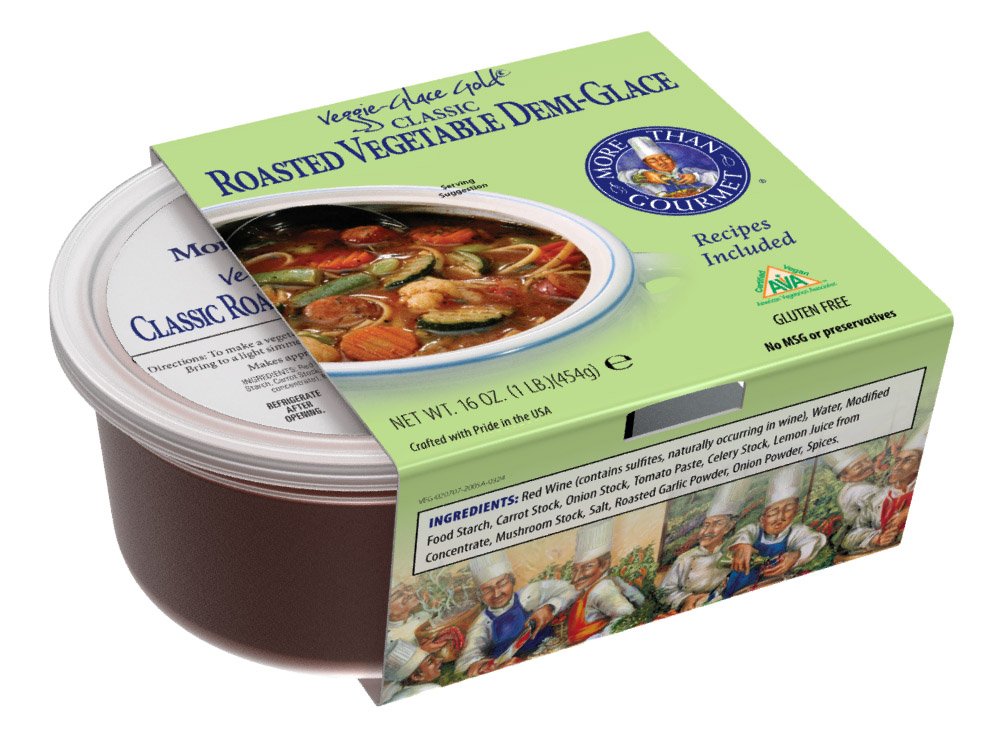
I present to you More Than Gourmet’s classic demi-glace reductions. These are a collection of gelatinized demi-glaces that may be used as stock, as a demi-glace, or as the basis for a heavier sauce. They are shelf-stable until opened, at which point they will last six months in the fridge. While not sodium-free, they are made with about a third of the salt/sodium of standard bouillon preparations and, to tell you the truth, I really can’t taste much salt in them at all, even at full concentration. They come in various incarnations, including vegetable/vegan, mushroom/vegan, veal, chicken, duck, lamb, and fish.

You can get them in small 1.5 ounce packets (including a variety pack, if you want to try some out), but I’ve been buying them in the one-pound tubs (yes, I use them that much). One thing I really like about the one-pound tubs is that I can open it up, carve off a slice, build my stock base, and if that’s not flavorful enough, carve off some more and deepen the concentration. Whether I’m making a quart of stock or a cup of glaze, these reductions are my go-to ingredient.

But, what about thickening that stock for a sauce? Well, for that I used to spend a lot of time making roux. Take equal parts fat and flour, cook them up at a low/med heat until they get to the desired nuttiness/darkness, and then hope you made enough for the quantity of base you want to thicken. I got into the habit of making a mess of roux, parceling it out into teaspoon punkles or cooling it into a sliceable stick, so I wouldn’t have to make it each time. Not optimal, but workable.

Jacques Pépin to the rescue!

I read an article in which the master (who, it turns out, doesn’t like fussing about with things when there’s a viable, equally useful alternative) sang the praises of Gold Medal’s Wondra. Now, Wondra has been around for decades, and chances are you’ve seen it at the grocer’s, down there on the bottom shelf under all the froufrou flours and organic/non-GMO pastas. Chances also are that you’ve never bought it, used it, or heard of it (I certainly hadn’t).

Wondra is a flour that is pre-cooked and finely milled, so that it dissolves immediately into liquid (hot or cold), with no lumps. Put that liquid on some heat and: voilà! instant thickener. In other words, it works just like corn starch, but it doesn’t have that gummy, flavorless, starchy mouth feel, but rather adds a bit of that woody/toasty base you get from roux. If you add some butter to the mix, it’s almost indistinguishable from a roux-based sauce. Combining Wondra with the More Than Gourmet reduction (and appropriate spices, herbs, aromatics, etc.) is a quick and easy way to get to the perfect ladle of sauce. Of course, if you’re trained at the Cordon Bleu, you’ve just fainted dead away, I’m sure, but for us mere mortals, this is a godsend.

But wait! There’s more!

Wondra has other uses, too. As a dredge on fried foods, it gives a crispier, lighter crust. I tried it last night on the slurry I use to make a lacy “skirt” around dumplings and gyoza, and it was light, fragrant, and oh-so-crispy. A massive improvement over using AP flour.

And it can be used for crepes as well, not only making them lighter and less glutinous, but also allowing you to skip the “resting” step that crepe batters usually require.

Wondra is my latest discovery from 2022 and, as such, I haven’t plumbed the depths of its possible uses, but it’s already earned a spot as a pantry staple.

That’s all for this week. Thanks for stopping by and may the year ahead be healthy, strong, and peaceful.

k


I’ve never been one for New Year’s resolutions. However, as someone who’s been developing software for thirty-five years, I am one for retrospective reviews, and just like deploying a new app to a production environment, hanging up a new calendar on the kitchen wall has always seemed an appropriate time for retrospection. After all, by this time the holiday hubbub has dissipated, the gardens are still asleep, kids are back in school, the days are short, the nights cold and lengthy. What better time to look back with an eye toward the future?

But, rather than setting goals, I look at trends in my past behavior and decide whether I’m on the right path, or want to implement a course correction.

For instance, last year I read a pitifully small number of books, less than one a month. Looking further, I see that this is a downward trend, and I want to correct it. But why did I read fewer books in ’22? The simple fact is, I was busy. With all the renovations and events and projects I had on my plate, I simply did not have enough time to sit back and relax with a book. Also, ’21 was COVID Lockdown year, with nothing in it by way of travel, family events, or DIY, so I had plenty of time then.

Unfortunately, this year is going to be a busy one, too. We’re still consolidating parts of our life, still fixing up the house, the gardens need upkeep. And I have to get serious about my coming retirement, figuring out what I need to do with Medicare, talk to our financial advisors, and wade through tons of info from HR. We’re also taking care of some medical stuff while we still have top-grade insurance.

So, seeing all that ahead, am I going to make a resolution to read a book (or more) a month? No. That’s setting myself up for failure, as too much can happen that might devour my free time. However, I am going to try to correct that trend, which means I need to apply a bit more discipline as regards my unstructured time.

This will seem silly to some, and as serious anal-retentive overkill to others. I don’t mind, though, because another trendline I’m fostering is not giving a damn about the opinion of others. It works for me, and I’m the only one for whom this needs to work.

Despite what Yoda says, I think trying is a worthy endeavor because life is rarely binary, and incremental progress is still progress. So while I’m not going to “resolve” to lose weight, learn Italian, or give up playing video games, I am going to encourage myself in certain directions, to wit:

  • Continue to Improve
    • Weight loss program
    • Healthier food choices
    • Regular exercise (workouts or garden)
    • Household improvements
    • Writing letters closer to monthly than quarterly
  • Course Corrections
    • Read more books
    • Read less news
    • Employ more social media “fasts”
    • Visit more with people IRL

May the new year bring you all much happiness.

Onward.

k

Dreaming, as One

There is something we share;
it is an idea, a thought,
a dream.

We call it a nation.

We dream that it is as real
as the earth beneath our feet,
as eternal as the stars.

We recall histories of its birth,
tell sagas of its darker days,
make plans for its future.

We believe that as it is now,
so shall it always be.

It is the same with
other peoples,
other dreams.

But we are wrong.
All of us are wrong.

These dreams are fragile, ephemeral,
dew-dazzled hopes of gossamer.

These dreams can break, vanish,
burnt by cruel suns, torn by raging winds.

All it takes is another’s dream, another’s will.

One person’s dream of power can destroy
an entire people’s dream of peace.

If we let it.

If we let it.


First, in Colorado, a woman wanted to expand her web-design business to include wedding websites, but she didn’t want to create websites for same-sex couples, as doing so would (somehow) be counter to her religious beliefs, so she sued her state and the case now sits before the SCOTUS. 

Then, in Virginia, a restaurant refused service to an organization that actively lobbies against women’s reproductive rights and LBTGQ+ rights.

And thus, predictably, many people began drawing an equivalency, leveling charges of hypocrisy and double-standards on the one side, and cheerily wagging the “What’s good for the goose . . . ” banner from the other.

Both, of course, are wrong. These are not equivalents.

I know, they seem like they are, but they aren’t. If they were, it would definitely be hypocritical to complain of the one whilst cheering for the other.

But they’re not.

Here’s the difference: The web designer wants to deny service to an entire class of people because of who they are, while the restaurant wants to deny service to a specific organization because of what they do.

The web designer wants to discriminate against a protected class of people, and that is contrary to federal and state law. She’s claiming that her personal religious beliefs trump the rights of an entire protected class. She’s not said how she would be materially damaged, were she to comply, and insofar as she hasn’t actually expanded her activities into the Wild World of Wedding Websites, she’s unable to show any damages beyond a preemptive fretfulness. 

What would we think if she wanted to deny service to another protected class, say people of color, or folks over 55? (I’m sure we could find some whackadoodle religion that looks with disdain upon interracial marriages or marriage for purposes other than procreation. What? Oh, yeah, right, we don’t have to look far, do we?) Would we be having this discussion if she wanted to turn those people away? 

The restaurant, on the other hand, has taken issue with the activities of a specific lobbying and activist organization. You might disagree with their decision to cancel the reservation, but not because lobbyists are a protected class of people (they’re not, trust me on this one). The restaurant owners aren’t turning away the group because they’re Christians, but because they’re activists who lobby against the rights and protections that many of the restaurant employees depend on (not to mention women and LGBTQ+ folks across the nation).

Now, if the restaurant said it was refusing service to all Christians, then yes, you’d have an equivalency, and I’d hold the door while you went to town on them. But they didn’t, so I won’t.

Take the case of Twitter and He-of-the-Ever-Shrinking-Moniker, KanyeWest/Kanye/Ye. Mr. West was recently suspended from Twitter (again). He wasn’t suspended because he is Black. If Twitter suspended all Black folks, there’d be riots in the streets. He wasn’t even suspended because he is an anti-semite. They didn’t even suspend him because of the anti-semitic comments he made elsewhere. They suspended him because he posted his anti-semitic trash on Twitter.

Twitter doesn’t ban anti-semites, as long as they adhere to the site’s rules of conduct. Mr. West didn’t, so he got put in a time-out. It’s the old “no shirt, no shoes, no service” rule of private business.

I find it frustratingly predictable that the camp which for decades has embraced the whole “no shirt, no shoes, no service” mantra has such a massive hissy-fit when someone applies that same rule to them. I also find it supremely irritating when the self-professed “progressive” camp so encourages what they (incorrectly) see as the same bad practices of the opposition.

And so, the saga of the American public’s consistent misinterpretation of both the First and Second Amendments continues, and judging from the arguments presented to the SCOTUS (not to mention the oh-so-helpful questions posed by the conservative claque, er, justices), we will pretty soon have a precedent that will erode the entire class of civil rights, where all you have to say is that God told you to do it and you’re good to go.

I’m pretty sure I’m preaching to the choir here (no pun intended), and that my dozen or so regular readers got the gist of things several paragraphs ago. And, sadly, I do not have a solution.

Some will chalk my opinions up to standard liberal nuance, and that’s fine with me, because I don’t think nuance is a bad thing. Life is complicated and chaotic, and we need to be kind and try to understand each other as much as we can. Nuance can help us do that, because nuance blends the black-and-white dichotomy favored by our binary brains into shades of grey, where our differences are not as distinct, and our commonalities become more apparent.

Thanks for reading.

Onward.

k

Beatle Birthday

This weekend is my Beatle Birthday.

I had my “LP” Birthday in 1992, my “Single” Birthday in 2003—and if you’re old enough to get those references, I see you—but they went by relatively (or completely) unnoticed, unmarked, unremembered. (My “78” Birthday, in 2036, might be the same, and I hope I’m lucky enough to reach it.)

Since 1967, though, I’ve thought fondly of this coming milestone, despite the fact that I was convinced I’d never reach such an “advanced” age. The song pretty much nailed what I looked forward to in my elder years (sans grandkids, of course; never wanted kids, much less grandkids), with its images of puttering in the gardens, fixing things about the house, taking a month at the seaside in summertime.

I mentioned last time that my retirement is finally visible on the horizon, and this birthday, routinely imagined for the past 55 years, is a time to stop, look around, and evaluate.

Some of my friends have already retired. Some have put their all into new ventures. Some hopped on a plane on Day One and began (or continued) to travel the world. Some, sadly, took ill, beginning entirely unplanned journeys. I admit, I compared the image in my head with how they began their Third Act, and felt the old report card put-down of “Not performing up to his potential.”

It’s not as though I plan never to travel. It’s not as though I plan not to try new things, learn new things. It’s not as though I plan to spend my entire retirement digging the weeds and fixing fuses. It’s just that, in my heart, after decades of pushing, learning, wrangling, fretting, struggling, planning, pacing, saving, working, I merely want to slow down and enjoy the ticking of the clock, the crackle of the fire, perhaps the crash of waves on the shore, and the settling of ice in a dram of whisky.

And, of course, I hope that she will still need me, that she will still feed me, when I’m sixty-four.

k

500 Days

In 500 days, I will retire. In more ways than one.

I will retire, as in leave the job I have held for lo these decades past.
I will also, for a time, retire, as in go to bed and sleep (I hope) for more than 5 hours at a shot.
I may also retire, in that I may allow my naturally reticent nature may be more the norm.

Either way, in 500 days I will have, for the first time ever, a long stretch of time where I do not have a day job.

I began working in my teens. During my college years I had to hold down a job. Even when I was studying in Jerusalem, I cleaned flats and played in the symphony for extra cash. After I dropped out and returned home, at age 21 or so, I began to work full-time. Vacations, if I had them, for the first decade or so were at most one week long. In the late 90s, I had enough seniority to afford my first two-week vacation and, in the early “oughts,” I had my first  three-week vacation (I’ve only had one other, in the mid-2010s). I’ve had a full-time job for over forty years, and have been at my current company for over three decades.

I’ve been lucky. I lucked into a good profession for which I had no schooling at a time when learning “on the job” was still a thing and aptitude combined with hard work carried enough weight to balance out the lack of a degree. I got lucky with a spouse who is good with money, contented more by daily kindnesses than by flashy acquisitions, and who truly is a life partner in every sense. As a result of these lucky breaks (and my perseverance), I can retire in my mid-60s, rather than having to work until I’m in my mid-70s.

Advice on making the transition from work-a-day-monkey-boy to curmudgeonly-semi-hermit is plentiful (although perhaps not that specifically tailored to my expectations). I have friends and relatives who’ve made the transition, have seen a shift in my news- and article-feeds toward the topic, and am in contact with professional advisors on how to handle the various mechanical and financial aspects of it.

More to the point, though, I’ve begun to mentally prepare. Work takes up a large chunk of my waking life (and a not insubstantial chunk of my sleep). What time that’s left over is usually spent with chores, errands, time with my spouse, with slivers left over to spend with friends, books, and this blog (really my only writing outlet, these days). When I get back that chunk of work-time, I know I will have to apply a level of discipline to my schedule that is currently handled by my desire to receive a paycheck. Not everything will change, but a lot will, and knowing that ahead of time seems crucial to a smooth phase-shift.

But there are some questions that cannot be answered before I reach the promised land. Currently, I am a morning person, but this is primarily because at 4AM, my brain often clicks into gear in order to prepare for the work-day. Absent that impetus, will I still be a morning person? Or will I join my wife in her night-owlishness? And what of reading time? I’m not a fast reader, but part of that is because my mind is distracted and focus is often difficult to achieve. Will that change when I don’t have on-call duties or inter-office politics niggling at my attention span?

Naturally, one thing I plan on doing more of is writing, but what shall I write? A while ago I turned my hand to a mainstream/literary novel, but it’s been a struggle; is that what I really want to write? I have other ideas for series and sequels in genre fiction, and I think they might be fun to write. I have also been enjoying experiments in poetry (though the drive to create them comes and goes like a tide). So, will I finish the work-in-progress, or just move on to other projects?

I feel that it must be better to recognize these “known unknowns” than to get blindsided by them. I’m sure there are plenty of “unknown unknowns” out there, lying in wait like tigers in the bush. Best to have my head in the game.

I’ll be spending these next 500 days in preparation: downsizing expenses; selling off the unused, unneeded, unnecessary aspects of our life; learning about what needs to be done, and by when. I’ll be listening to my friends who’ve “gone before,” and reading those dry-as-dust articles about asset allocation and required minimum distribution strategies. All exciting stuff, to be sure (not).

Onward.

k

Out of Many

we are
eight billion quilts
fashioned of threadbare cloth
stitched by blind hands
in a darkened room
uniquely alike
consistently different

or

are we
eight billion pieces
of patchwork pain
and remnant joy
a masterwork revealed
only when we see
not the threads of our lives
but the pattern of our existence