Feeds:
Posts
Comments

Two interesting articles out of the UK’s Guardian newspaper crossed my desk this morning. One was about bones, and one was about money.

First, a team of archaeologists and historians in Britain have uncovered the bones of Richard III. For real. The bones tell an amazing and horrifying story of the last moments of the last Plantagenet king, and the last British king to die in battle. And, for those who have been wondering just how much Shakespeare’s anti-Plantagenet propaganda was fiction regarding the king’s twisted form, we can now genuinely say that physically, at least, his depiction was accurate.

The team, working in a car park in Leicester, lifted the horribly severed skull, the arm and leg bones, and then the severely curved spine. The bones tell us something of his life, of his death, and of his treatment after death. Much of it was not pretty.

The second article I found of interest was an interview with Robert Reich and Jacob Kornbluth about the documentary that swept the Sundance Festival and will soon be in wide distribution. Inequality for All is being called the economy’s equivalent of An Inconvenient Truth.

Continue Reading »

Century City

Woohoo!

This blog just reached the 100 mark for folks interested enough to click the “Follow” button. (I do hate the term “followers.” You’re not that. You’re interested, and you might be following along with the ongoing conversation here, but “followers” just has too much baggage. Of course, “persons of interest” isn’t much better.)

On a purely empirical note, this does point out the difference between blogging and social networking. I’ve had an “Author” page on Facebook for years, but it took forever for that page to garner even two dozen interested persons. Here, in less than seven full months, we’re at 100 and (slowly) climbing.

On the flip side, I am pretty sure that each and every one of those FB “likers” has bought a copy of my latest novel. After all, it was their love of my books that made them look for me on FB in the first place. By contrast, I’d be really surprised if even 6% of the interested persons here has bought one of my books. I’m not complaining; I’m merely observing. It makes total sense, no? Most of you who have come here to this blog didn’t know me from Boo Radley before you happened by. Most of you didn’t come here wanting to know more about my books; you saw a post and found it of interest. Click: Interested person. Naturally, the transition from interested person to devoted reader is a slow, deliberate process, and one not to be rushed.

But I’m glad you’re all here (You, too, Gidi…you’re #100, believe it or not!)

And now, on with the show.

k

I have a birth defect. I was born without the sports gene.

Yes, thank you for your feelings of sympathy. Yes, it is quite a burden, especially for one living in America where sport is so culturally significant. When I lived in Jerusalem, where our main worries were about bombs on buses and where a Hail Mary was something altogether different, I felt more at ease. In Israel, I didn’t feel the constant pressure, the communal fever, the whiplash from elation to devastation that comes from having to follow and support my local team to the Finals, the Series, the Superbowl. I could relax. When I returned to America, arriving in late December during the hyperbolic run up to Xmas and the Superbowl, I experience a deep and disturbing culture shock.

As a child, I did my best at sports, though my heart was not in it. I was quite an active young boy, but my vision was poor, I played the violin, and I liked to read. Yes, as you can imagine, it was a cruel, cruel childhood when it came to sports. I was the boy picked next to last–right before the kid with the brace on his leg and right after the kid with the cast on his arm. The importance of sport in American culture was drilled into me again and again.

I played in the organized games, when required. Four-square was my best event, as the distances were short and the ball was large enough for me to see (I didn’t get spectacles until fifth grade). I remember one day, having been impressed into a softball game, that I got lost on the way to first base. The memory could be bitter, but I choose not to remember the fact that I couldn’t see well enough to navigate the 90 feet to reach the white bag on the ground; I choose instead to remember that I actually hit the ball: a miracle!

Continue Reading »

Back to Stratford

Kurt R.A. GiambastianiA few weeks ago, I reported that a book I was reading made me question my long-held belief that William Shakespeare, the man, and William Shakespeare, the playwright, were one and the same. Now before your eyes glaze over (“O, by Heav’n!” you say. “Not again!”) let me say that as a writer, I found this of great interest. Several people have tried to interpret aspects of my writing and deduce things about my background and history; this is exactly the same…except with a genius writer instead of me. Continue Reading »

A Peeper’s Dry Plate

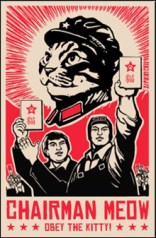
Obey the Kitty!It’s been seven months since I began this experiment, and I feel it’s been pretty successful. The interest from you all has gelled around a handful of topics–writing, food, reviews, Seattle–but I haven’t felt restricted or limited in any way. And to date, nearly a hundred of you have decided to keep tabs on my flow of opinions. Thank you; I find that gratifying and encouraging.

Oddly, one of the most popular posts has been my review of “Ripper Street.” That one post, still only a couple weeks old, ranks #4 on the “most viewed” list, surpassed only by the Home Page and other pages that have been here from the beginning. And most every day, it gets a couple hits, mostly from search engines looking for references to a “peeper’s dry plate.”

So, if you’re here looking for an explanation for that rogue comment, made by Sergeant Drake on “Ripper Street” (S1E1):

A “peeper” was Victorian slang for a mirror, but also (as today) for anyone who might be engaged in voyeuristic activities, such as a photographer of smut.

A “dry plate” is an improved photographic plate, using gelatin, that was invented in the late 19th c., and which had many practical advantages over the “wet plate.”

 My thanks again, to you who read this regularly.

k

Tough Room

Kurt R.A. GiambastianiThis article crossed my desk yesterday in which Chuck Wendig lays out in bold, unvarnished terms, just how rotten the publishing industry is. Thankfully, Chuck threw enough humor in there to keep us laughing while we cry.

Chuck hits all the high (aka low) points of the business, like why it’s absolutely insane to try to write to the market, and how unbelievably slow-moving the industry is (glaciers are hares in comparison).

Writerly-types, pay attention to #20, especially the link to Writer Beware. If you haven’t ever heard of Writer Beware, you have now. Go. Learn.

Geese

I rise early; dawn is just a hint behind the eastern hills. I slipper down to the kitchen for coffee, then, hot brew in hand, slipper back to the office. I snap on the worklamp, turn on the computer, then sit and sip while I wait for the heat to come up from the furnace,

Outside, dark grey clouds hang in an oyster blue sky. The rain has eased and all is quiet until, just there, from the south, down the street, I hear the call. It’s a faint “Honh!” Iike a French adolescent clearing his throat, first one, then another. I rise and step to the window. I pull aside the curtain and peer upward. “Honh, honh” gets closer, is repeated. Different voices echo the first, and craning my neck, I see them, a vee of dark wings just above the treetops. Black necks, white cheeks, beaks pointing north, they “honh” to one another. Passing instructions? Keeping tabs? Giving encouragement? They fly over my house, and I can see their fingertip feathers against the paling sky. Now past, continuing onward, their calls fade with distance as they travel, as they head north to their nesting grounds.

Every year, I hear them–south-bound in winter, north-bound in spring–and every time I smile. I live right along their route, right along the necklace of lakes and ponds that guide them: Green Lake, Bitter Lake, Twin Ponds, Ronald Bog, Echo Lake, and beyond.

They’re a bit early this year. A mild spring, then, and an early summer ahead.

k