Feeds:
Posts
Comments

Archive for the ‘Gardening’ Category

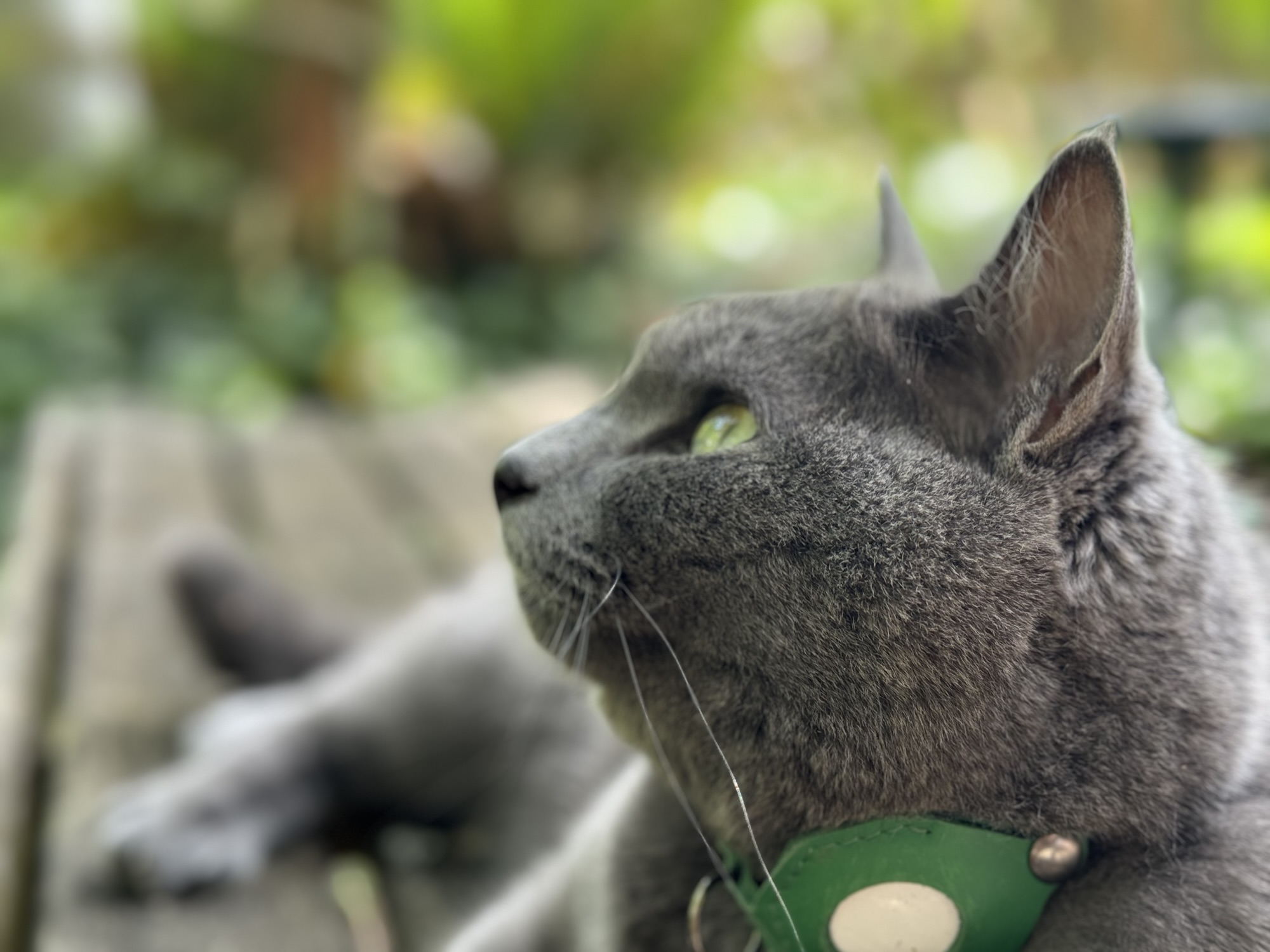
Lost Cat

he appeared one day
four-footed storm cloud
walking up to our deck
like he’d been there all his life

I said hey and
he squinted a smile
rising up to nuzzle my
offer of friendship

he became a fixture
prowler in the gardens
riding shotgun on my shoulder
as he supervised my labors

but his candle was brief
his rumble now silenced
and his spot in the sun
forever empty

Read Full Post »

This time of year—late October, early November—my walks gravitate toward a specific corner where two trees grow. I could show you a picture of them, but then you’d only know what they look like, and not what I see.

They’re a mismatched duo, a Mutt and Jeff of trees. One is a maple, about twenty feet tall, round in shape above a sturdy trunk, with those wonderful deeply cut leaves that rustle and dance in the breeze. The other, a blue noble fir, towers over its partner at thirty-five feet, a slender cone covered with densely packed needles that shrug off the weather. They’re both handsome trees, well-formed, healthy, and in spring and summer, the maple’s green leaves are a good match to the fir’s bluish cast. This this time of year, though, they become a spectacular complementary pair as the maple leaves slowly yellow and then turn a bright, happy orange.

My steps slow as I approach them and take in their contrasts. The fir seems even bluer, set off by the maple’s fire, and as I pass I see that where their branches come close, almost touch, the maple’s leaves have yet to fade, as if the blue of the fir is leaching out, keeping them green for just a little while longer. It’s like the fir, having enjoyed the company of its companion, is urging it to stay, have one more drink, before departing for its winter slumber.

In a few weeks, the fir will stand next to the scaffolding of its dormant friend, braving the winter alone, wishing for spring, and my walks will wend away to other areas, other avenues, other vistas. The memory of the orange and blue will stay with me, make me smile through the dark of winter and the greenery of next year, until their return, and we all meet again.


Read Full Post »

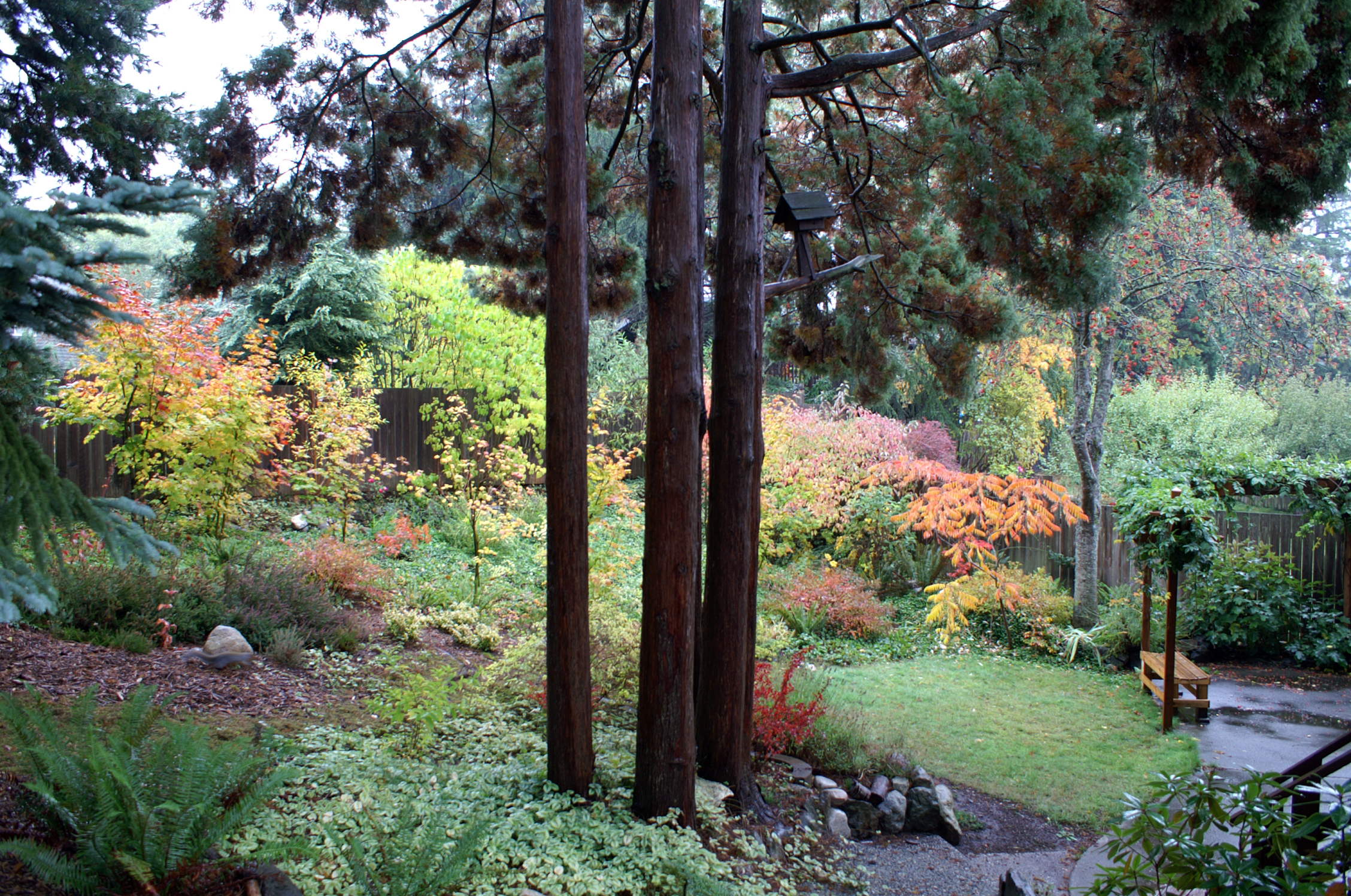
sumac, feathered fronds waving, hear it first
autumn’s gentle rapping on the garden gate
put on parti-colored togs to greet the arrival

nearby maples eavesdrop on the reunion
catch half the meaning but all the sense of joy
don festive gloves on five-fingered leaves

sweetgum and dogwood wake with a start
having overslept in summer’s waning sun
leaves blushing with groggy embarrassment

wisteria, in denial, refuses to join the fun
and with tendril fingers in viny ears
will sing la-la-la until their guest departs

evergreen elders tower over the festivities
enjoying the youthful exuberance at their feet
preparing for storms they know will come

Read Full Post »

Walking my garden paths
fingers inspecting leaves
snips cutting spent blossoms
I hum a tune born
four centuries past
across continents
and seas

I wonder if the author
as he wove his tapestry
of notes and voices
imagined his music
would live beyond his life
persist through time
as empires rose
and fell

I wonder if he
as the ink dried on
quavers and triads
imagined his melodies
would grace the flower-scented air
of distant gardens
in a land
unknown


Read Full Post »

Most of all, he enjoyed pruning the Japanese maples.

They stood beneath the canopy of evergreens–spruce, pine, fir, cedar, cypress–the giants of his garden. The tall conifers took the brunt of the weather, snarling into the winds, sacrificing muscular branches heavy with sap and resined scent to protect the more delicate growth at their feet. There was little to prune on these living towers; mostly he just carted away what the ocean-birthed storms snapped off, trimming back broken stubs, fulfilling his custodial chores while they, aloof and inscrutable, heads in the louring clouds, faced the southwesterly winds, ready for the next gale.

The other maples, the vine maples, were not his favorites, being a bit too boisterous, sending up trunk after slender trunk, reaching outward with multiplicative hands, begging for alms of sunlight. Pruning these, even the eldest of them, was like wrangling twelve-year-olds on a class trip. Just retrieve the one and you find that two others have ranged away from the pack. He loved them for their fall displays, though; their sudden, explosive shift from simple summer green to riotous fires of autumn could happen during a single night’s slumber. He was especially fond of the precocious one in the back, tucked under the pendant drapery of the grandmother spruce, because that maple was always first to change clothes, eager for colorful sweaters and winter’s onset.

But most of all, he enjoyed pruning the Japanese maples. Not the winter’s pruning, but in summer.

In winter, when they slept naked beneath the grey blankets of somnolent skies, he would trim them for shape, for strength, for optimal overlap and layering, and with an eye toward the tripartite growth that would come in spring. This, though, this was straightening the curled hand of a sleeping child, tucking them in beneath the covers. It was the trees, and it was him; two species, separate, unattached, isolate.

In contrast, the summer pruning–he could think of no other metaphor–was making love. The leaves of the Bloodgood–deep magenta, finely serrated, with thin, questing tips–rustled as his hands moved through the branches. The Autumn Moon’s leaves–pale green, delicate, so sensitive to light that a week’s sun would make them blush and August’s searing gaze could shrivel whole branches–bent to his ministrations, be it to rub out the dried tip or snip off a sere frond.

The two of them, though they were as old as others he’d planted, were barely half as tall. Theirs was a patient habit, a measured expansion, with each branch testing the world in three directions: one twig right, one left, one forward and upward. As his fingertips moved down each limb, each branch, each twig, he could divine their logic. They knew their limits and worked within them: send out scouts, read the reports, proceed only if conditions are favorable. He loved their caution to the point of emulating their unhurried approach in his own life. Knowing that his eyes could sense things they could not, knowing where the dappled sunlight would be best, he would pinch here, pluck there, and encourage them toward the unseen goal. Of their failures, his gentle caress revealed the abandoned twigs, stiff and pale where successes remained supple and green, and he would thumb them off. The snips were a last resort, for each leaf was a gem in the rough.

For when Summer packed its bags and Autumn came home to do its laundry, the evergreens remained dark and disinterested columns and the vine maples played frat-boy pranks on one another. But between the constancy and the chaos was the slow flood of color of his Japanese maples. The Bloodgood’s leaves crept from maroon to red to rust to scarlet to a crimson so sharp it could cut, while the Autumn Moon caught fire, dropping green for chartreuse, adding dry-brushed pinks, until October’s cold hearth brought the touch of orange hearthfire to each leaf.

He was aging, now, knees creaking, back growing stiff, while for these trees their youth was barely begun. He wondered–frankly, he worried–about what would happen to them once he’d passed. “Scatter my ashes on my trees,” he’d often say, though he only dreamed he would die while still near them. For as long as he could, he would remain there, caring for them at the same tempo they lived.

Because, most of all, he enjoyed pruning the Japanese maples.

k

Read Full Post »
For six decades, my feet have touched the earth. This did not seem a consequential thing before, but I have learned otherwise.

I grew up on the shores of San Pablo Bay. While, behind me, the dark oases of live oaks studded the rolling golden hills, I walked unshod down the shingled shore, the smooth curves of wave-worn pebbles pressing upward into the flesh of my bare feet. I would gather kelp vines to use as bullwhips, challenge fiddler crabs to duels, and with a poked finger annoy the anemones until they spat. My bare toes gripped the ragged rim of a tidepool’s edge, and my arches provided stability as I balanced on weather-beaten logs. To my bare feet, the cool water and the hot stones were as natural as the salt air and the scent of baking seaweed were to my lungs.

Then, with shoelaces tied together and draped over my neck, I kept my shoes dry as I crossed the tidal marsh that lay between shore and home,. Navigating past clumps of reeds, gently pushing aside the serrated blades of pampas grass, I let my feet breach the brackish water, sink into the yellow mud, continue down through muck the color of rust, until they hit the underlayment of fetid black peat, the foul and oily rot squishing upward between my toes. Here, shoes were worthless, destined (if used) to be left behind in a muddy grave or, worse, to survive for a few brief and redolent hours on the front stoop before my mother gave up and threw their ruined stink into the trash.

When school let out for summer, my friends and I tossed our tattered Keds aside and headed up into the sun-bleached hills behind our homes. We followed creekbeds and ridgelines, slid on the fragrant mat beneath the eucalyptus trees, and winced as spiny oak leaves pierced our callused feet. Come late August, with back-to-school sales shouting from every newspaper and TV ad, I’d be given new shoes, along with my mother’s admonition to take care of them this time because she wouldn’t be buying me any replacements.

To be safe, I rarely wore them outside of school.

In the time between those days and now, I maintained my contact with the earth, barefooting my way through the years. Working in my gardens, shaded by their canopy of spruce and fir and maple, I felt with each step the sun-warmed grass, the cushioned mat of russet needles, the crunch of pinecones, the coolth of upturned soil, and always I reveled in the chthonic energy that flowed upward from earth to sole to crown. My feet are still callused, though now mostly from walking on pavement than traipsing across youthful hills, but lately, age has begun to make its effects known.

An injured ligament across the left arch and instep has required support beyond what my bare feet can provide, for which I resorted to an ankle brace and bindings. The foot has improved, albeit with glacial speed, to the point where the tight grip of the bindings is not always required, but sadly, the foot is not yet able to go it alone, and so a shoe (with arch support) is needed.

The practice of walking shod was melted out of my DNA by the sun of many summers and so, even though it lessens the pain, wearing shoes around the house feels alien and unnatural. I feel as if I’m just passing through my own home, on my way to somewhere else, some place where bare feet are a faux pas.

My heart holds tight the hope that this is a temporary condition and not the first step down some inexorable decline, and that by the solstice I will once again be able to feel the ground beneath my feet, but there is no guarantee. Meanwhile, I will practice patience; but do not be surprised if, now and again, I leave my shoes on the bottom step and walk out to spend a few minutes standing barefoot beneath the garden’s green-leafed roof.

k

Read Full Post »

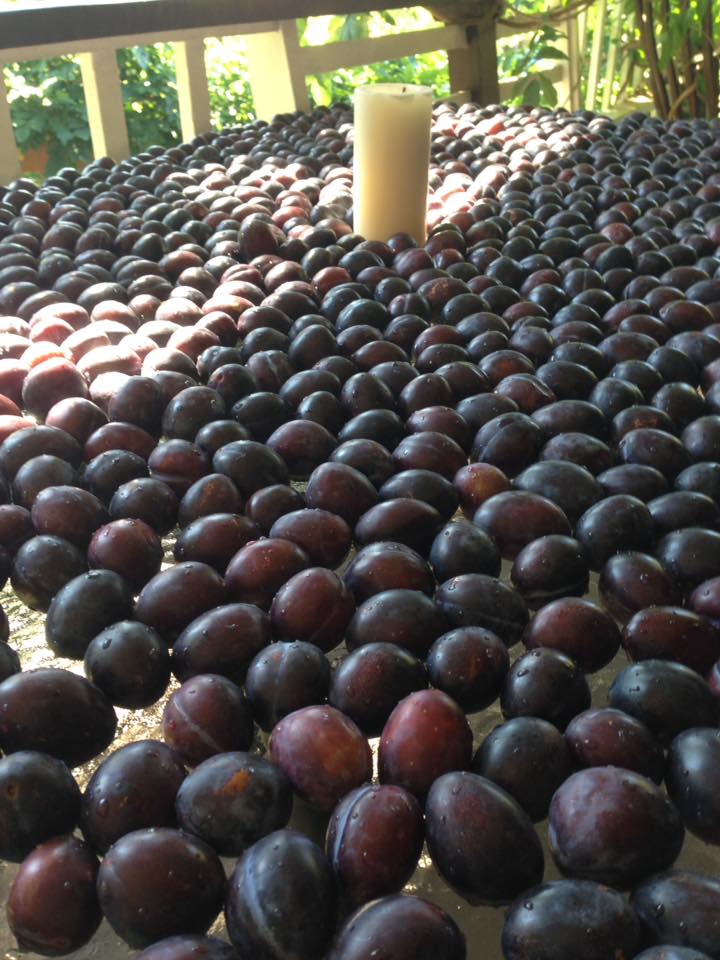
The Princess Gang rolled into the cul-de-sac on the day Mr. B’s plum tree decided to bloom.

That is the opening line to a story I’ve been playing with for a while, and like most of my mainstream fiction these days, it is based squarely in my real life. The Princess Gang was a cadre of small girls who used to rule the cul-de-sac, roaming their demesne like a pastel cloud of tulle-swathed glitterati. The plum tree was the Italian plum tree I planted in my front garden long before any of the Princess Gang were even born.

It was nearly twenty years ago that my wife and I drove back from the nursery with two plum trees sticking out of the back of our tiny hatchback, dormant branches rattling. I wanted some fruit trees in the front garden. Knowing the soil there was poor and that the area gets a lot of afternoon warmth, I thought a French or an Italian plum tree—no strangers to challenging conditions—would at least have a hope of survival. (more…)

Read Full Post »

Older Posts »