 For me, the most powerful tool in a writer’s toolbox is the power of observation. It not only helps me create believable characters, it also gives me the ability to fill my worlds with believable detail. Some examples…
I was in the office when the wind-up clock stopped. It didn’t go tick-tock—tick—-tock, slowing as it reached the end of its wind, but just went tick-tock-tick-tock—-, ending suddenly and abruptly like some metronomic cardiac arrest. Odd.
My stomach growled at me this morning, and it sounded for all the world like it said, “Hello, Chuckles.” My guts have never spoken to me so explicitly before, but I’m glad we’re on such friendly terms; that hasn’t always been the case.
For her 60th birthday, I gave my sister a vintage electric clock from the ’40s. It didn’t tick like a mechanical clock but hummed as it worked the sweep second hand around the dial. My sister liked this especially, as it matched her feeling of time as a continuum. I prefer the mechanical heartbeat of a tick-tock clock, as I like to think of time having a constant, measured passage.
These details of life and character are just the sort of things that inform my writing, providing snippets of description or personality. Observation is such a critical skill that it has actually become a pasttime for us.
We can play this game anywhere–at a restaurant, waiting at a stop light, anywhere–just by looking around at the people around us. (Coffee shops are perfect for this game.) I’ll pick someone or she might pick a couple, and we’ll start building backstories for them, weaving a tale of why they are there, what they’re doing, and what they are feeling. These aren’t just wild imaginings, though; we base our story on the subject’s dress, movement, and behavior. Couple on their third date? Construction worker doing the shopping for a sick wife? Woman contemplating divorce?
The key to the game is that the stories must be believable, and must tie into the person we observe. While my wife enjoys the game simply for the mental exercise, I find that it hones my skills and heightens my awareness. If you aren’t aware, you cannot observe, and if you aren’t observant, then you’re creating characters and descriptions in a vacuum.
Characters have to be believable, consistent, and comprehensible to the reader, even if the setting is as alien as a moon or the 9th century. In all the historical research and reading of memoirs I have done in preparation for my novels, the one thing I have learned is that we, as people, have not changed much. The world surrounding us has transformed, technologies have changed, but human behavior remains remarkably consistent.
So keep your eyes and ears open. Stay frosty. Inspiration may be standing ahead of you in the checkout line.
k
Read Full Post »
 I’m wrapping up my second month on this blog (boy, do I wish there was another word for this thing; “blog” just sounds so…indiscreet), and I thought it proper to do a little retrospective on the process.
 Ages ago, when the crust was cooling and TV was funny, there was an episode of M*A*S*H where Hawkeye was looking through the files for the map to the minefield and Radar says it’s right here. Under “B”…for “Boom.”
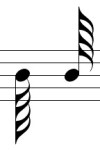 Before I started to write, I studied music. Classical music, ancient music, and modern; in orchestras (symphonic, chamber, and pit), in bands (marching, symphonic, jazz, and swing), and in trios, quartets, and quintets; as a student, as an amateur, and as a professional; as a violinist, a violist, on the tuba (Sousaphone and miraphone), with bass guitar, on percussion, and as a conductor: I did it all. For the first three decades of my life, music was my sole creative outlet.
 Kurt R.A. Giambastiani