Feeds:
Posts
Comments

Posts Tagged ‘quiet living’

Earlier, I waxed a little poetic about crickets and our lack of them here in Seattle. Anyone who’s read my novels might remember that crickets show up pretty regularly, there, and they will always be, for me, a comforting, blanket sound. “Blanket” sounds (in KRAG-speak) are sounds that fill the night air, but stay in the background; you don’t notice them until they’re gone. There are many other sounds that I find especially comforting and that, even when they wake me up in the middle of the night, immediately settle me back to sleep.

Foghorns are a big one. I grew up in the San Francisco Bay Area, where fog is a fact of life. Here, around the Puget Sound, it is similar. If you live anywhere near the shoreline, you quickly learn whence across the night water you can expect to see the blinking eye of a beacon and hear the comforting hoot of the horns. Foghorns ask their low, gentle questions across the Sound: Are you there? Can you hear me? Are you safe?

Trains, from a distance, evoke a similar mood. When we lived in Richmond Beach, closer to the shore, the coastline trains would sound their horns as they neared town. I always smile at their forlorn, two-toned call.

My favorite “blanket” sound, though, is one I’ve only experienced a few times in my life. Almost 30 years ago, my wife and I stayed in Anchor Bay, a small coastal town in Northern California. We stayed in a small cabin up on a bluff, overlooking the Pacific and a small rocky islet. On the shingled shore of that rock lay hundreds of seals, and they would bark all day and all night, their calls mixing with the rush of the surf to create a foundation of sound that waxed and waned with the strength of the ocean breeze. It took us two nights to become accustomed to this constant noise, but once we did, sleep was deep and satisfying.

I’m sure there are other sounds others find as relaxing as these. I would be interested in what your “blanket” sounds are…

k
Read Full Post »

Last month, the power went out on a windless day. Last month, we took a small step away from the digital age. These two events are not unrelated.

Unlike our last home, where the power went out any time a dog barked, the infrastructure surrounding our current residence is fairly robust. So we were surprised one quiet evening when, with only a slight breeze and no rain outside, the house went dark. In the sudden silence I could just hear all the hard drives spin down and all the electronic doo-dahs begin to tick as they cooled. The house, without power, felt dead.

And just as we found the electric bill and the number for the outage hot line, the power came back on.

Leaving me with the task of going around the house, resetting the little red digits on each and every clock and appliance, save the DVRs, which (being rented) are new enough to figure it out for themselves.

I detest this chore. Twice a year, on spring-forward/fall-back Sundays (don’t get me started), I have to do this chore, and if the power goes out, I have to do it again. I hate it. It’s tedious, numbing, and (in my opinion) unnecessary. And when I have to do it because the power went out for just a couple of minutes? Ooooooh. Stay away.

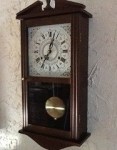
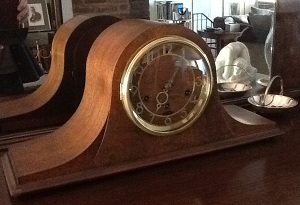
After some discussion and some rather blatant lobbying reminiscent of a child asking Mum and Dad for a puppy, I began to replace our red LED digital clocks with real clocks. For the most part, I replaced them with clocks that go “tick tock,” and several of which announce the hour with chimes or a gong. Being at least as old as I am, all of the clocks required a complete breakdown, cleaning, and oiling, but for me, this was part of the journey; this made them ours, part of our house, much more so than had we bought them at Target and put them right on the shelf.

It’s hard to describe the difference in the house, now. Aside from the obvious—the music of the Westminster on the quarter hours, the bong of the chimer on the half-hour—there is another, subtler effect. There are still a few to go—an alarm clock here, a display clock there—but already the house is a much calmer place. The rooms of our house, each with their small, wood-encased heartbeat, seem more alive. We both find that we like the house quieter, now. The television is off more. We read more, or tinker with small projects. And now, late at night or when the power goes out, time continues, the house lives on, and the steady tick of a nearby clock reassures us, its pendulum measuring out each quiet moment.

Read Full Post »

« Newer Posts