rain, cold, and woodsmoke
a cottage in the deep green
homespun alchemy
Posts Tagged ‘novel writing’
Today’s 4,000
Posted in Creativity, Poetry, tagged creative writing, haiku, modern poetry, nature, novel writing, Poetry, quiet living, Seattle, Writing on 13 Nov 2025| Leave a Comment »
Old Influencers
Posted in Creativity, Writing, tagged amber, books, Bradbury, Characters, creative writing, mccaffrey, novel writing, novels, pern, short fiction, short stories, Writing, zelazny on 20 Jul 2025| 2 Comments »
 Having been pleasantly surprised by my recent re-read of a sci-fi/fantasy series I’d loved as a teen, I decided to extend this run of good luck and re-read another series that was influential to my own writing style (when I eventually got one).
I first crossed paths with Roger Zelazny’s works—both short form and long—in high school. It was before I’d read much fiction at all, and thus I did not have a lot of knowledge to bring to the experience. Despite this lack (or perhaps because of it), Zelazny’s stories and novels stuck with me, shaping my appreciation of the written word from then on. Zelazny was one of the triumvirate of authors who influenced my youthful enthusiasm for fiction, along with grandmasters Anne McCaffrey (a major influence, I discovered last week) and, of course, Ray Bradbury.
Each of these authors drew a different type of appreciation from me. McCaffrey’s prose was not what stayed with me, but rather her characters and their relationships, which were crucial to the workings of her plots. In considering Bradbury, I admit that none of his novels stuck with me, but his short fiction! Oh, what magic I found there. The books that collected his short works in a thematic whole—The Illustrated Man or The Martian Chronicles—were treasure boxes to read and re-read.
Roger Zelazny, though, held a special place in my pantheon, and not just because he was the only one of the three I actually met. Back in the ’70s, I didn’t have the breadth of experience to understand what I so enjoyed about his works, but yesterday, as soon as I began his Nine Princes in Amber, I could pinpoint it precisely. Where McCaffrey’s prose was straightforward, and Bradbury’s was as near to poetry as one can get in prose, Zelazny’s writing has a distinctive “voice,” matched to the mind of the character, and integral to the tenor of the storyline. As I began this book, I heard echoes of Hemingway, of Chandler and Hammett, along with the flow and descriptive power that was Zelazny’s own. That “voice,” that touch of the hard-boiled detective, was a crucial element of the character in that opening chapter—Corwin, a man out of space and time, without memories, must navigate a dangerous world filled with people bent on his demise. It was all fedoras and noir on silver nitrate and razor-sharp repartee and chiaroscuro lighting until, amazingly, subtly, color crept into the world along with Corwin’s recovered memories, and the “voice” shifted as well, matching again the mindset of the Corwin’s evolution.
I was lucky enough to meet Mr. Zelazny in the early ’90s, after I’d made my first professional-level short story sale. It was at a sci-fi convention here in Seattle, and I was trying to learn as much as I could about the craft, and meet as many “pros” as I could (a terribly difficult task for an introvert like me), but I’d been met with nothing but condescension and rudeness from nearly every established writer I approached. But I put that aside as I’d come primarily because Zelazny was a featured guest. I’d heard him read from his forthcoming book (A Night in the Lonesome October), and I’d brought my limit of three books for him to autograph (my beat-up vintage copies of the two-volume Amber omnibus and a dog-eared paperback copy of Four for Tomorrow).
Having been scorched by other authors at the convention, I expected a perfunctory meeting at the signing table, but I was determined to let Mr. Zelazny know how influential his works had been on my own nascent attempts as a writer. Instead of just signing my old books and moving on with a nod, he asked if I was submitting my work; I said yes, and that I’d been in a recent issue of a small professional magazine. He knew the magazine, actually had back issues, and wrote down my name so he could look up my story. After all the bristles and cold-shoulders I’d received that weekend, a kind word from a writer so important to me was a gift dearer than rubies. Did he really have back issues of a small-run magazine? Was he really going to read my story? I don’t know; he might have merely been encouraging me, a gentlemanly gesture to a budding young man who had kept three of his books safe and secure for a score of years. Still, I like to think he might have.
Reading these old favorites again, though, now with my older, wiser eyes, I feel the old desire to craft words renewed. I want to finish reading all of these titles I’ve pulled from the stacks, but after that . . . after that, I think I have work to do.
k
Finding My Wellspring
Posted in Creativity, Fallen Cloud Saga, Writing, tagged books, Characters, creative writing, Creativity, dragonriders, Fallen Cloud Saga, fiction, mccaffrey, novel writing, novels, pern, Reading, Writing on 13 Jul 2025| 1 Comment »
 A friend asked the hive-mind for book suggestions—preferably science-fiction/fantasy/speculative fiction—to flesh out her summer reading list and (naturally) she got more titles than she could probably read in a year. I tossed in one title I’d read recently; it was less “spec-fic” and more what I’d call “magic realism,” but I had found it delightful and passed the title¹ along.
In perusing the suggestions from others, I saw a mix of genre classics along with (what I assumed were) newer titles. I used to read nothing but sf/f novels—they were my introduction into fiction, back in the late ’60s/early ’70s—but over time, for reasons (painful or practical), I drifted away from the genre, and have zero experience with many of the newer authors.
There was one particular suggestion, however, that caught my eye, It was a title² of which I’d not thought in decades, even though I adored the series when I was young. I was in my teens when the books were first published and I devoured them, thankful there was only a year between release dates.
In recent years, I’ve occasionally gone back to re-read some old favorites, but that proved a dicey proposition. At sixteen, seventeen, I had no comprehension of—much less appreciation for—writerly things like structure, characterization, world-building, foreshadowing, allusion, or pacing. If you gave me a brisk plot and a compelling reason to turn the page, I was all yours. Going back to those old, familiar titles led, more often than not, to disappointment. Clunky dialogue, predictable plots, heavy-handed setups, wooden characters, and banal prose were common, and that’s before considering the rampant sexism and gender dynamics of the period.
But, oh, I did so love these books, this series, this world. So I gave the first in the series a try.
What I found within shocked me.
It’s not that it is bad; far from it. Yes, the author has some annoying (to me) quirks, and is inordinately fond of multi-syllabic adverbs, but the characters are full and distinct, the world has a long and detailed history that affects the current action, the social structure is coherent, strong with rituals and patterns, and there is humor and passion and drama and risk aplenty.
What shocked me, though, were the echoes I recognized between these books and my own. Understand, between the time I read these books and the time I began writing fiction, two decades had passed. When I was writing my own books, I never thought back on these titles, not for inspiration, not at all.
And yet, as I re-read these old books, I see in them the seeds of the worlds I have built. From the psychic connections along ley lines in “Spencer’s Peace” and my Ploughman Chronicles, to the bonding between riders and walkers in The Fallen Cloud Saga, to the convolutions of time travel in Unraveling Time, here in these books lie the kernels from which my own books grew. These books, this series, they are my source, my wellspring.
All writers, I believe, are influenced by the writings of others. We’re all, as Stephen King once said, like “milk in the fridge,” picking up flavors from whatever we’re near, accreting reverberations from the artistry of those we admire. But to find so many thematic origins in one place, well, it’s like finding a loved one, long-lost, long-forgotten.
I’m exceedingly glad I took a chance on these old friends, and I will definitely read the six or seven titles that I read when I was a boy. I feel a need, after this difficult year, for an infusion of youthfulness and hope, and these books, for me, flow with those gifts.
k
¹ The Lost Bookshop, by Evie Woods
² Dragonflight, by Anne McCaffrey, first in the Dragonriders of Pern series
Quandary: To Write/To Scrap
Posted in Creativity, Writing, tagged creative writing, editing, novel writing, self-publishing, writer's block, Writing on 23 Jan 2025| Leave a Comment »
The first anniversary of my retirement approaches, and it finally feel as if I am making headway. I am not complaining, but it has been a period of great transition. After nine months, I am finally sleeping more than 5 hours/night (usually), all of our insurances are now in post-retirement mode, almost all of the “big” household projects are complete, and the gardens are now have less of the “prettyish kind of a little wilderness” vibe and more of the “someone definitely lives here” vibe.
Which means—in theory—that I now have time to relax, recreate, and indulge in avocational pursuits such as reading from my towering TBR stack, learning new weaving techniques, and of course, writing. Writing has been the most difficult for me to restart; I’ve tried to keep to my schedule here, but frankly, it’s been a challenge to maintain my regular Thursday posts. Life, current events, injuries, domestic duties, support of friends and family (such as I’m able), they all take energy and pull from my ability to focus. Poetry has been my mainstay, a manageable way to keep my hand in. Ideas and concepts bubble up while I’m on my walks, then percolate for a few days, a week at most, until they’re either tossed aside or they crystallize into something I can further fashion into a piece that I’m not embarrassed to post here.
Of Bushels and Lamps
Posted in Creativity, Fallen Cloud Saga, Writing, tagged book marketing, creative writing, marketing, novel writing, self-publishing, Writing on 13 Oct 2022| 2 Comments »
“Has John read your books?”
“I don’t know.”
“What do you mean? You guys talk about books all the time.”
“Well, sure. But not about my books.”
The above snippet of dialogue is verbatim from this past weekend, and it is Exhibit A in the case of Why I Absolutely Suck at Marketing.
In general, I do not know which of my friends have read any of my books. Yes, there are some exceptions to this—beta readers for a certainty, those who’ve expressed an opinion about a title—but if pressed, I know of only eight people who have definitely read one (or more) of my titles. And two of them are dead, so I’m really down to only six. That small list gets longer if I include people who I know have bought my books; but have they read them? One acquaintance told me flat out that she bought my books but did not read any of them, so I don’t take equate purchases with readers.
Why am I so in the dark on this topic? Because it is how I was raised. And it’s also my nature.
A big lesson of my youth was, “Don’t show off.” My father was insistent about this. “You have talents,” he would tell me, “but don’t get cocky, don’t show off, because there’s always going to be someone out there who’s richer or smarter or more talented than you are.” The subtext, coming from the grandson of a charcoal burner (yeah, it’s a real occupation), was essentially “Pride goeth before a fall.” Humility, my dad felt, consistently won over more people than braggadocio.
This fit well with my introverted mien. I have absolutely zero desire to “show off” and put myself in the spotlight (this blog notwithstanding), so self-deprecation and “hiding my lamp under a bushel” aren’t second nature; they’re first nature.
As a result, there are people who know me who don’t know that I’ve written nine novels (and counting). I don’t introduce myself, saying, “Hi, I’m Kurt. I’ve written nine novels. Heard of me? Want to read one?” In this age of self-publishing, being an accomplished novelist isn’t as big a deal as it used to be. Folks who learn of my bibliography might smile and nod, but the look in their eye betrays their unspoken reservations about the probable quality of my work.
None of this is to say I’m not proud of my books—I am—but there are just too many variables to the “Hi, I’m a writer” gambit. Nearly 20% of Americans didn’t read any books in the past year (print, e-book, or audiobook), and about half of the population has read fewer than six titles (and which ones do you think they’re going to buy? Mine?). Then there’s genre-preference, with “historical”-anything being at the low end of the popularity scale (and my stuff all being “historical”-something or other). Taken as a whole, there is absolutely no reason for me to expect that anyone I know is going to enjoy my books; the odds are simply against it.
Marketing is essentially nothing but “Look at me!” show-offery, and that is totally antithetical both to my attitude and to my nature. So, I suck at it.
However, this whole cover redux journey I recently began is nothing but marketing. Sort of. So, I’m a little conflicted. And a little anxious about the whole idea.
Still gonna do it, though.
k
In Defense of the Formulaic
Posted in Books, Movies, Writing, tagged creative writing, formulaic writing, genre writing, novel structure, novel writing, predictability, Writing, writing tips on 20 Jan 2022| Leave a Comment »
I was in a foul mood all last week, so when a friend offered her opinion of a movie I’d recently enjoyed, deeming it “fairly good, while predictable,” I took it as a passive-aggressive reference to my low-brow viewing choices.
Naturally, she did not mean it that way and (thankfully) I have a strict “reread before hitting enter” policy when posting to social media, so no damage was done, but it did get me thinking.
The movie in question is of the “coming of age” variety and my friend’s evaluation was, to be frank, pretty spot-on. The movie is predictable, as we follow a young man growing up, navigating the pain of early adulthood until, at movie’s end, he comes to terms with his father’s history of absence and utter unreliability.
Predictable. Trite. Cliché. I’ve used these words to describe (in negative terms) both books and movies. I’ve done so here on this blog, and usually I’ve not been kind about it. So, why do I look down my nose at some formulaic works, yet enjoy others? Why do I consider some works to be entertaining, even though they are utterly predictable?
We’re all familiar with the old argument about story archetypes, how many there are, and how old. According to common wisdom, there are only seven archetypal plots (though opinions differ, and widely so). Whether this is true or not, formulas are used to build stories, especially in film—the coming of age plot, the rom-com, the murder mystery—and they are often followed to the point where you can set your watch by what happens on screen. Eighteen minutes into an episode of Murder, She Wrote? A body is going to drop in three . . . two . . . one . . .
Why do we enjoy such stories, even when we know how they’ll work out? And when do we not enjoy them?
I returned to the movie under discussion, and found that my enjoyment had nothing to do with the story’s predictable nature. I knew the boy would grow up and be happy. I knew the boy’s father would remain an irredeemable two-dimensional deadbeat dad. I knew the boy would have some sort of confrontation with his father and, in so doing, accept his own adulthood. I knew all this would happen, and to be honest, those were the least engaging sections of the film.
What grabbed and held my interest were the differences, the ways in which the writers deviated from the expected. As one example, it was how a collection of men—grandfathers, uncles, and pseudo-uncles—cooperated to raise a boy, communal fathers to an abandoned son, a composite role model that was both counterpoint and counterpart to the flawed original. The formula, that’s the foundation on which the whole is built, the scaffolding that supports what is new, but it’s the differences that set it apart.
Absent these differences, that’s when formula is a problem. That’s why the 1998 shot-for-shot remake of Psycho was a flop: simply filming it in color wasn’t enough of a difference.
But with sufficient differences, ah!, now we have variations on a theme, the same story told from a different point of view, and we enjoy the result. Otherwise, we’d never watch another rom-com, see a new staging of Macbeth, or read another mystery novel. We’d be all “Been there; done that,” and set off in search of the totally new (and good luck with that).
Some will argue that there are no original stories; that everything is an interpretation of one of the seven archetypes; or a fanglement, a mash-up of two or more to fashion what merely seems new. I disagree but will allow that, in most cases, it is true. We do tell the same stories, over and over, and we enjoy the retelling, the predictability.
So, when I begin to fret that my current work-in-progress is just another old tale retold, I’ll make a point of remembering the differences I’m working into it. Style, setting, sub-plot, backstory, characterization, tone, structure, pacing—differences large and small all adding to a unique outcome.
Formulas just are; it’s how we employ them that determines if they’re worth the time.
k
Firefly: Carnival — Book Review
Posted in Books, Writing, tagged book review, Creativity, Firefly, novel writing, Titan Books, una mccormack on 30 Dec 2021| Leave a Comment »
Back when I was a panelist at writing/sci-fi conventions, I would occasionally pop in at the workshops, where pros read/critiqued story submissions and provided a professional’s view. The critiques were honest assessments, often served with actual “pro tips,” but the stories submitted were usually—to be honest—pretty awful.
On one such occasion a pro author/editor I knew provided a critique that was both the shortest I’ve ever heard as well as the definition of “damning with faint praise.”
Her critique: “It’s very nicely typed.”
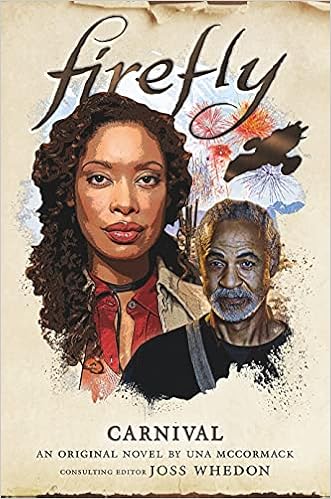
The newest title in the Firefly novel ‘verse is Una McCormack’s Firefly – Carnival, from Titan Books, and sadly, the best thing I can say about it is that “It’s very nicely bound.”
I’ve complained loud and long about previous titles in this series—the lone exception being Tim Lebbon’s entry, Firefly: Generations (also the only one with a title that comes with a colon instead of an en dash . . . go figger—as the entries written by James Lovegrove have been massive disappointments. Learning that this title was penned by a different author gave me hope.
Misplaced hope, as it turned out.
The basics of the plot are: Mal and crew are hired to provide security for a shipment and escort it across town from the train station to the space port where, once loaded, it flies off and they get paid. Naturally, things go wonky, the shipment goes astray, and two of Serenity’s crew are taken hostage—by the employer who hired the team—as collateral pending return of the goods or compensation for the loss. Failure, within 48 hours, and the “collateral” will be sent back in boxes.
Now, if that’s not a goofy enough setup for you, it gets better. Or worse. Example: the job pays 200 platinum (a ridiculously high wage for a few hours’ work) but when the crew is told they have to cover the losses, the sum is only 500 platinum (more than they have, of course, but 200 Pl is an unreasonable chunk of that profit margin).
The story unfolds and we learn that (unsurprisingly) nothing is as it seems, and therein lies the tale.
McCormack is a best-selling author of many television and movie tie-in novels, but reading this I came to the conclusion that those titles were best-sellers based on an established fan base and not on the style or content because . . . damn.
For any book set in the Firefly ‘Verse, you have to deal with the show’s excellent use of dialect and language. As with other books, the occasional sprinkling in of “g-less” gerunds (i.e., shootin’ and flyin’) helps evoke the tone from the show, and the reader fills in the rest. Lovegrove, for all his faults, did this well. McCormack does not. They pop up all over the place and, most troublesome, she throws them into non-dialogue sections, including those that are straight narrative and not part of a character’s internal thoughts. In addition, she decided to spice it up with other dialect elisions, such as “platinum” becoming “plat’num” which (to my ear at least) has no audible difference and only disturbs the eye as we trip over it. (In her defense, McCormack is a Brit who may very well have better diction than we Americans, so this may have made sense to her.)
Stylistically, the prose is pedestrian and flat, without any beauty. At regular intervals—presumably to evoke a feeling of action or a character making a quick assessment of surroundings—McCormack drops into a paragraph of fragment sentences. This in itself isn’t a bad practice, as it reads with more urgency, but when she drops pronouns and subjects from the beginning of the sentence, we have to re-read to make sure we get it, which obviates the point of the fragments. In fact, McCormack often creates sentences where the syntax is imprecise or vague, and it can be read with one of two (sometimes opposite) meanings depending on inflection. This is simply poor writing, and should have been caught and fixed.
Sadly, the editors seem to have taken holiday on this book. And, halfway through, the proofreaders seem to have gone to join them. This is less McCormack’s fault than Titan Books’, though the author is not off the hook either. Content errors. Out-of-place references to current pop-culture. Missing punctuation. Typos. For all of these, the author gets proofs, too, and there are simply too many errors late in the book to deny a lackadaisical process from start to finish.
In short, it’s a hot mess and I found myself remembering Lovegrove’s less-than-stellar titles in the series with something approaching fondness.
The Firefly novels are now one for six, with Lebbon’s book being the only one worth the time. It’s sad, but it’s clear at this point that these are simply revenue streams—something I should have figured going in—hackwork without interest in the actual art and craft of writing.
Frankly, I don’t know that I’ll bother with any future titles. My love for the show, its original use of language, the depth of its characterizations, begins to suffer from such low-bar fare.
In short, these books are beginning to damage my calm.
k
 Kurt R.A. Giambastiani