Feeds:
Posts
Comments

Posts Tagged ‘creative writing’

I was in a foul mood all last week, so when a friend offered her opinion of a movie I’d recently enjoyed, deeming it “fairly good, while predictable,” I took it as a passive-aggressive reference to my low-brow viewing choices.

Naturally, she did not mean it that way and (thankfully) I have a strict “reread before hitting enter” policy when posting to social media, so no damage was done, but it did get me thinking.

The movie in question is of the “coming of age” variety and my friend’s evaluation was, to be frank, pretty spot-on. The movie is predictable, as we follow a young man growing up, navigating the pain of early adulthood until, at movie’s end, he comes to terms with his father’s history of absence and utter unreliability.

Predictable. Trite. Cliché. I’ve used these words to describe (in negative terms) both books and movies. I’ve done so here on this blog, and usually I’ve not been kind about it. So, why do I look down my nose at some formulaic works, yet enjoy others? Why do I consider some works to be entertaining, even though they are utterly predictable?

We’re all familiar with the old argument about story archetypes, how many there are, and how old. According to common wisdom, there are only seven archetypal plots (though opinions differ, and widely so). Whether this is true or not, formulas are used to build stories, especially in film—the coming of age plot, the rom-com, the murder mystery—and they are often followed to the point where you can set your watch by what happens on screen. Eighteen minutes into an episode of Murder, She Wrote? A body is going to drop in three . . . two . . . one . . .

Why do we enjoy such stories, even when we know how they’ll work out? And when do we not enjoy them?

I returned to the movie under discussion, and found that my enjoyment had nothing to do with the story’s predictable nature. I knew the boy would grow up and be happy. I knew the boy’s father would remain an irredeemable two-dimensional deadbeat dad. I knew the boy would have some sort of confrontation with his father and, in so doing, accept his own adulthood. I knew all this would happen, and to be honest, those were the least engaging sections of the film.

What grabbed and held my interest were the differences, the ways in which the writers deviated from the expected. As one example, it was how a collection of men—grandfathers, uncles, and pseudo-uncles—cooperated to raise a boy, communal fathers to an abandoned son, a composite role model that was both counterpoint and counterpart to the flawed original. The formula, that’s the foundation on which the whole is built, the scaffolding that supports what is new, but it’s the differences that set it apart.

Absent these differences, that’s when formula is a problem. That’s why the 1998 shot-for-shot remake of Psycho was a flop: simply filming it in color wasn’t enough of a difference.

But with sufficient differences, ah!, now we have variations on a theme, the same story told from a different point of view, and we enjoy the result. Otherwise, we’d never watch another rom-com, see a new staging of Macbeth, or read another mystery novel. We’d be all “Been there; done that,” and set off in search of the totally new (and good luck with that).

Some will argue that there are no original stories; that everything is an interpretation of one of the seven archetypes; or a fanglement, a mash-up of two or more to fashion what merely seems new. I disagree but will allow that, in most cases, it is true. We do tell the same stories, over and over, and we enjoy the retelling, the predictability.

So, when I begin to fret that my current work-in-progress is just another old tale retold, I’ll make a point of remembering the differences I’m working into it. Style, setting, sub-plot, backstory, characterization, tone, structure, pacing—differences large and small all adding to a unique outcome.

Formulas just are; it’s how we employ them that determines if they’re worth the time.

k

Read Full Post »

I could say that, as she entered the drawing room, all skirts and leg-o-mutton sleeves of emerald silk over petticoats of crinoline and stiff cotton, the dark skin of her pearl-draped throat rising above her off-the-shoulder neckline, hair piled up in thick black plaits, dark eyes meeting each guest with a warm and welcoming glance, that she moved with the sound of rustling leaves, but such simplicity would be unfair, for the truth was more specific, more evocative, as with her smallest step we heard—all of us—the memory of an afternoon’s respite in the shade of a chestnut’s overarching boughs on a bone-dry summer day when rain was but a fond wish and the tree’s huge, canoe-like leaves, jostled by the gardenia-scented breeze, caressed one another with a dry and papery sweetness that was at once both gentle and substantial; such was her effect upon her parlor of admirers.

Read Full Post »

Waking is hardest
with heart still open
from night’s departing shades
and the dawning world without
so harsh and saber-sharp
eager for blood

My somnolent soul
has yet to splash its face
much less don plate or shield
and so lies bare before
the onrushing sweep of
life’s unforgiving blade

But since memory shows
my every morning has seen its afternoon
courage pulls thews taut
and thus is joined the daily battle
between my dreams
and the unsleeping world

k


Read Full Post »

Inspiration often comes from a surprising direction.

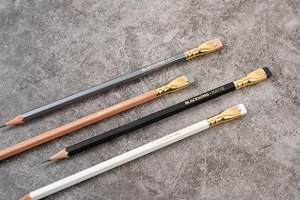
I recently had a birthday and my sister sent me a gift. It was a pack of pencils, with a cunning two-stage sharpener and a “point guard” (a metal cap that fits over and protects the pencil’s point, a thing of which I never before heard and now wonder how I ever lived without).

I have a thing about pencils. I’m very particular.

I do not like mechanical pencils. I positively loathe the disposable mechanical pencil (such wastefulness should be resoundingly decried). Give me a pencil of wood and graphite, every time.

Over the past six decades, I’ve always had a preferred brand.

  • First and for many years, it was the old-school yellow Ticonderoga #2. Nothing could beat it for availability, economy, smoothness of draw, and dark positive line.
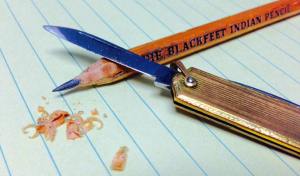
  • Then I discovered Blackfeet Indian pencils and immediately fell for their natural wood finish and aromatic cedar wood (not to mention the cedar wood box each dozen came in); I was faithful to them for years after they were discontinued, but recently the price of a box became too expensive.

Disappointed by replacement options and running low on my stock of (now prohibitively expensive) Blackfeet, I did what any self-respecting stationery nerd would do. I switched to a fountain pen. I wrote all of the Fallen Cloud Saga with a fountain pen, but recently, as I’ve been concentrating more on poetry, I’ve returned to my first love, the pencil, meting out my Blackfeet Indian pencils with miserly oversight, running each one down to the absolute nub.

Then my sister’s gift arrived.

The pencils she sent are Blackwing 602s. As with the Blackfeet Indian pencil, they had a long and storied reputation; 602s were the preferred (and often exclusive ) choice of great talents: artists (Chuck Jones, Don Bluth), composers (Copland, Bernstein, Sondheim), playwrights (O’Neill, Laurents), and novelists (Steinbeck, White). Also as with the Blackfeet, the line was discontinued in the late 1990s (at which time Sondheim reportedly bought himself a lifetime supply).

The Blackwing 602, however, was revived in 2010, and my sister, knowing my love of All Things Stationery, gifted me with a dozen.

And they are wonderful.

Smooth, long, lean, requiring only the lightest touch for a dark line, with graphite tough enough to hold a fine point (but easy to re-tip, using the 2-stage sharpener), and with a wide eraser that can be extended as it’s used up, they are my new favorite.

“But wait,” I hear you say. “What was that bit up there about inspiration? Where does that come in?”0

Well, it turns out that, as I’ve been toying with these new pencils, using them for notes and analyses for my day job, I’ve grown dissatisfied with using these perfect pencils just for jotting down procedures and sketching out data flows. Even using them for poetry wasn’t enough.

The obvious thing, then, was to take out The Wolf Tree, the novel I’ve been working on since before the pandemic, which still needs a lot of writing.

Which means that the gift of a pencil has unexpectedly provided me the inspiration to get back to work on my novel.

And that’s a gift with a worth that’s far above rubies.

k

Read Full Post »

I was born in fog
welling from the coast’s cold waters,
mariners’ mournful cautions
echoing ’round my infant hollow,
earth-bound cloudbanks
tumbling over the ringing hills,
billowing down our mist-slick street,
infusing my new world with ancient distance.

I grow old beneath rain
birthed by distant, tropical seas,
cooled by winds scented with
salt and sand and sun-warmed kelp,
sped by sky-high rivers
to beat upon these tree-clad shores
and wash down to feed the tidal flats
with burbling, silted waters of myriad streams.

Between them is stretched a life
where my limbs grew fast as springtime rye
beneath shadows chased by auspicious suns,
where towering guardians of wood and stone
surrounded the humid masses or arid wild,
where my heart tasted honeyed love and sharp-tongued disdain,
traveling inland altitudes redolent
of mineral earth, verdant crops, and heady loam,
but never the cold, deep cradle
whose primeval memory flows in my veins.

Bound by water,
I have slept in many places,
but only near the sea
have I lived.

Read Full Post »

A week or so ago, I had a hankering to spend time with some old friends. We’d been out of contact for fifteen years, and I felt it was time to reconnect, to catch up, to share stories. So, for the past week, I’ve been hanging with Alain, Bronwyn, Wrdisten, Boduos, and the rest of the gang from old Breizh.

In other words, I re-read The Ploughman Chronicles, my 9th century historical high fantasy series.

And we had a blast. Literarily speaking, that is.

In the year AD 880, much of Europe was on the cusp between the old/pagan and new/Christian worldviews, and Brittany itself (where the series is set) was in open revolt against the expanding Carolingian Empire, so there’s a lot of historical intrigue woven into the books. Added to that, though, is an even greater intrigue between our world and the fabled Summerland, the land of the Fey, which lies beyond the Veil. Now throw in a prophecy, that there will come a man who will travel between, and master the power of both the line magic of the Veil and the earth magic of the sleeping gods.

For me, though, it is the characters I love most. I mean, they’re so . . . individual, so quirky, each with a distinct manner, their own way of speaking, and with motivations that are set (and revealed) in layer upon layer.

These books are not your usual high fantasy; I can’t think of another series that even comes close to it. Sadly, this series got no love from my agent—perhaps precisely because it isn’t your usual high fantasy—so they never had much opportunity to get shopped around. Also sadly, when I decided to publish them myself, my editing skills weren’t as sharp as they should have been, so I had to contend with the odd typo (and I really hate typos, especially when I’m the one who let them get into the final product).

But here’s where y’all come in.

You see, I love these books, even more so after my re-read, and I want to share them with you.

So, from now through Monday (November 22), the Kindle versions are free. You can find them both on this page at Amazon.

Download them for free, get the reading app for free, and (I hope) fall in love with them, for free.

Paperback versions are still available, of course.

So go, enjoy; tell a friend; hell, tell an enemy, I don’t care. I just want to share them. And if you like them, write a review. If you don’t, tell it to my agent; I think you’ll find a receptive audience there.

k

Read Full Post »


your need is my desire
your desire is my hope
your hope is my dream
your dream is my heart
your heart is my home
your home is my love
your love is my comfort
your comfort is my need

Read Full Post »

« Newer Posts - Older Posts »