Feeds:
Posts
Comments

Posts Tagged ‘creative writing’

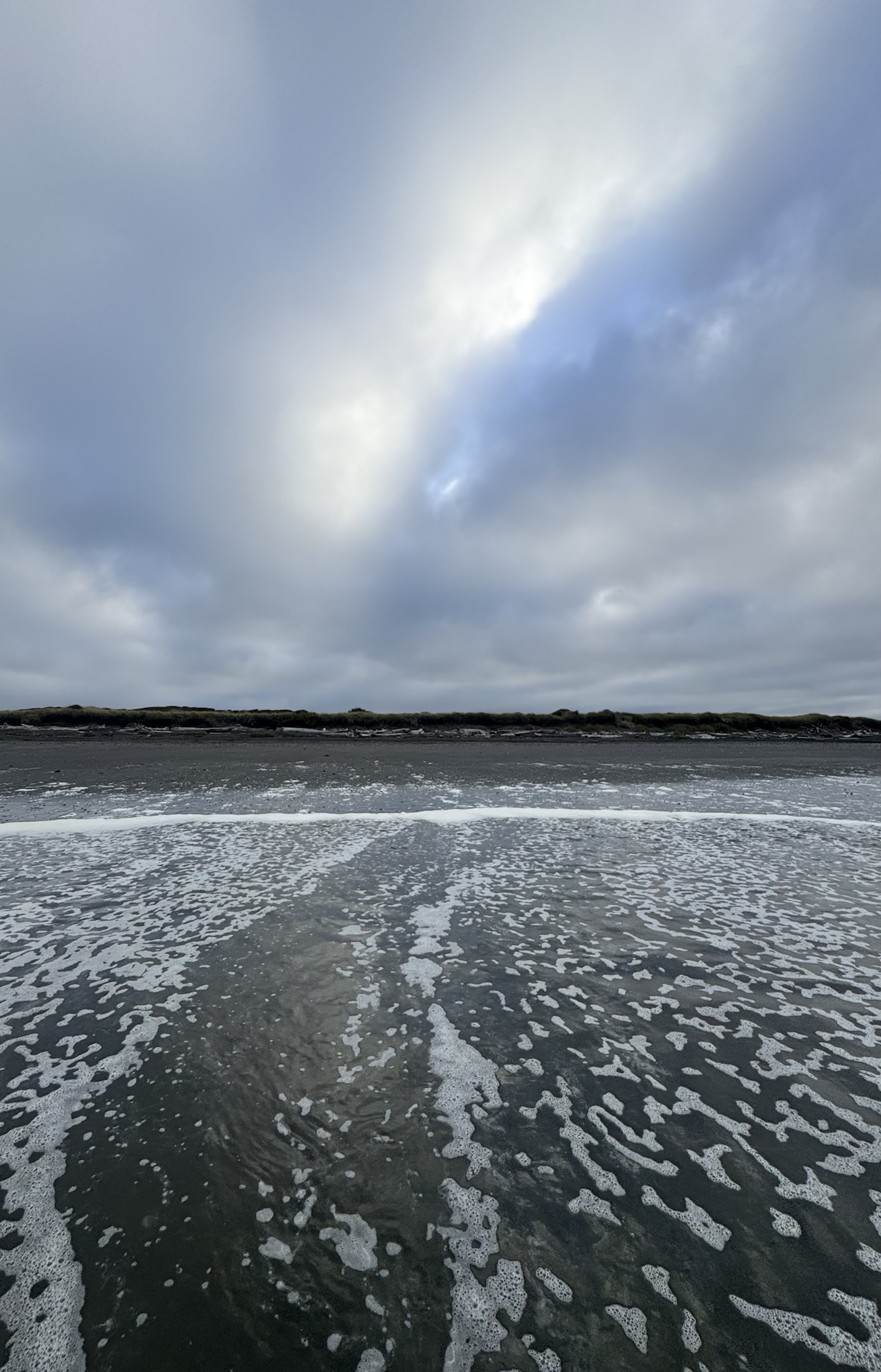
I was born of Pacific waters
bathed in their colors of stone and sky
swam their frigid swells and troughs
to return awakens my heart’s connection
to walk the firm yet yielding sand
to wade knee-deep through the rip
to comb a fiver’s worth of unbroken dollars
to have my ankles caressed by sea foam
to greet the sunrise and kiss the sunset
to hear my father’s words echo
“Never turn your back on the ocean”
though I do, if only to see my world
as the ocean views it
a dark forbidding challenge
to its unparalleled power
the Pacific is the edge of my existence
it flows in my veins
it nourishes my soul

Read Full Post »

I took my nose on a walk, today, and let it lead me from one memory to the next. It was a cool overcast midsummer morning, the land still damp, leaves still plump from yesterday’s sudden rain. Flowers nodded heavily, leaning from tidy beds over paved walkways like old men rising from a heavy sleep. Birds sought ripening berries through branch and bramble, and dogs led their owners from spot to spot, following their own noses.

First I tramped uphill over needles and cones, a well-trod path winding beneath conifers that lost their heads in the lifting fog. The air was redolent with resin and bark, soft earth and dew-soft ferns, and my nose remembered my time as a student at music camp, days and nights spent tucked up amidst giant sequoias, so close, so tall, that their height could not be seen, and my mind echoed with the opening beats of Copland’s Fanfare, an unexpected reveille to wake teenage musicians and fashion a memory never to be lost.

I walked onward along the ridgeline as the morning cleared, the slanting light breaking through the southern sky, the avenue warming with the summer’s rising sun. The scent of August grass, dry and seed-heavy, a mixture of soil and wood and hay and warmth, took me back to the rolling hills of my youth, slick and golden, begging us to take our cardboard squares to their tops and slide down their gentle slopes.

Farther, I passed beneath a plum tree, the path beside it filled with fallen fruit. The air was thick with a sweet, sun-stewed aroma that filled my brain with scenes of kitchens and bushel baskets and Mason jars and food mills and sacks of sugar all at the ready, as the thick preserves bubbled quietly on the stove.

Heading home, I walked along the main boulevard, wide and now sun-drenched, busy with cars and trucks. I sniffed the scents of diesel exhaust and hot pavement mingled with dust and the wafting aroma of brewing coffee. I closed my eyes and was met with the image of Jerusalem streets as I walked to the bus stop on my way to morning classes. The only thing missing was the adhan, broadcast from minarets, blaring across the awakening city.

It was a wide-ranging journey, though found within but a few miles on foot, a surprising trip through time and distance.

Read Full Post »

to these old eyes
we none of us have aged
and all are as when first we met

though days and years
and decades all
have trundled past our feast

though unforgiving fate
has called a few away
and left their seats unfilled

and loft-bound bitterness
and joy have played for us
their varied minstrel tunes

it’s just the failing candlelight
that limns us each
in haloed wisps of age

for if I squint I once again
can see us clear and bright
with vibrant youth

all straining ‘gainst the slips
and hungry soon
to master dreamed-of hopes

so charge your glass
and be upstanding so
that we may raise a toast

to all we’ve known
and all we’ve loved
and all that yet remains ahead

for life with all its sorrowed pain
is better lived than not
and better still
with friends beside

Read Full Post »

Having been pleasantly surprised by my recent re-read of a sci-fi/fantasy series I’d loved as a teen, I decided to extend this run of good luck and re-read another series that was influential to my own writing style (when I eventually got one).

I first crossed paths with Roger Zelazny’s works—both short form and long—in high school. It was before I’d read much fiction at all, and thus I did not have a lot of knowledge to bring to the experience. Despite this lack (or perhaps because of it), Zelazny’s stories and novels stuck with me, shaping my appreciation of the written word from then on. Zelazny was one of the triumvirate of authors who influenced my youthful enthusiasm for fiction, along with grandmasters Anne McCaffrey (a major influence, I discovered last week) and, of course, Ray Bradbury.

Each of these authors drew a different type of appreciation from me. McCaffrey’s prose was not what stayed with me, but rather her characters and their relationships, which were crucial to the workings of her plots. In considering Bradbury, I admit that none of his novels stuck with me, but his short fiction! Oh, what magic I found there. The books that collected his short works in a thematic whole—The Illustrated Man or The Martian Chronicles—were treasure boxes to read and re-read.

Roger Zelazny, though, held a special place in my pantheon, and not just because he was the only one of the three I actually met. Back in the ’70s, I didn’t have the breadth of experience to understand what I so enjoyed about his works, but yesterday, as soon as I began his Nine Princes in Amber, I could pinpoint it precisely. Where McCaffrey’s prose was straightforward, and Bradbury’s was as near to poetry as one can get in prose, Zelazny’s writing has a distinctive “voice,” matched to the mind of the character, and integral to the tenor of the storyline. As I began this book, I heard echoes of Hemingway, of Chandler and Hammett, along with the flow and descriptive power that was Zelazny’s own. That “voice,” that touch of the hard-boiled detective, was a crucial element of the character in that opening chapter—Corwin, a man out of space and time, without memories, must navigate a dangerous world filled with people bent on his demise. It was all fedoras and noir on silver nitrate and razor-sharp repartee and chiaroscuro lighting until, amazingly, subtly, color crept into the world along with Corwin’s recovered memories, and the “voice” shifted as well, matching again the mindset of the Corwin’s evolution.

I was lucky enough to meet Mr. Zelazny in the early ’90s, after I’d made my first professional-level short story sale. It was at a sci-fi convention here in Seattle, and I was trying to learn as much as I could about the craft, and meet as many “pros” as I could (a terribly difficult task for an introvert like me), but I’d been met with nothing but condescension and rudeness from nearly every established writer I approached. But I put that aside as I’d come primarily because Zelazny was a featured guest. I’d heard him read from his forthcoming book (A Night in the Lonesome October), and I’d brought my limit of three books for him to autograph (my beat-up vintage copies of the two-volume Amber omnibus and a dog-eared paperback copy of Four for Tomorrow).

Having been scorched by other authors at the convention, I expected a perfunctory meeting at the signing table, but I was determined to let Mr. Zelazny know how influential his works had been on my own nascent attempts as a writer. Instead of just signing my old books and moving on with a nod, he asked if I was submitting my work; I said yes, and that I’d been in a recent issue of a small professional magazine. He knew the magazine, actually had back issues, and wrote down my name so he could look up my story. After all the bristles and cold-shoulders I’d received that weekend, a kind word from a writer so important to me was a gift dearer than rubies. Did he really have back issues of a small-run magazine? Was he really going to read my story? I don’t know; he might have merely been encouraging me, a gentlemanly gesture to a budding young man who had kept three of his books safe and secure for a score of years. Still, I like to think he might have.

Reading these old favorites again, though, now with my older, wiser eyes, I feel the old desire to craft words renewed. I want to finish reading all of these titles I’ve pulled from the stacks, but after that . . . after that, I think I have work to do.

k

Read Full Post »

A friend asked the hive-mind for book suggestions—preferably science-fiction/fantasy/speculative fiction—to flesh out her summer reading list and (naturally) she got more titles than she could probably read in a year. I tossed in one title I’d read recently; it was less “spec-fic” and more what I’d call “magic realism,” but I had found it delightful and passed the title¹ along.

In perusing the suggestions from others, I saw a mix of genre classics along with (what I assumed were) newer titles. I used to read nothing but sf/f novels—they were my introduction into fiction, back in the late ’60s/early ’70s—but over time, for reasons (painful or practical), I drifted away from the genre, and have zero experience with many of the newer authors.

There was one particular suggestion, however, that caught my eye, It was a title² of which I’d not thought in decades, even though I adored the series when I was young. I was in my teens when the books were first published and I devoured them, thankful there was only a year between release dates.

In recent years, I’ve occasionally gone back to re-read some old favorites, but that proved a dicey proposition. At sixteen, seventeen, I had no comprehension of—much less appreciation for—writerly things like structure, characterization, world-building, foreshadowing, allusion, or pacing. If you gave me a brisk plot and a compelling reason to turn the page, I was all yours. Going back to those old, familiar titles led, more often than not, to disappointment. Clunky dialogue, predictable plots, heavy-handed setups, wooden characters, and banal prose were common, and that’s before considering the rampant sexism and gender dynamics of the period.

But, oh, I did so love these books, this series, this world. So I gave the first in the series a try.

What I found within shocked me.

It’s not that it is bad; far from it. Yes, the author has some annoying (to me) quirks, and is inordinately fond of multi-syllabic adverbs, but the characters are full and distinct, the world has a long and detailed history that affects the current action, the social structure is coherent, strong with rituals and patterns, and there is humor and passion and drama and risk aplenty.

What shocked me, though, were the echoes I recognized between these books and my own. Understand, between the time I read these books and the time I began writing fiction, two decades had passed. When I was writing my own books, I never thought back on these titles, not for inspiration, not at all.

And yet, as I re-read these old books, I see in them the seeds of the worlds I have built. From the psychic connections along ley lines in “Spencer’s Peace” and my Ploughman Chronicles, to the bonding between riders and walkers in The Fallen Cloud Saga, to the convolutions of time travel in Unraveling Time, here in these books lie the kernels from which my own books grew. These books, this series, they are my source, my wellspring.

All writers, I believe, are influenced by the writings of others. We’re all, as Stephen King once said, like “milk in the fridge,” picking up flavors from whatever we’re near, accreting reverberations from the artistry of those we admire. But to find so many thematic origins in one place, well, it’s like finding a loved one, long-lost, long-forgotten.

I’m exceedingly glad I took a chance on these old friends, and I will definitely read the six or seven titles that I read when I was a boy. I feel a need, after this difficult year, for an infusion of youthfulness and hope, and these books, for me, flow with those gifts.

k


¹ The Lost Bookshop, by Evie Woods
² Dragonflight, by Anne McCaffrey, first in the Dragonriders of Pern series

Read Full Post »

stop
stop
take a moment
stop
listen
hear that?
it’s life
rushing past
at the speed of sound
the tiny earthquake of an infant’s wail
squabbling chickadees on a dew-dropped branch
a sink full of dishes
the dog’s nails snare-drumming on the kitchen floor
cars trucks vans cycles all shushing purring grumbling past
a familiar key in the front door’s lock
voices near, voices far, loud or quiet, laughing, shouting
the fermata of your breath, your heartbeat’s vibrato
a dry fingertip turning a dry page
ice cubes in a tall glass
this
this is life
heard and gone
it is all we are
an ephemeral fabric
uncountable strands
of gossamer

Read Full Post »

I used to write you love letters
with age-old tools
with pen and paper
with flowers delivered to your desk
with gifts left to be found on a car seat

But since then my love has found voice
in other media
in home-baked bread
in racks of clean dishes
in beds made, ready to be rumpled

I write letters
in gestures and gifts of freed time
I sing songs
in tiptoed footsteps on lazy mornings
I craft poetry
in items checked off to-do lists

After so long, so many years,
my words, mere words,
seem insufficient to relate
the depths and breadth
of my heart’s compass

But perhaps a cup of tea
that I know you want
presented without
your having to ask
speaks better of my devotion

Read Full Post »

« Newer Posts - Older Posts »