Feeds:
Posts
Comments

Grey, in Living Color

I grew up in a black-and-white world. Not exactly like the way Calvin’s dad explained it, but pretty much.

When I was very young, television broadcast in black-and-white, and my life was filled with television. Soon, even though technology advanced and broadcasts switched to color, in our house we still only had a black-and-white television.

In fact, we didn’t have a color television until I was a teenager, when my grandfather passed away and we inherited his old massive oak-wood RCA Color TV console, with the remote control that sighed like a sulking teenager when you pressed down one of its three buttons. Thus, all my childhood TV viewing was black-and-white, never in color.

So how, then did I know that Captain Kirk’s tunic was tan, Spock’s blue, and Scotty’s red? Sure, I suppose my viewing might have been “enhanced” by color pictures in TV Guide, but if that’s so, then why do I also remember To Kill A Mockingbird in color?

When I watch the film, naturally I see it in black-and-white, but when I remember scenes, especially scenes from the book that didn’t make it into the movie, I remember them in color. I remember Scout’s red flannel shirt, her dark indigo overalls. Tom’s overalls were faded, as was the blue of his work shirt. Atticus wore suits of pale linen, grey pinstripe, and solid slate grey. Mayella had pink flowers on her dress, while the ones on Calpurnia’s chintz were blue.

Perhaps it is because so many things in that story were objects familiar to my youth. The bark of trees we climbed, the denim of our jeans, the thin cotton of our shirts, it was all as it was in the book. Or perhaps it’s because Harper Lee’s words were so simple and direct, so mesmerizing, that I couldn’t help but see the world she created in its entirety, vibrant with color.

To Kill a Mockingbird–in both book and film–was important to me when I was young, and it remains so today. Through its story, I discovered fiction that told of kids who were real, not the fantastical wunderkinder that I found in all the other books I was given. It was an adult story told simply, clearly, and with ultimate honesty. Within its pages, I learned that the world is not black and white, right and wrong, but filled with immeasurable greys  in which justice can be evil, and wrong-doing can be justice. I learned of the fallibility of mankind, and of the failures in our shared society when we forget that we are not alone in this world.

I remember Harper Lee’s classic in color, because it taught me about black and white, because it taught me about grey.

k

LasagnaMy wife is not Italian. She’s Irish. She just married an Italian. (Actually, I’m mostly French, but try telling that to someone who’s struggling to pronounce “Giambastiani.”)

She calls herself a “truck-stop cook.” She isn’t what she would call a “chef.” She is a craftsman who has a few really good recipes.

Over the years, she’s cooked these few (these happy few), receiving raves from friends and family lucky enough to partake. Over the years, she’s tinkered with each concoction, improving and perfecting her enchiladas, banana bread, beef stew, spag-bol, quiche Lorraine, cinnamon rolls, cookies, fudge, and–notably–lasagna.

She’s been working on her lasagna recipe for 30 years. She measures by eye, always has sauce and cheese left over, always makes them two at a time–a large one for the feast, a smaller one to be frozen, uncooked, for later–and always, always it is wonderful, flavorful, and unlike any other lasagna I’ve ever tasted.

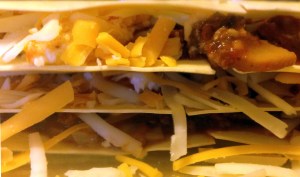
Last weekend, Ilene made her lasagna for a large gathering of friends and neighbors. The occasion was specifically to introduce her masterpiece to folks who’ve never had it before. Normally, I am her sous chef, doing all the chopping and grating, stirring and cleaning, while she swans in and casts her magic alchemy with handfuls of spice and multiple taste-tests. This time, however, I followed her around, noted her every move, measured every handful and pile she used, and weighed all the ingredients left behind. I calculated the mounds and pounds that went into each of the two mismatched pies, then got out my slide rule and conversion charts and constructed a single recipe for a 9×13″ lasagna.

Last night, I tried it myself, and got Ilene’s stamp of approval.

As with all recipes, I can think of things I want to try next time–a dash of this, a spoonful of that–but this is the radix, the omphalos, the groundwater source of Ilene’s wonderful, delectable, world-class lasagna.

Caveat: This is not a health-minded recipe. It’s a heart attack on a plate. We don’t have it every week, or even every month. For us, it’s a once-, maybe twice-a-year treat, usually bookended by days of low-calorie meals and exercise for preparation and recovery.

Trust me. It’s worth it.

Continue Reading »

Recipe for Love

Lasagna

“I’m a gourmet chef and I don’t measure anything.”

———

“Some people can cook. Others can follow recipes.”

These statements and others like them were leveled at me this weekend, after I mentioned I was going to attempt to capture the recipe for my wife’s world-class lasagna. Frankly, they caught me unaware. Never before had I come up against such blatant and illogical snobbery regarding recipes.

The fact is, if you’ve ever…and I mean everbeen taught how to cook something, you’ve used a recipe. “Recipe,” with its last century cousin “receipt” and the pharmaceutical “Rx,” all come from the Latin recipere, meaning “to receive or take.” Recipe, in fact, is the imperative form: Take! as this was the first word of almost every recipe written in that language.

Whether you were taught at your nana’s knee or trained at the Cordon Bleu, you were given step-by-step instructions on how to construct a dish. Whether you measure by the handful or the gram-weight, you’re following a recipe. Whether it was written down by Julia Child or passed down by oral tradition, you are following a recipe, and to pooh-pooh recipes (and those of us who follow them) as being somehow less than you is to ignore facts and to uselessly denigrate what is for many of us a gift of love.

That little 3×5 card with your grandmother’s crabbed scrawl, that brittle age-browned scrap of paper written by your mother’s hand, and that ancient notebook packed with torn clippings and annotated soup-can labels, those are physical manifestations of devotion, of love. You don’t cook out of hate. You don’t feed people you dislike. You don’t note what pleases the palate of enemies.

You don’t slave in the kitchen for hours and serve it up to people you don’t love.

Recipes are captured moments, repeatable moments. Recipes are confidences held between friends. “Here,” they say, “this is a secret from my heart.”

My wife has been making and perfecting her lasagna for thirty years. Each time, something is a little bit different. Ask her for the recipe (and many have), and she can’t tell you; she measures by eye, often has mounds of cheese or cups of sauce left over. And though I am working to write down her recipe from this last weekend’s bake-off, I know that in ten years’ time, it will be different.

But this recipe–this weekend’s recipe–is a starting point for everyone who’s ever asked for the secret. It’s a place for us all to start and then say, “Oh yes, it is wonderful; now I will make it mine.” They can add a bit more heat, a bit less ricotta, cook it a bit longer. They may still call it “Ilene’s World-Class Lasagna” or they may change it enough until, over time, it will be something all their own. It does not matter to me. It does not matter to my wife.

A recipe shared is an act of love. It’s your best effort, writ down and passed along, from hand to hand, kitchen to kitchen, family to family, heart to heart.

k

No-Knead Bread

Revise and Extend

Writing with Pen and Paper

Letters are nice things to get in the mail.

I’m not talking about bills or street-spam from your local dentist. I mean letters. Honest to God Letters, written by a person, meant for you and you alone.

Well, mostly…

There’s one kind of letter that I hate to get:

The Revision Letter.

Continue Reading »

Not That at All

If I told you I watched a movie about an old man, a young woman, and Paris, entitled Last Love, you might very well think it was a reboot of Last Tango in Paris.

And you would be wrong. This movie is not that. No, not that at all.

Continue Reading »

I’ve Got Rhythm

Stack of Books

I do not care for the heroic couplet.

daDa-daDa-daDa-daDa-daDee,
daDa-daDa-daDa-daDa-daDee.

It’s fine for a short poem or sonnet, but when you stack one atop the other for stanza after stanza, it gets predictable, monotonous, and boring. It’s why A Midsummer Night’s Dream is my least favorite of Shakespeare’s plays, as a huge portion of it is written in heroic couplets.

What does this have to do with writing prose? Plenty.

Continue Reading »

Jaybirds and Seahawks

Seattle has its idiosyncrasies. It’s what makes this city unique. It’s what gives the city its specific “feel.”

In general, we don’t use umbrellas. We’re more a head-down-and-face-the-weather sort of town.

In general, we’re polite and courteous. Drop your wallet and chances are someone will help you retrieve it (9 out of 10 times, according to a Reader’s Digest study). We say good morning and thank you to the bus driver. We rarely honk our horns at each other, except for a polite little “bip” when the guy in front hasn’t noticed the light’s turned green.

And, in general, we don’t jaywalk. As evidence of this, I supply a recent video that shows Seahawks fans waiting for the light to turn green before they cross the street to revel in their team’s recent victory over the Broncos.

Continue Reading »