 This morning, the ocean threw a brick at me.
My wife and I are out at the coast for a few days (we’re working things out, which is Very Good News) and, as is my wont when at the seaside, I got up early(ish) . . . earlier than she, anyway . . . and went for a walk along the shore.
Most people, when they walk along the seashore, do it in one of two ways: either they walk up along the high tide limit where the sand is still hard (but they won’t get their feet wet), or they walk down along the wave limit (where the occasional seventh wave might submerge them up to the ankles).
Yeah, that’s not me. I grew up on the Pacific coast, and the Big Blue is a critical actor in my emotional life. It’s where I go to purge my buffers and reevaluate the importance of things. Sitting on the edge of the world, glass of wine close at hand, I can look out along the curvature of the earth and watch the sun sink into the quicksilver sea; this is my heaven, my Fortress of Solitude, my recharging station. But walking along the water’s edge and not being in contact with the sea? . . . Yeah, not an option.
When I walk along the shoreline, I walk that gantlet between surf and shore. I’m always barefoot, and the water is always rushing in or flowing out around me. Sometimes this puts me knee-deep in some very cold water, but after the first five minutes, my feet don’t care anymore. They’ll complain loudly later, but for now, numbed by the northern Pacific’s chilly grasp, they’re quiet.
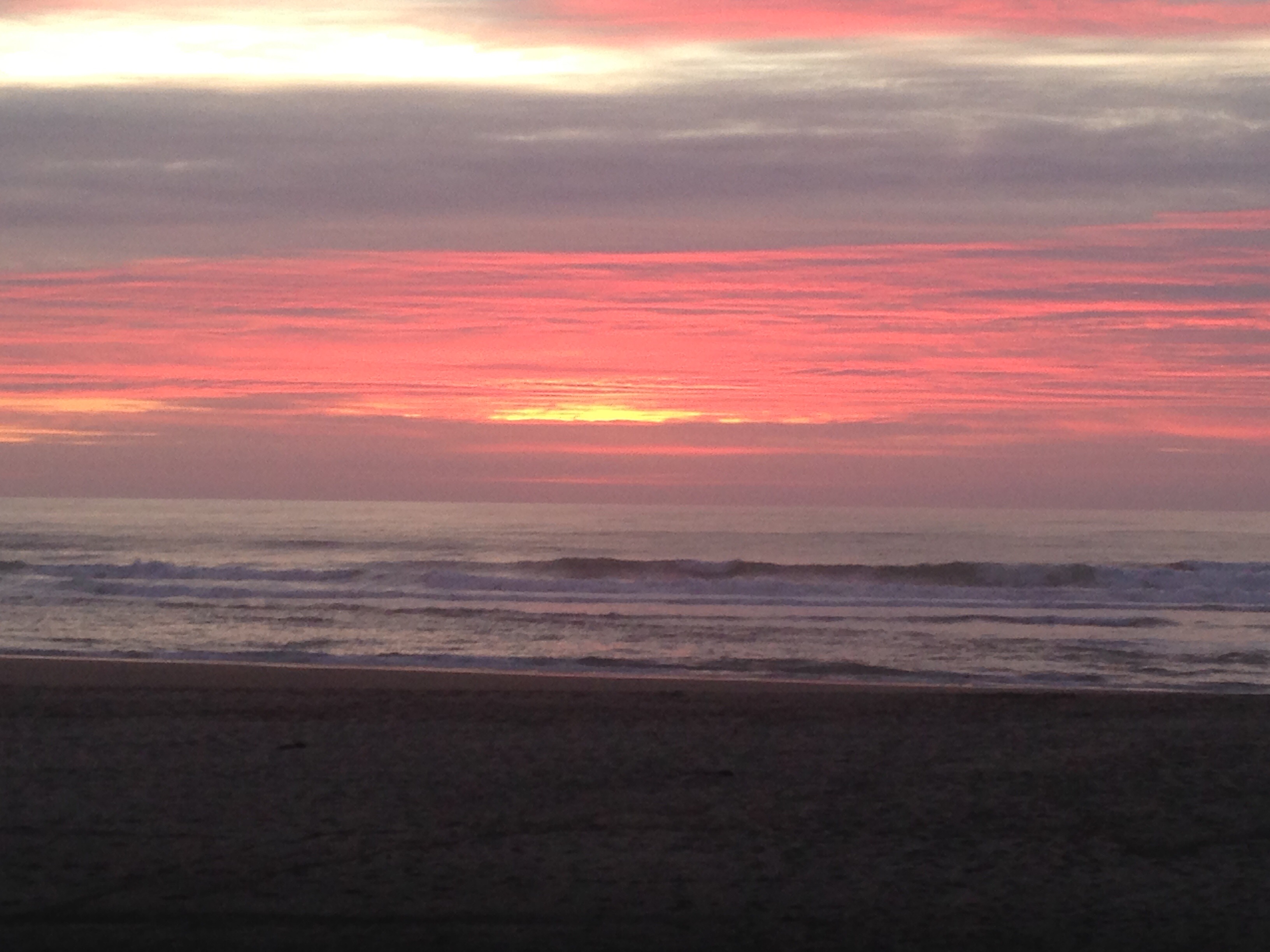
This morning, the colors of the water ranged (appropriately enough) from aquamarine and pale jade to cobalt blue, the deepest teal, and a series of greys from gunmetal to steel. Foam topped the curling waves and washed in on gentle rollers, highlighting the crests with white, ivory, and an algal yellow.
At one end of my walk along this section of the coast, in addition to long stretches of soft sand, there are outcrops of rocks, half-drowned at low tide, that add interest to the seascape. I walked among them, thigh-deep in the rushing grottoes, smelling the funk of barnacles and anemones warming in the early sun. Seagulls pried at the shells, hoping to find a loose one among the tightly packed multitudes, and plovers poked thin beaks between the stands, searching for worms and other digestibles. The scents of salt and seaweed mingled with the iron smell of sand and the tang of carbonate. It was . . . luscious. I felt at home. I felt at peace. I felt whole.
At the other end of my walk was the D River, the shortest river in the world (running from Devil’s Lake to the Pacific in just under 124 feet at high tide). I stood in the debouchment, where river meets the sea, and silently marked the pendulum of wave and outflow with the words “Fresh water. Salt water. Fresh water. Salt water.” as the river and the sea pulsed to and fro around my feet.
But it was midway along my trek that the Pacific got stroppy. I was walking through a rip, where the curve of the shore focuses the waves and forms a strong seiche of power. The sea pulled back her skirts to show me a graveled bed of pebbles and shells, and then launched a wall of water in my direction. Beneath that lunging froth I glimpsed a flash of red, a sizable chunk, tossed and tumbling in the clear salt sea, coming right at my shin. I stopped and saw that it was a brick, a full-sized everyday brick, red as a brick, hard as a brick, with clean sharp edges. It rolled past my foot, missing me.
Where the hell did it come from? There were no brick buildings I could see along the miles of shoreline I’d walked. The Pacific was adept at throwing pebbles up on the shore here, stones perfect for skipping across a placid lake, bits and pieces broken off from the outcrops I’d visited, but nothing the size of a mason’s brick. Nothing even half that size.
Was it personal? Was the Pacific angry with me? Had I been away from it for too long?
It’s tempting to think these things, to assign reason to an event that is completely random, but that is folly. The truth is that the Pacific, mother of my youth, heart of my soul, is just a body of salty water that has no mind, no intellect, no will, no reasoned purpose. She—and I continue to call her “she”—cannot even recognize my existence. She cannot sense anything.
I know this.
Yet, I still love this ocean, this birthplace of what I call “me,” and I will still talk to her as I walk her shores, ask her what I should do, and, depending on her mood, I will hear the answers in the murmur or the roar of her waves.
k
 Two weeks ago, I tried an experiment.
 The sheer number of women I know who have posted #MeToo is agonizing. Not intellectually. I’ve read the statistics know that, depending on the study, anywhere from 75% (
 Going back over early notes for this novel, I realized that this project has been rattling around in my head for over a decade.


 Kurt R.A. Giambastiani