Feeds:
Posts
Comments

Research Rabbit Holes

This week’s progress was slowed by a few issues.

First, Season 4 of Bosch dropped, and that simply had to be dealt with.

Second, I had some serious pain due to a nerve regrowing in my big toe (long story) and that made it impossible to concentrate on anything for about thirty-six hours.

Third, I was still on-call, and the weekend was punctuated with several job failures, including two early morning alerts that came to me in error. (Thanks, guys. Who wants to sleep in on the weekend anyway, amirite?)

With this as preamble, it wasn’t surprising that, once I finally got underway with chapter two scene one, my lack of concentration let me slip my lead and run down some research rabbit holes. Continue Reading »

p=mv

This is what momentum looks like.

Despite work deadlines, two days down with a stomach bug, a major financial planning session, and getting a windshield replaced, I still managed to get another scene completed and entered. This was Scene 3 (begun last week), which ends Chapter/Day One, and it was the first time for a couple of things.

Continue Reading »

Glad to Meet You

Writing on the novel continues, albeit slowly. In the middle of Scene 3, now.

In talking to my wife about my struggle, I mentioned that it felt like I’ve broken through a barrier, and that both my interest and enthusiasm had increased, to which she responded with a question: why is that?

I honestly hadn’t thought about why—I was just glad it was—but it engendered an interesting discussion.

Last week, I posted about how in this character-driven novel, I must engage in a lot more forethought. As I explained, writing about how a character reacts to action is a lot easier than writing about their motivation before that action is undertaken. That reality hasn’t changed, certainly not in the last week or so.

What has changed, though, is that I’m finally getting a handle on who my characters are.

This is a critical point, for me.

I’ve built and rebuilt my characters’ backstories close to a dozen times. I’ve changed family structure, occupations, names (lots and lots of names), affiliations, history, and well, damned near everything except their gender. I’ve also worked and reworked my outline, refining it, bringing in subplots, dropping subplots, chucking extraneous secondary characters, tightening it all up.

So, when I started writing, I had a pretty good handle on where my main characters had been and where they were headed.

All set, right?

Wrong.

Continue Reading »

Writing and Life

Progress on my book has been slow—not stopped, just slow—but I choose to view this as a good thing.

After years of thrashing about and achieving zero forward movement, I’m finally getting words on paper (yes, literally; I’m a longhand writer). Last night I finished the second scene, and now that it’s all keyed in and backed up, I decided to reflect a bit and see if I could identify the reasons why I’m having such a tough time building momentum.

It didn’t take long to find several culprits, including a slew of bad habits that I’ve developed during the fallow years. While I certainly have to deal with those bad habits, they’re specific to me and my life, and thus irrelevant to writing, per se, so I’ll skip discussing them here. Two issues, however, I think are worth discussing, as other writers may experience something similar. Continue Reading »

Lost Cræft

Some may find it odd that I, a guy who makes his living dealing with data, computers, bugs, and code, am such a fan of low-tech.

It’s not that I dislike technology—I don’t, and I have the phones, tablets, and game consoles to prove it—but while technology has made the lives of millions safer, easier, and more pleasant, it’s also taken us away from our roots, separating our connection to the physical world around us.

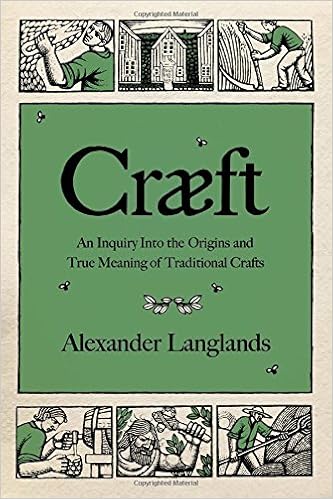
Alexander Langlands, an archaeologist who has worked uncovering Britain’s history for decades, thinks much the same way, and in his book, Cræft, he explores some of the most basic skills in human history, skills that require us to touch the world with our hands, and that are intimately tied to our environments and ecosystems. Through historical context and personal experimentation, Langlands shows us how tasks that, today, we might deem very simple—tasks such as digging a trench, weaving cloth, making hay, and thatching a roof—actually require broad experiential knowledge to master. He uses cræft, the Old English of the word craft, to highlight the change in the word’s meaning over the centuries. Continue Reading »

Meeting Timon

Last night we were supposed to go out to a movie. An old-fashioned date night, before I began a two-week on-call stint.

The plan was to go see a screening of the National Theatre’s 2016 production of Hamlet, but it had been one of those loooong weeks, where I was sure it was Friday but it was only Wednesday, and so on. My wife was just as exhausted, and there was no way she was going to make it through a four-hour play in a darkened room. I might have made it to Act IV, but she would have been snoring before the first body hit the floor.

Not to be completely deterred, we opted instead to stay in and watch a movie at home. No primp-n-prep, no travel, no finding a place to park. Plus, we had better lighting, a shorter duration, and cheaper snacks.

We kept with the Shakespearean theme, and opted to screen a play that we hadn’t before seen staged.

“What?!” you say (complete with interrobang). “There’s a Shakespeare play you haven’t seen?”

Yes.  It’s true, it’s true. Even though I love Shakespeare’s works, I must admit that I haven’t seen every play. Since production companies usually concentrate on the popular titles, there’s a fair number of plays I’ve never seen on stage or film.  Continue Reading »

I Want a World

I don’t want family
I don’t want friends
I don’t want a community

I want a world

A world where we all treat each other
like members of the community
like dearest friends
like cherished family

I want a world

k