Feeds:
Posts
Comments

Archive for the ‘Food’ Category

BBQ Rub & Sauce

I am not a pit-master nor am I an aficionado of All Things Barbecue, but I know what I like, and what I like in BBQ is a deep, earthy base topped with a tangy-never-sweet sauce. Toward that end, I’ve tried several recipes and, as usual, have come up with my own concoction, a combination accreted from the work of others and the results of my own experimentation.

This rub/sauce combo works exceedingly well on slow-baked pork ribs (I prefer St. Louis style cuts) and on quartered chicken. The rub, by itself, is also great for strong-flavored fish, sprinkled over omelets, and dusted on roasted vegetables.

The recipe below is enough for two racks of pork ribs (about 5 lbs worth) or a brace of chicken. The rub will last in the cupboard for months, while I keep the extra sauce in the fridge for a month (though in summer it rarely goes unused that long).

Aye, There’s the Rub

Ingredients

  • 2 tbsp dark brown sugar
  • 4 tsp ground cumin
  • 4 tsp smoked paprika (Spanish preferred)
  • 2 tsp garlic powder (roasted garlic powder preferred)
  • 2 tsp ground coriander
  • 2 tsp Kosher salt
  • 1/2 tsp ground chipotle pepper (optional)
  • 1/2 tsp powdered dried porcini mushroom (optional)

Procedure

  • Mix all ingredients together in a bowl.
  • If using on meat, pat meat dry with paper towels first, and then sprinkle on the appropriate amount (see above), on all sides, and massage in. Best if left on the meat for a minimum of 30 minutes or as long as overnight.
  • If using on fish, eggs, or veg, just sprinkle a dash over them as you might any spice mixture.
  • Store leftover rub in a sealed container in the spice cupboard.

Get Sauced

Ingredients

  • 1 cup ketchup
  • 1/4 cup white wine vinegar
  • 1/3 cup dark brown sugar
  • 1/3 cup molasses (regular, not blackstrap)
  • 1 tsp hot sauce of your choice (heat is a very personal thing)
  • 1 tsp Dijon (or spicy brown) mustard
  • 1 tsp fish sauce
  • 1/2 tsp Worcestershire sauce
  • 2-3 cloves garlic, minced and mashed

Procedure

  • Here, also, simply mix all ingredients together in a bowl. Adjust heat to taste.
  • After the meat has baked, and after it gets a singe with the blowtorch (or from broiler), brush on the sauce (all sides) and give it another singe.
  • Refrigerate leftover sauce in a closed container for up to a month.

k

Read Full Post »

Hearth and Home.

That’s the old phrase. Hearth and Home. It conjures up ancient images of thatch-roofed huts and stone fireplaces paved with glowing embers, perhaps topped by low-burning logs or maybe a kettle suspended over the flames. Move forward in time, and we imagine cozy cottages with wood-burning stoves providing heat for comfort and for cooking simple homemade fare. The hearth, the warmth of the homefire, the place where the family gathers to ward off the cold of night and keep the dangers of the rough world beyond our walls at bay, this hearth is the heart of the home.

At some point, though, the hearth and the cookfire diverged. While my great-aunt Italia prepared everything, from the morning coffee to the noonday bread and the evening’s ragout, all on her massive black-iron wood-burning stove, a behemoth that stood in the kitchen and that sent its warmth (and aromas) into every room of the house, the kitchen in my parents’ home had scissored the hearth’s purpose, assigning heat to the furnace, cordoning off cookfires to the tamed domesticity of oven and stove, and relegating flames to the fireplace where they functioned as mere decoration. We did not “gather around the stove” to ward off the night any more than we did so around the furnace.

As someone who enjoys cooking, “hearth and home” remained a catchphrase, but where kitchen became synonymous with hearth, and where (in my mind) the heat of the kitchen was the beating heart of the home.

Until last week.

Last week I learned that, in reality, it is not heat that makes my kitchen a place of love’s labors.

It is cold.

That’s because, a while ago, our fridge died. I woke up, made my super-strong coffee, opened the fridge for some cream and immediately knew something was wrong. The air within was a bit too warm, with a hint of mustiness. I was lucky in that we were able to save everything in the freezer, but everything else—dairy, many condiments, a lot of the veg, all the deli—was lost, not to be replaced until we could get a new appliance installed.

Living without a refrigerator for a week was, thankfully, not much more than a major annoyance and a relatively affordable expense; it was not a crisis. But it did show me how much large a part its simple duty—to keep fresh food cold—plays in my daily life. The refrigerator is like a time-machine, where time slows within its confines. Leafy greens do not wilt. Cheeses do not mold and milk does not sour. Refreshing beverages are ready to hand.

And when the new fridge was delivered and installed, as its refrigerant began to pump through its conduits, bringing life-altering food preservation back to my home, I felt like a hominid standing before a Kubrickian monolith, smashing bones with newly acquired power and insight.

The hearth will never lose its place in our collective consciousness as a symbol of home; its why we now put our single hearth in the main room of our houses, even if it’s fired only by gas jets or a “fireplace” video from Netflix.

But for me, the heart of my home is the kitchen, and the heart of the kitchen is the frigid lifeblood of the refrigerator.

k

Read Full Post »

Last week’s post got me thinking about my time in the kitchen.

My father encouraged his kids to learn to cook, by deed—he always cooked Sunday breakfast, manned the grill on cookouts, and was the go-to guy for fried chicken—as well as by word. The fact that my stepmother was, shall we say, not inspired in the ways of food preparation, was additional encouragement for us to learn how to feed ourselves. The lessons didn’t really “take” with my younger brothers, but with my sister and me, they definitely took root.

My first forays into the kitchen were, naturally enough, in supportive roles. Chopping, measuring, mincing, tending. This was useful as it taught me good knife skills, the benefit of mise en place, how to follow a recipe (and when to improvise), and how to accommodate different cooking times for disparate ingredients.

My first solo flight in the kitchen wasn’t a meal, though; it was a dessert, and the result inducted me into the realm of family legend. I was maybe twelve years old, home alone (for some reason) with hours to occupy myself, and being twelve, I wanted something to eat, something sweet, so I decided to make my favorite cake: Angel Food.

Checking the recipe, I made sure we had what I needed. With three growing boys in the house, a dozen eggs was only about half the supply in our pantry, and sugar, flour, and vanilla were also staples close at hand. I’d seen cakes baked before, so I knew the basics. Mix everything together, pour the batter into a form, bake, and a beautifully risen cake comes out. (Old hands will already see the flawed assumption here.)

Working diligently, I separated the dozen eggs, added some cream of tartar, dumped in the sugar, pulled out the French whisk, and started whipping. “Whip until soft peaks form” was the phrase in the recipe. Not having dealt with egg whites before, this was a bit of a puzzle, but I figured it’d become clear in time. I whipped and whipped. I switched hands when cramps set in. I kept whipping. A sense that I was missing something began to bloom in my sous-chef-heart, a vague feeling of being out of my depth. I switched back to my right hand, added a dash of fervor to my motions, and just as my shoulder started to seize up, I saw the mixture begin to change. It began to get foamy. Aha! My courage was renewed and I kept on whipping as the bubbles multiplied, gathered, grew smaller. But “soft peaks?” What did that really mean? Then, I saw what was happening. The foam began to achieve a structure, and the little bubbles would leave a tiny “peak” when I pulled the whisk up. I whipped more, but not too much, as the recipe also warned against achieving “stiff peaks.”

It didn’t look like any cake batter I’d ever seen—yellow, translucent, with a layer of foam across the surface—but (I reasoned) Angel Food cake didn’t look or feel like any other cake, so I was probably okay. When I poured the result into the cake form, it didn’t fill much of it. But (I again reasoned) all cakes rise in the oven, so this one would, too, rising up to fill the form. So, into the preheated oven it went.

My family arrived home just about the time it was ready to come out of the oven. The house smelled like heaven, and everyone was surprised and eager to try my first culinary attempt.

I pulled the form out of the oven and . . . looked down into its depths. The cake hadn’t risen. Not one millimeter. It was no taller than it was when it went in. If anything, it was shorter. Taken out of the form, it was a horror, a ring of translucent yellowish rubber reminiscent of jaundiced aspic. I stared at it. My kid brothers thought it the funniest thing of the year but, being boys, they cut a few “slices” and we tasted it. It was delicious; all the divine sweetness of Angel Food cake, now in a convenient compressed form. It was Angel Food jerky.

It went down in the annals as “Angel Food Flop.”

I learned a lot about cooking that day, one of which is: I’m not a great baker. Baking (to me) is too much like chemistry, where everything needs to be perfect before applying heat. That turned out not to be my style. My style is “cook a bit, taste a bit, correct” helped along by a healthy adaptability when faced with missing ingredients. I rarely cook anything the same way twice; each time I’ll try a tweak or decide that I want a slightly different mix of herbs this time.

Luckily (or not, depending on whether I’m counting calories), I married a woman who is a great baker, and one who can do with baking what I do with entrees: improvise. She gets the craft, knows it intuitively. She knows the arcane characteristics of baking powder, cream of tartar, sugars, egg whites. She measures by sight, rarely uses a recipe, and makes the best damned banana bread I’ve ever had.

I’m grateful for my dad’s encouragement. It taught me the importance of independence and adaptability, and kept me fed during my impoverished young adulthood. It also taught me the generous love language of spending hours in the kitchen and serving up a savory stew to beloved friends and family.

And I will always remember with love those Sunday mornings, a pitcher of orange juice on the table, KSFO on the radio, Dad crooning along with Mel Torme as he made pancakes, eggs, sausage, whatever his kids wanted for breakfast, while Mom slept in a bit longer.

It was his love language, too.

k

Read Full Post »

I’m taking a break from poetry and politics this week (because, oy, it’s been a rough start to the year), and instead turn to things domestic.

Throughout 2022, I tried a few new things in the kitchen (stop it! I’m talking about cooking, here), some of which turned out exceptionally well. I am not a chef, searching for the finest ingredients, using top-of-the-line equipment, and trying my hand at the most complex of recipes. No. Definitely not. What I am is a cook that likes to make the best meal with the least amount of effort using readily available ingredients and affordable cookware. In cooking, I search for that balance between work and result, cost and return. In other words, I’m a lazy foodie.

Finding that balance can be a challenge, but this year past, I discovered a few new (to me) products that really helped that equation, products I’d like to recommend to you: one brand of cookware, and two ingredients.
(Note: I receive NO kickbacks or compensation for these recommendations; I’m just one home cook passing along info on my good experiences.)

Recommendation #1: Cookware

One of my long-lasting battle campaigns has been with non-stick cookware.

A bit of personal history . . . When I was young, Teflon and Silverstone were the only non-stick games in town. Cheap was a necessary byword back then, and what I bought was awful. Made of thin stamped aluminum, they lasted maybe a year before they started to break down, flaked bits of black into my omelettes, became warped and dented with use, and got tossed out and replaced in relatively quick succession. Sometime in the ’90s I graduated to thicker-bodied cookware—like T-Fal and Calphalon which, while more expensive, didn’t break the bank and definitely lasted longer. Still, though, they were thinly coated products, and that coating still got scratched (despite proper care), the skillets still warped, and though their lifespan was about three times that of the old stuff, replacing them every two or three years annoyed me. Later, my cookware budget increased and technologies changed, so I tried several types of anodized non-stick cookware, but the extra cost did not translate into longer life or a reduction in warping on larger skillets. These days, I use stainless for pots and sauciers, cast iron for grilling and Dutch ovens, but I still want non-stick skillets for sautéing, cooking eggs and fish, and making pancakes/crepes. So, the battle continued.

Until last year.
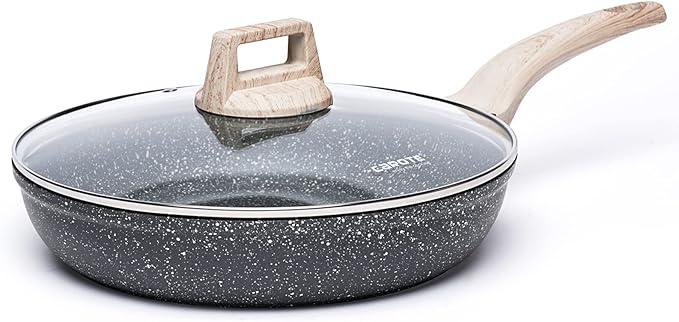
Last year I saw a non-stick skillet on sale. It was an 8″ skillet, and it was $13. It looked unlike any other skillet I’d ever tried and had received high ratings so, being extremely dissatisfied with my pricy Scan-Pan and Anolon skillets, I figured I could risk a little coin on this loss-leader.

Made by Carote, it was “grey granite” in color—an unusual but pleasantly retro look, reminiscent of old enamelware—was made of thick aluminum with five layers of heavy non-stick coating, and had a wood-tone handle (also lovely) that was super-comfortable and secure in the hand while also being oven-safe to 500°F. It didn’t take long for me to fall for this little skillet, especially after I realized that it had no riveting on the inside (where the handle connects), making cleanup (almost) a pleasure. Moreover, the base of the pan was thick, devoid of “hot spots,” and was designed to evenly expand and thus avoid warping.

When I checked the rest of the Carote line, I found that even the regular prices were a third the cost of the higher-end pans I’d been trying, so I picked up a ten- and a twelve-inch skillet, with covers, all for less than the last Scanpan skillet I’d bought.

They’ve been in daily use for the last three months, and I could not be more pleased. They come in other colors, which isn’t a factor for me, but might be for others, and a ten-piece set (skillets, pans, covers) can be had for around $120.

Recommendation #2: Ingredients

Another of my culinary challenges has been sauces.
If you make sauces, you need stock and you need a thickener. Making stock at home means saving bits and bobs from larger cuts and/or buying bones to roast, then hours of simmering and reducing all to turn a gallon of water into a quart of decent stock. Buying stock means, well, you can’t, not real stock, anyway; sure, you can buy broth and emend it, or you can buy bouillon cubes and try to counter all the salt, or . . .

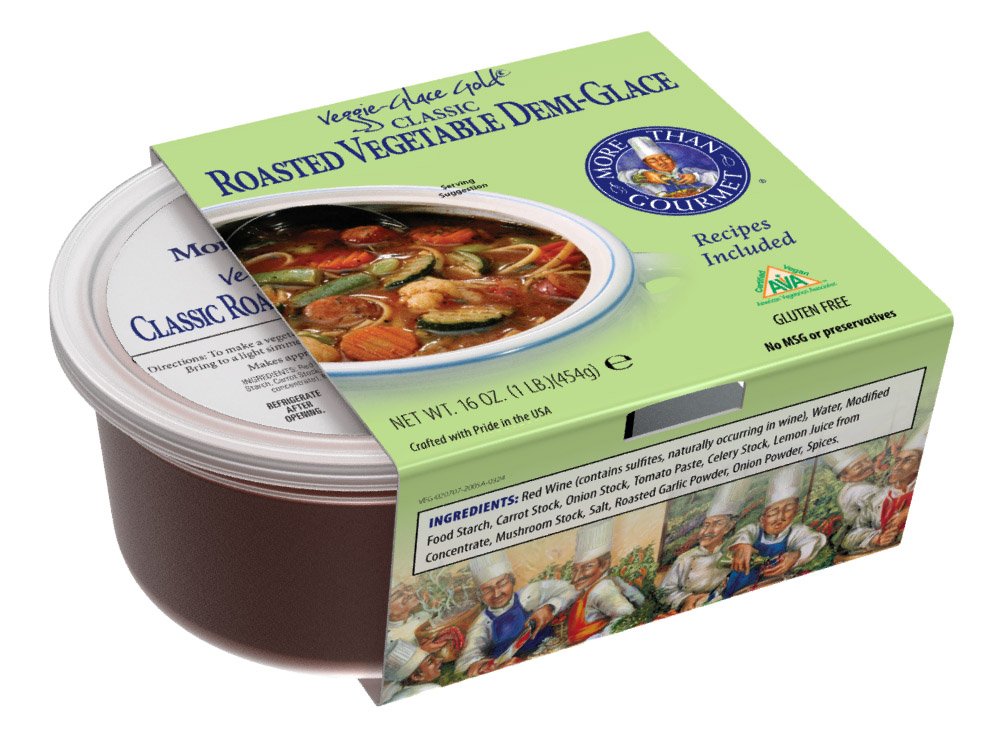
I present to you More Than Gourmet’s classic demi-glace reductions. These are a collection of gelatinized demi-glaces that may be used as stock, as a demi-glace, or as the basis for a heavier sauce. They are shelf-stable until opened, at which point they will last six months in the fridge. While not sodium-free, they are made with about a third of the salt/sodium of standard bouillon preparations and, to tell you the truth, I really can’t taste much salt in them at all, even at full concentration. They come in various incarnations, including vegetable/vegan, mushroom/vegan, veal, chicken, duck, lamb, and fish.

You can get them in small 1.5 ounce packets (including a variety pack, if you want to try some out), but I’ve been buying them in the one-pound tubs (yes, I use them that much). One thing I really like about the one-pound tubs is that I can open it up, carve off a slice, build my stock base, and if that’s not flavorful enough, carve off some more and deepen the concentration. Whether I’m making a quart of stock or a cup of glaze, these reductions are my go-to ingredient.

But, what about thickening that stock for a sauce? Well, for that I used to spend a lot of time making roux. Take equal parts fat and flour, cook them up at a low/med heat until they get to the desired nuttiness/darkness, and then hope you made enough for the quantity of base you want to thicken. I got into the habit of making a mess of roux, parceling it out into teaspoon punkles or cooling it into a sliceable stick, so I wouldn’t have to make it each time. Not optimal, but workable.

Jacques Pépin to the rescue!

I read an article in which the master (who, it turns out, doesn’t like fussing about with things when there’s a viable, equally useful alternative) sang the praises of Gold Medal’s Wondra. Now, Wondra has been around for decades, and chances are you’ve seen it at the grocer’s, down there on the bottom shelf under all the froufrou flours and organic/non-GMO pastas. Chances also are that you’ve never bought it, used it, or heard of it (I certainly hadn’t).

Wondra is a flour that is pre-cooked and finely milled, so that it dissolves immediately into liquid (hot or cold), with no lumps. Put that liquid on some heat and: voilà! instant thickener. In other words, it works just like corn starch, but it doesn’t have that gummy, flavorless, starchy mouth feel, but rather adds a bit of that woody/toasty base you get from roux. If you add some butter to the mix, it’s almost indistinguishable from a roux-based sauce. Combining Wondra with the More Than Gourmet reduction (and appropriate spices, herbs, aromatics, etc.) is a quick and easy way to get to the perfect ladle of sauce. Of course, if you’re trained at the Cordon Bleu, you’ve just fainted dead away, I’m sure, but for us mere mortals, this is a godsend.

But wait! There’s more!

Wondra has other uses, too. As a dredge on fried foods, it gives a crispier, lighter crust. I tried it last night on the slurry I use to make a lacy “skirt” around dumplings and gyoza, and it was light, fragrant, and oh-so-crispy. A massive improvement over using AP flour.

And it can be used for crepes as well, not only making them lighter and less glutinous, but also allowing you to skip the “resting” step that crepe batters usually require.

Wondra is my latest discovery from 2022 and, as such, I haven’t plumbed the depths of its possible uses, but it’s already earned a spot as a pantry staple.

That’s all for this week. Thanks for stopping by and may the year ahead be healthy, strong, and peaceful.

k


Read Full Post »
I am fortunate. I am fortunate because, once, I was poor.

You learn a lot from being poor. You get creative. Take food, for example.

During times when I struggled to make ends meet, I sometimes modified my diet, experimenting with less expensive substitutes (alternatives like textured vegetable protein) and more economical methods (yes, you can cook pasta with only a bowl and an electric tea kettle, but it takes a while). I learned where to find the best prices for food (including dumpsters behind grocery stores) and learned that when to shop is sometimes as important as where to shop.

When I was studying music in Jerusalem, I didn’t have much income. My scholarship covered my tuition and living quarters, but I still had to pay for food and clothing, books and supplies, transportation and postage and phone tokens. My parents usually sent a monthly stipend, but (adjusted for inflation) it was only about $150, which left me with a lot more month than money. I supplemented this by cleaning houses and playing gigs with the Jerusalem Symphony, but none of that was steady work.

It didn’t take long for me to find that the most economical place to shop for food was in the shuk. The shuk was like a farmer’s market, with aisles of open-air stalls selling fruit and veg and meats and spices, but it didn’t have the artisanal frippery and carnival vibe that permeate modern suburbia’s weekend analogues. No, the shuk was a place where working people shopped daily, filling a mesh bag with produce warm from the sun and bread warm from the ovens, taking it all home for the family meal. Vendors knew their regular customers, greeting them by name or honorific, chatting about current events or family woes, as together they searched for the ripest melon, the heftiest chicken, the most pungent cardamom, the sweetest halvah.

Prices were displayed, sometimes on a board above, but usually written with chalk on small slates propped up behind the stacked wares. As the day progressed, the desert heat intensified, creating a heady mélange of aromas, and the slates would become clouded by half-erasures and rewrites as prices were adjusted downward.

This was the time to shop: toward the end of the day, when vendors were especially eager to sell, sometimes at a loss, rather than cart what was left back into storage, and it was there, at just such a time, that I perfected my haggling technique (posted prices being merely a starting point, a suggestion as to where your journey would begin).

My girlfriend and I, low on funds, were looking for bargains, and the shuk, now in its last sun-drenched hour, was ready to supply them. Some stalls—the baker, the poulterer, the cheese-monger—had already shut down, their stock exhausted or the heat too punishing, but that was fine with us; we couldn’t afford chicken or cheese, anyway, and we could get simit—large sesame-topped loops of bread—from street vendors in the morning on the way to class. And there were plenty of vendors still open, willing to ride it out until closing in the hopes of a few last sales.

We bought a kilo of rice and some of that textured vegetable protein (aka TVP, aka kibble for people), then wandered past burlap sacks filled with nuts and seeds of all colors and sizes, until we came to a spot where the air was redolent with an almost indescribable mixture of warm wood, sweet hay, and a hint of something nearly but not quite citrus: tomatoes.

Two tomato vendors were set up across the pedestrian aisle from one another. One man was fanning himself with his newspaper and the other dabbed at his brow with a paisleyed kerchief. Before each one was a large display tray with a pyramid of deep red, glossy, perfectly ripe, and now fairly warm tomatoes. The prices were about two-thirds of what they had been that morning, but the first vendor had set his per-kilo price several agorot (subunits of shekels) below his across-the-aisle competitor’s.

So I ignored him and went to the second vendor.

We inspected his tomatoes. They were lovely, hand-filling Romas, perfect for a meatless ragout of TVP, to be served over rice, seasoned with wild herbs we’d pick along the road on our way home. I looked at the tomatoes, looked at the slate behind them, then looked at the vendor as I offered him half of his chalk-smudged price.

Naturally, he was wounded by such a paltry sum, but he did knock ten agorot off the price, bringing his price below that of his neighbor.

I shook my head, and walked two steps across the aisle.

The second vendor’s stock was just as good, just as ripe, just as inviting as the first. I offered him the price I offered the first vendor, but he, too, found it much too low. He had children at home, a family to feed. But—and there’s always a “but”—he liked the look of us, so he knocked ten agorot off of his price until he was the cheaper of the two.

I went back to the first vendor, raising my counter-offer, at which he rubbed at the slate and dropped his price again.

At this point, I didn’t have to go back to the second vendor. All I had to do was look over at him, gesture to the first vendor’s slate, and raise an eyebrow.

The second vendor scrubbed and wrote a lower price on his slate.

I looked back at the first vendor. Scrub. New price.

Second vendor, same.

Eventually, the second vendor got down nearly to my counter-offer, at which point the first vendor laughed, put down his slate, and conceded. We went to the winner, bought a kilo, and went home, snagging some wild saltbush and rosemary along the way.

As I said, though, being poor taught me many things beyond how to haggle for tomatoes. I learned how to live within my means, how to budget, and the importance of putting some funds by for the future. I also learned to be grateful for what I did have, rather than fuming over what I didn’t.

Most importantly, though, it taught me empathy for others in similar straits, as well as how easy it is to fall into a bad situation. One accident, one bad decision, and bam! you’re in trouble, trouble that may dog you for years. While I’ve never been completely destitute, I was close enough to see it from my seedy flat in the bad section of town, and I don’t wish that upon anyone.

I’ve tasted poverty; it’s bitter and dry and degrading, and I’ve worked hard to avoid it. But many others are not as lucky as I have been. For myriad reasons, and despite their best efforts, too many families struggle to survive, here in my country and around the world. At least here, where we have the wherewithal to help, we should help, and yet it is so hard to get agreement on this, a matter that to me is a very basic truth.

I wonder if those who complain about our efforts to help those less fortunate, who berate the government’s efforts to address a problem that half the nation seems eager to ignore, who ridicule those who demand a wage that provides them enough for food and shelter, I wonder if those people would benefit from a few months living on TVP and tomato sauce.

k

Read Full Post »

Cherries are, without question, my favorite fruit, and now, in early summer, they are plentiful. However, as with my last recipe post about pickled asparagus, there just isn’t enough time to consume all the cherries before they go off, so I’ve been playing with various ways to preserve them.

Which led me to having bowls of leftover cherry-stones.

Which, in turn, led me to orgeat.

Orgeat (pronounced OR-zhat) is an almond-infused syrup used in flavored coffees, tiki cocktails, and Italian sodas. Not being a big drinker of any of these, I’d never heard of orgeat before, but I am now a big fan. A glass of ice, a shot of orgeat, and some lightly carbonated San Pellegrino water make the most refreshing post-gardening quaff I’ve ever had the pleasure to imbibe.

What does this have to do with cherries? Well, cherry-stones are an optional (to some, but essential to me) ingredient in making orgeat.

Traditionally, orgeat is made with bitter almonds, but they’re hard to find and way more expensive than makes sense to me. Sweet almonds are commonly used in homemade orgeat, but by including cherry stones, I  add back a touch of bitter to temper the syrup’s sweetness.

This recipe is also eminently modifiable. Try different types of nuts. Try different flower-waters. Try skins on/skins off. This recipe is a guide to whatever is in season, whatever is available, adaptable to your particular tastes. See the Notes section for ideas on variations and uses. (more…)

Read Full Post »

Growing up, there were two foods I hated: liver and asparagus.

As an adult, I learned that the reason I hated those foods: my mom cooked the bejeezus out of them, turning the former into chew-toys and the latter into grey-green cylinders that were half vegetal mush and half indigestible cellulose. While liver never made it into my Top Ten, asparagus has become one of my favorite foods.

I roast my asparagus. I sauté it. I blanch it for salads and drop bias-cut slivers into soups. I add it to omelettes, quiches, crepes, pasta. I like it thick as a finger or thin as a cocktail straw. And now, I have a new way to enjoy it: pickled.

Don’t fear; this isn’t canning, with its attendant protocols and fears of botulism. No, this is easy. This is my kind of pickling: refrigerator pickling. It won’t keep on shelf through the nuclear winter, but it will last in the fridge for a month, no sweat.

The result is a spear that is tangy, savory, possibly with a bit of heat (your choice), but that’s still firm with a hint of crispness.

Great for snacks, salads, and the perfect accompaniment to charcuterie.

(more…)

Read Full Post »

Older Posts »