Feeds:
Posts
Comments

Archive for the ‘Books’ Category

What do a fork, a model of a ship, and a priest’s right eye have in common?

No, they’re not props from a horror movie.

They’re all objects discussed in Neil MacGregor’s book, Shakespeare’s Restless World: A Portrait of an Era in Twenty Objects.

As readers of this blog know, I have a bit of a fascination with Shakespeare, so this book is right in my wheelhouse. The subtitle gave me a general idea of what I was getting, but what I didn’t expect was such a fascinating overview of  life in the late Elizabethan/early Jacobean periods.

Neil MacGregor, Director of the British Museum, takes a disparate collection of 16th century objects–ranging from the everyday to the unique–and gives us a chapter on each one. Naturally, he describes each object, its history, its use, and its provenance, but this is all expected content. The lavish photos of the objects themselves (as well as related items) are clear, detailed, and beautiful, but each chapter really shines when MacGregor expands the discussion beyond the basics, showing us the social context of each item. Through MacGregor’s clean, unhurried prose, we learn what each object might have meant to the average groundling in the pit or noble in the tiers. An apprentice’s cap, for instance, looks simply like a cap to us, but if you were one of the Queen’s subjects on the streets of London in 1600, it would tell you of the wearer’s social standing, might remind you of the apprentice-led riots over food prices. Later, when you went to The Rose or The Curtain to see Coriolanus, and saw the cap-wearing citizens berating Menenius over the high cost of corn, you would remember those riots, and know that things might get very ugly, very quickly.

The list of objects MacGregor has chosen is, as I mentioned, varied. He discusses a fork used to eat sweetmeats in the same detail and depth as he does the model ship used as a token, built in thanks by James I for his safe passage home from abroad. Each object is inspected both as a thing from within Shakespeare’s world–i.e., as relates to his plays and the world of the theater–as well as within his world at large. In reading this book, I learned a great deal about the lives and the mindsets of Shakespeare’s patrons, high-born and low, but also expanded my understanding of the period and its conflicts.

This book was of great interest to me, as you might expect, but I wholeheartedly recommend it to anyone interested in history, the history of objects, and the tumultuous, change-filled period of late Elizabethan/early Jacobean England.

Oh, and that priest’s right eye?

Get the book.

k

Brickwork

Read Full Post »

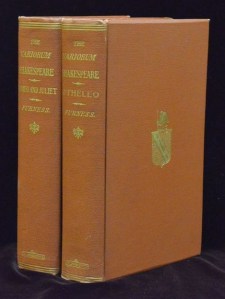
Lippincott Editions of Furness’ Variorum

Claire Bloom once told me that if I was serious about Shakespeare and acting, I must read the Shakespearean variorum. Through the variorum, she said, I could delve into the language and gain better understanding of its history and deeper meaning.

I took this advice to heart, despite the fact that I’m not an actor.

And the fact that I didn’t know what a variorum was.

And the fact that she wasn’t actually talking to me, specifically.

Yes, on rare occasions I take things celebrities say rather more personally than they were intended, such as when Sir John Gielgud gave me advice on friendship. To put your mind at ease, when I do this, I do it in a completely non-“I see you when you’re not looking,” non-“unbalanced creepy stalker” type way.

Honest.

Trust me.

Anyway… Once Ms Bloom told me this, I immediately went in search of a “variorum,” whatever it was. (more…)

Read Full Post »

I don’t have HBO, so I can only watch HBO’s Game of Thrones a decade or so after the premium class sees it. However, that has not saved me from seeing meme after meme based on the series, nor from having to wade through a sea of posts about how this was so good and that was so bad and–of course–how so many things were different than they were in the book.

Aficionados are terribly tempted to hold forth on the subject of their passion (and trust me, I do understand this temptation) but before you do so, before you post that screed on that critical aspect that HBO got wrong, there are three things you need to know: (more…)

Read Full Post »

Over on Facebook, a reader mentioned a scene in FC:1 that she really liked. I like to investigate this sort of specific feedback–the good and the bad–to see what worked and what didn’t work for my readers.

I remembered the scene she mentioned in general, but not in detail. The main reason I wanted to investigate, though, was that her description of it as dialogue-free was not my recollection; I remembered it as being chatty to the extreme, as two swoony teenaged girls prattled on about how divine it was going to be to see Sarah Bernhardt on stage. (For those of you out of the 19th-century loop, Sarah Bernhardt was the Lady Gaga of her day.)

So, I pulled down my copy of The Year the Cloud Fell and tried to figure out what this reader had meant when she referred to the scene’s “shared communication and not a scrap of dialogue.”

(more…)

Read Full Post »

Back in the late ’70s, James Burke introduced me to interdisciplinary thinking. His book and documentary series, Connections, showed how (for example) the use of lateen sails in the 14th century led to the discovery of electricity. The process was far from linear, but Burke made the connections along the way clear and irrefutable.

Mark Forsyth, in his book, The Etymologicon, has done much the same thing with words. (more…)

Read Full Post »

London is built upon its dead.

On our last visit to London, during an unseasonably warm April, we opted to flee from the Holy Week/Royal Wedding crowds that thronged the city center and seek a quiet, shaded walk. We found it in Kensal Green, one of the six great Victorian cemeteries that ring London. It was a spontaneous choice, our walk amongst the tombs, but it piqued my curiosity enough that I wanted to learn more about these somber, beautiful places of death.

Thus, when a friend told me about Catharine Arnold’s Necropolis: London and its Dead, I snapped it up.

It’s difficult for Americans to comprehend, sometimes, how young our nation is when compared to the rest of the civilized world. Though the native populations of the Americas had been here for thousands of years, they left the continent virtually unmarked by their presence. Seattle, where I live, was not here 150 years ago. Our streets were built on land uncut, our city laid out on land that had never known one stone stacked upon another. This is true of all American cities. There are no ruins of empires past beneath our feet. When we dig in the earth, we do not find coins of Rome or remnants of a Norseman’s armor. Thus, when we travel abroad and visit cities that have been in existence for centuries, for millennia, it is often difficult for us to grasp what that really means.

In the case of London, it means that the city is not only built upon the ruins of its past but that it is, quite literally, built upon the bodies of its dead.

(more…)

Read Full Post »

I grew up in a black-and-white world. Not exactly like the way Calvin’s dad explained it, but pretty much.

When I was very young, television broadcast in black-and-white, and my life was filled with television. Soon, even though technology advanced and broadcasts switched to color, in our house we still only had a black-and-white television.

In fact, we didn’t have a color television until I was a teenager, when my grandfather passed away and we inherited his old massive oak-wood RCA Color TV console, with the remote control that sighed like a sulking teenager when you pressed down one of its three buttons. Thus, all my childhood TV viewing was black-and-white, never in color.

So how, then did I know that Captain Kirk’s tunic was tan, Spock’s blue, and Scotty’s red? Sure, I suppose my viewing might have been “enhanced” by color pictures in TV Guide, but if that’s so, then why do I also remember To Kill A Mockingbird in color?

When I watch the film, naturally I see it in black-and-white, but when I remember scenes, especially scenes from the book that didn’t make it into the movie, I remember them in color. I remember Scout’s red flannel shirt, her dark indigo overalls. Tom’s overalls were faded, as was the blue of his work shirt. Atticus wore suits of pale linen, grey pinstripe, and solid slate grey. Mayella had pink flowers on her dress, while the ones on Calpurnia’s chintz were blue.

Perhaps it is because so many things in that story were objects familiar to my youth. The bark of trees we climbed, the denim of our jeans, the thin cotton of our shirts, it was all as it was in the book. Or perhaps it’s because Harper Lee’s words were so simple and direct, so mesmerizing, that I couldn’t help but see the world she created in its entirety, vibrant with color.

To Kill a Mockingbird–in both book and film–was important to me when I was young, and it remains so today. Through its story, I discovered fiction that told of kids who were real, not the fantastical wunderkinder that I found in all the other books I was given. It was an adult story told simply, clearly, and with ultimate honesty. Within its pages, I learned that the world is not black and white, right and wrong, but filled with immeasurable greys  in which justice can be evil, and wrong-doing can be justice. I learned of the fallibility of mankind, and of the failures in our shared society when we forget that we are not alone in this world.

I remember Harper Lee’s classic in color, because it taught me about black and white, because it taught me about grey.

k

Read Full Post »

« Newer Posts - Older Posts »