Feeds:
Posts
Comments

Archive for the ‘Creativity’ Category

Bloedel Reserve, Bainbridge Island, WA

I walk to work
The same hour each day
And make a time-lapse film
Frame by frame
To capture the passing year.

Buildings fall into vacant lots,
Rise from the rubble.
Storms flash overhead.
Cars blur past
Dreary commuters
Taking dreary steps
Toward dreary jobs.

But along the sidewalk,
Sweetgums grow
Tall, stately, serene,
Life in the grey and black canyons.

In winter, they sleep.
I walk wet pavement
Beneath dark, dripping skeletons.

With springtime sun,
Acid green buds
Burst open in an eyeblink
To shake new leaves
In the morning air.

My summer path leads
Beneath crinoline branches,
Silken leaves rustling,
Lazing in the light.

Autumn comes and the sun,
Tired out by long days,
Grows tardy.
The sweetgums sport fall fashions and,
For a few brief frames,
The sunrise and I,
Bleary-eyed,
Collars turned against the season’s chill,
Walk the streets together.

The sky is a purple shell.
The air is still.
The trees are dark,
Their branches garbed in orange and rust.
They do not rustle.
They do not shake.

They sizzle.

Deep within them, hidden by dying leaves,
A thousand starlings wake.
They greet the sunrise with
Gricks and whistles,
Creaks and pips.
I stand smiling
Beneath a thousand chittering mouths,
Listening to
The sound of butter in a hot skillet.

Sizzle. Pop. Hiss. Flutter. Zing.

A few more days,
A few more frames,
And the sun lags behind me.
The sweetgums now are silent,
Branches laden with sleeping birds.
Later still,
Once the trees drop their leafy frocks,
The starlings leave the city to winter’s cold,
And once more I walk alone
Beneath dark and bony boughs.

k

Typewriter

Read Full Post »

copy-cropped-copy-wpheader13.jpg

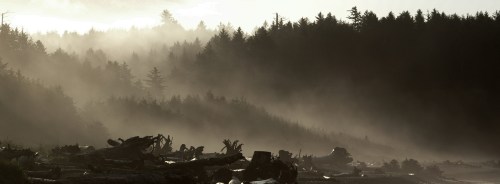
I walk the wavering limit of sand and sea, the Pacific’s grey serrated edge. The wind, flavored with salt and sun-dried kelp, pushes me, smudging my glasses with briny thumbs. A foam-white gull hunkers down against the wind. It glares at me with a yellow eye, wary but unwilling to move as long as I keep my distance. Plovers weave up and down the sand, dancing with their watery partner, piping and whistling. At my approach, they burst upward in a seething cloud of wings that veers drunkenly along the shore before settling down at a safer distance.

The waves hesitate, gathering their courage, then rush up the sloping shore. The first one covers my feet, the second my ankles, the third, calves. The water shocks with skin-tightening cold, but once the waves caress the sun-kissed sand, they recede with warmth and slip gently out to sea.

It is low tide, the time when the ocean rummages through dark cupboards, searching for trinkets and loose change to toss up on land when the next advance begins. Past offerings make ripples beneath the retreating waves or lie bright in the water-dark sand. Razor clams, splayed wide like nacre butterflies, are brittle and sharp splashes of dark purple or brilliant white. The pale skeletons of sand dollars lie strewn about, all broken, metaphors waiting to be used.

I walk through the dirty, heavy-handed rip current and the calmer, cleaner slack. I feel the tug of the water, sense the shifting sand beneath my feet. I taste both sea and earth on the ceaseless wind.

This is the edge, the limit of the world, the place where both land and ocean end.

Or begin.

k

Typewriter

Read Full Post »

Mouse RoadCats have their signs.
The twitching tail.
The flattened ears.
So do I.
Know me?
You’ll see them.
Esteem me?
You’ll heed them.
Else
No fireworks.
No tirades.
No hiss and lashing claws.
Just silence
And the snick of the closing door.
Too late.
Too late.
Call it what you want.
I no longer care.
Cats have their signs.

Typewriter

k

Read Full Post »

Several articles have crossed my desk recently about the removal of penmanship — specifically writing in cursive — from the curricula of public schools and the Death of Modern Civilization that will naturally follow.

Piffle.

Cursive is as relevant and useful today as is Secretary Hand (pictured right), and those who decry its elimination are merely holding on to their nostalgic memories, clinging to a past that is gone, never to be seen again.

In grammar school, the only failing grade I ever received was in penmanship (well, there was that D in “Comportment” … but let’s not open up that old wound). Despite years of toil, facility in cursive has remained beyond my capacity, and no amount of practice (or repetitive exercises handed out in punishment for my … creative alternatives) ever improved my skill. My cursive was (and is) a crabbed, uneven, slowly produced, literally painful, and for the most part illegible scrawl. Yet, I have lived my life comfortably without its advantages and, now that my parents are both dead, I almost never have to read anything written in cursive script. (more…)

Read Full Post »

Godfather G

Thanks to those who’ve taken the time to follow these posts. It’s been a bittersweet journey, but a valuable one for me.

This week, I went down to help my close up shop on my father’s life. For a poor kid from the backwoods of western Marin, grandson of an Italian immigrant, a high-school dropout who left home at thirteen and slept above the lanes when he worked as a pin-setter at the local bowling alley, he did pretty well.

His life was filled with love and grief. He had four talented children, but saw one of them succumb to addiction. He loved two wives, but saw them both die before him. He did not have a great number of friends, but those he had he treasured deeply.

I will miss him. I already do.

But all his troubles are now become as smoke, leaving him once more free of pain and worry.

Ciao, Papa. And thanks.

k

Read Full Post »

It was not until my high school years that my father talked to me of love. By that time, of course, I had succumbed to my fair share of crushes, passions, and fascinations (including one young girl who treated me so ill that I carved “LD” into the sole of my boot, that I might grind her initials into the dust with every step I took.)

By my sixteenth winter, though, the tenor of my heart had grown beyond such childish attitudes and sought more meaningful relations. One girl in particular had affected me deeply, and though my feelings were built of fragile glass, it was my first true adult love and I felt it as deeply and soberly as I was able. The day it all crashed down, the day that I at last admitted to myself the futility of my unrequited suit, I retreated to the blue shadows of my downstairs room, threw myself upon my bed, and wept.

Hours later, after I’d grown quiet, my father came downstairs and knocked upon my door. He came in, sat on the edge of the bed and, unexpectedly, he asked me about the girl: who was she? how did I feel about her?

I told him all.

When I was done, he did not try to cheer me up. He did not say I would “get over it” or that there were other fish in the sea. He did not tell me that the pain I felt was just a phase or that it was anything less than love. What he told me was:

“When your heart gets broken, it’s bigger when it heals, and the next time you fall in love, it will be deeper and stronger than the time before.”

This has proven true. Each time that I have loved it’s been the deepest, strongest, greatest thing I’ve known. Each time, the newer love puts former passions all to shame for pallid renderings of true adoration. And each time, I wonder if before I ever loved at all. The dark side of this lesson, though, is that with deeper love comes the risk of greater pain, but if not for love, what else is worth the risk?

k

Read Full Post »

As a skinny, myopic boy with a bookish nature and a talent with the violin, I was an easy — if not an obligatory — target for the stronger boys. I was punched and teased and bullied and beaten on the school tarmac. Several times I was “called out” to fight in the churchyard: appointments I never kept but instead walked past, shamefacedly heading home while the gathered boys jeered. I kept these trials to myself — to admit them was to admit my weakness — but one evening after one such “missed” appointment I could contain it no longer. I complained to my father, bemoaning the fact that I would never be as strong as those other boys. My father did not teach me to box nor puff me up with empty promises. Instead, he told me truly:

“There will always be someone smarter or richer or stronger than you. Do your best, and you can be happy with who you are and what you have.”

At first I rejected those words and their unflinching precision, but they haunted me through the months that followed. I refused to accept, at the age of nine, that I would never achieve what I perceived to be the only purpose in life: to be the best at something. As I wrestled with the concept, though, I realized that logically there could only be one person who was the richest in all the world, one who was smartest, one who was strongest; the vast majority of us could never be the best. To be the best, I saw, was a not a reasonable goal, whereas working to do one’s best could bring satisfaction in many ways.

It’s a lesson I must still relearn periodically.

k

Read Full Post »

« Newer Posts - Older Posts »