Feeds:
Posts
Comments

Posts Tagged ‘novels’

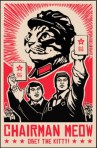
Obey the Kitty!Are there “rules” for genre fiction?

I’ve been called out by die-hard Alternate History readers for having “broken the rules” of the genre with my Fallen Cloud Saga. Charges that I “changed too much” or that “that’s not the way it was back then” were among the most common complaints. In response, I can only shrug. There are rules? I didn’t get any rulebook. What part of “alternate world history” is confusing these people?

When I sat down to outline the The Year the Cloud Fell (FC:I), I didn’t check to see what genre label it would sport. I had an idea, I worked on it, and I wrote the story I wanted to tell. My standalone novels, Dreams of the Desert Wind and Unraveling Time, are also good examples. Each one of those books blends elements of several genres: suspense, thriller, romance, time travel, adventure, historical fiction, etc. But I never set out to write a genre-bender. I set out to write a novel.

That’s because “genre,” as it’s used today, has nothing to do with writing, but it has everything to do with marketing.

Publishers want to make money; I can’t blame them for that, but in order to ensure the best return on their investment, they want to stack the odds in their favor. One way they do that is by giving books specific “genre” labels. Humor, Science Fiction, Fantasy, Romance, plus sub-categories like Alternate History, Steampunk, Police Procedural…these are all genre labels and yes, the fans of these genres have expectations about what will be inside a book that bears a specific label. That’s what makes the product predictable, and helps the publisher maximize profits by targeting their budget where it will do the best work.

But it has nothing to do with writing.

The book you have in mind might tick all the boxes for one of these labels. Many books do, and publishers (and agents) love that type of book because it makes their job easier. Unfortunately, none of my books fit so neatly into one category. So, should I change what I write? Should I “write to the market”?

Writing to the market is like setting out to write a blockbuster. You’re aiming at a sly, wily,  restlessly moving target. You’re having to guess, months in advance, what will pique the public’s interest, what will go viral, what will be trending upward on Twitter. In short, it’s a nearly impossible task, and if you succeed, it’ll be more luck than skill.

I write what I want to write. I build my characters, my worlds, my storylines specific to my needs, not the unwritten rules of bean-counters in marketing departments. Writing a novel is hard enough, without burdening myself with writing a book I’m not in love with.

k

Read Full Post »

Today was a good writing day.

Ilene and I have gotten into the habit of taking “rehearsing for retirement” mini-vacations. This weekend we took another, centered around our 29th wedding anniversary. We had plans of doing all sorts of things, going places, trying new restaurants, seeing a movie or two to see, but we ended up pretty much sticking around the house, reading, watching the Olympics, and (in my case) writing. I can barely wait until retirement.

I’ve been working on a critical section of FC:V (aka Beneath a Wounded Sky), and today I finally punched through to the other side. I know the Faithful Readers over on my Facebook page are sick of hearing about this “critical section” of the novel, but hey. It’s critical. It’s the difference between crying “Checkmate” in move 25 and making sure you have all the pieces in place so that it means something. That means a lot of work, and a lot of re-work. And then some re-re-work.

But it’s also been rewarding. Any time, in writing Book V, you can make a serious call-back to a scene in Book I, that’s a hell of a lot of fun. Challenging, too, though, primarily because nearly everyone in the chapter has conflicting emotions, and my POV character shifts emotional focus a couple/three times in the last scene alone. While it’s a simple matter to map the “top note” of each character’s main emotion, it’s a different kettle to ensure that all the underlying emotional content is logical as you move through the shifts each character experiences.

I feel particularly free, though, after today’s work. While this isn’t the emotional climax or the action climax, it’s the pivot. For those keeping count, I’m about 75% done. About another 100 pages to go in the main product, and the production work will be complete. Then I go into “post-production,” editing, reader feedback, re-editing, and then…well, you get the idea.

Believe me, though, “production” is the hardest part. When I get that done, pop the champers.

k

Read Full Post »

20120729-075810.jpgFor me, the most powerful tool in a writer’s toolbox is the power of observation. It not only helps me create believable characters, it also gives me the ability to fill my worlds with believable detail. Some examples…

I was in the office when the wind-up clock stopped. It didn’t go tick-tock—tick—-tock, slowing as it reached the end of its wind, but just went tick-tock-tick-tock—-, ending suddenly and abruptly like some metronomic cardiac arrest. Odd.

My stomach growled at me this morning, and it sounded for all the world like it said, “Hello, Chuckles.” My guts have never spoken to me so explicitly before, but I’m glad we’re on such friendly terms; that hasn’t always been the case.

For her 60th birthday, I gave my sister a vintage electric clock from the ’40s. It didn’t tick like a mechanical clock but hummed as it worked the sweep second hand around the dial. My sister liked this especially, as it matched her feeling of time as a continuum. I prefer the mechanical heartbeat of a tick-tock clock, as I like to think of time having a constant, measured passage.

These details of life and character are just the sort of things that inform my writing, providing snippets of description or personality. Observation is such a critical skill that it has actually become a pasttime for us.

We can play this game anywhere–at a restaurant, waiting at a stop light, anywhere–just by looking around at the people around us. (Coffee shops are perfect for this game.) I’ll pick someone or she might pick a couple, and we’ll start building backstories for them, weaving a tale of why they are there, what they’re doing, and what they are feeling. These aren’t just wild imaginings, though; we base our story on the subject’s dress, movement, and behavior. Couple on their third date? Construction worker doing the shopping for a sick wife? Woman contemplating divorce?

The key to the game is that the stories must be believable, and must tie into the person we observe. While my wife enjoys the game simply for the mental exercise, I find that it hones my skills and heightens my awareness. If you aren’t aware, you cannot observe, and if you aren’t observant, then you’re creating characters and descriptions in a vacuum.

Characters have to be believable, consistent, and comprehensible to the reader, even if the setting is as alien as a moon or the 9th century. In all the historical research and reading of memoirs I have done in preparation for my novels, the one thing I have learned is that we, as people, have not changed much. The world surrounding us has transformed, technologies have changed, but human behavior remains remarkably consistent.

So keep your eyes and ears open. Stay frosty. Inspiration may be standing ahead of you in the checkout line.

k

Read Full Post »

Yesterday was an interesting day on the KRAG blog.

Being supremely new to blogging (Week 5), I’ve been watching the “Stats” page with interest. WordPress provides a nice collection of statistics which—depending on what you see—can be either fascinating or depressing. I’ve been watching the blog-stats bounce along: the number of daily views within easy reach of zero, fewer followers than eggs in a carton, most traffic sourced specifically from my “author” page over on Facebook.

Then, yesterday, a spike: I had views from India, Canada, the UK, Israel, and New Zealand; the number of views was more than double the average; and several folks took the time to leave comments. I asked myself: What the hell happened, and why?

And this reminded me of Amazon.com and their maddening “Sales Rank.”

Of course, I had been aware of Amazon’s “Sales Rank” for a long time, but it really meant nothing to me. I never buy a book because it’s a bestseller. I only buy books because they are recommended or because they just sound interesting. Sales Rank? Who cares? Pas moi.

But when my first novel went for sale up on Amazon, I did a complete 180. Suddenly, nothing was more important than that damned Sales Rank. I began tracking it, checking in on it hourly, in fact, entering what I found in a spreadsheet. I found websites devoted to the tracking of the Amazon Sales Rank. I watched my book’s ranking trend upward, break upward into the 6-digits, into 5-digits, back to six, up again, back again. It would change radically, without discernable logic, bouncing from a low rank of over 1 million up to under 60,000. Then, one day, as I repeatedly hit F5 to refresh my screen, it bounced up to around 1,400.

Number 1,400!! Out of millions! Boy-o-boy! I was on my way!!

When I hit refresh again, it was back at #90,000. What the hell happened? And why?

I did more research, found article upon article purporting to divine the math, method, and meaning behind these numbers. Taken in the aggregate, however, it quickly became clear that no one really knows how the Amazon Sales Ranks are calculated.

I stepped back, and thought again about what the Amazon Sales Rank meant to me as a reader. This arcane, inscrutable number meant nothing to me as a reader or purchaser of books, so it probably meant little to the public at large.

Of course, the stats associated with my blog have a little more meaning—each new reader is potentially a new person who might want to read one of my books—but should I spend time tracking the stats and trying to discern the reason they spiked or dipped? Shouldn’t I spend my time on more meaningful and productive efforts? Damned straight.

It comes back to why I do this: for the love of writing, and for the conversations it engenders. It doesn’t matter to me if this blog has 20 readers or 20,000; it’s the writing, the connection, and the interactions with readers and other writers that count most.

k

Read Full Post »

Often, when someone learns that I am a published novelist, they give me a puzzled look. I know what they’re thinking.

Why are you still working that day-job, living in that house, driving that car?

I used to think that, too. I had already figured out where I’d be teaching (after receiving my honorary degree), had already picked my house on the shores of Green Lake,  and had chosen the flash car I would use to zip around town.

Then I sold my first novel. Nothing changes your worldview more than achieving your dream.

As a writer, I have had some successes: eight novels published, four by a large NYC publishing house, plus a smattering of published short stories, articles, and essays. I’ve also had—I used to call them failures, but now after “periods of redefinition,” I think of them as successes, too. You see, when I started out, anything other than a bestseller was a failure, but soon I would only fail if I got anything other than a solid sale. In time, I accepted any sale as a success, and then…you see where this is going.

A long time ago, Dean Wesley Smith asked me, “If you knew you would never sell another story, would you still write?” My answer was flippant. “Of course,” I said, “but tell me now so I won’t worry about it.” I was green as springtime grass, back then, and had yet to feel the heartbreak that only publishing can provide. Today, my answer still stands, but it stands on its own; it doesn’t need the cocksure attitude to prop it up.

When I started, I wrote as a way to achieve fame and fortune. Sure, some people make gazillions at it, but you can count those who do it consistently on your fingers. In reality, writing is a hard way to make a living, and if you’re in it only for the money, my advice is to get out, now.

Here’s what people don’t get: writing is an art, but publishing is a business, and publishing doesn’t give a toss whether your book is good or bad, it cares whether your book will sell or sit on the shelf. Your novel can be total crap, but if it’s the kind of total crap that sells, it’ll get snapped up. But good or bad, if it does get snapped up, there still isn’t a lot of money in it, and one sale is no guarantee of future sales.

Today, I don’t write for fame and fortune, nor do I equate not having them with failure. I write because I want to tell stories, and tell them well. If a book of mine doesn’t get finished, that’s a failure. If I just hammer out some words and have a lackluster product, or write something I don’t love, that’s a failure. If the faithful readers who do love my books don’t get to read any more of the stories I want to tell, that’s a failure.

Of course, if a publisher thinks I’m putting gold on the page, or Hollywood wants to option my novels, I sure as hell won’t complain. But that’s gravy, and I am able to succeed just fine without gravy.

k

Read Full Post »

Last night we screened the American version of “The Girl With the Dragon Tattoo.” I was disappointed, but not unexpectedly so.

Spoiler alert: If you haven’t seen the movie already, skip this post.

We read the books (in hardcopy, of course) years ago, burning through the trilogy in record time (for me…I’m a slow reader). While I didn’t find them flawless, I found them much more entertaining than Dan Brown or any of the other modern “thriller” genre. Personally, I found the whole Blomkvist-as-Babe-Magnet a bit tiresome, and felt Larsson intruding into the story with every conquest his hero made.

We did enjoy them, though, and when the Swedish movies came out, we snapped them up, screened them, and loved them.

In adapting a novel to the screen, you have to change something; you have to. Many people just don’t get this, and they’re angry when the screen version doesn’t match up with the novel, point for point, like a DNA profile. Every adaptation has to drop some elements, combine others, and sometimes insert new elements in translating from word to picture.

The Swedish versions did this perfectly. They dropped everything that was unnecessary (like the Blomkvist-as-Babe-Magnet wish-fulfillment), collapsed time, merged some ancillary characters, and told a story that was tighter, leaner, meaner, and more compelling than the original. Not bad.

Then, because Americans can’t be bothered to read subtitles, we made a version of the same movie, in English. It wasn’t atrocious, and if I’d seen it first, I’d have been less disappointed, but here were my complaints:

  • The opening credit sequence looked more like the start of a Bond film. It had nothing to do with the imagery of the film, a soundtrack that was jarring and out-of-place, and seemed so off-target that we wondered if they’d sent us the right DVD.
  • Why was Duck Lips (aka Daniel Craig) the only person in the movie who didn’t have a Swedish accent? Hell, even Robin Wright (great casting, BTW) did a passable job.
  • It was clear that someone in the Hollywood machine felt that the American version of Lizbeth had to be a bit more…sociable. While Rooney Mara did a very good job of acting, the writing and direction weakened the character. If you haven’t seen Noomi Rapace’s portrayal, rent the Swedish version and compare them. That is the Lizbeth Salander from the book.
  • Why change the end of the Harriet mystery? Why collapse the Anita/Harriet characters? The movie hit this point and it was like hitting a cobblestone road in run-flat tires. Bumpity-bump-thump, a few clumsy lines of dialogue, and Poof! Anita is gone. Where? Who knows, and it was so clunky I didn’t even scan back to parse the ham-handed expository block.

Not all was less than the original. Some of the Kubrik-esque rolling shots were quite effective, the soundtrack (apart from the opening credits) was effective, and Duck Li…I mean Daniel Craig was a more animated, less cryptic Blomkvist.

k

Read Full Post »

Yesterday, I set my brain to percolate on the chapter I’m writing in Beneath a Wounded Sky. I know it’s working because my autopilot has been disengaged.

We all have one. For instance, I have to pay close attention to where I’m going until I get at least 5 miles from the house. If I don’t, say, because my wife and I are discussing last night’s movie, the autopilot kicks in and we end up taking the exit for the transit station I use.

I am very dependent on my autopilot in the mornings. I’m an “early bird” at work; I come in at around 6:15am. I do this because it gives me a good chunk of time before all the damned meetings start up, and it also means I get to leave earlier, and can have some daylight at home to do chores, etc.

But at 5:20am, going through the routine of ablutions and departure prep, I need that autopilot, and when my brain is silently stealing processing power to percolate on a problem, I end up with a broken routine. I forget to shave, or I forget my bus pass, or I leave my mobile on the credenza. At critical points in this book, I’ve had arrived at the bus stop only to turn around and go home because I’ve forgotten something critical.

This morning, as I was reaching into the medicine cabinet, I really didn’t have a clue what I needed to do next. Shave? Brush my teeth? What did I just do, and what comes next? Have I done everything I need to do?

As annoying as this is, it’s a good sign. And already the dam is starting to crack. I won’t give any clues away, but this is a transitional chapter in Beneath a Wounded Sky, and the way through it needs to feel right. I’ve already figured how all the characters are feeling at this point, and that’s a big hurdle; now I can start putting them in motion.

Now…where did I leave my pen?

k

Read Full Post »

« Newer Posts - Older Posts »