 It’s always a thrill when other bloggers find enough interest in this blog to tag me in a post or give a nod for a blog-award. It’s gratifying to know that I’m not only reaching people, but doing so with value. And so I was pleased when Jon over at Jumping from Cliffs tagged me in The Next Big Thing Blog Hop.
TNBT asks a writer ten questions about their newest or upcoming work, and then hops on over to other writer’s blogs. These games of virtual tag are always fun because there’s always one or two questions in the stack that catch me off guard.
So first, the questions, and at the end, my five “tag-ees.”
What is the working title of your book?
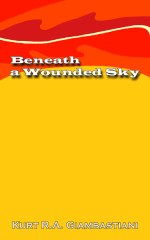
My most recent book is Beneath a Wounded Sky, Book V in the Fallen Cloud Saga. My shorthand for it is FC:V.
What genre does your book fall under?
The closest genre for the FC books is Alternate History, but the hardline Alt-Hist fans will disagree. As with most of my books, it blends genres, and while it’s mostly alt-hist, it also has fantasy and spiritual elements.
What is the one sentence synopsis of your book?
I shall try…
The Fallen Cloud Saga comes to a close as George Custer, Jr. rides with the Cheyenne Alliance to join forces from the Spanish Crown; together, they face George’s father, President Custer, Sr., and his American army, but their plans conflict with the vision seen by Speaks While Leaving, the Cheyenne seeress and guide.
How dat?
Where did you get the idea for your book?
The idea for the series started when I read The Great Dinosaur Extinction Controversy, by Officer and Page. That got me thinking about how dinosaurs might have survived into the common era (if North America’s inland sea had not receded). That got me thinking about how they might have adapted (smaller size) and what niches they might have filled (perhaps filling the niche that was filled by the Spanish horses). And that got me thinking about how life for the Plains Indians might have been different if, when the Spaniards arrived, the native peoples were already riding these smaller, horse-analogues. And that led me to wonder, “What would have happened if Custer didn’t die at the Little Big Horn?”
Who or what inspired you to write this book?
This last book was inspired by the devotees of the first four books in the Fallen Cloud Saga. When the publisher dropped the series on book four-out-of-five, I was crushed and the fans of the series were orphaned. Then I had some health problems and had to get that in hand, but it took a long time, and I wasn’t sure if I was ever going to write another book.
But the readers, they just loved those books. They sent letters, sent emails, posted on Facebook, made paintings of the characters. And they kept posting, year after year. They were never many in number (if they had been, the publisher would have jumped at FC:V), but they were so enamored of the books, the characters, the World of the Fallen Cloud. Their sincere wishes and gentle encouragement eventually got me back on track and got me writing again.
How long did it take you to write the first draft of your manuscript?
The first books in the FC Saga I wrote quickly; each one took me 9 months to a year at most (I write longhand, with pen and paper.) For FC:V, though, this last book, I had several failed starts. All told, it took me about four years from Page One to final End, but that wasn’t constant writing. Once I finally got the gears working again, it went quickly, but total writing time was probably about two years.
What other books would you compare this story with in your genre?
Since my book is a blend of genres, it’s hard to find a comparison within the major heading of “Alternate History.” However, I’m not the only one who’s pushed the edge of the definition envelope in alt-hist. Orson Scott Card’s “Tales of Alvin Maker” series also blends history and magic, realism with spiritualism, all in a North American setting, so as far as those elements go, it’s a pretty close match. The stories are nothing alike, but the world and even our writing styles have similarities.
Which actors would you choose to play your characters in a movie rendition?
Hehehe…Of course, Sandra Bullock would have to be cast as someone, just so I could meet her… But seriously…
I’ve never envisioned anyone in any of the character roles. I could name a handful of talented First Nations and Native American actors–Wes Studi as Limps, Irene Bedard as Speaks While Leaving, and I would have loved to see the late Will Sampson as one of my chiefs–but most names are not familiar to most movie goers. I’ve thought that in a few years Matthew McConaughey might work as my elder Custer (he wasn’t the fool you probably think he was). And I think Giovanni Ribisi could make a most memorable Vincent D’Avignon.
Will your book be self-published or represented by an agency?
It is impossible to get an agent or a major publisher interested in the fifth book of a series that another publisher dropped. It is almost as impossible to get a small-press or e-publisher interested in it. I tried, for a while, but no one likes leftovers.
But I felt strongly enough about this book, about completing this long, epic story for myself and for the readers, that I decided to go ahead and self-publish. This was not going to be a money-making or career-breakout novel, though. The goal was to make it available for those fans of the series, and if I got a few new readers along the way, that’d be grand. It is a really good series, and the reviews of the fifth book have all been glowing.
What else about your book might pique your reader’s interest?
You might see the premise “Indians Riding Dinosaurs” and think the series was for kids, full of adventure and Western tropes, but it isn’t. While the setting might be fantastical, the characters are not, nor are the troubles they face. The conflicts are so much more than just cowboys and Indians, white man against red. They are the conflicts of oppression, and of a nation’s conscience in the face of a great and long-accepted wrong. They are conflicts of two lovers torn apart by politics. They are the conflicts felt by the sons of famous fathers, and by the fathers of precocious sons. Men and women, loves and hates, friendships and betrayals, allies and enemies, all are here, all are within these books. If you’re still on the fence, check out Chapter One.
————————-
And now, please leapfrog from here over to some writers that I follow:
All very different from one another; all worth the look.
Read Full Post »
 Part of me always feels guilty.
 I was young, with a penchant for obsession. I studied musical performance and conducting, and ran with a cadre of like-minded scholars. I was a science-fiction/fantasy geek, and so were they. It was fated, then, that when the first Star Wars movie came out, we would band together for trips to The City. Week after week we would ride down Geary, invade The Coronet theater, outmaneuver all comers, and claim the eight seats at first-row-center. There, practically vibrating with anticipation, we would wait, hands poised, ready for the downbeat. Together, we would conduct the entire score (long ago committed to memory), cueing the chords of the Death Star leitmotif, pulling in horns and strings as we swept up to light-speed. It was grand. It was intoxicating.
 One day my mother came home with a slogan from her workplace. “Lower Your Expectations,” it read. Not really the gung-ho mentality of today but hey, it was the ’70s. Anyway, my father saw it, found it somewhat ludicrous, and came back with the flip side: “Up Your Aspirations!” He even had it printed up on a t-shirt.
 I’ve been trolling the blogs, the last few days, reading fiction from new/unpublished writers. I see the same thing, over and over, the same mistakes, repeated.
 Kurt R.A. Giambastiani