Feeds:
Posts
Comments

Posts Tagged ‘cooking’

Lasagna

“I’m a gourmet chef and I don’t measure anything.”

———

“Some people can cook. Others can follow recipes.”

These statements and others like them were leveled at me this weekend, after I mentioned I was going to attempt to capture the recipe for my wife’s world-class lasagna. Frankly, they caught me unaware. Never before had I come up against such blatant and illogical snobbery regarding recipes.

The fact is, if you’ve ever…and I mean everbeen taught how to cook something, you’ve used a recipe. “Recipe,” with its last century cousin “receipt” and the pharmaceutical “Rx,” all come from the Latin recipere, meaning “to receive or take.” Recipe, in fact, is the imperative form: Take! as this was the first word of almost every recipe written in that language.

Whether you were taught at your nana’s knee or trained at the Cordon Bleu, you were given step-by-step instructions on how to construct a dish. Whether you measure by the handful or the gram-weight, you’re following a recipe. Whether it was written down by Julia Child or passed down by oral tradition, you are following a recipe, and to pooh-pooh recipes (and those of us who follow them) as being somehow less than you is to ignore facts and to uselessly denigrate what is for many of us a gift of love.

That little 3×5 card with your grandmother’s crabbed scrawl, that brittle age-browned scrap of paper written by your mother’s hand, and that ancient notebook packed with torn clippings and annotated soup-can labels, those are physical manifestations of devotion, of love. You don’t cook out of hate. You don’t feed people you dislike. You don’t note what pleases the palate of enemies.

You don’t slave in the kitchen for hours and serve it up to people you don’t love.

Recipes are captured moments, repeatable moments. Recipes are confidences held between friends. “Here,” they say, “this is a secret from my heart.”

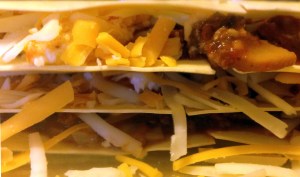
My wife has been making and perfecting her lasagna for thirty years. Each time, something is a little bit different. Ask her for the recipe (and many have), and she can’t tell you; she measures by eye, often has mounds of cheese or cups of sauce left over. And though I am working to write down her recipe from this last weekend’s bake-off, I know that in ten years’ time, it will be different.

But this recipe–this weekend’s recipe–is a starting point for everyone who’s ever asked for the secret. It’s a place for us all to start and then say, “Oh yes, it is wonderful; now I will make it mine.” They can add a bit more heat, a bit less ricotta, cook it a bit longer. They may still call it “Ilene’s World-Class Lasagna” or they may change it enough until, over time, it will be something all their own. It does not matter to me. It does not matter to my wife.

A recipe shared is an act of love. It’s your best effort, writ down and passed along, from hand to hand, kitchen to kitchen, family to family, heart to heart.

k

No-Knead Bread

Read Full Post »

Simple LivingCioppino is an Italian standard, a fish stew in a tomato-based sauce, but before we get into the recipe, let’s have a lesson in correct pronunciation.

First, in Italian, the initial letters “ci” makes a “ch” sound, like the word “ciao.” Next, know that the word has only three syllables, never four; say it cho-PEE-no, not chee-oh-PEE-no. If you want to be exact, throw a bit of the “i” in the first syllable–chyo-PEE-no–but keep it to three syllables.

Good. Now, onward.

For my family, cioppino is the traditional Christmas Eve supper. In the morning it’s coffee and pastries over which we plan our maneuvers like Napoleonic generals. Just before noon, we split up–some to the kitchen, some to the streets. The kitchen crew begins the prep work for the sides and salads, breads and sweet-afters, while the street crews disperse, heading out to fish mongers and green grocers in search of the freshest of the fresh.

The calls come in to the kitchen. There’s fresh rockfish down the wharf. Scotty’s has sea bass. Central has live Dungeness, but they look small. The Dungeness at Petrini’s are beefy and fresh, but cooked. The kitchen receives the intel, reroutes operatives ad hoc, decides on the final mix of fish and shellfish, and sends out orders to purchase. The great thing about cioppino is that you aren’t locked into any specific mixture of seafood or shellfish. The only criteria is that it has to be good; flash-frozen is good, fresh is better, live is best (especially for the bivalves). Some years, winter storms will keep the crab-boats in harbor. Other years, there is no suitable fresh fish to be had. You have to be nimble, but the recipe doesn’t really care, as long as there is ample in the aggregate.

So take this recipe and make it your own, build it to your own taste. Pre-shell all the shellfish if you prefer. Keep the base, and build on that.

(more…)

Read Full Post »

Simple LivingSomething tells me that Americans have lost touch with what chili really is.
Go down to the supermarket and you’ll find your choice of chili, chili con carne, and the mind-boggling “chili con carne with beans.” All of them are stultifying assaults to any palate and not worth the label of “chili.”

Red–a hearty meat stew–is to my heart and mind the original chili: nothing but meat and chili peppers. Sometimes called “Texas Red,” my version is definitely un-Texan, so I just call it “red,” but it is, at its core, a purist’s chili It has been a standard big-batch-home-cook recipe of mine for years. I usually cook up a big batch, we have a great meal, and then I freeze what’s left in discrete two-person servings that we can pull out at a moment’s notice.

Last night, for the first time, I rolled it out to non-family at a potluck evening, and it got raves all night. Anything that gets that kind of response deserves to be shared.

This red is best served in a bowl, over a hunk of freshly baked cornbread.

(more…)

Read Full Post »

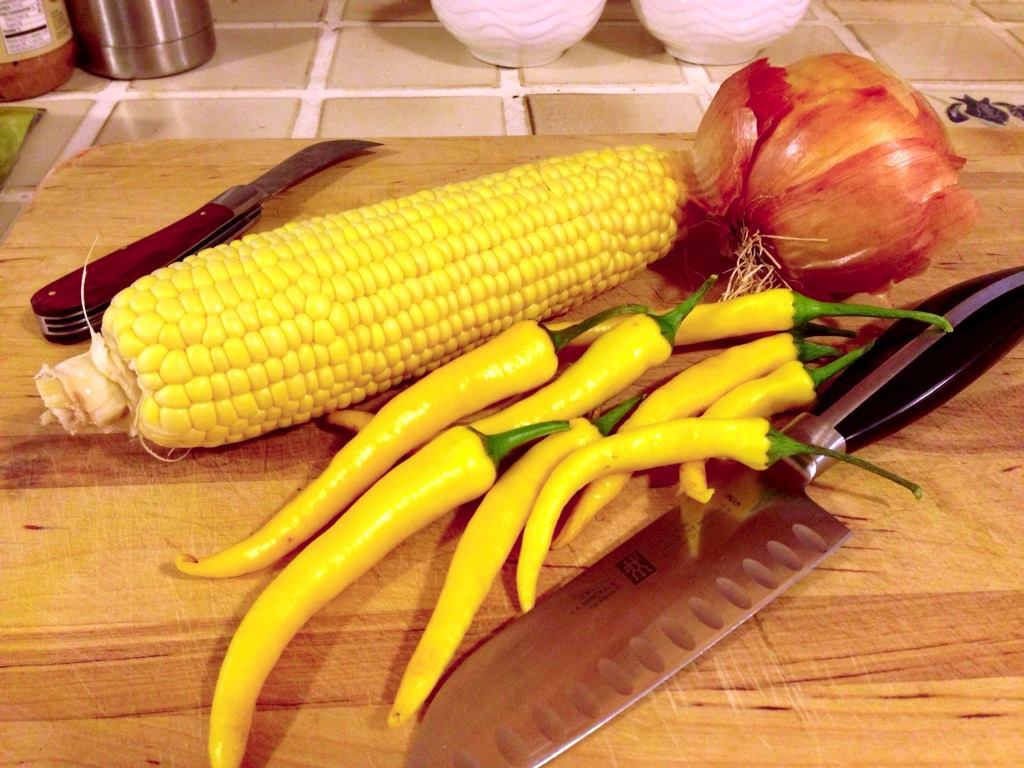
Golden CayenneA friend of mine runs OACA Pepper Farm, and he shared a great recipe for a hot sauce that uses carrots, onions, and habanero chili peppers. The carrots give sweetness, the habaneros the heat, and it comes out orange, tangy, and very good.

When my garden started providing me with golden cayenne chili peppers, I thought I might try a twist on the OACA recipe. Keeping with the a la page concept, I considered my options as to what might work well with the intense, almost candy-colored yellow of the golden cayennes. The answer came at a BBQ during Labor Day weekend: corn.

I whipped up a batch of this yesterday, and it’s yummy.

(more…)

Read Full Post »

Simple LivingWhen my Earthbox garden produced more cucumbers than I could consume, I naturally looked into pickling. As a child, I never cared for sweet pickles, but then again, the only sweet pickles I had came in the form of hot dog relish, so it wasn’t a good introduction. Then, earlier this year, I saw “bread and butter” pickles on the store shelf. Curious, I tried some.

Now that’s a good, sweet pickle. I set about devising a recipe.

“Bread and Butter” pickles got their name in during the Great Depression. Cucumbers are easy to grow, and very fruitful, so every home had some in the garden. A common Depression lunch during the growing season was bread, butter, and cucumbers. When the plants produced more fruit than could be used immediately, they pickled them and ate them through the cold months–with their bread and butter.

Slicing the cucumbers lengthwise, they’re easy to lay out onto a slice of bread. Take two thick slices of whole wheat bread, slather with some nice, salted butter, add a couple layers of these pickles, and tuck in.

Yum!

(more…)

Read Full Post »

Poached Egg Time TrialsYes, I can get a bit…obsessed…at times.

My good friends over at Cheap Seat Eats blog turned me on to a video in which Wylie Dufresne shows a new way to poach an egg. If you’ve been reading here for a while, you know I’ve been working to perfect the various methods of cooking the venerable Hen’s Egg. I just about have the hard-cooked egg down pat (thanks to my friend and author Barb Hendee), but the perfect poached egg has eluded me.

I’ve tried many methods. I’ve tried classic out-of-the-shell methods like the dead-drop (sticks to bottom of pot), the swirl/vortex (still all thready), and the Martha Stewart cook-in-spoon-followed-by-scissoring-off-the-threads-to-make-it-look-nice-nice method (too obsessive, even for me). I’ve tried several in-the-shell methods, too, from the classic 5-minute egg (impossible to peel), to David Chang’s one-hour slow-cook method (too unreliable and never cooked well enough).

Nothing has pleased me. Here’s what I want in a poached egg:

  • Firm, cooked white
  • Creamy, orange yolk, almost like a sauce when it spills
  • Enough of a “sag” in the cooked egg so that it looks poached, not hard-cooked

Dufresne’s method, based on modernist techniques and analysis, gives us a perfect, in-shell, poached/soft-cooked egg. I tried it once. Damned near perfect. I tried it again. Damned near perfect again. My only complaint was that the egg stood a bit too tall, and was a bit “too” cooked at the prescribed cooking time.

So, I set about performing a time trial. Four eggs. Four cook times, ranging from Dufresne’s prescribed 5:45 min, and downward.

(more…)

Read Full Post »

Simple LivingSome tips for your kitchen.  (Sorry…best I can do this week.)

Today: dealing with fruit flies, and storing your onions, and potatoes.

(more…)

Read Full Post »

« Newer Posts - Older Posts »